


Key Takeaways
- Biosynthetic materials are typically priced above fossil-based equivalents because of smaller production scales, higher capital intensity and more complex supply chains, even when life-cycle emissions are lower.
- Across techno-economic studies, feedstock and utilities account for a large share of production costs, with biogenic sugars, oils or residues often more expensive per unit of product than fossil naphtha or gas under current conditions.
- The cost gap is widest for "new" biosynthetic polymers such as PLA or PHA and narrowest for drop-in materials such as bio-based PET or bio-based polyamides that can share existing infrastructure and markets.
- Policy incentives, extended producer responsibility schemes and carbon or plastic regulations in the EU and US are starting to influence effective prices, but support is still far more developed for biofuels than for bio-based materials.
- Over the next decade, learning curves, scale-up of integrated biorefineries, and tighter rules on fossil-based plastics will matter more for pricing than marginal process tweaks. Buyers need to treat biosynthetic materials as a moving cost target, not a static premium.
What exactly do we mean by biosynthetic materials in a pricing context?
In this article, biosynthetic materials refer to polymers and other materials whose monomers are produced from biological resources, either through catalytic conversion of biomass or through fermentation routes using microorganisms. Examples include bio-based PET, bio-based polyamides, polylactic acid (PLA), polyhydroxyalkanoates (PHA) and biosynthetic fibers used in textiles.
From a pricing standpoint, these materials sit at the intersection of three markets:
- agricultural and forestry feedstocks such as sugar, starch, vegetable oils, lignocellulosic residues and increasingly captured biogenic CO₂,
- chemical and polymer markets where the benchmark prices are still set by fossil-based incumbents, and
- sustainability-driven segments in packaging, textiles and consumer products where buyers are willing to pay something for lower footprint, but within limits.
This creates a pricing problem that is fundamentally different from a conventional commodity polymer. Producers are trying to cover higher production costs in markets where reference prices are still anchored to fossil materials that carry unpriced externalities.
Why do biosynthetic materials still carry a price premium?

Across multiple techno-economic analyses of bioplastics and biobased chemicals, unit production costs for many biosynthetic routes remain above those of petrochemical benchmarks. PLA and PHA are often cited as costing tens of percent more per tonne than PET or PE under current scales and process configurations. Production capacities for most biosynthetic materials are small compared to mature petrochemical chains. Lower utilisation of fixed assets and less optimised logistics keep unit costs high. Feedstock cost and variability: Biogenic feedstocks can be more expensive per unit of carbon delivered to the process, especially when competing with food, feed or energy uses.
TEA studies repeatedly find that sugar and other feedstocks represent a large fraction of total production cost. Process complexity and capital intensity: Fermentation, separation and purification steps for biosynthetic routes often demand more unit operations and more energy per tonne than established petrochemical routes, particularly in early-stage plants. Against this backdrop, fossil-based plastics and fibers benefit from fully depreciated assets, integrated crackers and decades of process optimisation.
Their prices fluctuate with crude oil and gas markets, but their cost base has been driven down over many cycles of investment and consolidation. The result is a price ladder where many biosynthetic materials sit one or more rungs above fossil comparators in terms of cost per kilogram, even when life-cycle assessments show significantly lower greenhouse gas emissions.
How is the cost structure of biosynthetic materials actually built up?
The cost structure can be simplified into three major blocks, similar to advanced biofuels:
- feedstock costs,
- other operating costs, and
- capital-related costs.
Feedstock costs
Biomass-derived inputs typically account for a large share of total cost. In PLA production, for example, meta-analyses show that the cost of fermentable sugars and other raw materials is one of the dominant contributors to unit cost. Unlike oil, which is traded globally with transparent price indices, bio-based feedstocks are often sourced regionally. Prices depend on local agricultural conditions, logistics and policy support for competing uses such as bioenergy.
This leads to regional spreads in biosynthetic material prices even when the process technology is similar. Fermentation processes require nutrients, utilities, enzymes and sometimes expensive separation steps. Early plants often run below nameplate capacity and face higher maintenance and overhead costs per tonne. Over time, learning effects and process integration can reduce this component, but many routes have not yet moved far along the learning curve.
Biosynthetic material plants can have higher specific capital costs per unit of product capacity compared with mature petrochemical complexes, particularly when built as stand-alone facilities rather than integrated with existing biorefineries or industrial clusters. Financing conditions, risk perceptions and access to long-term offtake agreements all influence how much capital cost ends up reflected in product prices.
How do fossil prices and policy instruments shape relative pricing?
Relative pricing between biosynthetic and fossil-based materials is heavily influenced by fossil feedstock prices and by the presence or absence of policy instruments that internalise environmental costs. When oil and gas prices are low, fossil-based plastics, fibers and chemicals become cheaper, widening the gap to bio-based alternatives. Bioplastics and other biosynthetic products have continued to face cost challenges in such periods, even when environmental benefits are clear.
On the policy side, there is a contrast between biofuels and bio-based materials. Biofuels have benefited from mandates, blending targets and tax incentives in many regions. For bio-based materials, policy frameworks are weaker and patchier. EU documentation on bio-based products and OECD analyses highlight that quotas, public procurement and tax measures could improve competitiveness, but these are still emerging rather than universal. Extended producer responsibility rules, packaging regulations and recycling obligations also shape effective prices.
For example, requirements to fund end-of-life management of packaging can tilt procurement incentives toward materials that are easier to recycle or compost, which may favour some biosynthetic materials in specific applications but not across the board. The net effect is that market prices for biosynthetic materials reflect a mixture of intrinsic cost, fossil price cycles and incomplete policy internalisation of environmental externalities.
What should buyers and investors watch in the next decade?
For procurement teams, the key is to recognise that biosynthetic material prices are dynamic. Signals to monitor include:
- scale-up of integrated biorefineries that co-produce energy, materials and chemicals, which can improve cost allocation and resource efficiency,
- policy developments that extend carbon and circularity rules from fuels and electricity into materials,
- progress in feedstock diversification, including the use of residues and biogenic CO₂, which can reduce exposure to food commodity markets, and
- hard data from techno-economic and life-cycle studies rather than headline claims about "cost parity".
For investors, pricing analysis should focus on where a given biosynthetic route sits on its learning curve, how exposed it is to feedstock competition, and whether there is a credible path to operating in the same cost corridor as fossil-based competitors once environmental regulations tighten.
How FMI can help
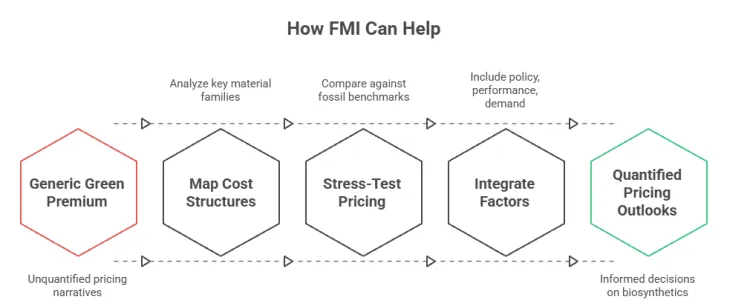
Future Market Insights can help clients move from generic "green premium" narratives to quantified pricing outlooks for biosynthetic materials. This includes mapping cost structures for key material families, stress-testing pricing against fossil benchmarks under different oil and gas scenarios, and integrating policy pathways and environmental performance into demand and price forecasts. By combining techno-economic evidence, regulatory analysis and end-use segmentation, FMI can help procurement leaders, product strategists and investors decide where biosynthetic materials justify a premium, where they are likely to converge toward parity, and where they remain structurally challenged on cost.
Sources
- Wellenreuther, C. (2021). "Cost structure of bio-based plastics: A Monte-Carlo analysis for PLA." Hamburg Institute of International Economics (HWWI) Research Paper No. 197.
- Philp, J. et al. (2014). "Biobased Chemicals and Bioplastics: Finding the Right Policy Balance." OECD, Paris. Includes updated price ranges for PLA, PHA and other bioplastics.
- European Commission (2022). "Biobased, biodegradable and compostable plastics - policy framework." Directorate-General for Environment, Brussels. Explains why biobased plastics are currently 20-100% more expensive than fossil plastics and outlines policy levers.
- IEA Bioenergy (2020). "Bio-based Chemicals: A 2020 Update." IEA Bioenergy Task 42 Biorefining in a Circular Economy. Reviews cost drivers and competitiveness of bio-based chemicals and materials in integrated biorefineries.
- Nosrati-Ghods, N. et al. (2025). "Techno-economic assessment of waste polylactic acid enzymatic hydrolysis and recycling for polylactic acid production." Techno-economic analysis of PLA recycling pathways, including cost components and sensitivities.
- Döhler, N. et al. (2022). "Market dynamics of biodegradable bio-based plastics." Journal of Cleaner Production. Analyses global bioplastic capacity growth, cost determinants and policy scenarios.
- BIO-PLASTICS EUROPE (2023). "Bio-based and biodegradable materials - Policy brief." EU Horizon 2020 project BIO-PLASTICS EUROPE, summarising policy context, cost barriers and uptake constraints for bioplastics in Europe.
- European Commission (2025). "COM(2025) 960: Communication on the EU bio-based products initiative." Recent EU communication on scaling bio-based products, including support mechanisms for innovative materials.
- IEA (2018). "The Future of Petrochemicals." International Energy Agency, Paris. Provides benchmark context on petrochemical cost structures, oil/gas dependency and the competitive landscape facing bio-based materials.
- Watkins, J. et al. (2024). "Techno-economic analysis of bioplastic and biofuel co-production systems." Examines co-production, capital intensity and scale effects in integrated biofuel-bioplastic facilities.

