


Key Takeaways
- Construction chemicals in India sit at the intersection of cement, petrochemicals and coatings, with concrete admixtures accounting for roughly two fifths of demand and waterproofing, flooring and tiling compounds making up a significant second tier, according to industry association papers.
- The supply chain is structurally multi tiered. Base petrochemicals and minerals are produced in a few coastal and mineral rich clusters, specialty formulators translate these into admixtures and coatings, and a long tail of regional distributors, ready mix concrete plants, applicators and small contractors determine what actually gets used onsite.
- Policy and standards increasingly anchor the chain. Indian Standards for concrete admixtures, waterproofing and coatings, along with building codes and public procurement norms, are slowly pushing the market away from commodity additives toward performance specified systems.
- Value and bargaining power tend to concentrate in two places: upstream in integrated chemical producers with access to feedstocks and downstream in large developers, cement majors and infrastructure EPC firms that control specifications and preferred vendor lists. Mid sized formulators often operate on thin margins and compete through technical service.
- Import dependence remains meaningful for specific resins, polymers and high performance additives, while the bulk of cementitious inputs are domestic. This mix creates both vulnerability to global petrochemical cycles and an opportunity for localisation if costs and quality can be matched.
How construction chemicals sit inside India’s building economy
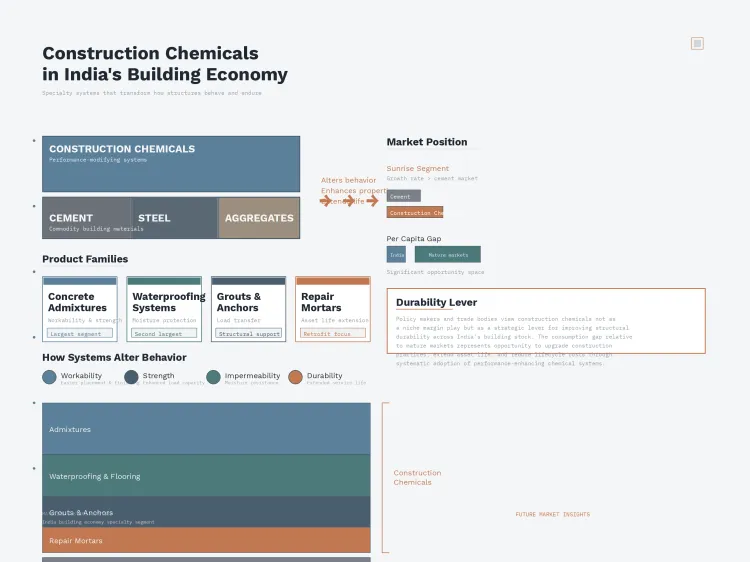
Construction chemicals in India are not a single product line. They are a family of systems that sit on top of cement, steel and aggregates and change how structures behave. Concrete admixtures alter workability and strength, waterproofing membranes and coatings protect against moisture ingress, grouts and anchors transfer loads, and repair mortars extend the life of ageing assets.
Industry association knowledge papers have long described construction chemicals as a sunrise subset of specialty chemicals, with growth rates higher than the underlying cement market. They also note that admixtures form the single largest segment by value, followed by waterproofing and flooring systems, and that India’s per capita consumption remains well below that of mature markets. That gap is one reason why policy makers and trade bodies see the segment as a lever for improving durability rather than only as a niche margin play.
From basic chemicals to job site application: the actual chain
At the top of the chain are base chemicals and minerals. Cracker complexes in states such as Gujarat and Maharashtra provide olefins and aromatics that feed into surfactants, dispersants, superplasticizer monomers and acrylic resins. Chlor alkali plants supply caustic soda and related inputs. On the mineral side, limestone, gypsum, fly ash, silica fume and various fillers feed cement and dry mix plants.
The next layer is specialty chemical manufacturing. Here, firms produce construction grade admixture components such as lignosulphonates, naphthalene sulphonates and newer polycarboxylate ether systems, along with waterproofing emulsions, epoxy and polyurethane systems, tile adhesives, grouts and repair mortars. Some of these plants are run by global brands operating in India, some by diversified Indian chemical companies, and some by focused domestic formulators.
Between formulation and end use sits a critical processing layer: cement plants, grinding units and ready mix concrete producers. They dose admixtures, integrate mineral additives and influence how consistently products are used. National Council for Cement and Building Materials and similar bodies bridge this space by testing admixtures, advising on mix designs and helping large users interpret Indian Standards for performance.
At the downstream end of the chain, warehouse and dealer networks move bags, drums and pails into city and district markets. For admixtures, the pivotal customers are ready mix plants and large contractors. For waterproofing and coatings, the key gatekeepers are project management consultancies, architects, applicator networks and retail dealers. In smaller cities and low rise construction, decisions are often made by local contractors and masons, whose incentives and familiarity with products differ from those of metro based engineering teams.
Where control and bottlenecks really sit
On paper, the supply chain runs linearly from feedstock to finished construction. In practice, the strongest control points often sit at two extremes.
Upstream, integrated petrochemical and large specialty players control availability and pricing of critical monomers and resins. When global petrochemical margins tighten or logistics are disrupted, formulators that rely heavily on imported inputs see costs move quickly. Government statistics on chemicals highlight how a small number of states dominate exports and bulk production, underscoring this concentration.
Downstream, specifications written into tender documents and project manuals decide which systems can be offered. Metro rail corporations, national highway authorities, public works departments and large private developers often call out compliance with specific Indian Standards for admixtures and coatings, minimum durability or life cycle performance, and occasionally named brands or approved lists. For suppliers, being on those lists is more important than having the lowest manufacturing cost.
Between these poles sits a crowded midstream of formulators and regional brands. Many of them manufacture under or alongside Bureau of Indian Standards certifications for concrete admixtures and related products, but compete through local relationships, credit terms and on site technical support rather than through unique chemistries. When raw material prices spike, this layer tends to absorb margin pressure unless it has enough scale to renegotiate feedstock contracts.
How Future Market Insights can help
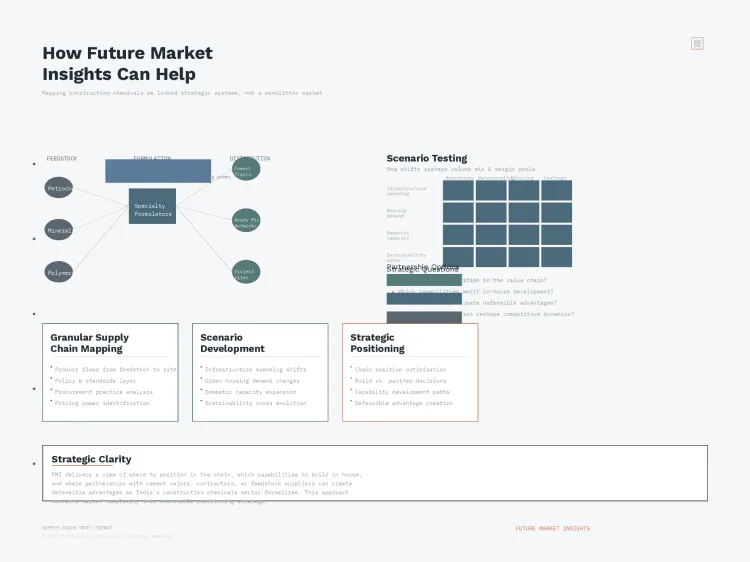
Future Market Insights can map the construction chemicals supply chain in India as a set of linked but distinct systems rather than as a single monolithic market. That starts with building a granular picture of product flows from basic petrochemicals and minerals through specialty formulations into cement plants, ready mix networks and project sites. It then layers on policy, standards and procurement practices to show how specifications are written, how vendor lists are constructed and where pricing power actually resides.
On top of this, FMI can develop scenarios that test how shifts in infrastructure spending, urban housing demand, domestic specialty chemical capacity and sustainability norms would reshape volume mix and margin pools across admixtures, waterproofing, flooring and coatings. For investors and operators, the outcome is a view of where to position in the chain, which capabilities to build in house and where partnerships with cement majors, contractors or feedstock suppliers can create defensible advantages as the sector formalises.
Sources
- FICCI, Knowledge Paper on Construction Chemicals as Enabler for Smart Cities, 2015
- FICCI, Knowledge Paper on the Indian Construction Chemicals Industry, 2013
- FICCI, Indian Chemical Industry and India Chem knowledge papers on specialty chemicals and downstream value chains
- Department of Chemicals and Petrochemicals, Government of India, ChemIndia Statistics at a Glance 2024
- NITI Aayog, Powering India’s Participation in Global Value Chains: Chemical Industry Report, 2025
- Bureau of Indian Standards, IS 9103: Specification for Concrete Admixtures, and associated product manuals
- National Council for Cement and Building Materials, technical material on concrete mix design and admixture testing
- Construction Industry Development Council, technical paper on admixtures for concrete with emphasis on superplasticizers

