


Key Takeaways
- Pet humanization in Southeast Asia is no longer confined to affluent households. Urban middle income families in markets such as Indonesia, Vietnam, Thailand and the Philippines are now a meaningful share of spend on branded food, health and grooming products.
- High income owners still drive the most visible and highest value basket, including premium imports, full service vet care and discretionary services. Middle income owners humanize mainly through upgraded food, preventive health and occasional treats, with strong sensitivity to promotions.
- The trend is heavily urban and formal retail driven. Rural and lower income households often keep dogs and cats but spend far less cash per animal, relying on leftovers and informal care, which means humanization in emotional terms is ahead of humanization in monetary terms.
- For middle income households, the ceiling is set by healthcare costs, service pricing, and the lack of affordable mid tier offerings. Premium foods and basic health products scale faster than pet hotels, insurance or advanced procedures.
- For brands and investors, the real opportunity lies in tiered propositions built around urban middle income wallets, not in assuming that the spend profile of high income districts in Bangkok or Jakarta represents the whole region.
- Policy and ESG pressures around animal welfare and food safety will gradually shift expectations upwards, but they will do so unevenly by city, species and channel. Operators that map these micro markets properly will see more durable growth than those chasing headline regional numbers.
Is spending still concentrated in high income households?
High income households still dominate the highest spend per pet. They are over represented in:
- import heavy premium and super premium foods
- high frequency grooming and boarding
- advanced veterinary diagnostics and procedures
- discretionary categories such as clothing, strollers and birthday events
However, several forces have pulled the middle income segment into the market. Urban middle classes in Indonesia, Vietnam, the Philippines and Thailand have expanded rapidly, with more dual income households and fewer children. As housing shifts to apartments and gated communities, small dogs and indoor cats become common. Modern retail and online platforms make branded food and health products available in supermarkets, convenience stores and major ecommerce marketplaces.
Social media normalises the idea of pets as companions rather than only working animals. The result is that while high income owners still shape the premium edge of the market, middle income owners now account for a rising share of volume in dry food, treats and basic healthcare products. Spend per pet is lower, but the population base is much larger.
How are middle income households in key markets actually spending?
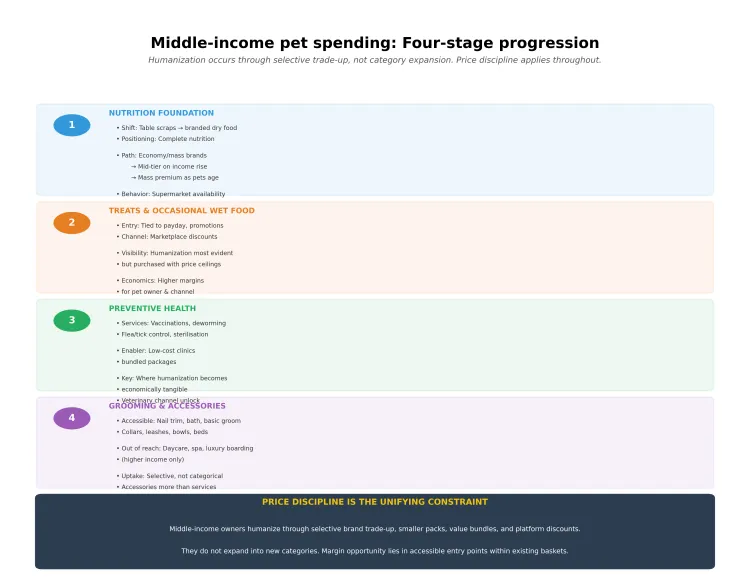
In middle income urban households the pattern is more incremental than dramatic. First, there is a clear shift from table scraps or generic feed to branded dry food positioned as complete nutrition. Owners start with economy or mass brands available in supermarkets, then trade up to mid tier or mass premium products when incomes rise or pets age. Second, treats and occasional wet food enter the basket, often tied to payday cycles and promotions on marketplaces.
These products carry higher margins and are where humanization is most visible, but they are still purchased with price ceilings in mind. Third, preventive health becomes more regular. Middle income owners in cities are increasingly willing to pay for core vaccinations, deworming, flea and tick control and sterilisation, especially when low cost clinics or bundled packages are available. This is where the economic value of humanization becomes tangible in veterinary channels. Fourth, grooming and accessories show selective uptake.
Nail trimming, bathing, basic grooming and simple accessories such as collars, leashes, bowls and beds are relatively accessible. High complexity services such as daycare, spa packages and luxury boarding remain a niche for higher income owners. Across these categories the common feature is discipline around price. Middle income owners are willing to humanize, but they do it through careful brand selection, smaller pack sizes, value packs and platform discounts.
Where does pet humanization still hit a ceiling for the middle class?
There are structural reasons why humanization does not simply converge to high income behaviour across the region. Household budgets remain constrained by housing, education, transport and food. Large veterinary bills or long term services such as insurance or daycare compete directly with core expenses. Even in cities, one serious illness can reset a household back toward low cost choices for future pets. Service infrastructure is uneven.
High quality clinics, grooming chains and boarding centres cluster in central districts of major cities. Peripheral districts and secondary cities may have pet shops and basic clinics but limited higher end services, which caps how far service based humanization can travel geographically. Cultural attitudes also vary. In some communities dogs and cats are valued primarily as guards or pest control, even when owners care about them deeply.
Spending on preventive healthcare or high priced food can be hard to justify socially, not only financially. Finally, the presence of large stray and community animal populations dilutes the link between emotional humanization and product uptake. Many people feed or care for animals that do not live inside their homes. That care rarely converts into sustained packaged product use, yet it is a real part of the regional pet landscape.
What does this mean for brands and investors?
Several implications follow for anyone building or evaluating pet humanization businesses in Southeast Asia. First, the most resilient growth will likely come from tiered product architectures that recognise at least three spending ladders: affluent owners who buy premium full basket solutions, upper middle income owners who will pay for mid tier food and preventive health, and lower middle income households who need entry level price points and small packs.
Second, food and preventive health are likely to keep outgrowing service based categories in the middle income segment. That does not make services unattractive, but it does mean that their addressable base is narrower and more exposed to shocks in household income. Third, omnichannel execution is not optional. Modern supermarkets, convenience chains, veterinary clinics and major online platforms all act as on ramps for middle income owners.
Overreliance on any one channel increases concentration risk and weakens a brand’s ability to follow owners as they move through income bands. Fourth, policy and ESG considerations will matter more over time. Animal welfare expectations, import standards for pet food and scrutiny of supply chains are all tightening. Operators that ignore these constraints in pursuit of fast volume growth risk reputational and regulatory setbacks that destroy value.
How FMI can help
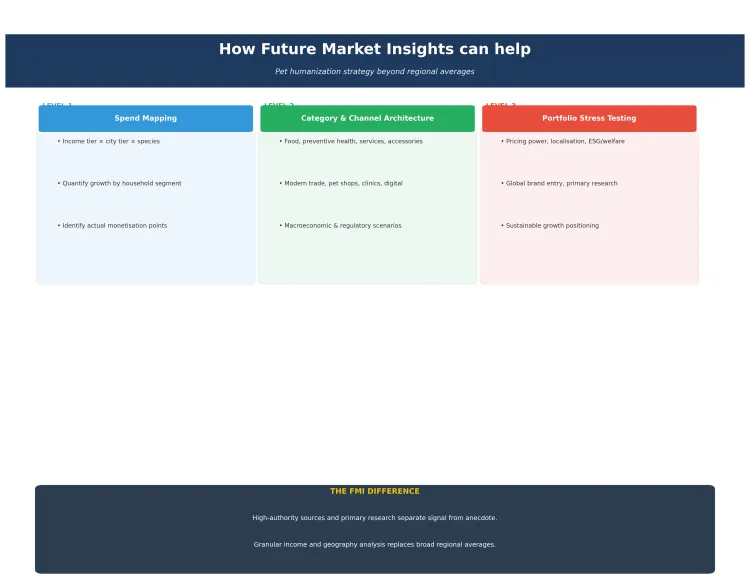
Future Market Insights can help investors, manufacturers and retailers move beyond headline narratives and understand where pet humanization is truly monetising across Southeast Asia. Our teams can map the spend ladder by income tier, city tier and species, and quantify how much of current and future growth is likely to come from affluent, upper middle and lower middle households.
We can build granular category views that distinguish between food, preventive health, veterinary services, grooming, accessories and emerging services, and show how each behaves under different macroeconomic and regulatory conditions. This includes detailed work on channel strategy, from modern trade and independent pet shops to veterinary clinics and digital platforms.
Using only high authority sources and primary research, we can also help clients stress test their assumptions on pricing power, product localisation, ESG and welfare standards, and competitive entry from global brands. The result is a clearer view of where to position portfolios for sustainable growth in pet humanization, rather than relying on broad regional averages or anecdotal signals from a few affluent neighbourhoods.
Sources
- Feed Business Middle East & Africa. "Pet Fair South East Asia returns to Bangkok as pet market soars
- Khaosod English. "Pet Humanization Drives Thai Business Growth to over $1 Billion." 29 March 2024.
- Krittanawongchai, Araya. "Living with Pets in Urban Lifestyle: A Case Study of Bangkok and Singapore." Master’s thesis, Chulalongkorn University. 2019
- Kadence International. "Pets Take Priority as Households Pull Back Elsewhere." Knowledge article on pet humanization trends in Asia, including Southeast Asia. 2025.

