


Key Takeaways
- Food processing cost structures are dominated by raw materials and labor, with labor costs representing a substantial portion of product costs in highly manual operations, making automation a strategic necessity rather than an optional upgrade.
- Energy consumption patterns reveal that refrigeration alone accounts for a major share of total energy bills in processing facilities and an even larger portion in cold storage operations, creating significant pressure for efficiency improvements and smart technology adoption.
- Equipment maintenance and total cost of ownership models show that initial purchase prices represent only a fraction of lifetime costs, with energy consumption, maintenance, and downtime comprising the majority of operational expenses.
- Labor shortages and regulatory compliance costs are forcing processors to reconsider traditional cost optimization strategies, with automation delivering substantial labor cost reductions while improving consistency and safety standards.
- The shift from manual to automated systems creates a two-tier market where processors with automation capabilities capture higher margins through improved efficiency, while manual operations face mounting cost pressures from wage inflation and productivity constraints.
Why labor costs dominate food processing economics and drive automation adoption?
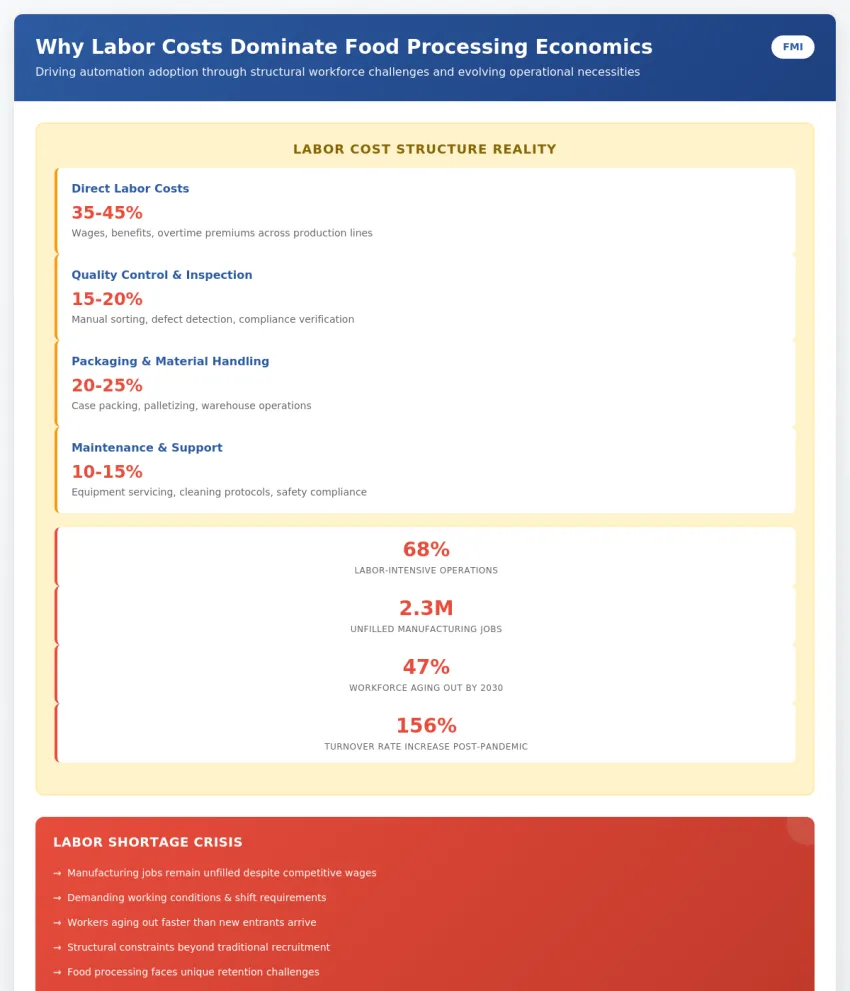
Food processing remains fundamentally labor-intensive across most segments, from meat processing and packaging to produce handling and quality control. Industry analysis consistently shows that labor costs can represent a substantial portion of total product costs, particularly in operations requiring manual sorting, packaging, and quality inspection.
The post-pandemic labor shortage has fundamentally altered this cost structure. Manufacturing jobs remain unfilled despite competitive wages, and the food processing sector faces particular challenges due to demanding working conditions and shift requirements. Workers are aging out of the industry faster than new entrants arrive, creating structural labor constraints that cannot be solved through traditional recruitment methods.
This labor crunch has transformed automation from a cost-optimization tool into an operational necessity. Processors who previously viewed automation as a long-term efficiency play now implement robotic systems to maintain production volumes. The economics have shifted decisively: where automation once required careful return-on-investment calculations, persistent labor shortages have shortened payback periods and reduced implementation risk.
The human element remains critical in food processing, but its role is evolving. Rather than eliminating workers entirely, successful automation strategies redeploy human capabilities toward higher-value activities like quality control, maintenance, and process optimization while machines handle repetitive, physically demanding tasks.
How energy consumption creates hidden cost pressures in food operations?
Energy represents the second-largest variable cost in food processing, yet its impact varies dramatically across different operational areas. Refrigeration systems consume disproportionate energy compared to other processing equipment, with cold storage facilities dedicating most of their electrical consumption to maintaining temperature control around the clock.
Processing operations face different energy profiles depending on their product mix. Heat-intensive processes like cooking, pasteurization, and drying create substantial energy demands, while packaging and assembly operations require relatively modest power consumption. The key insight for cost management is that energy usage patterns often correlate poorly with production output, meaning fixed energy costs can erode margins during periods of lower utilization.
Cold chain operations present particular challenges because refrigeration systems cannot be easily scaled up or down with production volumes. A facility must maintain temperature integrity regardless of whether it operates at full capacity or handles minimal throughput. This creates a high fixed-cost structure that rewards consistent, high-volume operations while penalizing seasonal or variable production patterns.
Energy efficiency investments in food processing often deliver returns beyond simple utility savings. Modern refrigeration systems with smart controls and variable-speed compressors not only reduce electricity consumption but also provide better temperature consistency, reducing product loss and improving quality outcomes. The compound benefits of energy efficiency extend through multiple cost categories, making these investments attractive even when utility savings alone might not justify the expenditure.
How equipment costs and maintenance shape long-term profitability?
The visible purchase price of food processing equipment represents only the initial layer of a much deeper cost structure. Total cost of ownership analysis reveals that energy consumption, maintenance requirements, and productivity impact create the majority of equipment-related expenses over operational lifetimes.
Maintenance costs vary significantly based on equipment design, operating environment, and usage patterns. Stainless steel construction, modular component design, and accessibility for cleaning and service all influence long-term maintenance expenses. Equipment operating in wash-down environments or handling acidic products faces accelerated wear patterns that increase both routine maintenance and component replacement costs.
Downtime represents perhaps the most expensive aspect of equipment ownership in food processing. Production schedules are often tightly coordinated with customer delivery requirements, making unplanned outages extremely costly. A few hours of equipment failure can disrupt supply chains, require premium freight costs, and potentially result in product spoilage or missed delivery commitments.
Preventive maintenance programs offer substantial cost advantages over reactive repair strategies, but they require upfront investment in maintenance capabilities and disciplined execution. Processors with robust maintenance programs typically experience lower overall equipment costs, higher production efficiency, and fewer emergency situations that disrupt operations and inflate costs.
Why packaging and end-of-line operations concentrate automation investment?
Packaging represents a natural focus area for automation investment because these operations typically involve repetitive, high-volume tasks that translate well to robotic systems. Unlike food handling processes that may require gentle manipulation or complex decision-making, packaging operations often involve standardized movements and predictable patterns suitable for automated systems.
The cost structure of packaging operations creates compelling automation economics. Manual packaging requires significant labor for tasks like tray denesting, product placement, sealing, and case packing. These activities are physically demanding, prone to repetitive stress injuries, and often difficult to staff consistently. Automated packaging systems can operate continuously with minimal operator intervention, improving both cost structure and production reliability.
Packaging automation also delivers quality benefits that extend beyond direct labor savings. Automated systems provide consistent product placement, uniform seal integrity, and precise weight control that manual operations struggle to match. These quality improvements reduce customer complaints, minimize rework, and decrease product waste, creating value that compounds throughout the supply chain.
The modularity of packaging automation allows processors to implement systems incrementally, starting with bottleneck operations and expanding as volumes and economics justify additional investment. This flexibility makes automation accessible to smaller processors who cannot justify comprehensive facility-wide automation but can benefit from targeted improvements in high-impact areas.
Sources
- Food Engineering Magazine. Automation and food processing today: It's about labor. Various industry surveys and operational analyses.
- Bureau of Labor Statistics. Manufacturing employment and wage data for food processing sectors.
- International Institute of Refrigeration. Energy consumption benchmarks for cold storage and food processing facilities.
- USA Department of Energy. Industrial refrigeration system efficiency guidelines and energy consumption analysis.
- London South Bank University. Cold storage energy consumption research and facility performance studies.
- Various technical publications on food processing automation, maintenance practices, and total cost of ownership analysis from engineering and industry sources.

