


Key Takeaways
- Beverage packaging pricing is dominated by raw material costs and manufacturing scale rather than design complexity alone, with aluminum cans carrying production costs that fluctuate directly with global aluminum pricing while PET bottles benefit from lower material costs but face mounting sustainability pressure.
- The real margin capture happens in three distinct layers: material sourcing control where established players like Crown Holdings and Ball Corporation negotiate volume discounts with aluminum suppliers, manufacturing scale that enables automated high-speed production lines, and brand positioning that allows premium pricing for specialized formats and sustainable alternatives.
- Manufacturing has shifted from simple container production to complex integrated systems requiring specialized coating technologies, lightweight engineering, and recycling compatibility, making technical expertise and processing capabilities critical differentiators beyond raw material access.
- Major packaging producers have achieved structural cost advantages through vertical integration of research and development, automated production systems, and global supply chain orchestration, while smaller manufacturers struggle with higher per-unit costs and limited bargaining power with material suppliers.
- The uncomfortable reality is that packaging material selection creates a multi-tier cost structure where aluminum cans command premium pricing despite higher material costs, PET bottles dominate through cost efficiency, and glass containers maintain niche positioning through perceived quality benefits.
Why do aluminum cans cost more than their material bills suggest?
Aluminum beverage can manufacturing represents one of the most capital-intensive packaging processes, where raw material costs form only the foundation of a complex cost structure. Crown has contractually passed through increased aluminum costs, which have been up 54% in the last 10 months, yet final can pricing reflects multiple hidden layers beyond basic aluminum sheet procurement.
The manufacturing complexity begins with specialized aluminum can production lines that require substantial infrastructure investments. American manufacturers produce around 100 billion aluminum cans each year for beverages, demanding continuous high-speed production capability that few manufacturers can economically justify. These production systems involve precision forming, specialized coating application, and quality control technologies that add significant capital depreciation costs to each unit produced.
Processing requirements extend far beyond simple aluminum shaping. Modern beverage cans require interior coating systems that prevent chemical reactions between the aluminum and beverage contents, exterior decorating capabilities for brand graphics, and specialized end-sealing technologies. Each processing step adds equipment costs, energy consumption, and technical expertise requirements that smaller manufacturers cannot easily replicate.
Supply chain coordination creates another cost multiplier. Three major suppliers produce a majority of the cans in the USA - Ball Corporation, Ardagh Group and Crown, giving these companies substantial leverage in negotiations with both aluminum suppliers and beverage customers. This market concentration enables better material procurement terms while creating barriers for potential competitors.
The recycling infrastructure adds hidden complexity to aluminum can economics. Aluminum cans are typically made of 73% recycled material, compared to 23% recycled content for glass bottles and less than 6% for plastic containers. While recycling reduces raw material costs, it requires extensive collection systems, transportation networks, and reprocessing capabilities that must be factored into total system costs.
Where do PET bottles achieve their cost advantages despite performance limitations?
PET bottle manufacturing benefits from fundamentally different economics than aluminum or glass alternatives. Plastic allows for mass production at a lower price point than glass or aluminum, creating structural advantages that extend throughout the supply chain and enable widespread market adoption despite environmental concerns.
The material cost structure reveals where PET bottles capture their primary advantages. The price of PET pellets as of November 2023, was around USD 8,000 to USD 9,000 per ton, representing predictable input costs that manufacturers can manage through established petrochemical supply relationships. Unlike aluminum pricing volatility or glass energy intensity, PET costs remain relatively stable and scalable.
Manufacturing efficiency creates additional cost advantages through simplified production requirements. In November 2023, the cost of processing a 500ml bottle was approximately USD 0.3 to USD 0.5 per bottle, reflecting streamlined blow-molding processes that require less energy and specialized equipment compared to aluminum forming or glass melting operations.
Transportation economics favor PET bottles through weight advantages that compound throughout distribution systems. The combination of low material costs, lightweight transportation benefits, and scalable production makes plastic the dominant choice for beverage packaging. These logistics savings become increasingly important for brands distributing across wide geographic markets.
The scale economics of PET bottle production create natural barriers against premium alternatives. In the global market of bottled water, the plastic bottle (PET) maintains a significant majority with over 80% of the sales share compared to the alternatives of aluminum cans and glass bottles. This market dominance enables continued investment in production efficiency and cost reduction that other materials struggle to match.
How do Crown Holdings and Ball Corporation maintain pricing power despite material cost pressures?
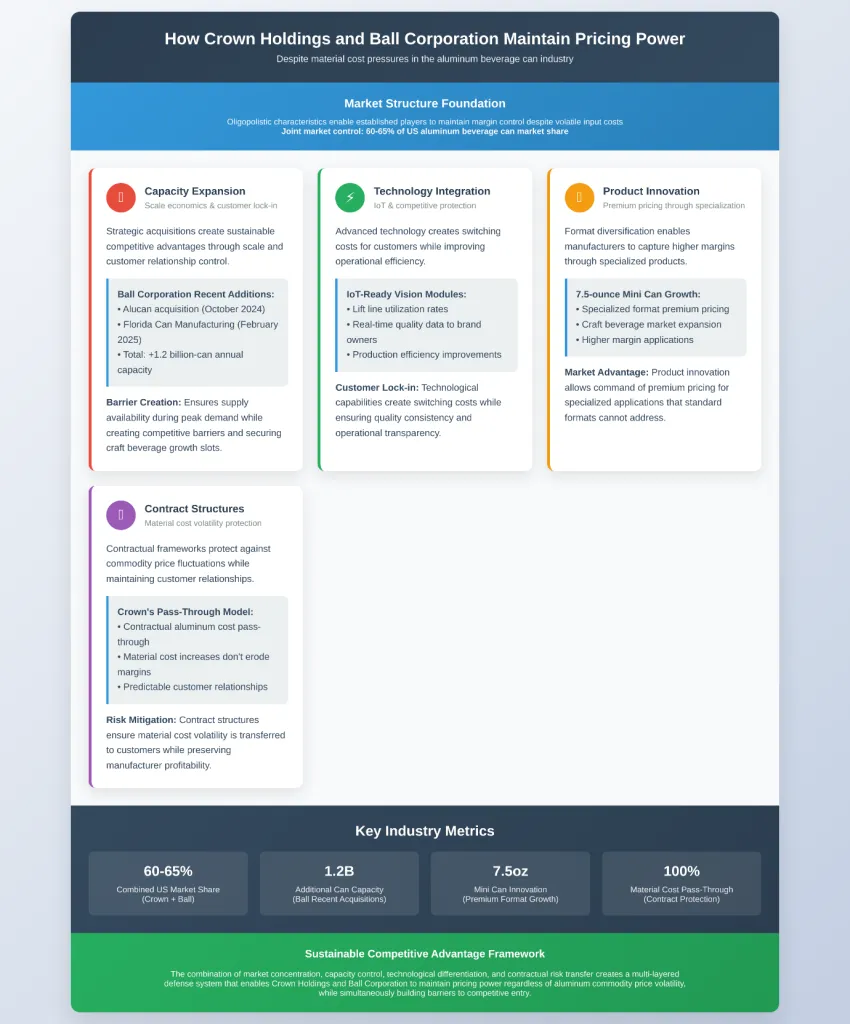
The aluminum beverage can industry exhibits clear oligopolistic characteristics that enable established players to maintain margin control despite volatile input costs. Ball Corporation and Crown Holdings jointly control roughly 60-65% of United States aluminum beverage cans market share, reflecting a moderately consolidated structure.
Capacity expansion strategies create sustainable competitive advantages through scale economics and customer relationship lock-in. Ball's acquisitions of Alucan in October 2024 and Florida Can Manufacturing in February 2025 added 1.2 billion-can annual capacity, securing slots for craft beverage growth. These capacity additions ensure supply availability during peak demand periods while creating barriers for competitors.
Technology integration provides another layer of competitive protection. Many invest in IoT-ready vision modules that lift line utilization and furnish real-time quality data to brand owners. These technological capabilities create switching costs for customers while improving production efficiency and quality consistency.
Product innovation enables premium pricing for specialized applications. Fisher noted industry growth with the 7.5-ounce mini can size, demonstrating how format diversification allows manufacturers to capture higher margins through specialized products that command premium pricing.
Contract structures protect against material cost volatility by passing through commodity price fluctuations to customers. Crown has contractually passed through increased aluminum costs, ensuring that material cost increases do not erode manufacturer margins while maintaining predictable customer relationships.
Sources
- USA Bureau of Labor Statistics. Producer Price Index by Industry: Glass Container Manufacturing and Metal Can Manufacturing.
- Federal Reserve Bank of Kansas City. Materials Pricing and Supply Chain Management in Container Manufacturing.
- USA Department of Energy. Energy Consumption Analysis for Glass Manufacturing and Aluminum Processing Industries.
- Environmental Protection Agency. Recycling Economics and Infrastructure Assessment for Beverage Container Materials.
- University Extension Services. Food and Beverage Packaging Cost Analysis and Manufacturing Process Economics.
- International Packaging Research Center. Container Materials Technology and Competitive Analysis Studies.

