


Key Takeaways
- Food-grade alcohol in China depends on grain and molasses based distilleries that are also linked to fuel and industrial ethanol demand.
- Domestic policy can restrict or redirect supply between fuel, chemical and food grade use, which changes available volume for beverage and food applications.
- Import reliance for specific purity grades creates exposure to foreign pricing and freight cost.
- Regional pricing power is shaped by provincial controls, licensing and logistics costs from inland distilleries to coastal users.
- Currency movement and global ethanol conditions influence the negotiation position of Chinese buyers and sellers.
Who produces food-grade alcohol in China and how is capacity distributed across regions and ownership types?
Food-grade alcohol production in China operates through a combination of state-linked distilleries and private enterprises that serve beverage, confectionery and food ingredient applications. Large state-connected grain processing groups maintain integrated facilities where ethanol production runs alongside starch, sweetener and animal feed operations, allowing flexible output allocation based on policy signals and profitability across product lines. Private distilleries concentrated in provinces with strong agricultural bases supply food-grade alcohol alongside fuel and industrial grades, with production decisions influenced by licensing requirements and provincial development priorities.
Regional capacity distribution follows feedstock availability patterns. Northeastern provinces including Heilongjiang, Jilin and Inner Mongolia host corn-based distilleries positioned near major grain production zones, benefiting from lower feedstock transport costs and access to agricultural policy support for value-added processing. Coastal provinces in the southeast, including Guangdong and Guangxi, concentrate molasses-based production linked to sugar refining operations, where food-grade alcohol emerges as a co-product within integrated sugar complexes. Central provinces such as Henan and Anhui maintain mixed feedstock operations serving regional beverage and industrial users.
Ownership structures create different exposure to policy directives. State-linked producers face stronger expectations to prioritize fuel ethanol programs when national energy security or air quality mandates require supply, even when food-grade applications offer better returns. Private operators maintain greater commercial flexibility but operate under provincial licensing systems that can restrict capacity additions, feedstock access or grade switching based on local industrial development goals.
How do domestic supply controls and policy priorities influence available volume for food-grade use?
National and provincial authorities exercise direct influence over ethanol allocation through fuel ethanol mandates, industrial development policies and grain security measures. China's National Energy Administration and National Development and Reform Commission have periodically expanded fuel ethanol blending requirements across provinces, directing specific distilleries to prioritize denatured ethanol for gasoline blending over food-grade or industrial applications. When such mandates activate, food-grade alcohol buyers face reduced domestic availability and must either compete for remaining supply at higher prices or increase import volumes.
Provincial governments add another control layer through production licenses, environmental permits and preferential energy or tax treatment that incentivize particular output mixes. Provinces pursuing air quality improvements or renewable energy targets may channel local distillery capacity toward fuel use through subsidies or mandated offtake agreements, tightening supply for food and beverage applications even when those segments would otherwise pay premium prices. Conversely, provinces with strong beverage industries may protect food-grade allocation to support local value chains.
Grain procurement and reserve policies create additional supply constraints. When national authorities restrict corn or wheat availability for non-feed industrial use due to domestic food security concerns or to stabilize grain prices, distilleries relying on these feedstocks face production curtailments. Such restrictions reduce total ethanol output and force food-grade buyers to source from the diminished remaining supply or turn to imports. The speed and scope of these policy shifts determine whether food-grade users face gradual price adjustments or sudden supply shortages requiring emergency sourcing.
Which feedstocks and processing routes dominate food-grade alcohol in China and how do they shape cost structure?
Corn represents the dominant feedstock for food-grade alcohol production in China, particularly in northern and northeastern provinces where grain availability and processing infrastructure concentrate. Distilleries typically achieve 380 to 400 liters of anhydrous ethanol per metric ton of corn through fermentation and multi-column rectification, with cost structures heavily influenced by corn procurement prices that fluctuate with domestic harvest conditions, government reserve operations and feed demand from livestock sectors. Energy costs for fermentation heat, distillation and dehydration add significant expense, with natural gas or coal-fired steam systems driving operational cost per liter.
Molasses-based production serves as the secondary route, concentrated in sugar-producing provinces where cane processing generates molasses streams requiring disposal or valorization. Integrated sugar refineries convert molasses to food-grade alcohol as a means of improving overall facility economics, with ethanol output helping offset volatile sugar pricing. Molasses ethanol production carries different cost dynamics, with feedstock cost tied to sugar industry profitability and processing yielding roughly 250 to 280 liters per ton of molasses. Lower yields compared to corn require efficient integration with sugar operations to maintain competitive cost positions.
Processing route choices affect product quality and cost. Multi-column continuous distillation systems produce neutral alcohol meeting food-grade specifications of 95% or higher ethanol content, requiring substantial capital investment but offering lower per-unit operating costs at scale. Smaller operations may use batch distillation with higher labor and energy costs per liter but greater flexibility to switch between grades based on demand signals. Rectification to reach pharmaceutical or extra-neutral grades above 96% ethanol adds processing stages and cost, creating price premiums for the highest purity specifications.
Plant utilization rates determine unit cost competitiveness. Facilities running at 80% or higher capacity spread fixed costs across larger output volumes, while operations constrained by feedstock access, policy restrictions or seasonal demand face elevated per-unit costs. This dynamic means that policy-driven fuel ethanol mandates, by ensuring steady high-volume offtake for participating distilleries, can lower their cost base even as they reduce food-grade availability, intensifying competitive pressure on facilities serving only food and beverage segments.
How does import reliance for specific grades influence pricing power for Chinese buyers and sellers?
China maintains net import positions for high-purity food-grade and pharmaceutical-grade alcohol, particularly for specifications above 96% ethanol content required by beverage bottlers, pharmaceutical manufacturers and specialty chemical users. UN Comtrade data indicates ethanol imports into China from the United States, European Union and Southeast Asian suppliers, with volumes fluctuating based on domestic production conditions and relative pricing between foreign supply and domestic output.
Import dependence for premium grades limits domestic producers' pricing power by establishing a ceiling determined by landed import costs. When domestic prices approach or exceed the sum of foreign spot prices, freight, insurance and applicable tariffs, buyers shift to imported supply, constraining domestic producers' ability to capture full scarcity premiums during tight supply periods. This dynamic proves particularly relevant during fuel ethanol mandate expansions or grain policy restrictions that reduce domestic food-grade output, as imports provide a release valve preventing extreme price spikes.
Trade policies and tariff structures directly influence this import ceiling. China applies most-favored-nation tariff rates and additional consumption taxes on imported ethanol, with effective duties varying by end-use classification. Bilateral trade agreements or temporary tariff adjustments alter the competitiveness of foreign supply, shifting the price level at which imports become economically attractive and therefore changing the negotiating position of domestic suppliers facing food-grade buyers. Regional free trade agreements covering Southeast Asian suppliers reduce landed costs from those origins, creating differentiated import competition by source region.
Freight cost volatility adds uncertainty to import pricing. Bulk ethanol shipments from the United States or Europe face ocean freight rates that fluctuated dramatically during recent supply chain disruptions, with container shortages and bunker fuel price swings creating wide variation in landed costs even when foreign spot prices remained stable. Chinese buyers managing import programs must navigate these logistics risks alongside product pricing, while domestic producers gain or lose relative competitiveness as freight conditions change independently of their own cost structures.
How do logistics, regional differentials and currency conditions translate into price dispersion inside China?
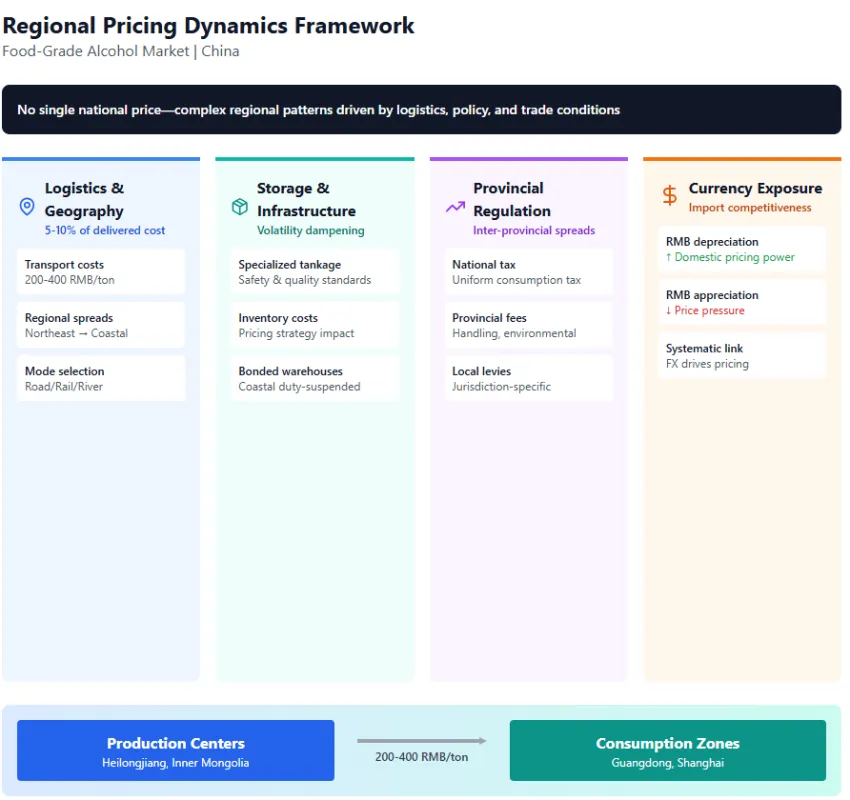
Food-grade alcohol moves from inland production centers to coastal consumption zones through road, rail and river transport networks, with logistics costs creating substantial regional price differentials. Distilleries in Heilongjiang or Inner Mongolia shipping to beverage bottlers in Guangdong or Shanghai incur transport costs of 200 to 400 RMB per ton depending on mode and distance, representing 5 to 10% of delivered cost. This creates pricing advantages for production facilities located near major consumption centers and explains persistent price spreads between northeastern supply regions and southern coastal demand zones.
Storage and handling requirements add complexity. Food-grade alcohol requires specialized tankage meeting safety and quality standards, with inventory carrying costs influencing pricing strategies for both producers and distributors. Regional bonded warehouse systems along the coast allow importers to store duty-suspended volumes, releasing them into domestic circulation as needed to manage price volatility. Provinces with more developed storage infrastructure experience lower price volatility than those dependent on just-in-time delivery from distant production sites.
Provincial tax and fee structures create additional price variation. While ethanol faces national consumption taxes, provincial and municipal authorities apply various handling fees, environmental charges and local levies that differ by jurisdiction. These regulatory cost differences compound transport expenses to produce significant inter-provincial price spreads, even for chemically identical products from the same production facility.
Currency movements affect domestic pricing through their impact on import competitiveness. RMB depreciation against the USD raises the landed cost of imported alcohol in local currency terms, reducing import competition and allowing domestic producers to increase prices without losing volume to foreign supply. Conversely, RMB appreciation makes imports more attractive in local currency, pressuring domestic pricing even when underlying production costs remain stable. This mechanism creates systematic correlation between exchange rate trends and domestic food-grade alcohol pricing power, with producers and buyers holding opposite preferences regarding currency direction.
The interaction of these factors means that food-grade alcohol pricing in China varies substantially by location, grade and timing, with no single national price but rather a complex pattern of regional quotations influenced by logistics positions, policy exposures and trade conditions specific to each buyer-seller relationship.
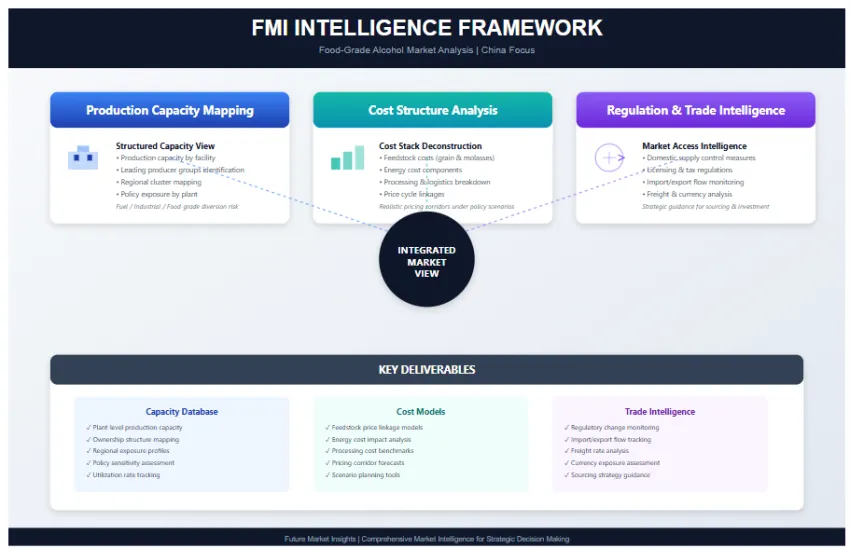
How can Future Market Insights support strategic decisions in food-grade alcohol in China?
Sources
- Chinese government ministries and regulatory bodies: Policy documents on ethanol production, supply controls, energy and agricultural programs affecting food-grade alcohol availability
- China Customs and UN Comtrade trade statistics: Import and export flows of ethanol and food-grade alcohol, including partner regions and unit values
- Annual and sustainability reports of selected Chinese distilleries and beverage alcohol producers: Production descriptions, product grades, feedstock usage and revenue segmentation
- International agencies such as FAO, IEA or OECD: Background on ethanol, feedstock and energy conditions relevant to China
- Reputable business media, for example Reuters or Nikkei: Coverage of policy shifts, supply tightness and trade related disruptions affecting food-grade alcohol in China

