


Key Takeaways
- Bentonite capacity is concentrated in the United States, India, China, Turkey and Greece, with regional specialisation in sodium and calcium grades
- Processing constraints in drying, milling and activation create premium spreads between raw clay and refined grades
- Drilling activity and construction demand act as primary short term pricing signals
- Freight volatility and container imbalance significantly impact landed cost due to bentonite bulk density
- Grade specific performance in foundry, drilling, feed and absorbent uses drives differentiated pricing bands
How is global bentonite production capacity distributed across leading mining and processing regions?
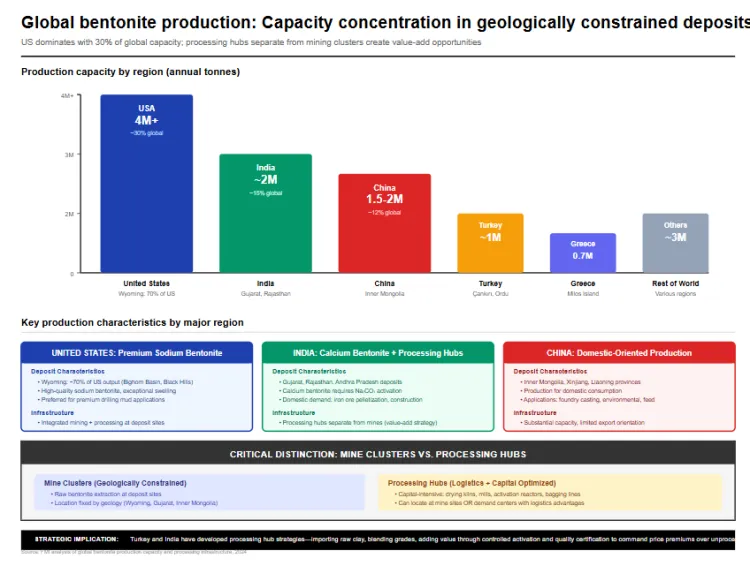
The United States dominates global bentonite production capacity, with Wyoming alone accounting for approximately 70 percent of US output and roughly 30 percent of total worldwide production. Deposits in the Bighorn Basin and Black Hills region supply high quality sodium bentonite with exceptional swelling properties, making American material the preferred choice for premium drilling mud and industrial applications. Annual US production capacity exceeds 4 million tonnes, with major operators maintaining integrated mining and processing facilities near deposit sources.
India ranks as the second largest producer, with capacity spread across Gujarat, Rajasthan and Andhra Pradesh. Indian operations typically focus on calcium bentonite extraction, which requires downstream activation through sodium carbonate treatment to achieve sodium equivalent properties. Processing infrastructure in India has expanded significantly over the past decade, driven by domestic demand from iron ore pelletisation, construction and agricultural sectors. Estimated annual capacity approaches 2 million tonnes, though actual output varies with industrial activity levels and monsoon impacts on mining schedules.
China maintains substantial capacity concentrated in Inner Mongolia, Xinjiang and Liaoning provinces, with production oriented toward domestic consumption in foundry casting, environmental engineering and feed applications. Turkish production from the Çankırı and Ordu regions supplies both domestic processors and European export channels, particularly for activated sodium bentonite destined for drilling and civil engineering uses. Greece produces primarily calcium bentonite from Milos Island deposits, serving Mediterranean and broader European construction and industrial buyers.
A critical distinction exists between mine clusters and processing hubs. Raw bentonite extraction occurs at geologically constrained deposit sites, while processing facilities requiring significant capital investment in drying kilns, grinding mills, activation reactors and bagging lines may be located either at mine sites or in demand centers with logistics advantages. Turkey and India have developed processing hubs that import raw material from smaller mines, blend grades, and add value through controlled activation and quality certification, enabling price premiums over unprocessed clay.
How do grade types and processing steps shape the supply of high value bentonite?
Sodium bentonite and calcium bentonite represent the two primary natural grades, distinguished by exchangeable cation composition that determines swelling behavior and application suitability. Sodium bentonite exhibits high swelling capacity, forming viscous suspensions ideal for drilling mud, sealants and pellet binders. Calcium bentonite swells less but offers advantages in absorbent applications including pet litter, agricultural carriers and certain foundry uses. Natural sodium deposits command immediate premiums due to their performance without chemical modification.
Calcium bentonite undergoes activation through sodium carbonate addition, which exchanges calcium ions for sodium and enhances swelling properties to approximate natural sodium performance. This process requires precise chemical dosing, mixing equipment and quality control protocols, adding 30 to 50 percent to raw material costs depending on scale and efficiency. Activated bentonite typically sells at prices 20 to 40 percent below natural sodium material due to slight performance gaps in demanding applications, though it serves as an effective substitute in many uses.
Drying represents a critical processing bottleneck, as bentonite extracted at moisture contents of 25 to 35 percent must be reduced to below 10 percent for grinding, activation and stable storage. Rotary dryers and fluid bed systems require substantial energy inputs, and drying capacity often limits throughput more than mining or milling stages. A 100,000 tonne per year processing line may require 15 to 20 million cubic feet of natural gas annually for drying, making energy costs a significant pricing factor in regions with high fuel prices.
Milling and grinding determine particle size distribution, which directly affects suspension rheology, filtration performance and application effectiveness. Jet mills and roller mills produce finer particles commanding premiums in specialty applications like pharmaceuticals, cosmetics and high performance drilling fluids. Standard hammer mills serve construction and lower specification industrial uses. The capital intensity of fine grinding equipment and associated maintenance costs create natural segmentation between commodity and specialty bentonite pricing tiers.
Value addition depends far more on processing infrastructure investment than on raw mineral abundance. Regions with low cost energy, efficient logistics and technical expertise in activation chemistry capture substantially higher margins than raw material exporters. This dynamic explains why Turkey and India have steadily increased their share of processed exports despite having smaller reserves than the United States or China.
Why does drilling activity and construction seasonality exert strong influence on bentonite pricing?
Drilling mud applications consume approximately 35 to 40 percent of global bentonite production, with oil and gas well drilling representing the most price inelastic and quality sensitive demand segment. Rig count cycles directly correlate with bentonite procurement volumes, as each well requires 100 to 500 tonnes depending on depth, geology and drilling fluid system design. When rig counts rise in response to elevated oil prices or accelerated exploration programs, drilling contractors secure bentonite supplies through term contracts and spot purchases, tightening availability for other applications.
The 2017 through 2019 period demonstrated this relationship clearly, as recovering oil prices lifted North American rig counts from 400 to over 1,000 units, driving premium Wyoming sodium bentonite prices from 90 to 140 dollars per tonne FOB mine gate. Conversely, the 2020 demand collapse reduced rig counts below 300 units, causing prices to fall back to 85 to 95 dollar ranges as drilling mud demand evaporated. Bentonite suppliers with heavy exposure to energy sector buyers experienced sharp margin compression, while those serving diversified industrial channels maintained more stable pricing.
Construction demand exhibits seasonal patterns, with peak activity in spring and summer months in temperate regions. Civil engineering projects consume bentonite for slurry walls, tunneling fluids, horizontal directional drilling and soil stabilization. Large infrastructure programs can absorb 50,000 to 200,000 tonnes over multi year timelines, providing demand visibility but also creating temporary tightness when multiple projects overlap geographically. Monsoon patterns in India and Southeast Asia create distinct procurement windows, as construction activity pauses during heavy rain periods, then surges in dry seasons.
When drilling demand spikes, bentonite producers allocate material toward higher margin oilfield grades, reducing shipments to foundries, pelletising plants and absorbent manufacturers. This allocation behavior amplifies price increases in the drilling segment while creating spot shortages and price pressure in industrial grades. Contract structures increasingly include volume flexibility clauses and price adjustment mechanisms tied to rig count indices to manage this allocation tension.
How do logistics, freight costs and port constraints affect bentonite price realisation?
Bentonite bulk density of 0.6 to 0.9 tonnes per cubic meter creates unfavorable freight economics, as standard shipping containers reach volumetric capacity at 12 to 16 tonnes, well below the 25 to 28 tonne weight limit. This inefficiency effectively doubles per tonne freight costs compared to denser minerals like iron ore or bauxite. A 40 foot container shipped from Houston to Mumbai might cost 2,000 to 4,000 dollars depending on rate conditions, translating to 125 to 250 dollars per tonne freight component for bentonite versus 50 to 100 dollars for denser commodities.
Container shortages during 2021 and 2022 severely disrupted bentonite trade flows, as shipping lines prioritized higher value cargo and repositioned empty containers to balance global imbalances. Lead times extended from 4 to 6 weeks to 12 to 16 weeks for certain routes, and spot freight rates spiked to levels exceeding the FOB value of lower grade material. Some importers shifted to bulk vessel shipments for large volumes, accepting higher minimum order quantities and port handling complexity to secure more predictable freight costs.
Inland transport costs significantly impact delivered pricing, particularly for landlocked consumption centers. Road haulage from Wyoming mines to Midwest industrial users adds 40 to 80 dollars per tonne depending on distance and fuel prices. Rail transport offers economies for unit train volumes but requires suitable loading and unloading infrastructure. Indian processors face similar challenges moving material from Gujarat or Rajasthan mines to southern pelletising plants, with transport costs reaching 20 to 35 dollars per tonne over 1,000 to 1,500 kilometer distances.
Export corridor bottlenecks at ports create additional pricing pressure. Limited bulk handling capacity, customs clearance delays and inadequate warehouse space near loading berths force producers to maintain larger inventory buffers, increasing working capital costs. Turkish exporters shipping through Samsun or Iskenderun face periodic congestion that extends loading times and raises demurrage risk. These logistics constraints favor producers with integrated port facilities or strong relationships with terminal operators, creating competitive advantages beyond raw material quality.
The combined effect of freight volatility and logistics constraints means that delivered cost can vary by 100 to 200 percent between efficient and constrained supply chains for identical material. Buyers increasingly evaluate total landed cost rather than FOB pricing alone, and procurement strategies emphasize supply chain resilience alongside unit price optimization.
How do regional production strategies and capacity expansions shape forward pricing trends?
Turkish capacity expansions targeting European and Middle Eastern demand have introduced competitive pressure on established suppliers. New integrated facilities in the Çankırı region with modern activation plants and dedicated export terminals can deliver activated sodium equivalent material to Mediterranean buyers at landed costs 10 to 20 percent below US natural sodium imports. These expansions totaling approximately 500,000 tonnes of new capacity between 2018 and 2023 have compressed premium spreads for natural versus activated grades in European channels.
Indian producers pursuing vertical integration into pelletising and foundry applications reduce their exposure to export price volatility while securing captive demand for mid grade material. Investments in beneficiation technology allowing lower purity deposits to be upgraded economically expand effective capacity without proportional reserve depletion. This strategy supports stable domestic pricing but limits export availability during periods of strong internal industrial demand, creating periodic tightness in Asian spot supply.
US producers with established Wyoming operations maintain pricing power in premium drilling applications due to material consistency, reliable logistics and technical support infrastructure. However, these advantages diminish for lower specification industrial uses where activated material from alternative sources provides adequate performance. Forward pricing trends suggest continued premium compression in mid tier grades while high specification drilling and specialty products sustain differentials of 40 to 60 dollars per tonne above commodity levels.
Capacity expansion decisions increasingly incorporate processing sophistication rather than raw mining throughput alone. Producers investing in fine grinding, controlled activation chemistry, application specific blending and technical service capabilities position themselves to capture value in segments less vulnerable to commodity price cycles. Contract structures reflect this shift, with more agreements specifying performance parameters and technical support rather than simple tonnage and base price terms.
The emergence of regional processing hubs in Turkey, India and potentially East Africa suggests a future landscape where mining and processing become more geographically separated, similar to patterns in aluminum or copper. This evolution would shift pricing power toward entities controlling efficient processing assets and logistics infrastructure rather than those owning the largest reserves, fundamentally altering competitive dynamics in bentonite supply.
How Future Market Insights Can Help

Sources
- USGS and national geological surveys Used for country level bentonite production statistics and mineral reserve information.
- FAO and international trade databases Used to validate export flows, grade distribution and processing trade patterns.
- Industrial minerals and drilling industry publications Used for pricing indicators, drilling activity impact and application level demand shifts.
- Company production reports and technical data sheets Used for grade specifications, processing capacity descriptions and product quality parameters.
- Reputable logistics and commodity trade media Used for freight trends, container availability and regional port constraints that shape landed cost.

