


Key Takeaways
- Health emergencies reveal vulnerabilities created by concentrated global manufacturing, particularly when production for vaccines, diagnostics and active pharmaceutical ingredients concentrates in a handful of countries or facilities.
- Domestic production improves security of supply but raises unit cost and capital intensity, creating fiscal tension between emergency preparedness and healthcare budget efficiency during stable periods.
- Global supply chains deliver efficiency in normal periods but struggle under export controls, logistics disruptions and demand surges that characterize emergency response conditions.
- Governments respond through incentives, stockpiles and strategic manufacturing mandates, attempting to balance resilience against cost through hybrid approaches that combine selective domestic capacity with managed global sourcing.
- Long term policy choices reshape procurement, pricing and industrial strategy, as temporary emergency measures often translate into permanent changes in supplier relationships and manufacturing footprint decisions.
Why do health emergencies expose the risks of globalised manufacturing dependence?
Export bans and restrictions represent the most immediate supply disruption mechanism during health emergencies. When COVID-19 emerged in 2020, over 80 countries implemented export controls on personal protective equipment, diagnostics and therapeutic candidates. India restricted hydroxychloroquine and paracetamol exports, the European Union imposed controls on vaccine exports, and the United States invoked Defense Production Act authority to prioritize domestic supply. These actions immediately disrupted procurement for countries dependent on imports, demonstrating that global trade flows reverse to nationalist priorities under crisis conditions.
Logistics disruption compounds supply chain vulnerability during emergencies. Air freight capacity contracted by 30 to 40 percent during early COVID-19 response as passenger flights ceased, eliminating belly cargo space that pharmaceutical supply chains routinely utilize. Cold chain capacity became acutely scarce for vaccine distribution, with countries lacking domestic manufacturing waiting months longer for delivery than those with local production capability. Temperature sensitive biologics and diagnostics face elevated degradation risk during extended logistics delays, reducing product effectiveness even when supply eventually arrives.
Supplier concentration creates single point failure risk that emergency demand surges expose. Global vaccine manufacturing concentrates in facilities operated by a limited number of multinational corporations, with individual plants sometimes representing 20 to 30 percent of worldwide capacity for specific vaccine types. Diagnostic reagent production similarly concentrates among handful of suppliers controlling proprietary formulations. When emergency demand increases five to ten fold within months, concentrated production cannot scale rapidly enough to serve all buyers simultaneously, forcing allocation decisions that leave dependent countries without access.
Just in time inventory practices eliminate buffer stock that could absorb demand variability during emergencies. Healthcare systems globally have reduced pharmaceutical and medical device inventories to minimize working capital and storage costs, operating on 30 to 60 day supply levels in stable periods. This efficiency oriented approach provides no surge capacity when emergencies increase consumption rates or disrupt replenishment flows. Countries lacking domestic production face months long shortages while waiting for global manufacturers to increase output and allocate scarce supply.
Regulatory dependency on foreign manufacturing creates approval and oversight challenges during crises. When essential medicines or diagnostics are produced exclusively in facilities located outside a country, domestic regulators lack direct inspection authority and must rely on foreign regulatory agency assessments or mutual recognition agreements. During emergencies requiring accelerated approvals, this dependency slows authorization processes and reduces confidence in supply chain integrity, particularly when geopolitical tensions influence regulatory cooperation.
How does local manufacturing improve resilience for vaccines, diagnostics and critical medicines?
Assured access to supply represents the primary benefit of domestic manufacturing capacity. Countries hosting vaccine production facilities, such as the United States, United Kingdom, China and India, achieved earlier and more comprehensive COVID-19 vaccination coverage than import dependent nations. Domestic manufacturers prioritize home country supply through formal government agreements or informal political pressure, ensuring allocation even when global demand exceeds capacity. This access advantage proved particularly significant during the 12 to 18 month period when vaccine supply remained constrained globally.
Faster response times to emerging threats stem from geographic proximity and regulatory familiarity. Domestic manufacturers can initiate production scale up, clinical trials and regulatory submissions without international coordination delays. During H1N1 influenza pandemic response in 2009, countries with local vaccine production began distribution months earlier than import dependent nations. Diagnostic test development and scaling similarly benefits from domestic manufacturing, as regulatory agencies maintain direct oversight and can expedite emergency use authorizations for locally produced products.
Domestic regulatory control enables rapid authorization and quality oversight during emergencies when standard approval processes prove too slow. Regulators inspect local facilities directly, maintain ongoing communication with manufacturers and can implement adaptive regulatory pathways suited to emergency conditions. This direct oversight relationship facilitated rapid authorization of COVID-19 diagnostics, therapeutics and vaccines in countries hosting production, whereas import dependent nations waited for foreign regulatory decisions or conducted redundant reviews.
Security of supply during geopolitical disruption represents a strategic consideration beyond pure health system efficiency. Countries recognize that health emergencies often coincide with or result from geopolitical instability that can disrupt trade relationships. Domestic manufacturing capability for vaccines, antibiotics and other essential medicines provides autonomy from potential supply weaponization or trade dispute collateral effects. This security rationale justifies maintaining capacity even when peacetime economics favor imports.
Economic and industrial policy benefits create broader rationale for domestic health manufacturing beyond emergency preparedness alone. Local production generates employment in high skill pharmaceutical and biotechnology sectors, supports research institutions and builds technical capabilities transferable to other industries. Governments increasingly view health manufacturing as strategic industrial policy serving multiple objectives including emergency resilience, economic development and technology sovereignty.
Why does domestic production struggle to compete on cost during non emergency periods?
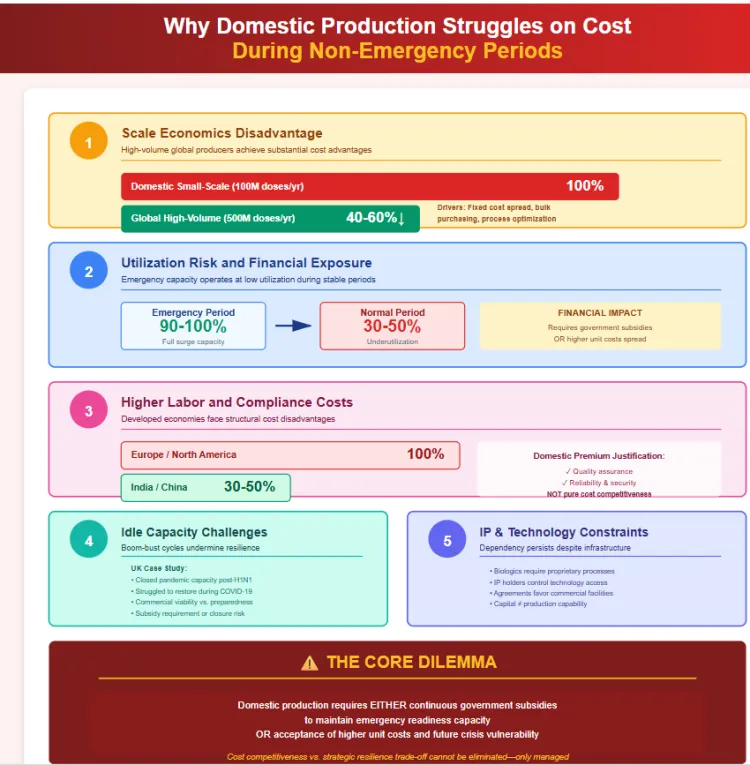
Scale economics in pharmaceutical and vaccine manufacturing create substantial cost advantages for high volume global producers. A facility producing 500 million vaccine doses annually achieves unit costs 40 to 60 percent lower than a plant producing 100 million doses due to fixed cost amortization, bulk input purchasing and process optimization investments. Countries with smaller populations cannot economically justify facilities sized for global export unless they accept dependence on export revenue vulnerable to international competition.
Utilisation risk creates financial exposure for domestic manufacturing capacity maintained primarily for emergency preparedness. Vaccine facilities designed to surge production during pandemics operate at 30 to 50 percent capacity during normal periods when seasonal influenza and routine immunization represent total demand. This underutilization requires either government subsidies to maintain readiness or acceptance of higher unit costs spread across lower volumes. Private sector manufacturers avoid this risk by serving global demand, while domestic focused plants require public support.
Higher labour and compliance costs in developed economies compound the challenge of competing with manufacturing located in lower cost regions. Indian and Chinese pharmaceutical manufacturers benefit from labour costs 50 to 70 percent below European or North American levels, while maintaining regulatory standards adequate for export to developed nations. Domestic production in high income countries must justify premium pricing through quality assurance, reliability or security considerations rather than pure cost competitiveness.
Idle capacity challenges during stable periods create pressure to repurpose or close domestic facilities that lack commercial viability. Governments face difficult choices between subsidizing capacity that generates no immediate benefit or allowing closure and accepting future vulnerability. The United Kingdom closed pandemic vaccine manufacturing capacity after H1N1 response, then struggled to rapidly restore capability during COVID-19. These boom and bust cycles undermine the resilience rationale for domestic capacity.
Technology transfer and intellectual property constraints limit domestic production options for biologics and complex medicines requiring proprietary manufacturing processes. Even when countries establish production facilities, accessing the technology platforms necessary to manufacture cutting edge vaccines or therapeutics requires agreements with intellectual property holders who may prioritize their own commercial facilities. This dependency persists even after capital investment in domestic manufacturing infrastructure.
How do governments attempt to balance resilience and efficiency through policy tools?
Incentives and subsidies compensate domestic manufacturers for accepting underutilization risk and higher operating costs. The United States Biomedical Advanced Research and Development Authority provides advance funding for pandemic vaccine capacity, effectively paying manufacturers to maintain surge capability through development contracts and manufacturing readiness agreements. European Union recovery plans allocate billions toward regional pharmaceutical and vaccine manufacturing, explicitly prioritizing resilience over pure cost efficiency.
Advance purchase agreements guarantee demand for domestic producers, reducing commercial risk and justifying capacity investment. Governments commit to purchasing minimum volumes at predetermined prices, providing manufacturers with revenue certainty that supports facility operation during low demand periods. These agreements function as insurance premiums paid during stable times to ensure access during emergencies, with governments accepting higher per unit costs as the price of assured supply.
Stockpiling programs attempt to create buffer inventory without requiring continuous domestic production. Strategic national stockpiles for vaccines, antivirals, antibiotics and medical countermeasures provide surge capacity to bridge gaps between emergency onset and production scale up. However, stockpile approaches face limitations including product expiration, storage costs and inability to address novel threats requiring new products. COVID-19 demonstrated that stockpiles cannot substitute for manufacturing agility when facing previously unknown pathogens.
Public private partnerships combine government funding with private sector manufacturing expertise, sharing both investment burden and operational risk. Governments provide capital for facility construction and maintain ownership while contracting private operators to manage production and serve commercial demand during stable periods. This model attempts to preserve surge capacity while minimizing idle asset costs, though governance complexity and misaligned incentives can undermine effectiveness.
Regional manufacturing hubs represent an intermediate approach between pure domestic production and global dependence. African Union initiatives to establish regional vaccine manufacturing, Latin American pharmaceutical production networks and ASEAN supply chain integration efforts aim to achieve scale economies serving multi country regions while reducing dependence on distant suppliers. These initiatives balance sovereignty concerns with economic reality by sharing capacity investment across allied nations.
How do emergency driven manufacturing decisions reshape long term health system strategy?
Procurement rules evolve following emergencies to embed resilience considerations alongside cost criteria. Before COVID-19, most government pharmaceutical procurement prioritized lowest cost qualified bidders. Post pandemic procurement increasingly weights supply security, domestic content requirements and supplier diversification into award decisions. European Union pharmaceutical strategy and United States executive orders now mandate consideration of supply chain resilience in public procurement, fundamentally changing competitive dynamics for suppliers.
Industrial policy pivots toward life sciences as governments recognize health manufacturing as strategic capability requiring sustained support. Germany increased pharmaceutical manufacturing subsidies, France announced multibillion euro domestic drug production investments and Japan designated vaccine manufacturing as national security priority. These policy shifts indicate that temporary emergency measures are translating into permanent industrial strategy reorientation viewing health products alongside defense and semiconductors as sectors requiring domestic capability regardless of pure commercial economics.
Supplier diversification mandates replace previous acceptance of concentrated sourcing when cost advantages justified dependency. Governments now require or strongly incentivize pharmaceutical and medical device buyers to maintain multiple qualified suppliers for critical products, even when single source procurement would reduce costs. This diversification imperative increases complexity and expense but reflects recognition that resilience requires redundancy incompatible with efficiency maximization.
Regulatory harmonization initiatives accelerate as countries seek to expand trusted supplier pools beyond purely domestic options. Mutual recognition agreements, joint inspections and coordinated emergency authorizations attempt to reduce regulatory friction that fragments global supply while maintaining quality standards. These cooperation frameworks aim to preserve global trade benefits while building resilience through broader supplier qualification.
Investment in domestic research and development capacity increases as governments recognize that manufacturing capability depends on underlying innovation ecosystems. Funding for vaccine platform development, diagnostic technology advancement and therapeutic research expands beyond immediate emergency response to build long term capabilities supporting rapid crisis response. This R and D investment complements manufacturing capacity to create integrated domestic supply ecosystems.
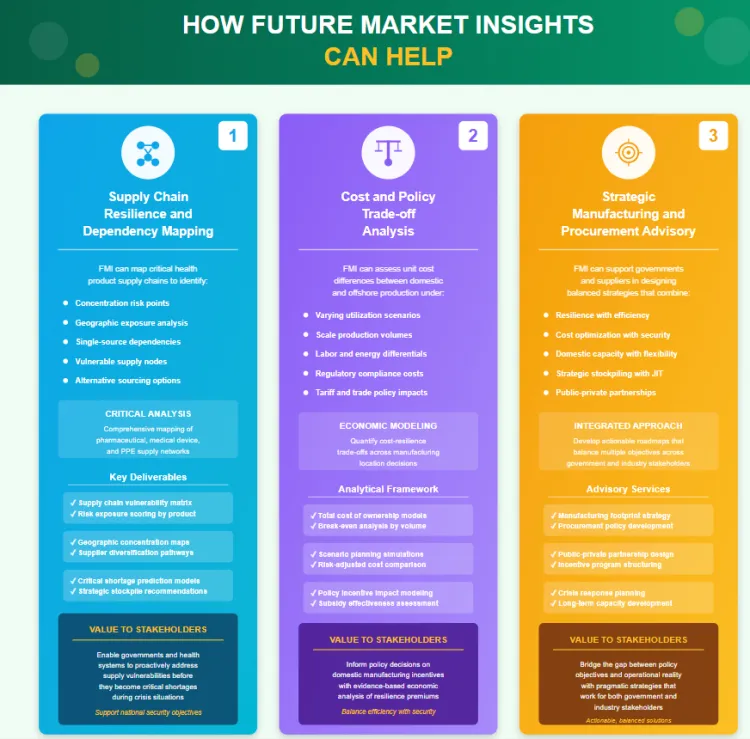
How can Future Market Insights help?
Sources
- World Health Organization and national public health agencies
- Used for emergency preparedness guidance and essential product prioritisation from organizations including WHO, US Centers for Disease Control and European Centre for Disease Prevention and Control.
- Government policy papers and industrial strategy documents
- Used for domestic manufacturing incentives, stockpile programs and procurement reforms including national pharmaceutical strategies, pandemic preparedness plans and economic recovery legislation.
- International trade and customs databases
- Used to assess import dependence and supply concentration through analysis of pharmaceutical and medical device trade flows, export restriction measures and supply chain exposure.
- Pharmaceutical and diagnostics manufacturer disclosures
- Used for production footprint, capacity and emergency response actions documented in company reports, regulatory filings and transparency disclosures from major vaccine and pharmaceutical manufacturers.
- Reputable global health and policy media
- Used for reporting on export controls, supply disruptions and manufacturing debates from sources covering public health policy, pharmaceutical industry developments and emergency response coordination.

