


Key Takeaways
- Regulations like FMVSS (United States) and ECE R108/R109 (Europe) formalize quality expectations for retreaded tires.
- Compliance costs in inspection, testing and traceability raise barriers against low-grade retreaders.
- Large certified retreaders gain pricing leverage through quality assurance and audit documentation.
- Defense, aviation and high-load transport buyers rely on audit-ready standards as procurement criteria.
- Certification becomes a commercial differentiator, not just a regulatory checkbox.
Which regulatory standards define the quality threshold for retreading in key regions?
Federal Motor Vehicle Safety Standard 117 governs retreaded tire manufacturing in the United States. The regulation requires visible identification markings that include the retreader's DOT code, tire size specifications, and the month and year of retreading. FMVSS 117 mandates that casings undergo thorough inspection before retreading, eliminating units with structural damage, exposed cords, or sidewall degradation. Performance testing verifies bead retention strength and high-speed endurance capabilities.
Europe operates under ECE Regulation 108 for retreaded passenger car tires and ECE Regulation 109 for commercial vehicle applications. Both frameworks specify inspection protocols for casing integrity, bonding strength between tread and casing, and dimensional accuracy after vulcanization. The regulations require permanent markings that identify the retreading facility and confirm conformity with ECE standards. Testing includes load-carrying verification and speed ratings that match or approach virgin tire specifications. Aviation ground support, military logistics, and cross-border freight operations reference these standards as baseline quality thresholds. Certification under FMVSS or ECE provides legal clearance and signals adherence to uniform safety criteria.
How do these compliance mandates shape operational cost structure for retreaders?

Meeting FMVSS and ECE requirements demands capital investment in specialized equipment. Shearography systems detect internal separation and delamination invisible to visual inspection. X-ray or ultrasonic testing identifies steel belt shifts and casing fatigue. Automated buffing equipment maintains precise tread removal depth, preventing under-buffing that weakens bonds or over-buffing that thins the casing. Temperature-controlled curing chambers ensure vulcanization consistency across batch sizes. These systems represent fixed costs that dilute per-unit expense only at higher production volumes.
Personnel qualification adds recurring expense. Inspectors require training in defect recognition, non-destructive testing interpretation, and documentation protocols. Quality auditors must maintain traceability records linking each retreaded tire to its original casing history, retreading date, and process parameters. Small facilities often lack the throughput to justify dedicated quality staff, forcing multi-role assignments that compromise inspection rigor. Large retreaders distribute labor costs across thousands of units monthly, achieving lower per-tire compliance expense. They also negotiate bulk pricing on testing consumables and calibration services.
Documentation infrastructure imposes administrative burden. Certified retreaders maintain digital or physical records for every casing, tracking prior retread cycles, repair history, and failure modes. Batch-level process logs capture curing temperatures, pressure profiles, and adhesive application rates. This traceability satisfies audit requirements but requires database management and archival discipline that informal operators avoid. Compliance cost structures favor scale players who amortize inspection technology and administrative overhead across substantial unit volumes.
Why does certification create pricing advantages for scale players?
Certified retreaders command price premiums because procurement officers value risk mitigation. Fleet managers face liability exposure if tire failure causes accidents involving injury or cargo loss. Retreads bearing FMVSS or ECE markings shift legal responsibility to the retreader, whose insurance and quality systems provide recourse. Uncertified retreads leave liability ambiguity, deterring institutional buyers despite lower acquisition cost.
Traceability enables warranty enforcement and performance accountability. Certified retreaders issue warranties tied to specific mileage or time periods, backed by casing documentation that proves compliance with retreading protocols. If premature failure occurs, the retreader can verify whether the casing met acceptance criteria or whether misuse voided the warranty. Informal retreaders offer no such transparency. Their lack of batch records and process controls prevents root-cause analysis when failures arise.
Large certified operators also supply procurement departments with audit documentation that satisfies internal compliance reviews. Government agencies and defense contractors require vendor certifications confirming adherence to safety standards. Third-party audits validate process controls, calibration schedules, and training records. Certified retreaders maintain these systems as routine operations, while small shops cannot afford the audit readiness infrastructure. This documentation capability translates into contractual access that excludes non-compliant competitors, allowing certified retreaders to price based on quality assurance rather than competing solely on cost.
How do audit-driven procurement behaviors change competitive dynamics?
Defense logistics prioritize supply chain integrity. Military vehicle fleets demand retreads with full traceability to prevent counterfeit or substandard components from entering service. Procurement contracts specify certification requirements, effectively barring uncertified retreaders from bidding. Aviation ground operations impose similar restrictions. Tugs, fuel trucks, and baggage carts operate in environments where tire failure disrupts critical schedules. Airports require vendor compliance with ECE R109 or equivalent standards, narrowing the competitive field to certified retreaders.
Heavy freight carriers increasingly adopt procurement policies that favor certified suppliers. Large trucking companies negotiate annual retread contracts with terms that include mileage guarantees, failure rate caps, and replacement protocols. These agreements depend on the retreader's ability to produce audit trails linking performance data to specific tire batches. Certified retreaders leverage this capability to secure long-term contracts at stable pricing, insulated from spot-price competition with low-cost providers who lack documentation infrastructure.
Certification acts as a gatekeeping mechanism. Buyers who prioritize compliance self-select into relationships with certified retreaders, creating a segmented competitive landscape. Price-sensitive buyers without audit requirements continue purchasing uncertified retreads, but their volume concentrates among informal operators competing on cost alone. Certified retreaders operate in a higher-value segment where quality assurance, warranty confidence, and procurement compatibility justify premium pricing. Regulatory frameworks thus partition the competitive environment into compliance-driven and cost-driven tiers.
Where do regulatory gaps still allow under-spec retreads to compete on price?
Enforcement inconsistency enables informal retreading in regions with limited inspection capacity. Some jurisdictions mandate certification but lack roadside enforcement or periodic vehicle inspections that verify tire compliance. Operators purchase uncertified retreads knowing detection risk remains low. Informal supply chains serve price-sensitive buyers who prioritize immediate cost savings over long-term reliability or legal compliance.
Emerging economies often delay implementing rigorous retread standards. Local retreaders continue using manual inspection methods and rudimentary curing equipment, producing output that fails FMVSS or ECE criteria but meets local tolerance for lower safety margins. Import restrictions or tariff structures protect these operators from certified competitors, sustaining parallel ecosystems where compliance carries no commercial advantage. Owner-operators in agriculture, construction, and regional transport prioritize upfront affordability, creating persistent demand for non-certified retreads despite documented safety risks.
Regulatory gaps also persist in secondary vehicle categories. Off-road equipment, agricultural machinery, and low-speed industrial vehicles often fall outside tire safety regulations designed for highway use. Retreaders serving these applications avoid compliance costs entirely, competing on price without certification requirements. These niches insulate informal retreaders from regulatory pressure, preserving cost-based competition in segments where safety standards remain voluntary or unenforced.
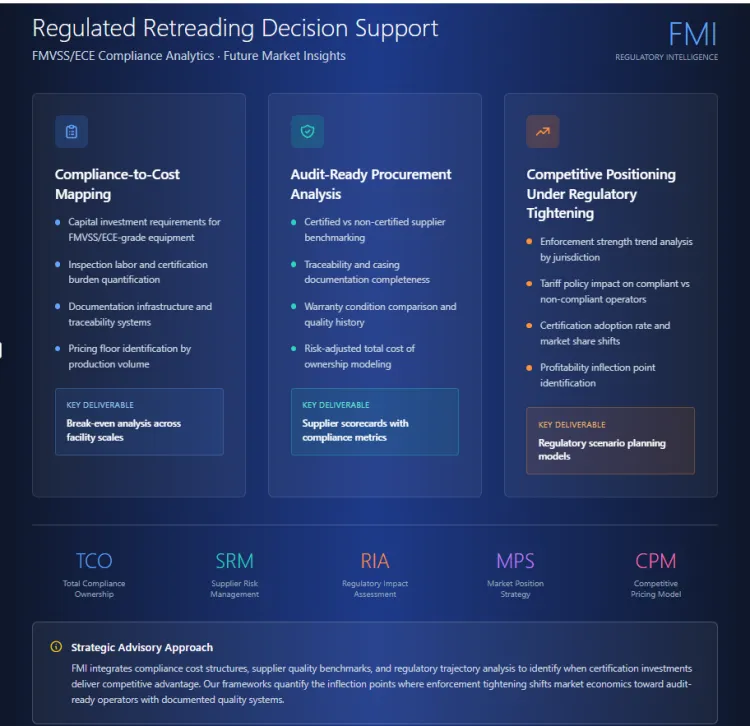
How can Future Market Insights help
Sources
- National highway and road-transport regulators: Details of FMVSS and regional retread testing and labeling mandates.
- European and international tire regulatory standards bodies: ECE R108/R109 compliance criteria, performance testing requirements and certification rules.
- Defense and government procurement guidelines: Audit and traceability rules affecting approved vendor lists for retread supply.
- Industry associations and technical literature: Operational practices, casing inspection methodologies and quality-system cost structure for certified retreaders.
- Reputable business media covering transport cost controls: Commentary on fleet decisions, compliance enforcement trends and price differentiation tied to safety standards.

