


Key Takeaways
- Aquafeed production for salmon and trout consumes the largest share of crude Fish Oil volumes
- Dietary supplement refiners depend on stable EPA and DHA composition, creating quality-driven allocation tension
- Seasonal feed spikes divert crude oil away from nutraceutical refiners and elevate pricing
- Refining capacity constraints widen the premium spread between crude and concentrated oils
- Price direction is often set by aquaculture cycles rather than nutraceutical demand
Why do aquafeed producers dominate crude Fish Oil consumption and set baseline pricing pressure?
Aquafeed manufacturers consume 65 to 75 percent of global crude Fish Oil production, making them the dominant demand channel. Salmon and trout aquaculture requires feed formulations containing 8 to 15% Fish Oil by weight to provide essential omega-3 fatty acids, primarily EPA and DHA, which carnivorous fish cannot synthesize efficiently from plant-based alternatives. With global salmon production exceeding 2.8 million metric tons annually and feed conversion ratios of 1.2 to 1.4 kilograms of feed per kilogram of fish, aquafeed alone absorbs 300,000 to 400,000 metric tons of Fish Oil each year.
Volume scale creates pricing leverage. When aquafeed producers negotiate crude oil purchases, they operate at tonnages ranging from 500 to 2,000 metric tons per transaction, often under quarterly or semi-annual contracts linked to reference pricing indices. Nutraceutical refiners, by contrast, typically purchase 50 to 200 metric ton lots with more frequent spot transactions. This volume differential means crude oil suppliers prioritize aquafeed customers during periods of tight supply, and baseline pricing reflects aquafeed willingness-to-pay rather than nutraceutical refiner economics.
Feed formulation flexibility limits how high aquafeed buyers will bid. When Fish Oil prices rise above $2,200 to $2,500 per metric ton, nutritionists reduce inclusion rates from 12 percent to 8 percent and substitute with poultry fat, rapeseed oil or algal oil blends. This substitution threshold establishes a practical ceiling on crude pricing during most periods, but nutraceutical refiners cannot reduce omega-3 content without compromising product efficacy, leaving them exposed to price spikes that aquafeed producers avoid through reformulation.
How does seasonal demand in salmon and trout farming influence crude Fish Oil allocation?
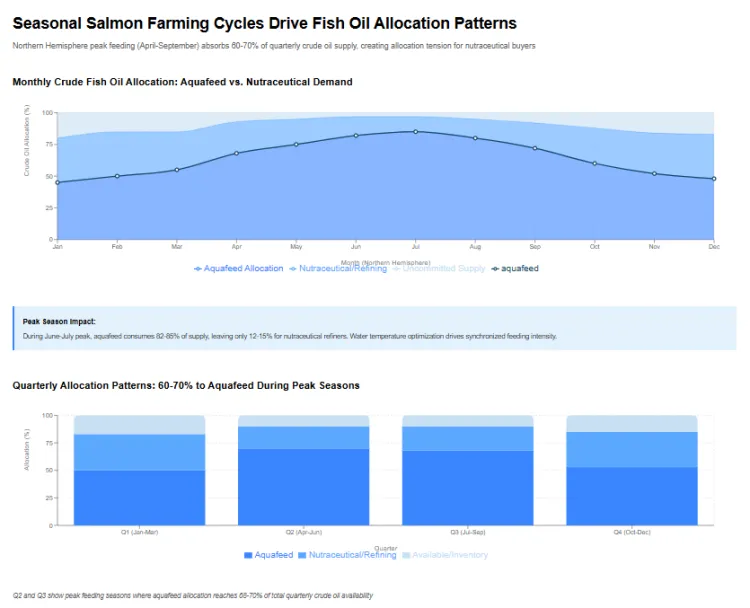
Salmon farming follows predictable biological cycles tied to smolt stocking, seawater transfer and harvest timing. In the Northern Hemisphere, peak feeding occurs from April through September when water temperatures optimize growth rates and fish appetite increases. During these months, aquafeed production intensifies and crude Fish Oil procurement accelerates, creating seasonal demand surges that absorb 60 to 70 percent of quarterly crude oil availability. Refiners seeking consistent monthly supply face allocation shortages and must either build inventory ahead of feeding seasons or accept premium pricing during peak periods.
Feed stages determine oil specification requirements. Starter feeds for smolts require higher omega-3 concentrations to support rapid development, while grower and finisher feeds use lower inclusion rates. However, total volume consumed during grow-out phases exceeds starter volumes by 8 to 10 times, meaning even modest inclusion rates create substantial crude oil demand. A single large salmon farming operation producing 40,000 metric tons annually consumes 3,500 to 5,000 metric tons of feed-grade Fish Oil across all life stages.
Geographic concentration amplifies seasonal effects. Norway, Chile and Scotland account for more than 60 percent of global salmon production, and their aquafeed plants operate on synchronized cycles aligned with regional farming calendars. When Norwegian farms enter peak feeding in June and July, crude oil suppliers prioritize filling aquafeed orders, reducing availability for refiners in North America and Europe who compete for the same Peruvian and Scandinavian crude oil sources. This creates predictable allocation tension where nutraceutical buyers either pay 8 to 12 percent premiums during aquafeed peak seasons or accept delayed delivery.
Why do nutraceutical refiners face tighter supply whenever aquafeed demand rises?
Nutraceutical refiners require crude Fish Oil with EPA plus DHA content exceeding 25 percent and peroxide values below 5 meq/kg to ensure efficient molecular distillation and concentrate yields. Not all crude oil batches meet these specifications, and only 40 to 55 percent of total crude production qualifies as refinery-grade. When aquafeed demand increases, suppliers divert higher-quality crude to feed producers willing to pay premiums for fresher, lower-oxidation oil that improves feed palatability and shelf life. This leaves refiners competing for a shrinking pool of suitable feedstock.
Batch-to-batch variability complicates sourcing. Crude Fish Oil derived from anchovy, herring or mackerel varies in EPA and DHA ratios depending on species, catch season, geographic origin and processing methods. Refiners targeting specific concentrate compositions require consistent fatty acid profiles to optimize distillation parameters and maintain concentrate quality. When supply tightens and refiners must accept off-spec crude, yields drop from 85 to 70 percent and production costs increase by $400 to $700 per metric ton of finished concentrate.
Inventory management strategies differ fundamentally between channels. Aquafeed producers can tolerate 4 to 8 weeks of crude oil storage because feed production occurs continuously and oil turnover is rapid. Refiners, however, store crude for 12 to 20 weeks to buffer seasonal availability gaps and ensure consistent processing schedules. Extended storage requires nitrogen blanketing, temperature control and antioxidant addition to prevent oxidation, adding $60 to $90 per metric ton in handling costs. When crude supply tightens during aquafeed peaks, refiners face a choice between paying spot premiums or depleting inventories and risking production interruptions later.
How does limited refining capacity widen the price gap between crude Fish Oil and high-purity concentrates?
Molecular distillation and concentration processes transform crude Fish Oil into pharmaceutical-grade concentrates containing 60 to 90 percent EPA plus DHA, but global refining capacity remains constrained relative to nutraceutical demand growth. Fewer than 30 facilities worldwide possess the wiped-film evaporators, high-vacuum systems and cryogenic equipment required for high-purity concentration, and total throughput capacity reaches only 45,000 to 55,000 metric tons annually. This bottleneck decouples concentrate pricing from crude oil movements, creating premium spreads that widen when refining utilization exceeds 85 percent.
The refining process consumes substantial crude input and energy. Producing one metric ton of 80 percent EPA plus DHA concentrate requires 2.8 to 3.5 metric tons of refinery-grade crude, depending on starting composition and yield efficiency. Processing stages including degumming, winterization, molecular distillation and deodorization consume 350 to 500 kilowatt-hours of electricity and 180 to 250 kilograms of process chemicals per ton of concentrate. When crude pricing remains stable but concentrate demand rises, refiners capture expanding margins because throughput constraints prevent new competitors from entering and spot concentrate prices reflect scarcity rather than input costs.
Deodorization and quality assurance add final cost layers. Concentrates must achieve peroxide values below 2 meq/kg and total oxidation values below 10 meq/kg to meet USP or EP pharmaceutical standards. Steam distillation removes volatile oxidation products and fishy odors, but aggressive deodorization can strip valuable minor components and reduce concentrate stability. Refiners balance deodorization intensity with quality targets, and premium concentrates achieving heavy metal levels below 0.1 ppm and dioxin levels below WHO limits command 15 to 25 percent price premiums over standard grades.
How does the allocation dynamic between feed and supplement channels shape long-term pricing trends in Fish Oil?
Aquaculture growth trajectories drive structural allocation shifts. Global salmon and trout production increased 4 to 6 percent annually over the past decade, absorbing incremental crude Fish Oil supply despite improved feed conversion efficiency and partial omega-3 substitution. If aquaculture growth continues while wild-capture fisheries remain constrained by quotas and biomass sustainability limits, aquafeed will claim progressively larger shares of available crude oil, forcing nutraceutical refiners to bid higher for shrinking allocations or transition toward algal oil alternatives.
Quota decisions in Peru, Norway and Iceland create supply volatility that amplifies allocation pressure. Peruvian anchovy quotas fluctuate with El Niño cycles and biomass assessments, ranging from 2.5 to 4.5 million metric tons per fishing season. Since anchovy yields 4 to 6 percent Fish Oil by weight, quota reductions of 1 million tons remove 40,000 to 60,000 tons of crude oil from global supply. During low-quota years, aquafeed buyers secure preferred access through long-term relationships and volume commitments, leaving refiners to source higher-cost Norwegian or Icelandic crude or reduce concentrate production.
Refinery investment lags demand growth, perpetuating premium spreads. Building new molecular distillation capacity requires $15 to $25 million in capital investment and 24 to 36 months from planning to commissioning. Refiners hesitate to expand when crude supply volatility creates feedstock risk and when algal oil development threatens long-term demand. This investment caution sustains refining bottlenecks that keep concentrate pricing elevated even during periods when crude oil costs moderate, creating persistent arbitrage opportunities for refiners with spare capacity and driving ongoing industry consolidation.
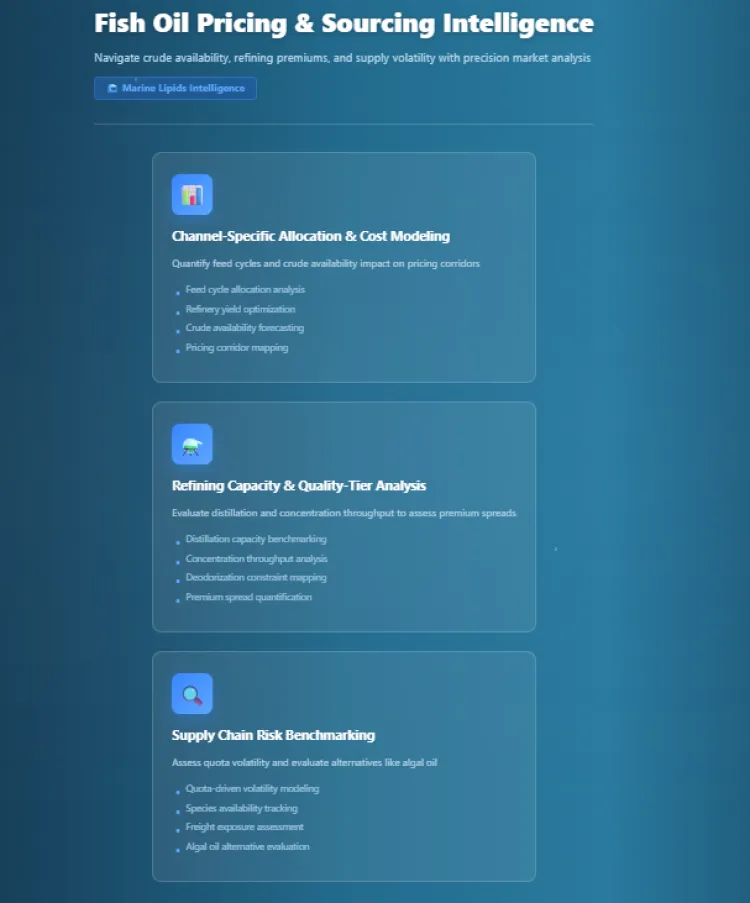
How can Future Market Insights support pricing and sourcing decisions in Fish Oil
Sources
- FAO fisheries and aquaculture statistics: Catch volumes, species data, aquaculture feed consumption
- Norwegian and Peruvian fisheries authorities: Quota decisions, landing reports and biomass assessments
- Omega-3 refining and marine ingredients industry reports: EPA/DHA concentration practices, yield factors and refining capacity
- Aquafeed industry publications: Seasonal feed demand patterns, species nutrition requirements and allocation dynamics
- Reputable commodity and shipping media: Freight trends, supply disruptions, export flows and pricing commentary

