Key Takeaways
- Precipitated silica in BRICS sits on top of a very physical chain: high-purity silica sand, soda ash, acids, heat, water and tight process control, rather than a generic specialty-chemical box.
- The same upstream silica ecosystem feeds flat and display glass on one side and precipitated silica for green tires and rubber compounds on the other, so glass and tire cycles are coupled at the sand and sodium-silicate level.
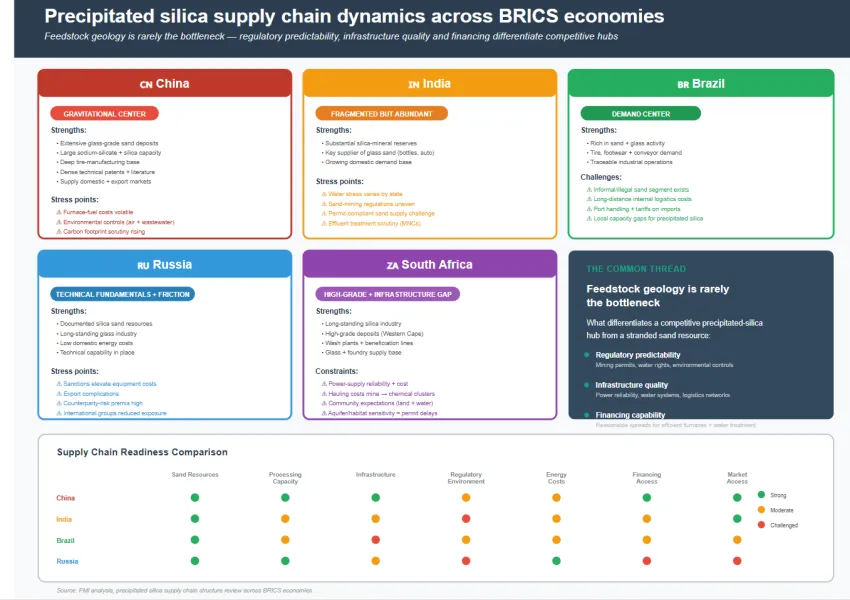
- In BRICS, the dominant cost stresses differ: China on furnace and drying energy plus environmental controls, India on sand logistics and water, Brazil on informal sand and permitting, Russia on energy and sanctions-driven logistics, South Africa on mine-to-plant distance and power reliability.
- Regulatory pressure on tire rolling resistance and wet grip drives structural demand for highly dispersible precipitated silica in tread compounds, but that demand is constrained by the capacity and know-how of a limited number of producers.
- The red pill for buyers is that precipitated silica costs are less about the headline silica sand price and more about furnace energy, water, effluent handling and the risk pricing of ESG and local permitting.
What does the precipitated silica value chain look like from quartz sand to specialty filler?
Industrial silica starts as high-purity quartz sand. Mining companies extract and beneficiate silica sand deposits with high silicon dioxide content for glass and industrial applications, typically through washing, screening and classification to remove clays and heavy minerals. BRICS countries are embedded in this upstream: India’s geological agencies document large reserves of quartz and silica minerals, South African authorities map glass-sand deposits around the Western Cape, and operators in Russia and Brazil supply glass-grade silica sand for containers, float glass and automotive glazing.
From there, the route to precipitated silica has three main stages. First, glass furnaces or rotary furnaces convert a mix of silica sand and soda ash into sodium silicate, or water glass. This is the thermal bottleneck, with furnaces running well above 1 000 degrees Celsius and consuming significant fuel or electricity. Second, sodium silicate solution is reacted with a mineral acid, or with carbon dioxide and an acid, under controlled conditions.
Technical literature describes carbonation and acidification routes where sodium silicate solutions are bubbled with a carbon-dioxide/air mixture and then acidified to a target pH to precipitate amorphous silica with tuned surface area and pore volume. Third, filtration, washing, drying and milling define the final product: highly dispersible grades for tires, softer grades for oral-care abrasives, free-flow aids for food and feed, or matting agents for coatings. Patents and process descriptions emphasise control of morphology, surface area and silanol density because these micro-features drive reinforcing behaviour in elastomers.
In parallel, other parts of the same sand base go straight into flat glass, solar glass and container glass. Technical notes on glass sand highlight how low-iron, tightly sized silica sand underpins solar-panel glass and architectural glass production. That is the screens side of the story. The tires side runs through sodium-silicate and precipitation plants, but both ultimately compete for similar high-quality sand, energy and water.
Which cost buckets actually drive precipitated silica pricing in BRICS?
Raw materials are the visible starting point. Silica sand looks cheap per ton but becomes expensive once you factor in purification and transport at scale. The more stringent the iron and trace-metal limits, the more washing, classification and sometimes flotation you need, and these steps carry capital costs, energy use and water demand. Soda ash is often imported or produced in large regional plants, so its price reflects global trona and synthetic-soda economics rather than local sand conditions. Acids such as sulfuric and hydrochloric acid are bulk chemicals but still add a material line item to the bill.
Energy and utilities are where costs start to bite. Furnaces for sodium silicate and dryers for precipitated silica are energy intensive. Studies on ceramics and glass show that thermal energy can represent a large fraction of production costs, and that pattern carries directly into silicate and silica operations. Electricity costs also matter for milling, air classification, material handling and dust control.
Water and effluent handling form a third pillar. Precipitation, washing and filtration generate large volumes of dilute sodium-sulfate and silicate-bearing liquors. Plants must treat or reuse these streams, which implies investment in clarifiers, filters, evaporation or discharge infrastructure and permits. In regions where water stress is a political issue, such as parts of India, South Africa and Brazil, permitting risk for high-water-use plants is now part of the core cost structure, not an afterthought.
Labour and overheads are meaningful but secondary. These plants are capital and utility heavy rather than labour heavy, so project finance terms, local interest rates and the cost of environmental compliance inspections often matter more than hourly wages. Logistics closes the loop: sand and sodium silicate are bulky, low-value-per-ton products, so haul distance to furnaces and precipitation units can determine site selection more than nominal tax incentives.
Where do ESG, water and permitting risks show up in pricing and availability?
ESG risk in precipitated silica shows up directly in capital and operating costs. Water is the most visible pressure point. Precipitation, washing and filtration stages use large volumes of water, and discharge must comply with progressively tighter standards. Plants that design for high recycling rates and low specific water use face higher upfront capex but reduce their exposure to future scarcity, tariff hikes or withdrawal limits.
Land and biodiversity risks concentrate at the sand-mining end of the chain. Studies of illegal sand extraction in Brazil and official reviews of dormant and abandoned silica-sand mines in South Africa underline how quickly community tolerance can erode around poorly managed operations. When that happens, new permits become slower and more expensive, and existing sites may face remediation obligations or stricter oversight.
Carbon and energy intensity matter as tire and electronics OEMs sharpen their Scope 3 accounting. Furnaces for soda ash, sodium silicate and glass are obvious decarbonisation targets, and buyers increasingly ask for emissions per ton of product. Academic and industry work on green or biosilica routes, for example using rice-husk ash, point toward alternative sources that can cut energy use and embed circularity into tire compounds. These do not close down conventional sand-based precipitated silica in BRICS, but they do frame a future where high-carbon, water-intensive plants face systematic price pressure or lose access to premium customers.
The uncomfortable reality is that the lowest apparent price per ton often comes from operations with weaker documentation and looser controls. For OEMs selling into Europe, North America or regulated Asian markets, those savings are increasingly outweighed by reputational and compliance risk. The cost of credible documentation and audited ESG practices is already embedded in the most reliable silica offers, and that differential is likely to widen.