


Key Takeaways
- Price in natural food colors is the translation of agricultural volatility, extraction yield, compliance load, and synthetic-to-natural substitution pressure into a widening range of ex-factory and end-use prices.
- Indian turmeric from the 2023 crop trades at 1.66 USD per kg, with 2024 crop at 1.68 USD per kg. Export values reached 212.65 million USD in 2023 with total volume of 167,280 metric tons.
- Sensient Technologies Color Group reported revenue of 647.9 million USD in 2024, with quarterly revenue increases of 16.7 million USD in Q4 2024 driven by solid volume growth and sales wins particularly in natural colors.
- California Assembly Bill 418 passed in November 2024 prohibits using Red 3 and other synthetic dyes. European Food Safety Authority revised guidelines tightening regulations on artificial colorants.
- India ANGRAU data shows turmeric production reached 1,054,000 metric tons from 305,000 hectares in 2023-24. Maharashtra leads with 326,970 metric tons followed by Karnataka at 129,400 metric tons.
- Supply chain disruptions created challenges for manufacturers in meeting consumer demand and maintaining consistent product quality. Stock levels for turmeric dropped from 1.2 million bags to 500,000 bags.
How do feedstock costs for agricultural raw materials shape ex-factory pricing for turmeric, paprika, spirulina, and beet extracts?
Feedstock volatility dominates natural food color pricing architecture. Indian turmeric production reached 1,054,000 metric tons from 305,000 hectares in 2023-24 with productivity of 3,656 kg per hectare according to ANGRAU agricultural ministry data. Maharashtra leads with 326,970 metric tons followed by Karnataka at 129,400 metric tons and Tamil Nadu at 111,670 metric tons.
Seasonal agricultural yields create discontinuous supply patterns. Production of beetroot and turmeric extracts depends heavily on crop cycles which fluctuate based on weather, disease pressure, and cultivation decisions. Stock levels for turmeric dropped from 1.2 million bags to 500,000 bags while daily arrivals decreased from 22,000-23,000 bags to 9,000-10,000 bags.
Extraction yield determines material cost share. Turmeric cultivation costs 310,670 rupees per hectare with labor representing 47.12 percent of total cost based on ANGRAU cost-return structure data. Working capital accounts for 87.61 percent of production economics.
Processing complexity increases with stability requirements. ADM developed extraction technologies in December 2024 that remove sugars, starches, and potential proteins, resulting in colors withstanding harsh processing environments without impacting flavor according to company announcements.
Where does energy intensity and extraction complexity create regional cost floors?
Energy manifests across multiple processing stages from drying to extraction. Turmeric and paprika require intensive drying operations. Spirulina cultivation demands controlled temperature and light management. Solvent extraction, spray drying, and concentration steps add energy layers that create regional cost asymmetry.
Regional energy tariff differences shape competitive positioning. EU industrial electricity rates significantly exceed those in China, India, and Southeast Asia. Indian processors benefit from power tariffs in lower ranges while EU processors face rates often double or triple Asian levels.
Yield loss factors compress margins. Spice variability and seasonality generate scrap rates during extraction. Quality control for color consistency and compliance certification adds inspection costs. Processing infrastructure requires continuous operation with testing facilities for emissions validation and stability certification.
How do compliance requirements and clean-label mandates create pricing floors versus synthetic dyes?
Regulatory frameworks establish market access barriers. California Assembly Bill 418 passed in November 2024 prohibits using Red 3 and other synthetic dyes, forcing manufacturers to transition to natural alternatives. European Food Safety Authority revised guidelines tightening regulations on artificial colorants and increasing demand for natural pigments like beetroot red and spirulina extract.
FDA approval processes create development timelines. FDA granted approval in 2024 for spirulina extract in beverage applications demonstrating regulatory adaptation to support natural colorant use in processed foods according to federal register notifications.
Clean-label audits compress discount headroom. Food manufacturers reformulated existing products to include natural food colors. Production complexity and color consistency requirements increase overall natural food color prices compared to synthetic counterparts which are mass-produced from petrochemical sources at lower cost.
What margin profiles emerge across premium stabilized emulsions, oleoresins, powders, and commodity extracts?
Sensient Technologies reported total revenue of 1.56 billion USD in 2024 with Color Group revenue of 647.9 million USD according to company fact sheet. The Color Group reported quarterly revenue of 158.1 million USD in Q4 2024, an increase of 16.7 million USD compared to prior year driven by solid volume growth and sales wins particularly in natural colors.
Givaudan acquisition of DDW strengthened natural color portfolio and market presence. Givaudan completed acquisition in December 2022 bolstering capabilities to provide expanded portfolio of natural coloring solutions aligning with growing demand for clean-label products per industry announcements.
GNT launched GNT Ventures investment arm in November 2024 to promote innovation and sustainability in plant-based colors. The independent investment firm will invest in startups developing new and improved plant-based coloring solutions in four key areas covering raw materials and fermentation, processing, food ingredients, and upcycling.
Leading companies focus extensively on research and development to innovate new high-performance products. Companies invest substantial portions of annual revenues in innovation. Ottera and DSM collaborated combining strengths in innovation, production, and global distribution.
How do FOB pricing benchmarks translate across turmeric oleoresin, paprika extract, spirulina powder, and carmine concentrate?
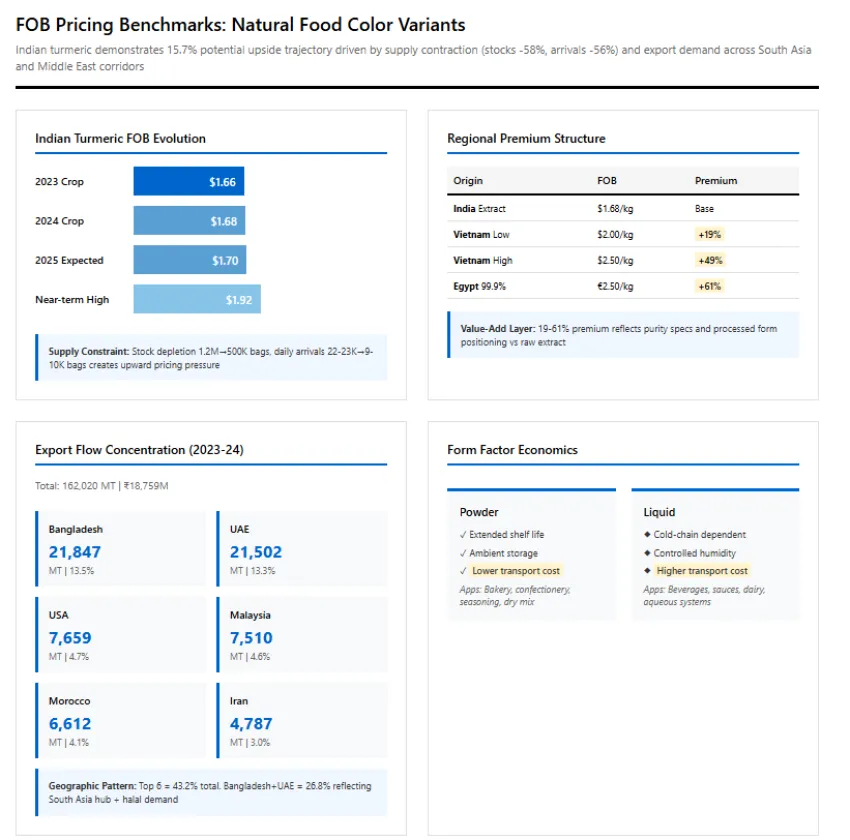
Indian turmeric FOB pricing shows volatility across crop years. Turmeric from 2023 crop trades at 1.66 USD per kg while 2024 crop reaches 1.68 USD per kg according to trade intelligence sources. Traders expect 2025 crop to reach 1.70 USD per kg ex-market with potential to hit 1.92 USD per kg in near term due to low stock levels and strong export demand.
Vietnamese and Egyptian turmeric demonstrates regional competition. Vietnamese turmeric powder available for 2.00 to 2.50 USD per kg reflecting competitive edge. Egyptian turmeric powder at 99.9 percent purity trades at FOB 2.50 euros per kg representing 2.04 percent increase and showcasing strong position in processed forms.
Major export flows concentrate in South Asia. India exported 162,020 metric tons valued at 18,759 million rupees in 2023-24 per ANGRAU export data. Major importing countries include Bangladesh with 21,847 metric tons, UAE with 21,502 metric tons, USA with 7,659 metric tons, Malaysia with 7,510 metric tons, Morocco with 6,612 metric tons, and Iran with 4,787 metric tons.
Powder natural food colors offer easier storage and transportation with normally lower cost of transportation compared to liquid forms. Beverage applications prefer liquid natural food color while other applications prefer powder form based on processing requirements.
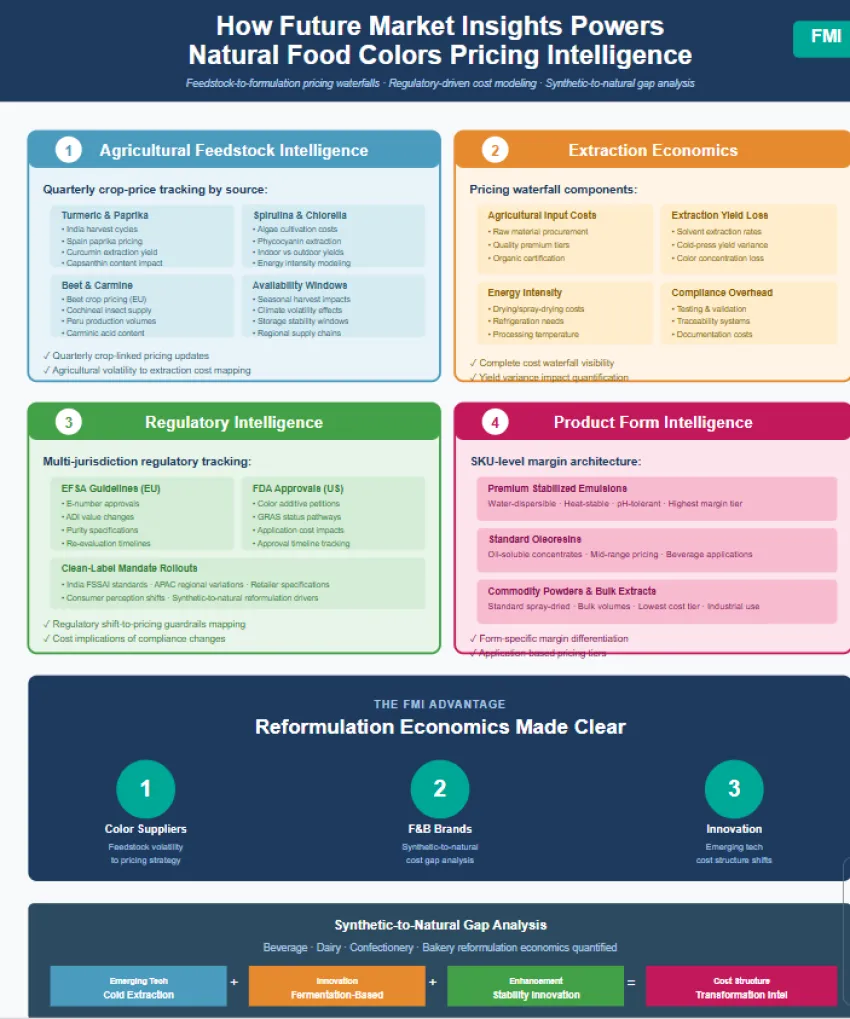
How can Future Market Insights help on pricing in natural food colors?
Sources
- Novais, C. et al. (2022). “Natural Food Colorants and Preservatives: A Review, a Demand, and a Challenge.” Journal of Agricultural and Food Chemistry (ACS).
- Luzardo-Ocampo, I. et al. (2021). “Technological Applications of Natural Colorants in Food Systems: A Review.” Foods (MDPI).
- Divya, K. et al. (2025). “Impact of Conventional and Advanced Techniques on Stability and Functionality of Natural Food Colourants.” Foods (MDPI).
- “Assessing the Sustainability of Natural and Artificial Food Colorants.” (LCA-focused review, available via ResearchGate / academic journals).
- Sensient Food Colors. “The Economics of Natural Color Pigments.” Sensient technical article on pigment concentration, cost-in-use, and category-wise usage.
- Sensient Food Colors. “Cost-In-Use.” R&D article explaining dosage, pigment load, and cost-per-serving comparisons for synthetic vs natural colors.
- Elchemy. “Understanding the US Food Dye Ban: What It Means for Suppliers and Manufacturers.” Blog outlining cost and supply-chain implications of shifting away from synthetics.

