


Key Takeaways
- Stevia addressed the biochemical problem of sweetness without calories, but it never solved the full functional and economic role bulk sugar plays in global food systems.
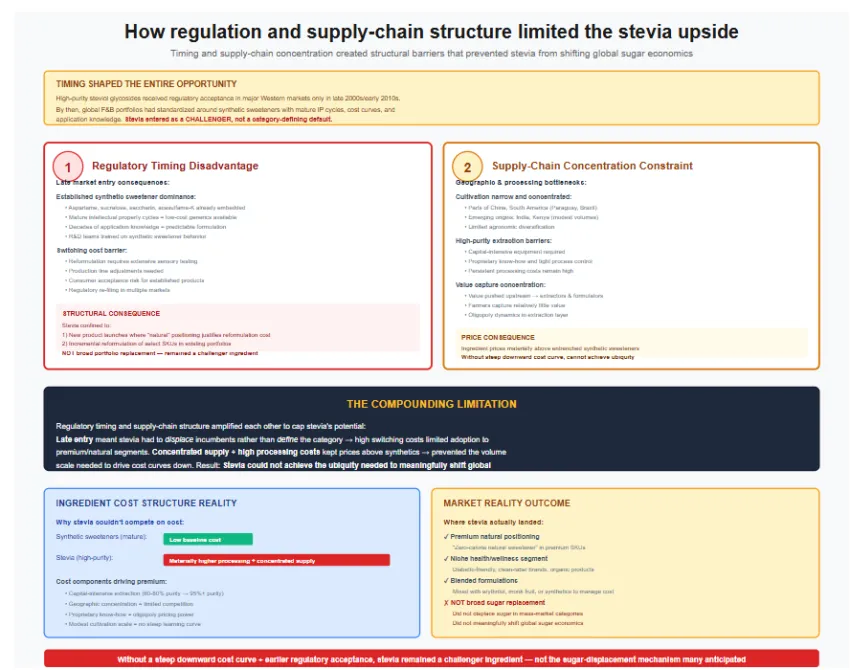
- Regulatory lags, imperfect early taste profiles and a highly concentrated supply chain meant stevia entered global markets after cost, technology and formulation norms were already set by synthetic sweeteners and cheap sugar.
- Evidence for non-sugar sweeteners as population-level obesity levers is mixed, limiting stevia’s ability to anchor a broad public-health narrative.
- The value pool shifted toward extraction and formulation technology rather than farming or consumer markets, keeping the ingredient structurally premium.
- A realistic counterfactual points to earlier regulatory acceptance, faster sensory innovation and better distribution economics as the only paths that could have meaningfully increased stevia’s role in sugar reduction.
What problem was stevia supposed to solve
From an economic and health-systems perspective, the underlying problem was not sweetness itself but excessive calorie load from refined sugar and syrups. Policymakers were searching for mechanisms to flatten obesity and diabetes curves without politically difficult restrictions on consumer choice. A high-intensity, plant-derived sweetener with no caloric burden looked like a tool that could absorb part of that pressure.
Stevia’s biochemical profile made this plausible: extreme sweetness per gram, negligible caloric contribution and no meaningful glycaemic load. Conceptually, this created a pathway for beverage and food manufacturers to engineer calorie reductions without forcing consumers to abandon sweetness altogether. In a purely theoretical model, a natural, zero-calorie molecule could have become the backbone of a recalibrated global sweetener system.
What stevia actually delivered to the food system
Stevia delivered sweetness intensity and safety, but not the structural properties that sugar brings. Sugar is not just a sweetener; it is a bulking agent, humectant, texturiser and browning driver. Removing sugar therefore creates several technical deficits across confectionery, bakery, dairy and frozen categories that stevia alone cannot fill. Any model assuming one-to-one substitution is structurally flawed. The sensory barrier mattered as well. Early commercialisation depended heavily on the dominant glycosides (stevioside and rebaudioside A). Both produced discernible bitterness and lingering aftertaste at the concentrations needed for full sugar replacement.
Later glycosides with better sensory performance did emerge, but required more advanced purification and fermentation processes, which kept costs elevated and supply constrained for years. In practice, stevia functioned as a partial substitute: useful for reducing sugar in beverages and some dairy applications, but rarely able to drive deep sugar cuts without blending, bulking agents or parallel reformulation. That limited its macro-impact from the start.
How the health evidence shaped the narrative
If the health data had been unequivocal, governments might have architected stronger incentives for stevia-based sugar reduction. But the evidence base for non-sugar sweeteners, taken as a whole, is mixed. Controlled trials show calorie reduction when these sweeteners displace sugar, but population-level data are noisy, heterogeneous and often neutral.
This created two consequences. First, policymakers focused on structural dietary change rather than sweetener substitution as the main lever. Second, companies reframed stevia as one element within broader low-sugar portfolios, not a transformational public-health mechanism.
Absent strong regulatory pressure or clear public-health consensus, stevia’s adoption curve depended almost entirely on commercial economics-and those economics favoured incremental, not absolute, substitution.
Sources
- Ashwell, M., & Elliott, P. (2015). The use of low-calorie sweeteners by adults: Implications for weight management. Nutrition Bulletin, 40(4), 341-347.
- Brouns, F., et al. (2021). Replacing added sugar with non-caloric sweeteners: A review of health outcomes. Frontiers in Nutrition, 8, 1-15.
- Dragomir, N., Grigore, D. M., & Pogurschi, E. N. (2025). Beyond sugar: A holistic review of sweeteners and their role in modern nutrition. Foods, 14(18), 3182.
- European Food Safety Authority. (2023). Safety evaluation of steviol glycosides produced by a new process as a food additive. EFSA Journal, 21(11), e08387.
- Hossain, M. F., et al. (2017). Cultivation and uses of stevia. African Journal of Food, Agriculture, Nutrition and Development, 17(4), 12745-12761.
- Mathur, S., et al. (2017). Critical review on steviol glycosides: Pharmacological, toxicological and therapeutic aspects. International Journal of Pharmacology, 13(7), 916-928.
- Toews, I., et al. (2019). Association between non-sugar sweetener intake and health outcomes. BMJ, 364, k4718.
- United States Food and Drug Administration. (2017). GRAS Notice 702: Purified steviol glycosides.
- United States Food and Drug Administration. (2019). GRAS Notice 790: Steviol glycosides (minimum purity 95%).

