


Key Takeaways
- Lead-acid battery prices are shaped more by intended use, warranty terms, and distribution layers than by the basic materials themselves, allowing premium industrial products to earn higher returns.
- Lead is still the largest raw material cost, but the final selling price also includes manufacturing precision, formation cycles, testing processes, packaging, and the cost of honoring warranties.
- Chinese producers lower global price expectations by controlling multiple stages of the supply chain and prioritizing scale, while long-established brands rely on service quality, certifications, and long-term reliability commitments to protect their margins.
- Efforts to make supply chains more resilient, such as holding larger inventories, diversifying smelter sources, and relocating manufacturing, have increased total operating expenses.
- The strongest profit capture takes place in product specialization, recycling and service infrastructure, and ownership of upstream and downstream supply elements instead of in the battery hardware alone.
- Chinese manufacturers have shown that similar performance can be delivered at lower prices, pushing legacy companies to emphasize brand trust, service coverage, and performance guarantees rather than basic specifications.
Why do lead-acid batteries cost more than their raw material bills suggest?
Even though lead dominates the material cost, manufacturers incur many other expenses that heavily influence final pricing. Precision in plate production, alloy composition, separator optimization, and chemical formulation require skilled labor, controlled environments, and specialized machinery. These steps determine capacity consistency, safety, cranking performance, and cycle life, all of which influence what the market is willing to pay.
Formation, which involves charging and conditioning the plates, is one of the most energy-intensive and time-consuming stages. A battery may spend days in formation chambers, occupying factory space and tying up capital. Quality assurance also extends beyond simple voltage checks. Manufacturers conduct vibration tests, thermal stress testing, deep-discharge validation, and electrolyte stability checks depending on the battery type.
Brand positioning further affects pricing because many customers pay for the expectation of longevity. Telecom operators, data centers, and industrial buyers prioritize uptime and long-term reliability, so they choose brands with established field performance. These segments are willing to pay a premium because the cost of downtime far exceeds battery price differences. Additionally, recycling infrastructure, which is mandatory in most markets, requires investments in collection networks, safe transportation, and partnerships with authorized recyclers. These components add cost but also create a circular ecosystem that benefits established suppliers.
Where do supply chain disruptions actually hit lead-acid pricing?
Supply chain volatility affects the industry in several interconnected ways. Any fluctuations in refined lead availability immediately influence procurement costs because lead accounts for a large percentage of total material input. When smelters face restrictions or logistical delays, manufacturers must either buy at higher spot prices or adjust production schedules, both of which affect profitability.
Energy costs also play a growing role. Lead-acid manufacturing, particularly formation and curing, requires substantial power consumption. In markets where electricity pricing fluctuates, the cost of producing each battery can vary month to month. Regulatory compliance adds another layer, as governments increasingly enforce stricter emission controls on smelting and recycling operations. This can temporarily reduce available supply or increase processing expenses.
Freight conditions influence landed costs as well. When international shipping becomes congested or more expensive, the cost of transporting batteries or lead ingots rises sharply. Because batteries are heavy and classified as hazardous for transport, even minor changes in logistics pricing significantly impact final costs. Manufacturers are therefore shifting toward more regionally distributed production models to reduce long-distance shipping.
How are Chinese brands disrupting traditional pricing models?
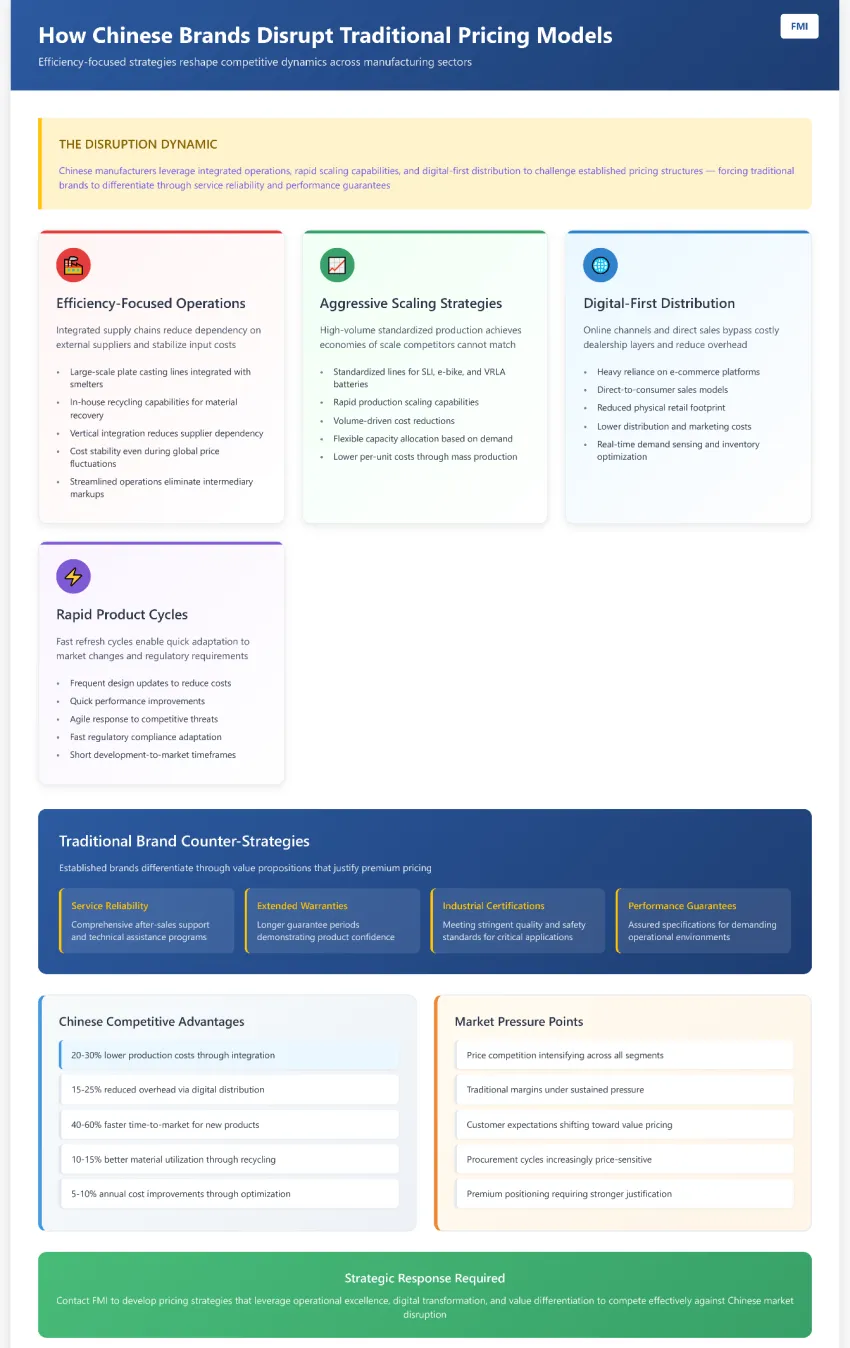
Chinese manufacturers continue to reshape competitive dynamics through efficiency-focused strategies. Their large-scale plate casting lines, integrated smelters, and in-house recycling capabilities reduce dependency on external suppliers. This approach allows them to stabilize input costs even when global lead prices fluctuate.
Their ability to scale production rapidly supports aggressive pricing. By running high-volume standardized lines for SLI, e-bike, and VRLA batteries, they achieve economies of scale that smaller and more diversified producers cannot easily match. Digital-first distribution also reduces overhead, as many Chinese brands rely heavily on online channels, bypassing costly dealership layers.
Their product refresh cycles are faster, enabling quick adaptation to changing demand or regulatory requirements. While established brands often focus on long-term contracts and multi-year product cycles, Chinese brands take a more agile approach, frequently updating designs to cut cost, improve performance, or match competitors. This forces traditional brands to differentiate with service reliability, stronger warranties, industrial certifications, and performance guarantees that justify a higher price point.
Sources
- USA Department of Energy (DOE). Battery Manufacturing and Supply Chain Assessment: Lead-Acid and Advanced Battery Technologies.
- International Energy Agency (IEA). Battery Markets and Global Supply Chains: Trends in Lead-Acid and VRLA Applications.
- United Nations Environment Programme (UNEP). Lead Recycling, Environmental Compliance, and Industrial Battery Markets.
- Fraunhofer Institute for Chemical Technology (ICT). Lead-Acid Battery Production: Material, Process, and Cost Analysis.
- European Commission - Joint Research Centre (JRC). Battery Technology Lifecycle, Supply Chains, and Market Economics for Industrial Applications.

