


Key Takeaways
- Healthcare mobility equipment pricing is dominated by Medicare reimbursement rates and material costs rather than pure manufacturing complexity, with power wheelchairs requiring extensive prior authorization processes that create barriers favoring established suppliers like Invacare, Sunrise Medical, and Drive Medical.
- Manufacturing costs concentrate in three critical areas: material selection involving specialized aluminum and stainless steel components for durability and safety, assembly processes requiring precision engineering for FDA compliance, and quality control systems that validate performance across weight capacity and safety standards.
- The real margin capture happens in three distinct layers: Medicare-approved supplier status that controls market access, technical service capabilities including maintenance and repair networks, and product portfolio breadth that enables cross-selling across manual and power mobility categories.
- Established players like Invacare and Drive Medical maintain structural advantages through economies of scale in material procurement, established Medicare provider relationships, and comprehensive distribution networks that smaller manufacturers cannot easily replicate.
- Supply chain disruptions have fundamentally altered mobility equipment cost structures, with aluminum and steel price volatility creating pressure that flows through every product category from basic manual wheelchairs to complex power mobility systems.
Why do power wheelchairs cost dramatically more than their material bills suggest?
Healthcare mobility equipment manufacturing operates under fundamentally different economic constraints than consumer products. Medicare reimbursement structures create artificial pricing frameworks where manufacturers must align their costs with predetermined payment schedules rather than traditional market-driven pricing models.
The component stack reveals where costs actually accumulate beyond basic materials. Aluminum frames represent a significant portion of material costs, but medical-grade aluminum requires specialized alloys and manufacturing processes that command premium pricing. 300 Series stainless steel components used in critical stress points like wheel mounts and locking mechanisms must meet strict biocompatibility and corrosion resistance standards that multiply raw material costs.
Manufacturing complexity extends far beyond basic metal fabrication. Power wheelchairs require integration of electronic control systems, battery management units, and motor assemblies that must operate reliably under continuous use conditions. Each component requires extensive testing and validation to meet FDA medical device requirements, creating quality control costs that can represent substantial portions of final product pricing.
The Medicare approval process creates another layer of cost complexity. Manufacturers must maintain extensive documentation systems, conduct clinical trials for new products, and provide ongoing technical support for approved devices. These regulatory compliance costs remain relatively fixed regardless of production volume, creating economies of scale that favor large, established manufacturers.
Professional fitting and customization requirements add substantial service costs beyond the basic product. Power wheelchairs typically require multiple patient evaluations, custom seating configurations, and ongoing maintenance support that must be factored into the total cost structure, even though these services may not be directly reimbursed by Medicare.
Where do Medicare reimbursement structures actually drive mobility equipment economics?
Medicare's Durable Medical Equipment (DME) benefit fundamentally shapes the entire mobility equipment industry through predetermined reimbursement rates and qualification requirements. The competitive bidding program used to select approved suppliers creates artificial market constraints that traditional supply and demand economics cannot address.
Reimbursement rates vary dramatically based on equipment classification and patient eligibility criteria. Basic manual wheelchairs receive lower reimbursement levels but require minimal approval documentation, while power wheelchairs command higher payments but demand extensive prior authorization processes including face-to-face physician evaluations and detailed medical necessity documentation.
The 13-month rental-to-ownership model for power wheelchairs creates unique financial dynamics. Suppliers must provide full-service support including maintenance, repairs, and replacements during the rental period while receiving graduated payments that may not cover immediate costs. This cash flow challenge favors larger companies with sufficient capital reserves to manage extended payment cycles.
Regional reimbursement variations create geographic cost disparities. Medicare Administrative Contractors set different payment rates across regions, forcing manufacturers to adjust their distribution strategies and supplier networks based on local reimbursement economics rather than traditional market factors like transportation costs or customer density.
How are established manufacturers maintaining margin control despite cost pressures?
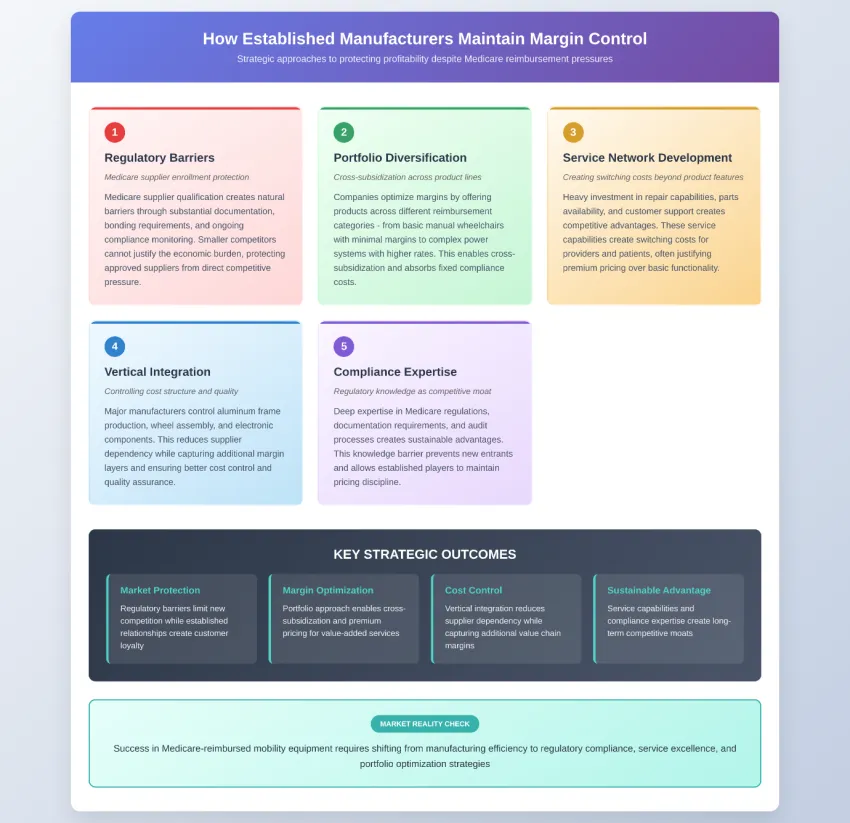
Major mobility equipment manufacturers have developed sophisticated strategies to protect margins within the constraints of Medicare reimbursement structures. Rather than competing purely on manufacturing efficiency, successful companies focus on regulatory compliance, service capabilities, and product mix optimization.
Medicare supplier enrollment creates natural barriers to entry that protect established players. The qualification process requires substantial documentation, bonding requirements, and ongoing compliance monitoring that smaller competitors often cannot justify economically. This regulatory moat enables approved suppliers to maintain pricing discipline without direct competitive pressure from new entrants.
Product portfolio diversification allows margin optimization across different reimbursement categories. Companies like Invacare offer products ranging from basic manual wheelchairs with minimal margins to complex power systems with higher reimbursement rates. This portfolio approach enables cross-subsidization and helps absorb the fixed costs of maintaining Medicare supplier status.
Service network development creates competitive advantages that extend beyond pure product manufacturing. Established suppliers invest heavily in repair capabilities, parts availability, and customer support systems that create switching costs for healthcare providers and patients. These service capabilities often justify premium pricing even when competing products offer similar basic functionality.
Vertical integration strategies reduce supplier dependency while capturing additional margin layers. Major manufacturers increasingly control their own aluminum frame production, wheel assembly, and electronic component sourcing, reducing reliance on external suppliers while gaining better cost control and quality assurance.
Sources
- Centers for Medicare & Medicaid Services. Medicare Coverage of Durable Medical Equipment and Wheelchairs: Reimbursement Guidelines and Supplier Requirements.
- USA Food and Drug Administration. Medical Device Manufacturing Standards: Quality Control Requirements for Mobility Equipment and Assistive Devices.
- National Institute for Occupational Safety and Health. Material Selection and Safety Standards for Healthcare Mobility Equipment: Aluminum and Steel Applications.
- Department of Veterans Affairs. Wheelchair and Mobility Equipment Procurement: Cost Analysis and Supplier Performance Evaluation.
- International Organization for Standardization. ISO 7176 Series: Wheelchairs Testing Standards for Safety, Performance, and Durability Requirements.
- Medicare Administrative Contractors. Durable Medical Equipment Competitive Bidding Program: Supplier Selection and Reimbursement Rate Determination.

