


Key Takeaways
- Smart mining infrastructure costs are dominated by upfront capital expenditure rather than operational expenses, with autonomous truck systems requiring massive initial investments that only large miners can justify through scale economics and fleet utilization.
- The real margin capture happens in three layers: equipment utilization optimization through continuous operations, predictive maintenance systems that prevent costly breakdowns, and integrated data platforms that enable remote operations centers managing multiple sites from single locations.
- Major players like Rio Tinto and BHP have achieved structural cost advantages through vertical integration of hardware, software, and services, while smaller miners remain dependent on fragmented vendor ecosystems with higher per-unit costs and limited bargaining power.
- IoT sensor networks and connectivity infrastructure represent the hidden cost multiplier in smart mining, with private networks, satellite connectivity, and data processing creating ongoing operational expenses that compound over time.
- The uncomfortable reality is that smart mining technology creates a two-tier industry where scale determines viability, forcing smaller operators to either partner with technology leaders or accept commodity-level margins in traditional operations.
Where do smart mining costs actually accumulate across the value chain?
Smart mining represents a fundamental shift from labor-intensive operations to capital-intensive technology platforms. The cost structure spans multiple interconnected systems rather than discrete equipment purchases, creating complexity that favors large-scale operators with dedicated engineering teams and substantial balance sheets.
The foundation layer consists of autonomous equipment and robotics. Mining companies deploy fleets of autonomous haul trucks, drilling rigs, and loading equipment that operate continuously without human operators. Academic studies on mining automation emphasize that these systems require not just the vehicles themselves but comprehensive infrastructure including dedicated roadways, charging stations, maintenance facilities, and safety systems that can cost several times the base equipment price.
Above this hardware foundation sits the connectivity and data infrastructure. Smart mining operations depend on reliable, high-bandwidth networks that can handle massive data flows from thousands of sensors across remote mining sites. Companies have invested heavily in private cellular networks, satellite communications systems, and edge computing platforms that process data locally before transmitting insights to central operations centers.
The control and analytics layer represents where mining companies attempt to capture the highest value. Centralized operations centers allow skilled personnel to monitor and manage multiple mine sites simultaneously, theoretically reducing labor costs while improving consistency and safety. These facilities require sophisticated visualization systems, redundant communication links, and highly trained operators who command premium salaries.
Integration and maintenance costs often exceed initial projections. Smart mining systems must interface with existing equipment, legacy software platforms, and regulatory compliance systems. Mining operations generate vast amounts of data that require storage, processing, and analysis capabilities that scale with fleet size and operational complexity.
Why Rio Tinto and BHP capture disproportionate value from automation investments?
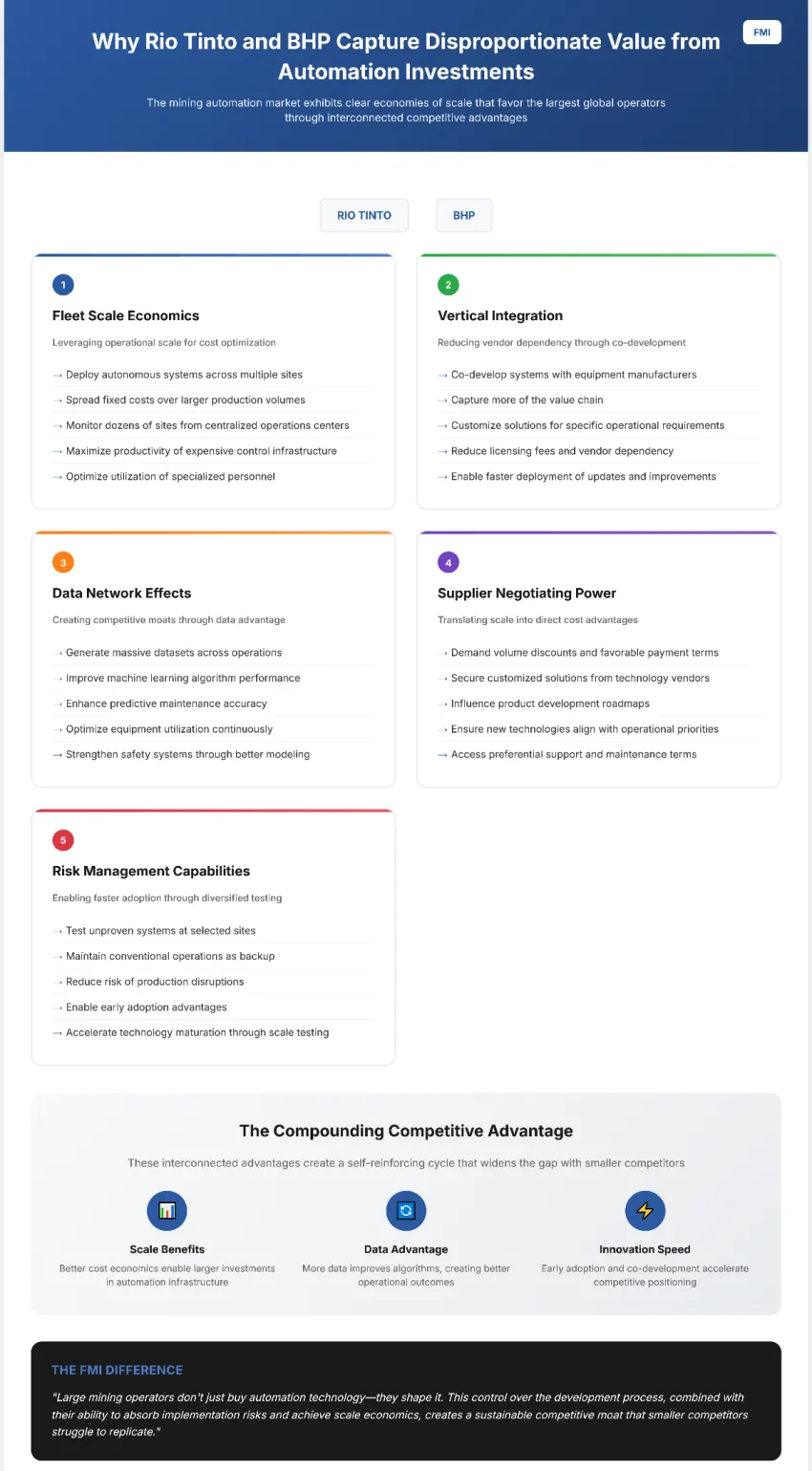
The mining automation market exhibits clear economies of scale that favor the largest global operators. Rio Tinto and BHP have achieved cost advantages through several interconnected mechanisms that smaller competitors struggle to replicate.
Fleet scale enables better utilization economics. Large miners can deploy autonomous systems across multiple sites, spreading fixed costs over larger production volumes. Their operations centers monitor dozens of sites simultaneously, maximizing the productivity of expensive control infrastructure and specialized personnel.
Vertical integration reduces vendor dependency. Rather than purchasing complete solutions from technology suppliers, major miners co-develop systems with equipment manufacturers, capturing more of the value chain and customizing solutions for their specific operational requirements. This approach reduces licensing fees, improves system integration, and enables faster deployment of updates and improvements.
Data network effects strengthen over time. Large mining operations generate massive datasets that improve the performance of machine learning algorithms and predictive models. Better algorithms lead to improved equipment utilization, more accurate maintenance predictions, and enhanced safety systems, creating a competitive moat that widens as operations scale.
Supplier negotiating power translates directly into cost advantages. Major miners can demand volume discounts, favorable payment terms, and customized solutions from technology vendors. They also influence product development roadmaps, ensuring that new technologies align with their operational priorities rather than generic market requirements.
Risk management capabilities allow faster adoption of new technologies. Large miners can afford to test unproven systems at selected sites while maintaining conventional operations elsewhere. This reduces the risk of production disruptions while enabling early adoption advantages when technologies mature.
Why mid-tier miners face structural disadvantages in smart mining adoption?
Smaller mining operations encounter multiple barriers that compound the cost disadvantage of smart mining systems. These challenges extend beyond simple scale economics to include technological complexity, skills requirements, and financial constraints.
Technology integration complexity exceeds internal capabilities. Smart mining systems require extensive customization and integration work that demands specialized engineering skills. Mid-tier miners often lack dedicated technology teams and must rely on external consultants, increasing implementation costs and reducing system optimization.
Infrastructure requirements create minimum viable scale thresholds. Private communication networks, operations centers, and maintenance facilities have high fixed costs that cannot be justified by smaller production volumes. This forces smaller miners to accept shared services or simplified systems that deliver reduced benefits.
Vendor relationships favor volume customers. Technology suppliers prioritize large mining companies for product development partnerships, technical support, and favorable pricing. Smaller miners receive standard products with limited customization and higher per-unit costs.
Skills acquisition becomes increasingly expensive. Smart mining operations require personnel with specialized technical skills in automation, data analysis, and system integration. Large miners can offer career advancement opportunities and premium compensation packages that smaller operators cannot match.
Financial constraints limit experimentation and learning. Smart mining adoption often requires multiple iterations and continuous improvement to achieve projected benefits. Smaller miners may lack the financial resources to support extended learning curves or system modifications needed for optimal performance.
Regulatory compliance adds disproportionate overhead. Safety regulations and environmental requirements apply equally to all mining operations regardless of size. Smaller miners must invest the same effort in compliance documentation and safety systems while spreading these costs over smaller production volumes.
How smart mining economics reshape competitive positioning?
The cost structure of smart mining technology is creating a fundamental realignment of competitive advantages in the mining industry. Traditional competitive factors such as ore grade, location, and labor costs remain important but are increasingly overshadowed by technology adoption and scale advantages.
Operational leverage increases dramatically with automation. Smart mining systems can operate continuously without shift changes, fatigue management, or many of the constraints that limit human-operated equipment. This creates significant productivity advantages for companies that achieve successful implementation while penalizing those that cannot make the transition.
Capital intensity shifts from mining equipment to technology infrastructure. Traditional mining investments focused on trucks, shovels, and processing equipment with relatively predictable costs and performance characteristics. Smart mining requires investments in software, communications, and data systems that have less predictable returns and require ongoing technological updates.
Competitive moats become increasingly difficult to breach. Companies that successfully implement smart mining systems accumulate operational data, technical expertise, and vendor relationships that create substantial barriers to entry. Late adopters face the challenge of competing against established technology platforms while bearing the full cost of developing equivalent capabilities.
Risk profiles diverge between early adopters and followers. Mining companies that invest early in smart mining technology accept higher technical and financial risks in exchange for potential competitive advantages. Companies that delay adoption reduce short-term risks but may find themselves at permanent disadvantages as technology leaders establish market positions.

Sources
- Journal of Mining and Metallurgy. Economics of Autonomous Truck Systems and Data-Driven Decision Making in Mining Operations.
- University of Queensland Research Publications. The Economics of Smart Mining: Costs, Benefits, and Future Potential.
- Australian Mining Magazine. Cost Efficiency and Technological Barriers in Smart Mining: A Study of Large vs. Mid-Tier Players.
- International Council on Mining and Metals (ICMM). Innovation in Mining: How Automation and Smart Technologies Are Reshaping the Industry.

