

- Market Size (2026)
- USD 4.5 Bn
- Forecast (2036)
- USD 12.9 Bn
- CAGR (2026 to 2036)
- 11.2%
How big is Smart Mining Technologies Market in 2026?
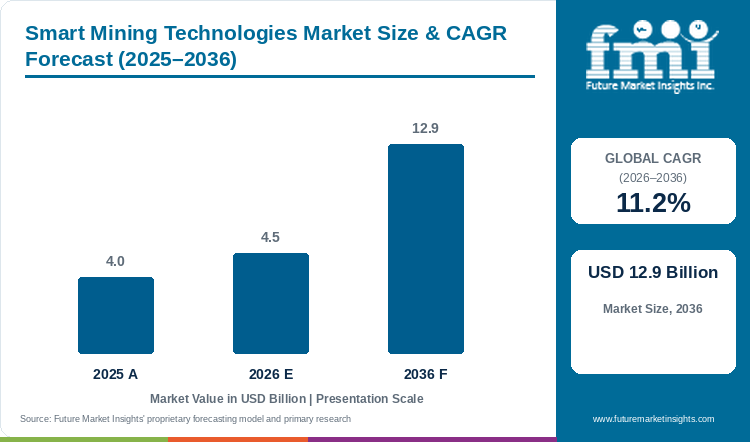
Demand is projected to expand at 11.23% CAGR from 2026 to 2036. Market value rises from USD 4 billion in 2025 to USD 4.45 billion in 2026 and USD 12.9 billion by 2036.
Smart mining technologies become useful when a mine can connect sensing, software or automation with an operating task and maintain that connection under site conditions. Demand includes supply-chain coordination, operating control, analytics and related applications, with the buyer's integration responsibilities differing across those tasks. China's selection of 77 intelligent-technology coal-mine upgrade pilots provides a defined development pipeline with quantified targets and acceptance requirements. [1] Australia's CSIRO research addresses underground sensing and mission-control concepts, while Canadian work applies AI to understanding energy use in electric mining vehicles. [2][3] These examples identify practical development directions for suppliers serving different parts of the mine. Epiroc's mixed-fleet automation offering also illustrates why installed equipment compatibility matters to a proposal. [4] Through 2036, commercial progress will depend on converting these capabilities into site-specific systems that operators can use, maintain and extend as working conditions and equipment arrangements change.
Key Market Trends & Insights
- Defined operational targets make technology procurement more specific.
- Site integration can delay the conversion of a pilot pipeline into revenue.
- Supportable remote-operation systems can address a mine-specific service requirement.
Regional Highlights
- China's National Energy Administration selected 77 coal-mine intelligent-technology upgrade pilots, with owners required to quantify targets and complete expert acceptance (FMI outlook: 13.7% CAGR, 2026 to 2036).
- CSIRO's Australian work describes underground fibre-optic sensing, data-informed mining decisions and mobile mission-control concepts, bringing attention to the link between information collection and operating action (FMI outlook: 13.2% CAGR, 2026 to 2036).
- Chile's surface-mine purchasing scenario places remote-operation systems within a wider arrangement for moving material and maintaining equipment across the site (FMI outlook: 12.4% CAGR, 2026 to 2036).
Market Size & Forecast
Table 1: Market Size and Forecast for Smart Mining Technologies Market (USD billion and percentage), 2025 to 2036
| Metric | Value |
|---|---|
| 2025 market value | USD 4 billion |
| 2026 market value | USD 4.45 billion |
| 2036 market value | USD 12.9 billion |
| CAGR 2026 to 2036 | 11.23% |
| Revenue increase 2026 to 2036 | USD 8.45 billion |
| Market expansion 2026 to 2036 | 2.90 times |
The market covers mine-specific automation and remote operations together with connected safety, monitoring and optimisation. Mineral output is not itself a measure of technology adoption.
Mining equipment information can support the maintenance decisions covered in the Asset Performance Management Market. Integrating those records with operating data helps the mine connect a measured condition with the team responsible for reviewing equipment health and scheduling work.
The mine-technology acceptance pipeline
China's quantified pilot programme, CSIRO's underground sensing research and Canadian electric-vehicle analysis represent different stages and tasks within smart mining. [1][2][3] Epiroc's mixed-fleet automation offering adds a current commercial example of equipment compatibility. [4] These cases make the relationship between a technical capability and its site-level implementation central to the purchasing assessment.
Table 2: Industry evidence relevant to the smart mining technologies market
| Indicator | Data point or observation | Market relevance | Source |
|---|---|---|---|
| Pilot implementation | China selected 77 intelligent-technology coal-mine upgrade pilots with quantified targets and expert acceptance. | Project delivery must be connected with the defined operating and acceptance requirements. | [1] |
| Underground information | CSIRO describes fibre-optic sensing and mission-control research for mining. | Information delivery must connect with the staff responsible for operating decisions. | [2] |
| Mixed-fleet automation | Epiroc documents an agnostic automation offering for mixed equipment fleets. | Retained equipment and supported interfaces influence upgrade scope. | [4] |
Analyst Perspective
"Mining automation has to fit the machines and responsibilities already present at the site. A supplier's offer becomes easier to evaluate when equipment control, operating information and continuing support are tied to an identified task, giving the buyer a workable route from a demonstration to daily operation."
- Sudip Saha, Co-founder, Future Market Insights
How is the Smart Mining Technologies Market segmented?
The market is segmented by Technology Solution, Application, and Region.
Technology-solution categories separate AI/ML-enabled supply-chain management, mining analytics, metal-trading platforms, emissions software and other systems. Application categories identify whether the purchase supports operating control, risk and compliance, data warehousing or another task. Retaining these axes helps buyers distinguish a mine-wide integration project from a narrower software or sensing requirement, while keeping the operating owner and acceptance criteria visible within the commercial comparison.
Why is AI/ML-enabled supply chain management a leading solution?
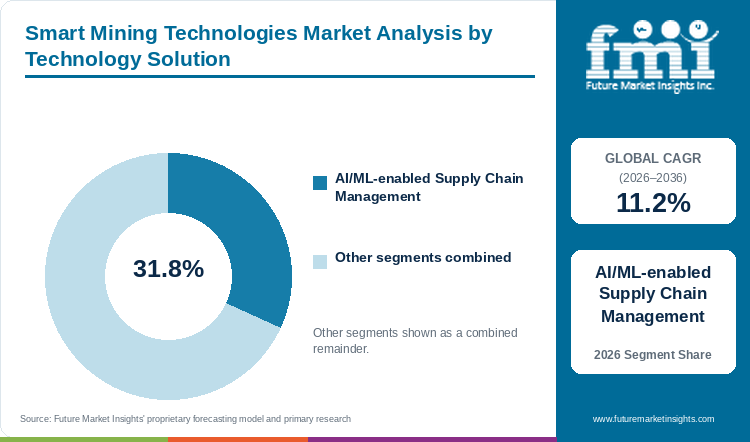
Table 3: Technology Solution Share for Smart Mining Technologies Market (percentage share), 2026
| Technology Solution | Estimated share (2026) |
|---|---|
| AI/ML-enabled Supply Chain Management | 31.8% |
| Other technology solution segments | 68.2% |
| Total | 100.0% |
Table 4: Segment Position and Market Growth for Smart Mining Technologies Market, 2026 to 2036
| Metric | Value |
|---|---|
| Global CAGR (2026 to 2036) | 11.23% |
| Profiled technology solution segment | AI/ML-enabled Supply Chain Management |
Mine supply chains connect equipment availability, spare parts, consumables and the movement of material, so a disruption in one part can affect the operating plan elsewhere. The AI/ML-enabled Supply Chain Management segment is estimated to account for 31.8% of technology-solution demand in 2026 because buyers need a more usable relationship between those records and their planning decisions. The commercial value depends on data quality and the way the proposed system fits existing procurement, maintenance and logistics processes. A mine evaluating a platform needs to establish which decisions it will support and who remains responsible for reviewing its recommendations. Suppliers can differentiate through integration and practical administration that make the resulting information useful to the staff coordinating everyday work across the site.
The AI/ML-enabled Supply Chain Management segment is projected to account for 31.8% of technology solution demand in 2026.
- AI/ML-enabled Supply Chain Management: 31.8% of technology solution demand (2026 estimate).
- A usable connection between materials, equipment and operating plans supports the supply-chain software purchase.
What supports mining operations and process-control demand?
Table 5: Application Share for Smart Mining Technologies Market (percentage share), 2026
| Application | Estimated share (2026) |
|---|---|
| Mining Operations & Process Control | 38.6% |
| Other application segments | 61.4% |
| Total | 100.0% |
Mining Operations & Process Control links technology spending with the activities through which a mine moves material and manages its production processes, supporting an estimated 38.6% application share in 2026. The buyer needs a system that works with the equipment, communications and operating responsibilities already present at the site. Epiroc's automation offering addresses mixed fleets, illustrating why compatibility across machines can shape the technical proposal. [4] A useful supplier assessment therefore considers the complete operating arrangement, including the information available to personnel and the support needed when conditions change. Commissioning and acceptance are material parts of the purchase because a capability demonstrated in isolation must still fit the mine's actual tasks before it can support continuing operations.
The Mining Operations & Process Control segment is projected to account for 38.6% of application demand in 2026.
- Mining Operations & Process Control: 38.6% of application demand (2026 estimate).
- Equipment compatibility and site-level acceptance connect an automation proposal with dependable operating control.
- Electrified mining vehicles depend on the monitoring and control functions covered in the Battery Management System Market. Their information can form part of the wider operating assessment when a mine examines energy use, equipment availability and the conditions under which a vehicle is maintained.
What are the drivers, restraints, and opportunities in the Smart Mining Technologies Market?
A mine buys a useful operating capability when the proposed technology fits its machinery, information flows and staff responsibilities. Suppliers can differentiate through commissioning and continuing support that preserve this fit as the site changes. The opportunity lies in making sensing, analytics and control usable within everyday decisions across the mine.
Driver
Mines need information and control systems that support identifiable operating decisions, creating demand for technologies connected with equipment, material movement and maintenance. China's intelligent-technology pilot programme quantifies project targets and requires acceptance, providing a specific implementation setting. [1] Suppliers can address those requirements by showing how their system fits the mine's tasks and how it will be commissioned and supported under the site's actual conditions.
Restraint
Installation and integration can delay the transition from a proposed capability into dependable operation, particularly when several equipment and software systems must work together. China's programme allows a construction period generally extending up to three years, illustrating the delivery work involved. [1] The mine also needs clear operating and maintenance ownership after acceptance, with communications and compatibility requirements affecting the resources needed to retain a usable system.
Opportunity
Suppliers can develop business by connecting useful sensing or analysis with the decisions made by operating personnel. CSIRO's underground research and Canadian work on electric-vehicle energy use provide distinct development examples. [2][3] A practical integration and support arrangement can help a mine introduce these capabilities within its equipment and maintenance environment, while mixed-fleet automation offers another route to extending the use of installed machinery. [4]
The Multifunction Calibrators Market supplies instruments that support verification of selected electrical and process quantities used in industrial systems. A mine maintaining connected measurement equipment needs the relevant calibration tasks and records to fit its continuing maintenance programme.
Which country CAGRs are profiled in the Smart Mining Technologies Market?
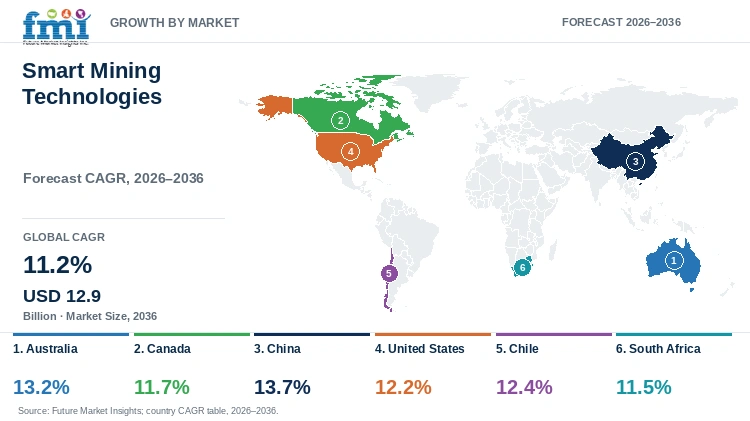
Table 6: Country CAGR Comparison for Smart Mining Technologies Market (CAGR percentage), 2026 to 2036
| Country | CAGR |
|---|---|
| Australia | 13.2% |
| Canada | 11.7% |
| China | 13.7% |
| United States | 12.2% |
| Chile | 12.4% |
| South Africa | 11.5% |
Country-wise Analysis
Australia Smart Mining Technologies Market Outlook (2026 to 2036)
CSIRO's Australian work describes underground fibre-optic sensing, data-informed mining decisions and mobile mission-control concepts, bringing attention to the link between information collection and operating action. [2] This creates a technical setting in which a mine can assess which condition needs to be measured and how personnel will use the result. Suppliers can address that opportunity by connecting sensing and control proposals with the site's communications and maintenance arrangements, particularly where an underground installation must remain usable as work progresses. The commercial value includes the ability to support the system beyond demonstration, with clear responsibilities for interpreting information and responding when the measured conditions require a change in operations.
Canada Smart Mining Technologies Market Outlook (2026 to 2036)
Canadian mining research applies AI to understanding energy use in electric mining vehicles and examines battery behaviour under demanding underground conditions. [3] This gives the country profile a specific data-and-equipment setting, where the usefulness of an analytical system depends on the conditions represented in its inputs. A mine considering related technology needs to connect the information produced with its operating and maintenance decisions, including how staff assess equipment performance over time. Suppliers can make that relationship more useful through clear integration and support arrangements, allowing the customer to compare an emerging capability with the requirements of its own vehicles, environment and production schedule.
China Smart Mining Technologies Market Outlook (2026 to 2036)
China's National Energy Administration selected 77 coal-mine intelligent-technology upgrade pilots, with owners required to quantify targets and complete expert acceptance. The programme generally allows a construction period of up to three years. [1] These requirements make project delivery and acceptance meaningful parts of the technology demand pipeline. Suppliers serving such projects need to establish how their systems fit the selected mine and which operating results will be assessed, particularly when several equipment and software packages form part of one upgrade. Clear interfaces, commissioning plans and continuing support can strengthen the commercial offer by connecting the proposed capability with a system the mine can use and maintain after acceptance.
United States Smart Mining Technologies Market Outlook (2026 to 2036)
US mines evaluating automation need a proposal that identifies the equipment and operating task involved, because a useful control arrangement must fit the site's existing machinery and responsibility structure. Mixed-fleet compatibility is one practical part of that assessment, with Epiroc describing automation that can accommodate machines from different manufacturers. [4] Buyers can compare the integration work needed for their own fleet with the support and information available to operating personnel, rather than treating a single automation demonstration as a complete site design. Suppliers that make those continuing responsibilities clear can support selective upgrades, particularly where the customer expects to retain serviceable equipment while extending its connected operating capabilities.
Chile Smart Mining Technologies Market Outlook (2026 to 2036)
Chile's surface-mine purchasing scenario places remote-operation systems within a wider arrangement for moving material and maintaining equipment across the site. A buyer needs to establish which task will change, how the control information reaches the operating team and how support will be provided when conditions or machinery change. Mixed equipment fleets can make interface compatibility commercially important, so the proposal should identify the integration and commissioning work needed for the actual operation. Suppliers can improve their position through a clear transition plan and continuing technical support, helping the mine introduce connected capabilities while preserving understandable responsibility for the work performed by people and equipment throughout the operating area.
South Africa Smart Mining Technologies Market Outlook (2026 to 2036)
South African mine buyers considering connected monitoring or safety-related information systems need a defined response process alongside the measurement capability. The commercial task concerns how information reaches the responsible personnel, what action it supports and how the system remains usable as the working environment changes. Suppliers can address that opportunity by connecting the proposed sensors and software with the mine's existing communications, maintenance and operating procedures, particularly where several teams depend on the same information. Clear training and support arrangements help preserve that connection after commissioning, while an agreed acceptance process allows the buyer to assess the completed installation against the task for which it was purchased.
Who are the notable companies in the Smart Mining Technologies Market?
Caterpillar; Komatsu; Sandvik; Epiroc; Hexagon
Smart-mining suppliers bring equipment, automation and site information into operating decisions that vary between mines. Caterpillar, Komatsu, Sandvik and Epiroc contribute machinery and control capabilities, while Hexagon participates through sensing and software. A mine compares the proposal against its installed fleet, communications and working conditions, with commissioning and continuing support shaping the value of the system.
Competitive Benchmarking: Smart Mining Technologies Market
Table 7: Competitive positioning for the smart mining technologies market
| Company | Positioning | Commercial distinction |
|---|---|---|
| Caterpillar | Mining equipment and automation | Machine-linked operating scope |
| Komatsu | Mining equipment and remote systems | Equipment integration and site support |
| Sandvik | Underground equipment and automation | Task-specific deployment and acceptance |
| Epiroc | Mining equipment and connected systems | Operating integration and maintenance |
| Hexagon | Mining sensing and software | Measurement-to-decision workflow |
Key Developments in the Smart Mining Technologies Market
- National Energy Administration (2026-02-09): NEA selected 77 coal-mine intelligent-technology upgrade pilot projects following applications and expert review. [1]
- CSIRO (2025-04-01): CSIRO described underground fibre-optic sensing, data-informed mining decisions and mobile mission-control-centre research. [2]
Key Players in the Smart Mining Technologies Market
Mining equipment and automation
- Caterpillar
Mining equipment and remote systems
- Komatsu
Underground equipment and automation
- Sandvik
Mining equipment and connected systems
- Epiroc
Mining sensing and software
- Hexagon
Smart Mining Technologies Market Report Scope
Table 8: Report Scope for Smart Mining Technologies Market, 2026 to 2036
| Coverage field | Report scope |
|---|---|
| Market definition | The market covers mine-specific automation and remote operations together with connected safety, monitoring and optimisation. Mineral output is not itself a measure of technology adoption. |
| Quantitative units | USD billion |
| Historical reference year | 2025 |
| Forecast period | 2026 to 2036 |
| Market breakdown | Technology Solution; Application; Region |
| Countries profiled | Australia; Canada; China; United States; Chile; South Africa |
| Regions covered | North America; Latin America; Western Europe; Eastern Europe; East Asia; South Asia and Pacific; Middle East and Africa |
| Key companies profiled | Caterpillar; Komatsu; Sandvik; Epiroc; Hexagon |
Smart Mining Technologies Market Research Methodology
Table 9: Research Methodology for Smart Mining Technologies Market, 2026 edition
| Method | Approach |
|---|---|
| Market definition | The market covers mine-specific automation and remote operations together with connected safety, monitoring and optimisation. Mineral output is not itself a measure of technology adoption. |
| Secondary research | Public institutional reports, regulator publications, technical literature and supplier documentation provide the operating context for the market. |
| Quantitative coverage | Market values are expressed in USD billion, with a 2025 base value, a 2026 estimate and a projection for 2036. |
| Segment and country assessment | Segment categories retain distinct demand measures, while each country profile is linked with its estimated CAGR for 2026 to 2036. |
| Company comparison | Representative participants are compared by the product or service offered, the customer application and the implementation requirements relevant to procurement. |
Smart Mining Technologies Market by Segments
Smart Mining Technologies Market segmented by Technology Solution:
- AI/ML-enabled Supply Chain Management
- Mining Analytics Platform
- Blockchain-based Metal Trading Platform
- Emissions Management Software
- Others
Smart Mining Technologies Market segmented by Application:
- Mining Operations & Process Control
- Risk & Compliance Management
- Mining Data Warehousing
- Others
Smart Mining Technologies Market by Region
- North America
- United States
- Canada
- Latin America
- Chile
- Brazil
- Mexico
- Argentina
- Western Europe
- Germany
- France
- United Kingdom
- Italy
- Spain
- Benelux
- Nordics
- Eastern Europe
- Poland
- Czech Republic
- Romania
- Hungary
- East Asia
- China
- Japan
- South Korea
- South Asia and Pacific
- Australia
- India
- ASEAN
- New Zealand
- Middle East and Africa
- South Africa
- GCC Countries
- Türkiye
- Israel
Research Sources and Bibliography
- [1] National Energy Administration. 2026-02-09. Coal-mine intelligent-technology upgrade pilot list
- [2] CSIRO. 2025-04-01. Smart solutions for sustainable mining: next-generation researchers
- [3] Natural Resources Canada. Accessed 16 October 2026. How Artificial Intelligence is helping scientists understand energy use in electric mining vehicles
- [4] Epiroc. Accessed 16 October 2026. AUTOMATE: Agnostic machine automation
This Report Answers
- How large is the Smart Mining Technologies Market in 2026?
- What is the growth outlook for the Smart Mining Technologies Market through 2036?
- What is the 2026 share of AI/ML-enabled Supply Chain Management?
- What is the 2026 share of Mining Operations & Process Control?
- Which profiled market has the highest projected growth?
- Who are the notable participants in the Smart Mining Technologies Market?
Frequently Asked Questions
How large is the Smart Mining Technologies Market in 2026?
The market is estimated at USD 4.45 billion in 2026, compared with USD 4 billion in 2025.
What is the growth outlook for the Smart Mining Technologies Market through 2036?
The market is projected to reach USD 12.9 billion by 2036, representing a CAGR of 11.23% from 2026 to 2036.
What is the 2026 share of AI/ML-enabled Supply Chain Management?
The AI/ML-enabled Supply Chain Management segment is estimated to account for 31.8% of technology solution demand in 2026. A usable connection between materials, equipment and operating plans supports the supply-chain software purchase.
What is the 2026 share of Mining Operations & Process Control?
The Mining Operations & Process Control segment is estimated to account for 38.6% of application demand in 2026. Equipment compatibility and site-level acceptance connect an automation proposal with dependable operating control.
Which profiled market has the highest projected growth?
China has the highest projected rate among the markets profiled, at 13.7% CAGR from 2026 to 2036.
Who are the notable participants in the Smart Mining Technologies Market?
Representative participants include Caterpillar, Komatsu, Sandvik, Epiroc, Hexagon.
Preview the report firsthand - request a free sample
Get SampleGet the brochure for pricing and purchase details.
Get PDFTable of Content
- Key Takeaways
- Market Size and CAGR
- Top Growth Driver
- Fastest Growing Segment
- Leading Region
- Key Companies
- Emerging Opportunities
- Executive Summary
- Global Market Outlook
- Demand-side Trends
- Supply-side Trends
- Technology Roadmap Analysis
- Analysis and Recommendations
- Analyst Perspective (What is happening? Why now? What should investors know?)
- Key Questions Answered
- How large is the market?
- What is the CAGR?
- What are key trends?
- Which region dominates?
- Who are the leaders?
- Market Overview
- Market Coverage / Taxonomy
- Market Definition / Scope / Limitations
- Research Methodology
- Chapter Orientation
- Analytical Lens and Working Hypotheses
- Market Structure, Signals, and Trend Drivers
- Benchmarking and Cross-market Comparability
- Market Sizing, Forecasting, and Opportunity Mapping
- Research Design and Evidence Framework
- Desk Research Programme (Secondary Evidence)
- Expert Input and Fieldwork (Primary Evidence)
- Tooling, Models, and Reference Databases
- Data Engineering and Model Build
- Quality Assurance and Audit Trail
- Market Background
- Market Dynamics (Drivers, Restraints, Opportunity, Trends)
- Scenario Forecast (Optimistic, Likely, Conservative)
- Impact Analysis
- AI Impact
- Sustainability Impact
- Regulatory Impact
- Technology Impact
- Consumer / Buyer Analysis
- Purchase Drivers
- Adoption Barriers
- Buyer Journey
- Opportunity Map Analysis
- Product Life Cycle Analysis
- Supply Chain Analysis
- Investment Feasibility Matrix
- Value Chain Analysis
- PESTLE and Porter's Analysis
- Regulatory Landscape
- Regional Parent Market Outlook
- Production and Consumption Statistics
- Import and Export Statistics
- Global Market Analysis and Forecast, 2021 to 2036
- Historical Market Size Value (USD Billion) Analysis, 2021 to 2025
- Current and Future Market Size Value (USD Billion) Projections, 2026 to 2036
- Y-o-Y Growth Trend Analysis
- Absolute $ Opportunity Analysis
- Global Market Pricing Analysis, 2021 to 2036
- Global Market Analysis and Forecast, By Technology Solution, 2021 to 2036
- Introduction / Key Findings
- Historical Market Size Value (USD Billion) Analysis By Technology Solution, 2021 to 2025
- Current and Future Market Size Value (USD Billion) Analysis and Forecast By Technology Solution, 2026 to 2036
- AI/ML-enabled Supply Chain Management
- Mining Analytics Platform
- Blockchain-based Metal Trading Platform
- Emissions Management Software
- Others
- Y-o-Y Growth Trend Analysis By Technology Solution, 2021 to 2025
- Absolute $ Opportunity Analysis By Technology Solution, 2026 to 2036
- Global Market Analysis and Forecast, By Application, 2021 to 2036
- Introduction / Key Findings
- Historical Market Size Value (USD Billion) Analysis By Application, 2021 to 2025
- Current and Future Market Size Value (USD Billion) Analysis and Forecast By Application, 2026 to 2036
- Mining Operations & Process Control
- Risk & Compliance Management
- Mining Data Warehousing
- Others
- Y-o-Y Growth Trend Analysis By Application, 2021 to 2025
- Absolute $ Opportunity Analysis By Application, 2026 to 2036
- Global Market Analysis and Forecast, By Region, 2021 to 2036
- Introduction
- Historical Market Size Value (USD Billion) Analysis By Region, 2021 to 2025
- Current Market Size Value (USD Billion) Analysis and Forecast By Region, 2026 to 2036
- North America
- Latin America
- Western Europe
- Eastern Europe
- East Asia
- South Asia and Pacific
- Middle East and Africa
- Market Attractiveness Analysis By Region
- North America Market Analysis and Forecast, By Country, 2021 to 2036
- Historical Market Size Value (USD Billion) Trend Analysis By Market Taxonomy, 2021 to 2025
- Market Size Value (USD Billion) Forecast By Market Taxonomy, 2026 to 2036
- By Country
- United States
- Canada
- By Technology Solution
- By Application
- By Country
- Market Attractiveness Analysis
- By Country
- By Technology Solution
- By Application
- Key Takeaways
- Latin America Market Analysis and Forecast, By Country
- Historical Market Size Value (USD Billion) Trend Analysis By Market Taxonomy, 2021 to 2025
- Market Size Value (USD Billion) Forecast By Market Taxonomy, 2026 to 2036
- By Country
- Chile
- Brazil
- Mexico
- Argentina
- By Technology Solution
- By Application
- By Country
- Market Attractiveness Analysis
- By Country
- By Technology Solution
- By Application
- Key Takeaways
- Western Europe Market Analysis and Forecast, By Country
- Historical Market Size Value (USD Billion) Trend Analysis By Market Taxonomy, 2021 to 2025
- Market Size Value (USD Billion) Forecast By Market Taxonomy, 2026 to 2036
- By Country
- Germany
- France
- United Kingdom
- Italy
- Spain
- Benelux
- Nordics
- By Technology Solution
- By Application
- By Country
- Market Attractiveness Analysis
- By Country
- By Technology Solution
- By Application
- Key Takeaways
- Eastern Europe Market Analysis and Forecast, By Country
- Historical Market Size Value (USD Billion) Trend Analysis By Market Taxonomy, 2021 to 2025
- Market Size Value (USD Billion) Forecast By Market Taxonomy, 2026 to 2036
- By Country
- Poland
- Czech Republic
- Romania
- Hungary
- By Technology Solution
- By Application
- By Country
- Market Attractiveness Analysis
- By Country
- By Technology Solution
- By Application
- Key Takeaways
- East Asia Market Analysis and Forecast, By Country
- Historical Market Size Value (USD Billion) Trend Analysis By Market Taxonomy, 2021 to 2025
- Market Size Value (USD Billion) Forecast By Market Taxonomy, 2026 to 2036
- By Country
- China
- Japan
- South Korea
- By Technology Solution
- By Application
- By Country
- Market Attractiveness Analysis
- By Country
- By Technology Solution
- By Application
- Key Takeaways
- South Asia and Pacific Market Analysis and Forecast, By Country
- Historical Market Size Value (USD Billion) Trend Analysis By Market Taxonomy, 2021 to 2025
- Market Size Value (USD Billion) Forecast By Market Taxonomy, 2026 to 2036
- By Country
- Australia
- India
- ASEAN
- New Zealand
- By Technology Solution
- By Application
- By Country
- Market Attractiveness Analysis
- By Country
- By Technology Solution
- By Application
- Key Takeaways
- Middle East and Africa Market Analysis and Forecast, By Country
- Historical Market Size Value (USD Billion) Trend Analysis By Market Taxonomy, 2021 to 2025
- Market Size Value (USD Billion) Forecast By Market Taxonomy, 2026 to 2036
- By Country
- South Africa
- GCC Countries
- Türkiye
- Israel
- By Technology Solution
- By Application
- By Country
- Market Attractiveness Analysis
- By Country
- By Technology Solution
- By Application
- Key Takeaways
- Key Countries Market Analysis
- United States
- Pricing Analysis
- Market Share Analysis, 2025
- By Technology Solution
- By Application
- Canada
- Pricing Analysis
- Market Share Analysis, 2025
- By Technology Solution
- By Application
- Mexico
- Pricing Analysis
- Market Share Analysis, 2025
- By Technology Solution
- By Application
- Brazil
- Pricing Analysis
- Market Share Analysis, 2025
- By Technology Solution
- By Application
- Chile
- Pricing Analysis
- Market Share Analysis, 2025
- By Technology Solution
- By Application
- Germany
- Pricing Analysis
- Market Share Analysis, 2025
- By Technology Solution
- By Application
- United Kingdom
- Pricing Analysis
- Market Share Analysis, 2025
- By Technology Solution
- By Application
- Italy
- Pricing Analysis
- Market Share Analysis, 2025
- By Technology Solution
- By Application
- Spain
- Pricing Analysis
- Market Share Analysis, 2025
- By Technology Solution
- By Application
- France
- Pricing Analysis
- Market Share Analysis, 2025
- By Technology Solution
- By Application
- India
- Pricing Analysis
- Market Share Analysis, 2025
- By Technology Solution
- By Application
- ASEAN
- Pricing Analysis
- Market Share Analysis, 2025
- By Technology Solution
- By Application
- China
- Pricing Analysis
- Market Share Analysis, 2025
- By Technology Solution
- By Application
- Japan
- Pricing Analysis
- Market Share Analysis, 2025
- By Technology Solution
- By Application
- South Korea
- Pricing Analysis
- Market Share Analysis, 2025
- By Technology Solution
- By Application
- Poland
- Pricing Analysis
- Market Share Analysis, 2025
- By Technology Solution
- By Application
- Hungary
- Pricing Analysis
- Market Share Analysis, 2025
- By Technology Solution
- By Application
- Türkiye
- Pricing Analysis
- Market Share Analysis, 2025
- By Technology Solution
- By Application
- South Africa
- Pricing Analysis
- Market Share Analysis, 2025
- By Technology Solution
- By Application
- Australia
- Pricing Analysis
- Market Share Analysis, 2025
- By Technology Solution
- By Application
- United States
- Market Structure Analysis
- Competition Dashboard
- Competition Benchmarking
- Market Share Analysis of Top Players
- By Regional
- By Technology Solution
- By Application
- Emerging Startups
- Innovation Benchmarking
- Competition Analysis
- Competition Deep Dive
- Caterpillar
- Overview
- Product Portfolio
- Profitability by Market Segments
- Sales Footprint
- Strategy Overview
- Marketing Strategy
- Product Strategy
- Channel Strategy
- Komatsu
- Sandvik
- Epiroc
- Hexagon
- Caterpillar
- Case Studies
- Success Stories
- Recent Developments
- Competition Deep Dive
- Assumptions & Acronyms Used


