


Key Takeaways
- Flat panel display pricing is dominated by yield rates and manufacturing complexity rather than raw material costs alone, with OLED panels carrying production costs 2.5 times higher than equivalent LCD panels due to lower yields and higher depreciation expenses.
- Manufacturing has shifted from simple glass substrate assembly to complex multi-layer deposition processes requiring specialized clean rooms, precision lithography equipment, and sophisticated yield management systems that favor large-scale producers.
- The real margin capture happens in three distinct layers: premium panel technologies where Samsung and LG Display control proprietary processes, supply chain orchestration that locks in component pricing advantages, and brand positioning that justifies higher selling prices despite comparable hardware specifications.
- Chinese manufacturers like BOE and TCL CSOT have proven that display performance parity is achievable at lower price points through government subsidies, vertical integration of glass substrates, and aggressive capacity expansion that spreads fixed costs across larger production volumes.
- Supply chain disruptions have fundamentally altered display cost structures, with glass substrate shortages and rare earth material constraints creating pricing pressure that flows through every application category from smartphones to large-format televisions.
Why do premium display panels cost more than their material bills suggest?
Flat panel display manufacturing represents one of the most capital-intensive and technically complex processes in modern electronics production. Unlike consumer electronics assembly, display fabrication requires semiconductor-grade clean rooms, precision deposition equipment, and quality control systems that dwarf the visible material costs.
The component stack reveals where costs actually accumulate beyond basic materials. Glass substrates from suppliers like Corning, AGC, and SCHOTT typically represent a significant portion of material costs, but specialized substrates for OLED production command premium pricing due to lower thermal expansion requirements and higher purity standards needed for organic material deposition.
Manufacturing complexity extends far beyond substrate preparation. OLED production involves organic material evaporation processes that require ultra-high vacuum chambers, precision shadow masks, and controlled atmospheric conditions throughout multiple deposition stages. Each layer must be deposited with nanometer-level precision while maintaining material purity that prevents contamination-induced defects.
The yield challenge creates cascading cost effects throughout the production system. According to industry analysis, Samsung's QD-OLED production achieved only 68% yield rates in 2022 for 65-inch panels, though this improved to 84% by 2023. Every failed panel represents not just wasted materials but also consumed clean room capacity, equipment time, and skilled technician labor that must be amortized across successful units.
Depreciation costs form another substantial hidden expense. State-of-the-art OLED fabrication lines require investments approaching half a billion dollars per facility, with equipment that becomes obsolete within 5-7 years as display technologies evolve. These depreciation expenses must be recovered through panel pricing regardless of material cost fluctuations.
Where do Chinese manufacturers actually achieve cost advantages?
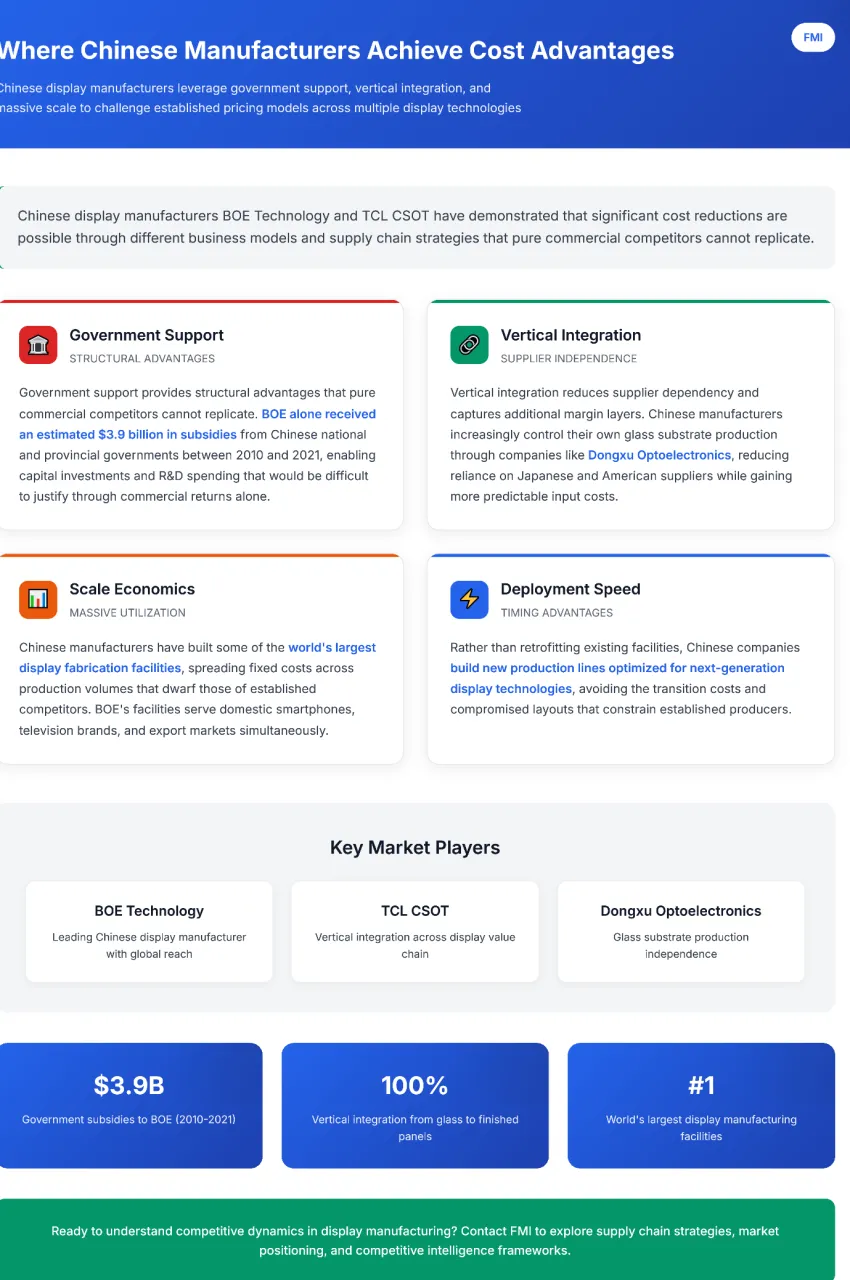
Chinese display manufacturers have demonstrated that significant cost reductions are possible through different business models and supply chain strategies. BOE Technology and TCL CSOT have leveraged government subsidies, vertical integration, and massive scale investments to challenge established pricing models across multiple display technologies.
Government support provides Chinese manufacturers with structural advantages that pure commercial competitors cannot replicate. BOE alone received an estimated $3.9 billion in subsidies from Chinese national and provincial governments between 2010 and 2021, enabling capital investments and R&D spending that would be difficult to justify through commercial returns alone.
Vertical integration reduces supplier dependency and captures additional margin layers. Chinese manufacturers increasingly control their own glass substrate production through companies like Dongxu Optoelectronics, reducing reliance on Japanese and American suppliers while gaining more predictable input costs. This integration extends to specialized chemicals, cleaning equipment, and even fabrication machinery through partnerships with Korean equipment suppliers.
Scale economics enable better utilization of expensive fabrication equipment. Chinese manufacturers have built some of the world's largest display fabrication facilities, spreading fixed costs across production volumes that dwarf those of established competitors. BOE's facilities produce panels for domestic smartphone manufacturers, television brands, and export markets simultaneously, achieving utilization rates that justify continued capacity expansion.
The speed of capacity deployment gives Chinese manufacturers timing advantages in emerging technologies. Rather than retrofitting existing facilities, Chinese companies build new production lines optimized for next-generation display technologies, avoiding the transition costs and compromised layouts that constrain established producers.
How do material costs and supply chain disruptions actually impact pricing?
Raw materials represent a smaller portion of total display costs than commonly assumed, but supply chain disruptions create pricing volatility that affects the entire industry structure. Glass substrates, rare earth materials for phosphors, and specialized chemicals each contribute to cost uncertainty that manufacturers must manage through inventory strategies and supplier relationships.
Glass substrate availability has become a critical bottleneck, particularly for advanced display technologies. LTPS glass substrates required for OLED production face supply constraints as demand outpaces the capacity expansion of established suppliers. This shortage forces Chinese manufacturers to qualify domestic suppliers like Dongxu, accepting quality compromises in exchange for supply security.
Energy costs significantly impact display manufacturing economics, particularly for processes requiring high-temperature deposition and continuous clean room operation. Glass manufacturing and substrate preparation consume substantial energy, making fabrication facilities sensitive to electricity pricing and availability. Recent energy cost inflation has placed major display glass manufacturers in challenging financial positions.
Logistics constraints compound material cost pressures. Display panels are fragile, bulky products that require specialized packaging and transportation. International shipping disruptions directly impact landed costs, while the weight and size of large display panels make regional production increasingly attractive despite higher labor costs.
Component standardization reduces some supply chain risks while creating others. Standardized backlight systems, driver chips, and interface components enable multiple sourcing but also expose manufacturers to industry-wide shortages when key components become constrained.
Sources
- Office of Technology Assessment. Flat Panel Displays in Perspective: Building USA Capabilities in Flat Panel Displays. Washington, DC: USA Government Printing Office, 1995.
- Display Supply Chain Consultants. OLED Display Cost Model: Manufacturing Cost Analysis and Forecasts of OLED Display Panels. Various industry reports and cost analysis studies.
- Omdia. Display Manufacturing, Technology & Components: OLED Display Cost Model. Technical analysis and production cost forecasting for display technologies.
- IHS Markit. Manufacturing Cost Analysis by Display Technology. Semiconductor and display industry cost structure analysis.
- University of Cambridge. Solution-Processed OLED Research and Commercial Applications. Academic research on OLED manufacturing processes and cost optimization.
- Seoul National University Institute for Industrial Systems Innovation. Lot-sizing and Scheduling in Flat-Panel Display Manufacturing Process. Industrial engineering analysis of display production optimization.
- Information Technology and Innovation Foundation. How Innovative Is China in the Display Industry? Policy analysis of Chinese display industry development and innovation capabilities.

