


Key Takeaways
- Natural food colour pricing is dominated by complex extraction processes and agricultural raw material costs rather than simple commodity pricing, with production costs running several times higher than synthetic alternatives according to UN Food and Agriculture Organization data.
- The real margin capture happens in three distinct layers: proprietary extraction technologies where established players like Sensient and Chr. Hansen control advanced processing methods, agricultural supply chain management that locks in raw material pricing, and application-specific formulations that create switching costs for food manufacturers.
- Manufacturing has shifted from simple botanical extraction to sophisticated processing involving microencapsulation, pH stabilization, and heat resistance enhancement, making thermal management and shelf stability critical cost drivers beyond raw material prices.
- Chinese and Indian manufacturers have disrupted traditional pricing models by controlling integrated supply chains from cultivation to extraction, yet premium brands maintain market position through superior stability technologies and regulatory compliance capabilities.
- Supply chain vulnerabilities create structural cost pressures as natural colours depend on seasonal agricultural cycles, with beetroot, turmeric, and spirulina yields fluctuating substantially due to weather conditions and climate factors.
- The cost differential between natural and synthetic colours persists despite technological advances, with natural colorants requiring higher usage levels due to lower pigment concentrations and reduced stability under processing conditions.
Why do natural food colours cost more than their raw material bills suggest?
Natural food colour production represents a convergence of agricultural commodity trading, specialized extraction chemistry, and food technology engineering. Unlike synthetic dyes manufactured from petrochemical feedstocks in predictable quantities, natural colours require complex processing chains that begin with agricultural raw materials containing minimal actual pigment content.
The extraction process reveals where costs actually accumulate. Beetroot processing for red pigments involves washing, crushing, filtration, concentration, and stabilization steps that can extend over several days. Turmeric extraction for curcumin requires specialized solvents, temperature control, and purification stages to remove flavors and odors while preserving color intensity. Spirulina processing for blue pigments demands controlled drying, cell disruption, and protein separation to isolate phycocyanin compounds.
Sensient Technologies and Chr. Hansen have built competitive advantages through proprietary extraction technologies that improve yield and stability. Their specialized equipment configurations, processing parameters, and stabilization methods create barriers to entry that smaller manufacturers cannot easily replicate. These companies can achieve higher pigment concentrations and better shelf stability, justifying premium pricing despite using similar raw materials as commodity producers.
The integration challenge extends beyond extraction equipment. Natural colours require specialized storage conditions, cold chain logistics, and technical support for food manufacturers implementing these ingredients. Each application demands specific pH tolerance, heat stability, and light resistance characteristics that drive formulation complexity and technical service costs.
Where do supply chain dependencies create pricing volatility?
Agricultural dependencies fundamentally differentiate natural food colours from synthetic alternatives. While synthetic dyes benefit from stable petrochemical feedstock pricing and consistent manufacturing conditions, natural colours face seasonal availability, crop quality variations, and climate-related supply disruptions that compound throughout the processing chain.
Turmeric cultivation in India, the world's largest supplier, faces monsoon dependency, soil quality variations, and curcumin content differences across growing regions. Poor weather conditions can reduce curcumin yields substantially, forcing extractors to increase raw material usage or accept lower final product concentrations. Similar vulnerabilities affect beetroot production in Europe, spirulina cultivation in Asia, and annatto harvesting in South America.
The processing bottleneck amplifies raw material volatility. Natural colour extraction facilities require substantial fixed investments in specialized equipment, yet they must adjust production volumes based on seasonal raw material availability. Unlike synthetic manufacturing plants that operate at consistent capacity year-round, natural colour processors face utilization fluctuations that increase per-unit overhead costs during low availability periods.
Regulatory compliance adds another complexity layer. Natural colours must meet food safety standards, organic certifications, and regional regulatory requirements that vary by destination market. These compliance costs remain relatively fixed regardless of production volume, creating economies of scale that favor large, established processors over smaller regional players.
How are established players maintaining margin control despite cost pressures?
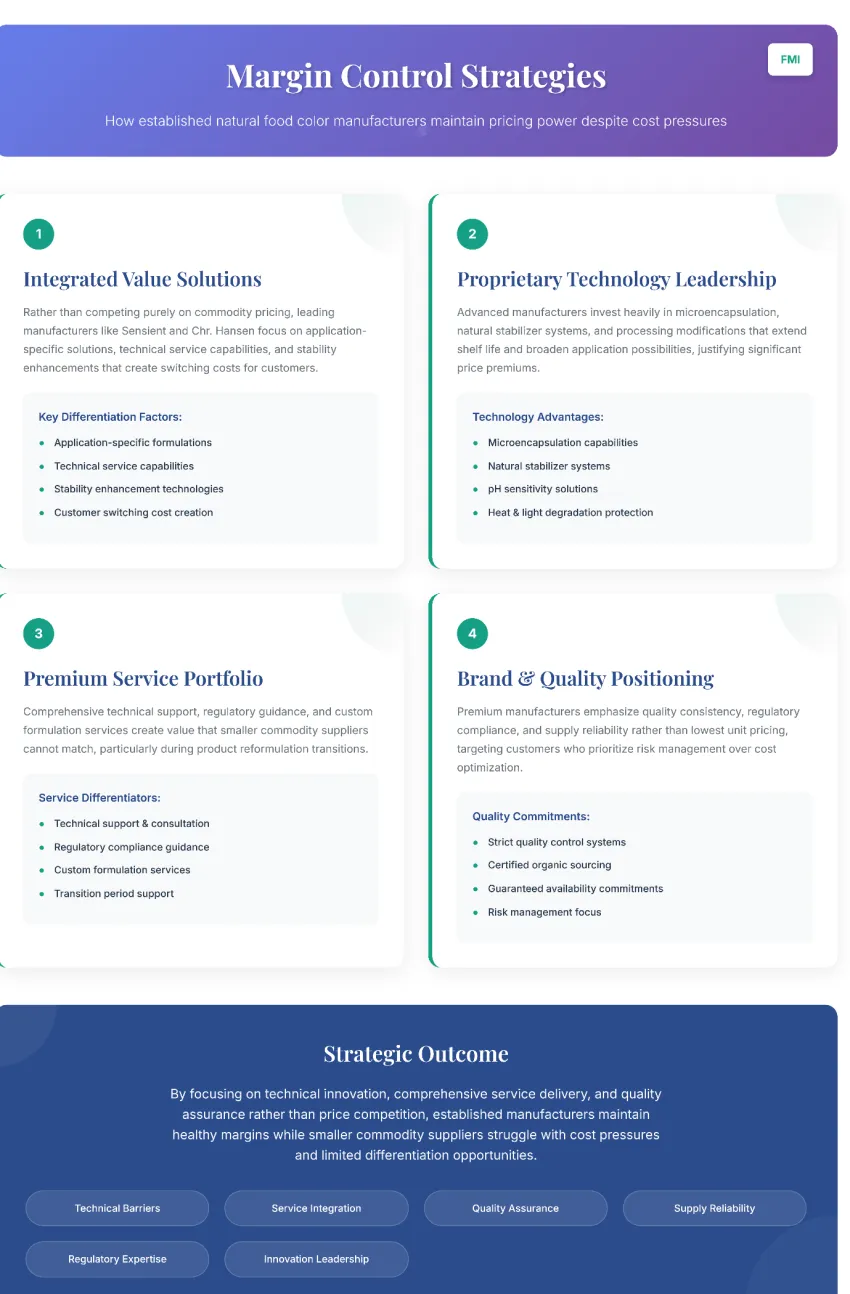
Major natural food colour manufacturers have developed integrated strategies that capture value beyond simple extraction processing. Rather than competing purely on commodity pricing, companies like Sensient and Chr. Hansen focus on application-specific solutions, technical service capabilities, and stability enhancements that create switching costs for customers.
Proprietary stabilization technologies represent a key differentiation mechanism. Traditional natural colours suffer from pH sensitivity, light degradation, and heat instability that limit their application range. Advanced manufacturers invest heavily in microencapsulation, natural stabilizer systems, and processing modifications that extend shelf life and broaden application possibilities. These improvements justify significant price premiums while creating technical barriers for competitors.
Customer relationship management provides another margin protection strategy. Established suppliers offer comprehensive technical support, regulatory guidance, and custom formulation services that smaller commodity suppliers cannot match. Food manufacturers value these services particularly when reformulating products to replace synthetic colours, creating opportunities for premium pricing during transition periods.
Brand positioning strategies emphasize quality consistency, regulatory compliance, and supply reliability rather than lowest unit pricing. Premium manufacturers maintain strict quality control systems, certified organic sourcing, and guaranteed availability commitments that justify higher prices for customers prioritizing risk management over cost optimization.
Where does extraction technology create competitive advantages?
The shift from traditional extraction methods to advanced processing technologies has created a two-tier market structure where technology leaders capture disproportionate value while commodity processors compete on volume and price. Advanced extraction techniques enable higher yields, improved stability, and expanded application ranges that translate directly into pricing power.
Supercritical fluid extraction represents one technological advancement that differentiates premium suppliers. This process uses pressurized carbon dioxide to extract pigments without harsh solvents, resulting in cleaner flavor profiles and improved stability characteristics. The equipment investment and technical expertise required limit this capability to larger manufacturers, creating natural barriers to competitive entry.
Fermentation-based production offers another technological differentiation opportunity. Instead of extracting pigments from agricultural crops, advanced manufacturers use controlled fermentation processes to produce natural colours from microorganisms. This approach reduces agricultural dependency, improves consistency, and enables year-round production at predictable costs. Companies investing in biotechnology capabilities position themselves advantageously as this technology matures.
Microencapsulation and stabilization systems provide immediate commercial advantages. Natural colours traditionally suffer from degradation under food processing conditions, limiting their application range and requiring higher usage levels to maintain color intensity throughout product shelf life. Manufacturers developing effective stabilization systems can offer lower usage rates and broader application compatibility, creating compelling value propositions for customers.
What this means for natural food colour competitive positioning?
The cost structure analysis reveals that successful natural food colour manufacturers must choose between volume-focused commodity strategies and value-added technology differentiation. Pure extraction processing leads to margin compression as agricultural costs become transparent and basic processing methods commoditize.
Technology-focused strategies emphasize stability improvements, application-specific formulations, and customer service capabilities that justify premium pricing. These approaches require substantial investments in research and development, specialized equipment, and technical support capabilities that create sustainable competitive advantages.
The processing architecture decision becomes critical for long-term competitiveness. Companies building around standard extraction methods benefit from lower capital requirements but face intense price competition. Those investing in proprietary processing technologies, fermentation capabilities, and stabilization systems must justify additional development costs through superior performance and market positioning.
Sources
- United Nations Food and Agriculture Organization. Global food commodity prices and natural ingredient production costs analysis.
- USA Department of Agriculture. Agricultural statistics and weather-dependent crop yield variations for color-producing plants.
- European Food Safety Authority. Natural food colorant stability testing requirements and performance documentation.
- International Food Information Council. Consumer preferences and purchasing decisions regarding natural versus synthetic food ingredients.
- Environmental Protection Agency. Resource consumption analysis for natural color extraction processes versus synthetic color production methods.

