


Key Takeaways
- Smart camera pricing is dominated by sensor technology and processing power rather than housing and optics.
- Manufacturing has shifted from simple assembly to complex integration of image signal processors, AI accelerators, and edge computing capabilities, making thermal management and power efficiency critical cost drivers beyond raw component prices.
- The real margin capture happens in three distinct layers: sensor technology where Sony and Samsung dominate with proprietary CMOS innovations, processing architectures where ARM, NVIDIA, and Intel compete for AI workloads, and system integration where companies like Hikvision and Bosch control complete solution stacks.
- Chinese manufacturers have proven that hardware parity is achievable through standardized ARM processors and commercial CMOS sensors, but differentiation increasingly depends on software algorithms, AI model optimization, and edge processing capabilities rather than hardware specifications alone.
- Supply chain disruptions have fundamentally altered smart camera cost structures, with semiconductor shortages creating pricing pressure that flows through every application category from industrial machine vision to security surveillance systems.
Why do industrial smart cameras cost more than their sensor and processor bills suggest?
Smart cameras represent a convergence of multiple high-value technologies packaged into ruggedized industrial housings. Unlike consumer cameras optimized for volume production, industrial smart cameras must integrate machine vision software, real-time processing capabilities, and specialized interfaces for factory automation systems.
The component stack reveals where costs actually accumulate. CMOS image sensors from Sony, Samsung, or OmniVision typically represent the largest single cost element, with industrial-grade sensors commanding premium pricing for features like global shutters, extended temperature ranges, and specialized spectral responses. Sony's IMX series sensors, designed specifically for machine vision applications, can cost several times more than consumer-grade equivalents due to lower volumes and higher performance requirements.
Processing architecture forms the second major cost bucket. ARM Cortex-A processors running at gigahertz speeds have become standard for edge AI processing, with manufacturers selecting from Texas Instruments' AM62x series, NVIDIA's Jetson platform, or NXP's i.MX processors based on computational requirements. These processors must handle not just image capture but real-time analysis, pattern recognition, and communication with factory control systems.
The integration challenge extends beyond component selection. Smart cameras require specialized image signal processors, dedicated memory for frame buffering, industrial communication interfaces like GigE Vision or Camera Link, and ruggedized housings designed for harsh manufacturing environments. Each layer adds engineering complexity and manufacturing costs that pure component analysis misses.
Where do processing bottlenecks actually drive smart camera pricing?
Edge computing requirements have fundamentally altered smart camera architectures. Traditional machine vision systems relied on external computers for image processing, but modern smart cameras must perform complex algorithms locally to meet real-time performance requirements in industrial applications.
ARM-based processors have emerged as the dominant architecture for smart camera processing. Companies like Texas Instruments offer AM6xA vision processors specifically designed for camera applications, integrating ARM Cortex-A cores with dedicated image signal processors and AI acceleration units. These processors can handle multiple camera streams simultaneously while running machine learning models for defect detection or quality control.
The computational demands vary dramatically by application. Simple presence detection might require only basic ARM Cortex-M microcontrollers, while complex machine vision applications demand multi-core Cortex-A processors paired with neural processing units. NVIDIA's Jetson platform has gained traction in high-end applications requiring GPU acceleration for deep learning inference, but at significantly higher cost and power consumption.
Processing bottlenecks create cascading cost effects throughout the system. Higher computational requirements drive memory specifications, thermal management complexity, and power supply design. Smart cameras running AI inference models require fast DDR4 memory, active cooling systems, and power delivery circuits capable of handling variable computational loads.
How are Chinese manufacturers disrupting traditional smart camera pricing models?
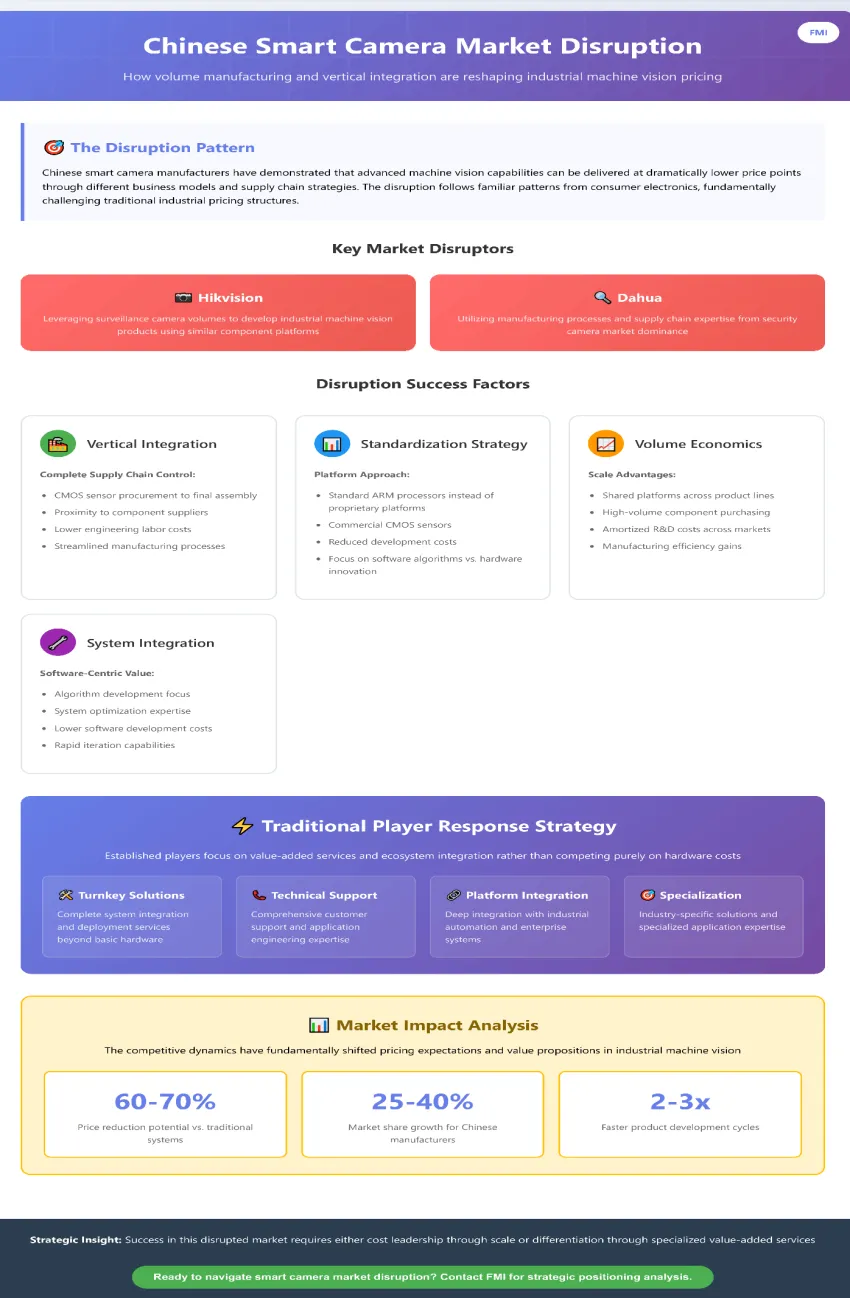
Chinese smart camera manufacturers have demonstrated that advanced machine vision capabilities can be delivered at dramatically lower price points through different business models and supply chain strategies. Hikvision and Dahua have leveraged their surveillance camera volumes to develop industrial machine vision products using similar component platforms and manufacturing processes.
The disruption follows familiar patterns from consumer electronics. Chinese manufacturers achieve cost advantages through vertical integration, controlling everything from CMOS sensor procurement to final assembly. They also benefit from proximity to component suppliers and lower engineering labor costs for software development and system integration.
Standardization plays a crucial role in cost reduction. Rather than developing proprietary processing platforms, many Chinese manufacturers build around standard ARM processors and commercial CMOS sensors. This approach reduces development costs but limits differentiation to software algorithms and system optimization rather than hardware innovation.
The competitive response from established players has focused on value-added services and ecosystem integration. Companies like Cognex and Keyence emphasize turnkey solutions, technical support, and integration with industrial automation platforms rather than competing purely on hardware costs.
Where does AI processing create new cost and performance dynamics?
Artificial intelligence has become a key differentiator in smart camera applications, but AI processing requirements create new cost and performance trade-offs that didn't exist in traditional machine vision systems. Edge AI capabilities allow smart cameras to perform complex analysis locally rather than sending raw images to external computers, but this requires additional processing power and memory.
ARM's Ethos NPU (Neural Processing Unit) technology represents one approach to efficient AI acceleration in smart cameras. These dedicated AI processors can handle machine learning inference with lower power consumption than general-purpose processors, but they add cost and design complexity to camera systems.
The software stack becomes increasingly important as AI capabilities expand. Machine learning models require training data, algorithm optimization, and continuous updates to maintain performance. Companies that can develop and maintain effective AI algorithms gain competitive advantages that pure hardware manufacturers cannot easily replicate.
Processing efficiency directly impacts system costs through power consumption and thermal management requirements. AI workloads can create significant heat generation, requiring active cooling systems that add cost and complexity to camera designs. Power-efficient processors reduce these secondary costs while enabling smaller, more compact camera form factors.
What this means for smart camera competitive positioning?
The cost structure analysis reveals that successful smart camera manufacturers must choose between volume-focused commodity strategies and value-added solution differentiation. Pure hardware competition leads to margin compression as component costs become transparent and manufacturing processes standardize.
Value-added strategies focus on software capabilities, AI algorithm performance, and system integration services that justify premium pricing. These approaches require significant investments in software development and domain expertise that create barriers to entry for commodity competitors.
The processing architecture decision becomes critical for long-term competitiveness. Companies building around ARM processors benefit from a broad ecosystem of software tools and component suppliers, while those investing in proprietary processing platforms must justify the additional development costs through superior performance or unique capabilities.
Sources
- National Institute of Standards and Technology (NIST). Industrial Machine Vision Systems: Standards, Performance Metrics, and Architecture Trends.
- IEEE Xplore / IEEE Robotics & Automation Society. Advances in Smart Camera Architectures and Edge AI for Machine Vision.
- European Commission - Joint Research Centre (JRC). AI and Computer Vision in Industrial Automation: Technology Landscape and Regulatory Implications.
- International Electrotechnical Commission (IEC). Standards for Machine Vision, Imaging Sensors, and Industrial Camera Interfaces.
- USA Department of Energy (DOE). Semiconductor and Sensor Supply Chain Assessment: Implications for Imaging and Vision Systems.

