


Key Takeaways
- In industrial and professional cleaning equipment, three groups consistently appear at the top: Kärcher, Nilfisk and Tennant, each positioning itself as a global leader in cleaning technology or professional equipment, with operations in dozens of countries.
- Industrial vacuum cleaners are a subsegment inside this broader professional cleaning ecosystem, so these groups capture a very large share of big industrial tenders, but the market as a whole is still fragmented, with hundreds of specialist brands and regional manufacturers listed on technical marketplaces.
- Their advantage is less about "being famous" and more about service networks, regulatory compliance, hazardous dust handling, and the ability to guarantee uptime and documentation for food, pharma, and ATEX environments.
- Buyers do not pay only for a vacuum motor and a steel drum. They pay for engineering, certifications, integration with central systems, and multi-year support contracts, which is why these brands can hold premium pricing even when cheaper machines exist.
Why can only a few brands scale globally in industrial vacuums?
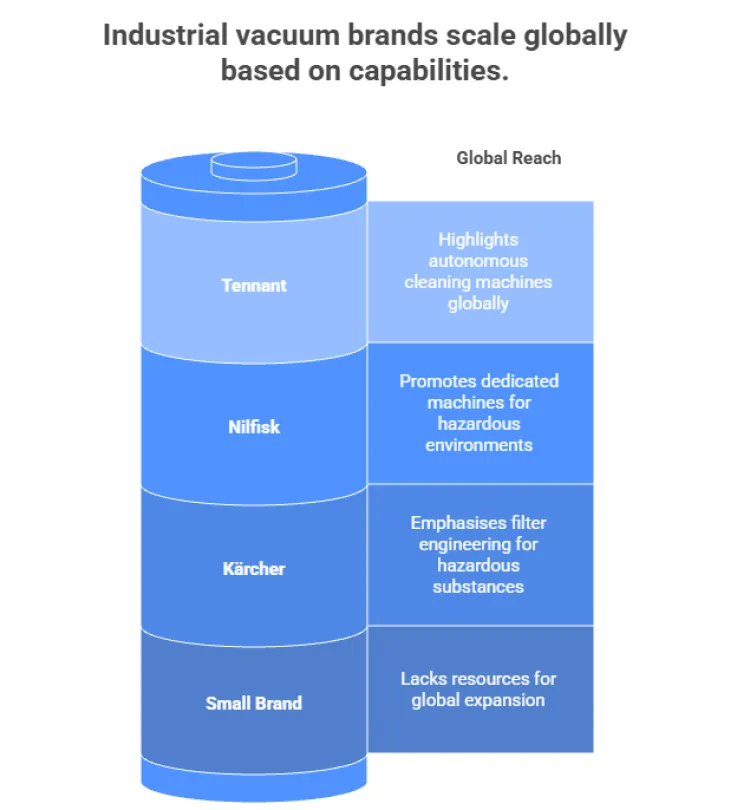
First, safety and compliance. Industrial vacuums in food plants, pharmaceutical lines, metal machining or chemical facilities have to deal with hazardous dusts, combustible atmospheres and strict hygiene rules. That is why Nilfisk promotes dedicated machines for combustible dust, hazardous dust recovery, and food and pharma environments, and why Kärcher emphasises special filter engineering and long service life for hazardous substances. Designing, certifying and updating those machines across multiple regulatory regimes requires serious engineering teams and testing investment, which is not trivial for a small regional brand. Second, service networks and uptime.
For an automotive plant, a flour mill, or a pharma filling line, a failed central vacuum system is a production problem, not a cleaning inconvenience. The big groups run global or regional service networks, offer spare parts logistics and on-site technicians, and can support multi-year service contracts across many facilities. Tennant’s published global locations, and Nilfisk’s network of dealers and subsidiaries across more than 100 countries, are signalling this capability. A small standalone vacuum maker may build a good machine, but it cannot always promise global uptime and parts in three days.
Third, product platforms and integration. Industrial vacuums are increasingly part of larger systems: centralised vacuum plants, dedusting solutions tied into process machines, or fleets that sit in a broader cleaning equipment ecosystem. Nilfisk talks about centralised vacuum systems that can be integrated with process machines, and Kärcher positions industrial vacuums together with industrial dedusting solutions. That kind of modular platform, shared components and integration know-how tends to favour a few large engineering organisations.
Fourth, capital and R&D cycles. The same groups that lead in industrial vacuums are also pushing automation and digitalisation in cleaning equipment. Tennant, for example, has been highlighted as a major global manufacturer of autonomous cleaning machines, and Nilfisk has invested for more than a century in successive cleaning technologies. Those capabilities spill over into smarter vacuums, better motor and battery platforms and improved fleet management tools. A small player usually cannot amortise the R&D cost of that over a global installed base.
How FMI Can Help
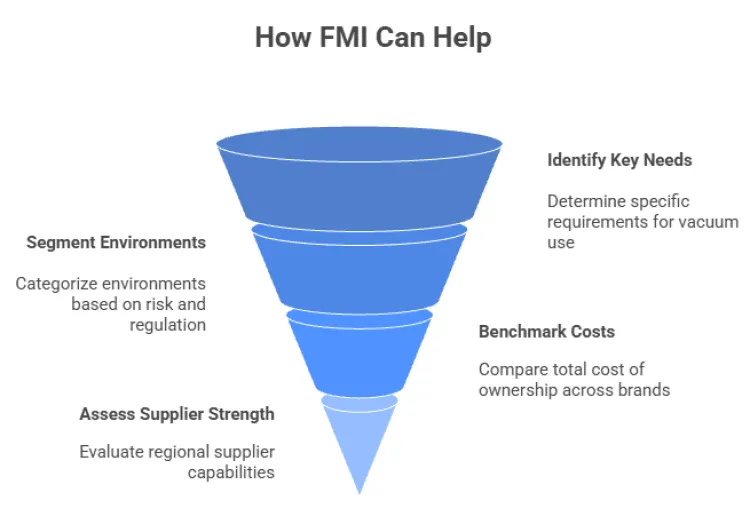
From an FMI perspective, the interesting work is not to repeat "Kärcher, Nilfisk, Tennant are big," but to map where their advantages actually matter. That means building a segmentation that separates hazardous dust and regulated environments from low risk, light duty use, benchmarking total cost of ownership across brands for representative use cases, and overlaying that with regional supplier strength. You could easily turn this into a short vendor landscape note for industrial vacuums in selected sectors, where the real value is not ranking brands by logo size but helping buyers understand when they truly need a premium global player and when a good regional manufacturer is enough.
Sources
- Kärcher company information on global leadership in cleaning technology and professional and industrial vacuum ranges.
- Nilfisk group information describing it as one of the world’s leading manufacturers of professional cleaning equipment, with industrial vacuum offerings for food, pharma and manufacturing.
- Tennant Company profiles describing it as a recognised cleaning industry leader and USA market leader in cleaning equipment, with global operations and industrial applications.
- Engineering marketplace listings showing the breadth of industrial vacuum cleaner brands and models, indicating a fragmented supplier base beyond the large global groups.

