


- The Hyaluronic Acid Products Market is expected to grow from USD 9.94 billion in 2026 to USD 16.82 billion by 2036, at a CAGR of 5.4% during the forecast period.
- With production volumes increasing, manufacturers are looking at regional manufacturing strategies to improve supply continuity and regulatory compliance.
- The ability to formulate and distribute locally is becoming increasingly important for serving hospitals, specialty clinics and aesthetic medicine providers.
- Future Market Insights estimates that hospital pharmacies will account for 50.3% of the market in 2026, highlighting the need for strong regional supply chains.
- Companies are weighing the benefits of global production efficiencies against the need for geographically diversified manufacturing footprints to improve resilience.
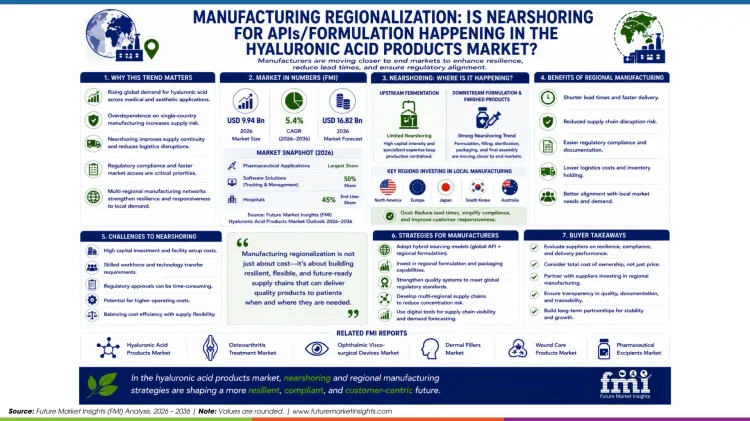
The Hyaluronic Acid Products market is on the cusp of a transition where production strategy will be as important as product innovation. Future Market Insights projects the market to reach a valuation of USD 9.94 billion by 2026, reflecting a CAGR of 5.4% over the forecast period (2026-2036).
This sustained growth is making manufacturers rethink the configuration of their production networks. Today, companies are increasingly considering regional production and formulation capabilities that can improve supply responsiveness and meet local regulatory requirements, not just centralized manufacturing facilities.
This trend is particularly important for injectable hyaluronic acid products in the treatment of osteoarthritis and in medical aesthetics. For these products, uninterrupted availability in healthcare settings requires strict manufacturing controls, validated quality systems and reliable distribution channels.
Regionalization also provides an opportunity to develop relationships with institutional buyers. According to Future Market Insights, hospital pharmacies are expected to account for 50.3% of the market distribution in 2026, making hospitals one of the largest purchasing channels for hyaluronic acid products. Hence, local supply capabilities support manufacturers in more efficiently addressing procurement requirements and inventory planning.
The product composition also supports the need for consistency in manufacturing. For manufacturers serving this dominant segment, standardized production processes and reliable quality management will be increasingly important. Single cycle injection products are expected to capture 54.7% of the market in 2026.
China’s forecasted 7.9% CAGR through 2036 also reflects the country’s increasing importance in the global hyaluronic acid industry. As demand increases in regions, companies may look at how to use established production hubs with localised formulation, packaging and distribution operations to create more resilient supply chains.
However, regionalization of manufacturing does not mean the total transfer of production. Many companies will likely deploy hybrid operating models that preserve global manufacturing efficiencies but enhance regional finishing, logistics and commercial support capabilities closer to end markets.
A balanced approach can improve responsiveness without sacrificing economies of scale. Companies can respond to changing customer needs, while maintaining consistency in product quality.
The myth is that nearshoring means abandoning existing manufacturing hubs. In practice, regionalization often means adding new local capabilities to existing production networks to increase flexibility and reduce operational risk.
Bottom Line
The Hyaluronic Acid Products Market is expected to grow from USD 9.94 billion in 2026 to USD 16.82 billion by 2036, and the regionalization of manufacturing is becoming a strategic business consideration. Companies that integrate efficient global production with enhanced regional supply capabilities may be better positioned to support hospitals, healthcare providers and rising international demand as well as enhance supply chain resiliency.
Related FMI Reports
- Hyaluronic Acid Products Market
- Dermal Fillers Market
- Osteoarthritis Therapeutics Market
- Ophthalmic Drugs Market
- Injectable Drug Delivery Market
- Medical Aesthetics Market
- Regenerative Medicine Market
- Pharmaceutical Supply Chain Market
- Biopharmaceutical Manufacturing Market
- Orthobiologics Market

