


Executive Summary: From Temperature Visibility to Spoilage Decision Intelligence
Cold chain food logistics is shifting from temperature visibility to spoilage decision intelligence. Basic sensor alerts show that a temperature event happened. Buyers now need earlier proof of how that event affects shelf life, retailer acceptance and claim exposure.
The pressure is commercial and operational. Fresh food logistics teams face shorter delivery windows and stricter retailer receiving checks. Food producers want fewer disputes after delivery. Retailers want better confidence that products can stay sellable after arrival.
This report examines the needs of CEOs, CTOs, CIOs and Marketing/Sales leaders in cold chain food logistics. It connects Future Market Insights market data with public evidence from FAO, USDA ERS and FDA. The SaaS opportunity is to turn cold chain records into a live spoilage risk system.
FAO reported in March 2026 that insufficient refrigeration causes 526 million tonnes of food loss and waste. This volume was near 12.0% of the global total. The figure makes cold chain software more than a route visibility tool. It becomes a decision layer for protecting food value before products reach the shelf. [5]
Market Overview: The Spoilage Control Imperative in Cold Chain Logistics
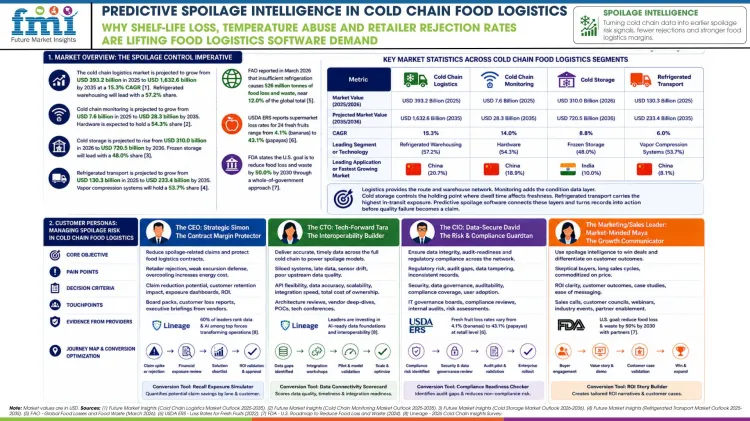
The cold chain logistics market is projected to grow from USD 393.2 billion in 2025 to USD 1,632.6 billion by 2035. Future Market Insights places the market CAGR at 15.3% over the forecast period. Refrigerated warehousing is expected to lead with a 57.2% share. [1]
Cold chain monitoring is projected to grow from USD 7.6 billion in 2025 to USD 28.3 billion by 2035. Hardware is expected to hold a 54.3% share in the monitoring market. This shows that sensors and devices remain the entry point for cold chain data. [2]
Cold storage is projected to rise from USD 310.0 billion in 2026 to USD 720.5 billion by 2036. Frozen storage is expected to lead with a 48.0% share. Refrigerated transport is projected to grow from USD 130.3 billion in 2025 to USD 233.4 billion by 2035. Vapor compression systems are expected to hold a 53.7% share in that market. [3] [4]
USDA ERS food loss data shows why the retail end of the chain matters. The agency reports supermarket loss rates for 24 fresh fruits. Rates range from 4.1% for bananas to 43.1% for papayas. This loss context shows why cold chain buyers need software that can forecast quality risk before products reach a receiving dock. [6]
FDA states that the United States has a goal to reduce food loss and waste by 50.0% by 2030. The agency connects this goal with a whole-of-government approach involving USDA, EPA and USAID. Cold chain software can support this broader goal when it helps prevent quality loss before disposal becomes necessary. [7]
Key Market Statistics Across Cold Chain Food Logistics Segments:
| Metric | Cold Chain Logistics | Cold Chain Monitoring | Cold Storage | Refrigerated Transport |
|---|---|---|---|---|
| Market Value (2025/2026) | USD 393.2 Billion (2025) | USD 7.6 Billion (2025) | USD 310.0 Billion (2026) | USD 130.3 Billion (2025) |
| Projected Market Value (2035/2036) | USD 1,632.6 Billion (2035) | USD 28.3 Billion (2035) | USD 720.5 Billion (2036) | USD 233.4 Billion (2035) |
| CAGR | 15.3% | 14.0% | 8.8% | 6.0% |
| Leading Segment or Technology | Refrigerated Warehousing (57.2%) | Hardware (54.3%) | Frozen Storage (48.0%) | Vapor Compression Systems (53.7%) |
| Leading Application or Fastest Growing Market | China (20.7%) | China (18.9%) | India (10.0%) | China (8.1%) |
These figures show a layered cold chain system. Logistics provides the route and warehouse network. Monitoring adds the condition data layer. Cold storage controls the holding point where dwell time affects freshness. Refrigerated transport carries the highest in-transit exposure. Predictive spoilage software connects these layers and turns records into action before quality failure becomes a claim.
Customer Personas: Managing Spoilage Risk in Cold Chain Food Logistics
The CEO: Strategic Simon - The Contract Margin Protector
Strategic Simon is the CEO of a cold chain logistics provider. He sees spoilage as a contract margin problem. A late or temperature-abused load can trigger claims and weaken the next renewal. His concern is not only whether the shipment arrived. He wants proof that the product arrived with enough usable shelf life.
- Core Objective: Simon must reduce spoilage-related claims and protect food logistics contracts. He needs a system that shows which routes and facilities create the highest financial exposure.
- Pain Points: Retailer rejection can convert a profitable lane into a disputed account. Temperature excursions may be hard to defend if the provider has only basic threshold logs. Overcooling can raise energy cost when teams use it as a defensive operating habit.
- Decision Criteria: Simon reviews software by claim reduction potential and customer retention impact. He values dashboards that compare spoilage exposure by lane and account. He needs a clear link between software spend and margin protection.
- Touchpoints: Simon reviews board packs, customer loss reports and executive briefings from logistics technology vendors.
Evidence from Providers:
Lineage’s 2026 Cold Chain Insights Survey found that 60.0% of food and beverage supply chain leaders ranked data and AI among the top forces transforming operations. The same survey identified planning coordination, productivity and spoilage reduction as cited AI outcomes. This evidence supports Simon’s need for technology that links cold chain data to operating results. [8]
Journey Map & Conversion Optimization:
Simon’s journey starts when finance teams identify recurring claims from fresh product lanes. He asks operations to separate carrier failure from storage dwell time and retailer-side rejection patterns. A SaaS provider should offer a Spoilage Cost Exposure Assessment. The assessment should estimate avoidable claims and rank the top lanes for predictive monitoring. Conversion improves when the platform shows a contract-level payback model instead of a generic monitoring promise.
The CTO: Tech-Forward Tara - The Shelf-Life Model Architect
Tech-Forward Tara is the CTO. She must turn raw sensor readings into a working shelf-life model. Her problem is not the absence of data. Her problem is that reefer readings, warehouse sensors and product attributes often sit in separate systems. She needs a model that explains which event actually changes product quality.
- Core Objective: Tara must build a technical layer that predicts spoilage risk by product, temperature history and dwell time. The system must work across transport and warehouse environments.
- Pain Points: Fixed temperature thresholds can create alert fatigue. A short event may matter less than a longer mild deviation for some products. Product metadata is often missing from shipment feeds. This makes a precise shelf-life score difficult.
- Decision Criteria: Tara reviews model accuracy and data coverage. She tests whether the platform can ingest IoT feeds, WMS records and carrier telematics. She requires validation against real delivery outcomes before scaling a model across accounts.
- Touchpoints: Tara reviews API documentation, architecture diagrams and proof-of-concept trials using shipment history.
Evidence from Providers:
Tive’s food and beverage page states that real-time visibility can help minimize temperature excursions, reduce waste and support product quality. The same page says alerts can reduce spoilage and lower the likelihood of rejected loads and claims. This evidence fits Tara’s need for data that supports early intervention during shipment. [9]
Journey Map & Conversion Optimization:
Tara’s journey begins with a technical audit of temperature feeds and product master data. She tests whether the platform can convert temperature curves into freshness risk by SKU. A SaaS provider should offer a Shelf-Life Model Pilot. The pilot should compare predicted risk scores with actual delivery exceptions. The conversion point is reached when Tara can show that the model reduces false alarms and identifies the loads that need action first.
The CIO: Data-Driven David - The Cold Chain Record Governor
Data-Driven David is the CIO. He owns the record chain behind each shipment. His concern is auditability and access control. A temperature event must be traceable from the device to the dashboard and the customer report. The record must remain usable when a dispute appears weeks after delivery.
- Core Objective: David must maintain trusted cold chain data across shippers, carriers and warehouses. He needs system integration that reduces manual reporting and protects the chain of custody.
- Pain Points: Temperature records often come from separate devices and partner portals. Manual downloads slow dispute resolution. Missing timestamps can weaken claims defense. Customer reporting can become inconsistent when each account receives a different record format.
- Decision Criteria: David reviews API maturity and ERP fit. He needs audit trails, role-based access and exception reporting. He also reviews security posture because shipment records may include customer and commercial data.
- Touchpoints: David reviews vendor risk assessments, security questionnaires and ERP integration workshops.
Evidence from Providers:
Samsara’s food and beverage platform page states that fleets can connect drivers and cold-chain data on one platform. The page references digital temperature logs, automated FSMA reporting and real-time monitoring. This evidence supports David’s need for a unified record system rather than isolated device logs. [10]
Journey Map & Conversion Optimization:
David’s journey starts with a record-mapping exercise. He identifies which temperature records sit in telematics systems, warehouse systems and customer portals. A SaaS provider should offer a Temperature Data Readiness Checklist. The checklist should map each data source to an audit requirement. Conversion improves when David sees a working exception report by shipment, customer and temperature event.
Marketing & Sales: Growth-Focused Grace - The Freshness Proof Builder
Growth-Focused Grace leads Marketing and Sales. She must prove that the logistics provider protects sellable life. Retail buyers are not persuaded by a broad cold chain claim. They want evidence that deliveries arrive within agreed quality windows. Grace needs proof that turns operational performance into a renewal story.
- Core Objective: Grace must convert spoilage intelligence into a sales asset. She needs account-level evidence that supports renewals and helps defend premium service pricing.
- Pain Points: Sales teams often lack proof behind freshness claims. Retailers may dispute delivery quality after a temperature event. Competitors can look similar when providers show only fleet size and warehouse capacity.
- Decision Criteria: Grace needs retailer-facing dashboards and lane-level quality reports. She values evidence that links monitoring with lower rejection exposure. Account teams need simple visuals that can be used in quarterly business reviews.
- Touchpoints: Grace uses CRM dashboards, retailer meetings and sales enablement workshops.
Evidence from Providers:
Geotab announced an upgraded cold chain solution in 2025 with new hardware and software capabilities for temperature-sensitive shipments. The company described near real-time monitoring, multi-zone temperature support and advanced alerts. The release also linked the solution to spoilage risk reduction and compliance support. [11]
Journey Map & Conversion Optimization:
Grace’s journey begins with customer questions about rejection rates and freshness protection. She asks operations for proof by lane and customer. A SaaS provider should offer a Freshness Proof Sales Pack. This pack should include load-level temperature records, exception summaries and estimated remaining shelf-life indicators. Conversion improves when sales teams can show retailer-ready proof without asking operations for manual reports.
Key Market Research Pointers: Future Outlook for B2B SaaS in Cold Chain Food Logistics
To provide a specific perspective beyond standard syndicated research, consider these five evidence-based pointers for the future of the Cold Chain Food Logistics Market, specifically for B2B SaaS providers:
- Remaining Shelf-Life Scoring by Product and Lane: Cold chain software will move beyond pass-or-fail temperature alarms. Each product type reacts differently to time and temperature exposure. A lettuce load and a frozen meal shipment cannot share the same risk rule. SaaS platforms can score remaining shelf life by SKU, lane and dwell time. This gives dispatchers a decision tool instead of a warning light.
- Exception Triage Engines for Temperature Abuse: Cold chain teams cannot treat every deviation as equal. A short door-open event may not require the same action as a prolonged reefer failure. Exception triage engines can rank events by likely quality impact and claim exposure. This helps teams act first on the loads that carry the highest commercial risk. The SaaS value sits in prioritizing work rather than producing more alerts.
- Retailer Rejection Intelligence for Account Teams: Retailer rejection is often treated as an after-the-fact claims issue. SaaS platforms can connect receiving outcomes with route history and temperature records. This can reveal which customers, lanes and product groups create the highest rejection exposure. Sales teams can then prepare renewal discussions with operational proof. CEOs can use the same view to price service levels more accurately.
- Cold Chain Digital Twins for Dock and Dwell-Time Control: Food quality can erode before a truck leaves the warehouse. Digital twins can model dock congestion, staging time and route delay before those problems damage shelf life. The model can recommend earlier loading changes or alternate shipment sequences. This creates a planning layer for operations teams. The most useful platform will connect the digital twin to live warehouse and transport data.
- Automated Claims Defense and Customer Proof Packs: Temperature data becomes more valuable when it is formatted for disputes and buyer reviews. SaaS platforms can create proof packs that include temperature history, corrective actions and handoff records. CIOs get an audit-ready data package. Sales teams get customer-ready performance evidence. This turns cold chain records into a commercial asset instead of an internal archive.
- Uniqueness Explanation: These pointers move beyond market size commentary and standard visibility claims. The article focuses on how spoilage risk moves through warehouse, transport and retailer receiving points. It treats predictive spoilage intelligence as a decision system. The operating shift is from monitoring temperature to managing remaining shelf life. The technology shift is from device alerts to data models. The buyer shift is from logistics service comparison to proof-based contract renewal.
Conclusion: The Strategic Imperative of Spoilage Decision Systems
Predictive spoilage intelligence is becoming a business requirement in cold chain food logistics. Shelf-life loss and temperature abuse now affect more than operations. They influence retailer acceptance, contract renewal and customer trust. The strongest cold chain providers will not only prove that a shipment stayed cold. They will show how much usable product life remained when it arrived.
B2B SaaS providers must connect temperature records with shelf-life risk and retailer outcomes. CEOs need margin exposure by customer and lane. CTOs need validated models that reduce false alerts. CIOs need trusted records that support disputes and audits. Sales teams need proof that can defend service value. The practical opportunity is clear. Cold chain data must become a quality decision system before food reaches the shelf.
Ready to reduce spoilage exposure in cold chain food logistics? Request a Demo of our Predictive Spoilage Intelligence Platform to forecast shelf-life risk, prioritize temperature exceptions and strengthen retailer delivery proof.
References
- [1] Future Market Insights. "Cold Chain Logistics Market: Global Industry Analysis 2015 - 2024 and Opportunity Assessment 2025 - 2035." https://www.futuremarketinsights.com/reports/cold-chain-logistics-market
- [2] Future Market Insights. "Cold Chain Monitoring Market: Global Market Analysis Report - 2035." https://www.futuremarketinsights.com/reports/cold-chain-monitoring-market
- [3] Future Market Insights. "Cold Storage Market: Global Market Analysis Report - 2036." https://www.futuremarketinsights.com/reports/cold-storage-market
- [4] Future Market Insights. "Refrigerated Transport Market: Global Industry Analysis 2015 - 2024 and Opportunity Assessment 2025 - 2035." https://www.futuremarketinsights.com/reports/refrigerated-transport-market
- [5] Food and Agriculture Organization of the United Nations. "Cooling the chain, cutting the waste." March 30, 2026. https://www.fao.org/energy/news-and-events/news/news-details/cooling-the-chain-cutting-the-waste/en
- [6] USDA Economic Research Service. "Food Availability (Per Capita) Data System - Food Loss." January 5, 2025. https://www.ers.usda.gov/data-products/food-availability-per-capita-data-system/food-loss
- [7] USA Food and Drug Administration. "Food Loss and Waste." January 13, 2025. https://www.fda.gov/food/consumers/food-loss-and-waste
- [8] Lineage. "New data: What today’s supply chain leaders expect from tomorrow’s cold chain networks." June 2, 2026. https://www.onelineage.com/news-stories/cold-chain-insights-report-2026
- [9] Tive. "Save Temperature-Sensitive Perishable Shipments." https://www.tive.com/get-started-food-and-beverage
- [10] Samsara. "Samsara for Food and Beverage." https://www.samsara.com/industries/food-and-beverage
- [11] Geotab. "Geotab Unveils Advanced Cold Chain Solution with New Hardware and Enhanced Software." October 9, 2025. https://www.geotab.com/apac/press-release/cold-chain-management/

