


- Private label is not yet publicly disclosed as a clean share number inside plant-based ice cream, but the threat is real because the frozen department already has high store-brand penetration.
- PLMA and Circana data show store brands reached 21.3% dollar share and 23.5% unit share across tracked retail categories in 2025.
- Frozen is one of the most exposed departments, with store brands holding 25.9% dollar share and 27.5% unit share in 2024.
- In plant-based ice cream, private label is most threatening in cups, tubs, vanilla, chocolate, coconut-based, blended-base, and family take-home formats.
- Premium craft-style and strongly branded indulgence SKUs are safer than simple “dairy-free vanilla” or “non-dairy chocolate” products.
- Common misread: vegan positioning protects national brands. It does not. If taste is acceptable and price is lower, private label can take the repeat purchase.
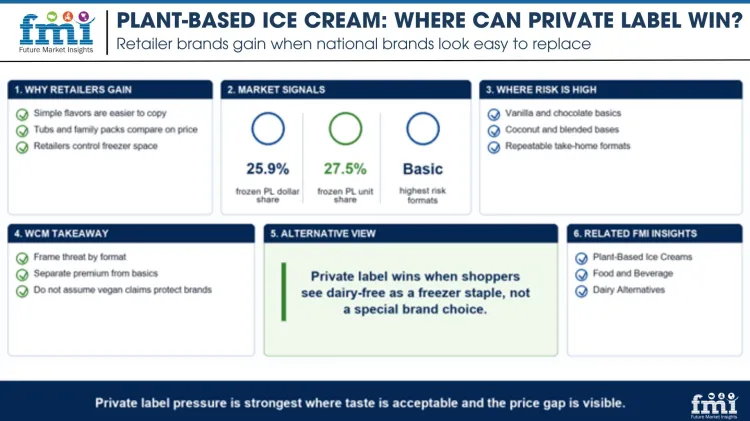
Private label is becoming a clearer threat in plant-based ice cream, but the risk is uneven. Retailers are not trying to become vegan dessert specialists. They are gaining leverage as plant-based ice cream moves from trial to replenishment. That is where store brands perform best.
the clearest public signal comes from the broader store-brand market. Store brands reached 21.3% dollar share and 23.5% unit share in 2025, according to PLMA’s Circana-based store brand facts. Frozen also remains one of the most exposed departments. In 2024, store brands held 25.9% dollar share and 27.5% unit share in frozen. That does not mean private label already owns one-fourth of plant-based ice cream. It means plant-based ice cream sits inside a retail department where shoppers are already comfortable buying retailer-owned frozen products.
That makes FMI’s Plant-Based Ice Creams Market is important for reading the risk. FMI shows that hypermarkets and supermarkets account for 46.2% of plant-based ice cream sales. That makes the category highly exposed to retailer shelf decisions. A national brand can build awareness, but the retailer controls freezer space, promotion calendars, price gaps, and adjacency to dairy ice cream. When the dominant channel is organized grocery, private label does not need to beat every brand on emotion. It only needs to offer acceptable taste at a better price in the most repeated formats. Plant-Based Ice Creams Market Plant-Based Ice Creams Market
The most vulnerable category is cups and tubs. FMI identifies cups and tubs as the top product type, accounting for 41.9% of product type demand. This format is a private-label sweet spot because it is easy for shoppers to compare price per pack, flavor, size, and promotion. A private-label vanilla or chocolate tub does not need to out-story Ben & Jerry’s or Van Leeuwen. It needs to be good enough for a household dessert occasion at a lower price.
Blended-base products are also vulnerable. FMI notes that blended bases lead the plant-based ice cream category with 56.8% share. Blended bases can reduce dependence on a single hero ingredient and give retailers flexibility to balance texture, cost, and label claims. That flexibility is useful for private label because the retailer can brief the product around price architecture and mainstream acceptability rather than a highly differentiated ingredient story.
The safest branded territory is premium indulgence. Brands that sell recognizable flavor architecture, richer mix-ins, dessert intensity, or distinct identity are harder for private label to copy convincingly. A simple non-dairy vanilla tub is exposed. A dense brownie, cookie dough, caramel swirl, or pistachio-style premium product is less exposed because the brand promise includes experience, not a dairy-avoidance claim alone.
The middle of the market is where national brands are most at risk. These brands are too expensive to fight private label on value but not distinctive enough to justify premium pricing. If their only claim is “plant-based,” the retailer can replicate the claim. If their texture is only average, the retailer can match it. If their flavor system is generic, the retailer can sit next to them with a lower price and better shelf economics.
The Non-Dairy Ice Cream Market also supports this reading because supermarkets remain the leading distribution channel in non-dairy ice cream, while singles, impulse products, and take-home formats shape different buying occasions. Private label is clearest where the purchase is planned, comparable, and repeatable. It is weaker where the purchase is impulsive, premium, novelty-led, or tied to a specific brand craving. Non-Dairy Ice Cream Market
The categories most vulnerable to private label are take-home tubs, family packs, vanilla, chocolate, coconut-based basics, blended-base basics, and mainstream grocery multipacks. The categories less vulnerable are premium pints, indulgent mix-in flavors, chef-style formulations, limited editions, distinctive oat-based brand propositions, and foodservice-linked branded formats.
The practical answer is that private label is not yet publicly measurable as a precise plant-based ice cream share. But the verified department-level data shows the direction clearly: frozen is already private-label friendly, and plant-based ice cream’s clearest channel is controlled by retailers. That makes the category exposed.

