


Key Takeaways
- Global produced water volumes are rising faster than oil output, with forecasts from industry associations indicating a potential doubling of volumes from conventional fields over roughly a decade, turning it into one of the largest managed waste streams in the sector.
- Regulators in offshore regions such as the North-East Atlantic now impose performance standards of about 30 milligrams per litre for dispersed oil in produced water discharges, coupled with risk based frameworks that push operators toward reinjection or higher levels of treatment.
- In the United States, federal effluent limitation guidelines have already restricted or prohibited discharges from unconventional plays to municipal treatment works, and the Environmental Protection Agency is preparing revisions that explicitly consider modern treatment capabilities and emerging contaminants such as PFAS.
- Peer reviewed assessments of produced water regulations across major producing regions show a clear shift from simple volume or oil and grease limits toward multi parameter standards and jurisdictional frameworks that extend to reuse and human exposure pathways.
- Field and state level data indicate that more than 90 percent of onshore produced water in some basins is still reinjected, but drought, competition for freshwater and disposal restrictions are driving more interest in reuse for fracturing, industry and even agriculture where quality allows.
How produced water moved from byproduct to policy priority
For decades produced water was treated as an inevitable byproduct of oil and gas extraction, managed mainly through disposal wells offshore and onshore. Volumes are large and rising; as fields mature, water cuts increase and water to oil ratios climb. Industry and research society estimates suggest that produced water already exceeds global oil production by several multiples on a volumetric basis, with projections indicating continued growth as conventional fields age.
Initially, policy concerns focused on obvious pollutants such as dispersed oil. Offshore regions in the North-East Atlantic, under the OSPAR convention, introduced performance standards for oil in water and targets for aggregate reductions, making produced water one of the most visible environmental issues in the offshore regulatory agenda. Onshore, attention grew later and for different reasons.
Shale development, hydraulic fracturing, recurring droughts and public concern about water scarcity forced regulators in North America and elsewhere to reassess how much produced water can realistically be injected indefinitely and what it would take to view it as a usable resource. At the same time, research on chemical composition and exposure pathways highlighted that produced water carries a complex mixture of salts, hydrocarbons, metals and treatment chemicals that do not fit easily into legacy regulatory boxes.
What is actually tightening: discharge, reuse and reinjection rules
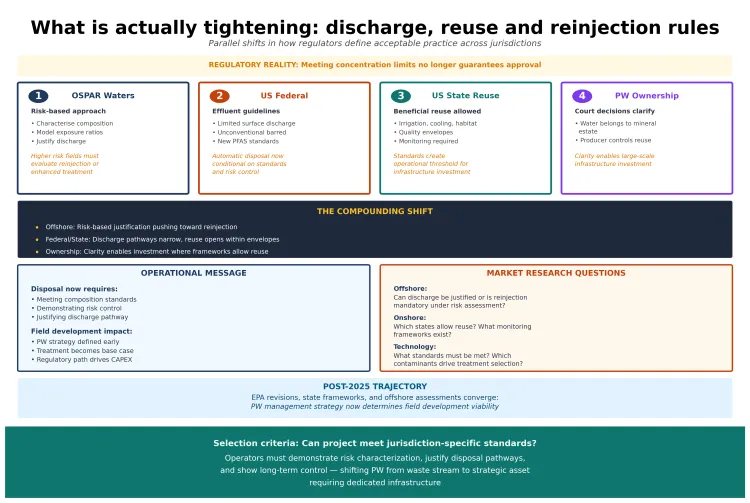
Tightening does not mean a single global standard; it means several parallel shifts in how regulators define acceptable practice. Offshore in OSPAR waters, performance based limits for dispersed oil around 30 milligrams per litre have been in place for years, but are now embedded in a broader risk based approach that requires operators to characterise produced water composition, model exposure ratios and justify discharge strategies. Under this approach, meeting a concentration limit is a starting point, not an end point, and higher risk fields are pushed toward reinjection or additional treatment.
In the United States, effluent limitation guidelines for conventional and unconventional oil and gas cover what can be discharged to surface waters or municipal plants. Produced water can only be discharged in limited onshore areas when it is of sufficient quality to support agriculture or wildlife, and more recent pretreatment standards fully prohibit unconventional wastewaters from being sent to municipal treatment plants. The Environmental Protection Agency has signalled that it plans to revise these guidelines again, explicitly referencing advances in treatment technology and the need to address new contaminants such as PFAS. At state level, working groups and water planning initiatives are building frameworks for beneficial reuse.
These often allow treated produced water to be reused for irrigation, industrial cooling or habitat support in arid regions, but only within defined quality envelopes and under monitoring requirements. The operational message is straightforward. What was once an almost automatic disposal route is now conditional on meeting specific standards and demonstrating control over long term risks. Several jurisdictions are also clarifying who owns produced water and therefore who can decide to invest in treatment and reuse. Recent court decisions in key producing regions have affirmed that, unless lease terms state otherwise, produced water is part of the mineral estate and belongs to the producer. That kind of clarity is becoming a precondition for large scale infrastructure investment.
How quality standards map into treatment trains and cost
The tightening of rules shows up most clearly in the treatment targets that engineers are asked to meet. Historically, treatment trains for produced water were designed around removing oil and suspended solids to meet a single concentration limit before discharge offshore or disposal onshore. As regulators move toward more comprehensive water quality objectives, treatment trains become more layered and more differentiated by end use. Where the objective is still disposal or reinjection, the core questions centre on compatibility with reservoir conditions and disposal permits.
This often translates into requirements to manage scale forming ions, particulates and bacteria, alongside basic oil removal. In many cases this can be achieved with combinations of gravity separation, flotation, filtration and chemical dosing without resorting to expensive desalination. Where the goal is reuse in fracturing, industrial processes or irrigation, policy increasingly demands tighter control over salts, organics, metals and in some cases trace organics and radionuclides. Academic and regulatory reviews of reuse projects show that this often pushes operators toward membrane technologies, advanced oxidation and hybrid systems.
The capital and operating costs per barrel rise sharply, but so does the ability to access non disposal outlets in water stressed regions. Quality standards therefore function as rungs on a ladder. At the lower rungs, relatively low cost treatment can meet discharge or reinjection rules. As one climbs toward potable or agricultural quality, each incremental contaminant that must be controlled adds process steps, energy use and residual waste streams that must themselves be managed. The strategic question for operators is how far up that ladder local policy, water scarcity and stakeholder expectations are likely to push them over the life of a field.
How tightening rules change the economics of treatment choices
On paper, many produced water reuse options can compete with deep well disposal once avoided disposal costs, reduced freshwater purchases and regulatory risk are priced in. In practice, operator decisions are made under uncertainty about long term regulatory trajectories, commodity prices and asset life. Data from onshore basins in the United States show that more than 90 percent of produced water volumes are still reinjected, either for disposal or for enhanced recovery, with only a small minority treated for beneficial use. Even where reuse pilots have demonstrated technical feasibility for agriculture or industrial cooling, scaling has been slow, partly because quality standards are stricter and liability for any future contamination is not easily transferred.
Offshore, the cost of moving from discharge to full reinjection or to very high polishing levels must be weighed against field life and infrastructure constraints. OSPAR’s risk based frameworks give operators some latitude to design least cost solutions consistent with environmental objectives, but they also limit the scope for simply diluting produced water and relying on dispersion. That means treatment choices are increasingly shaped by case specific modelling and engagement with regulators rather than by fixed rule of thumb design factors.
How Future Market Insights can help
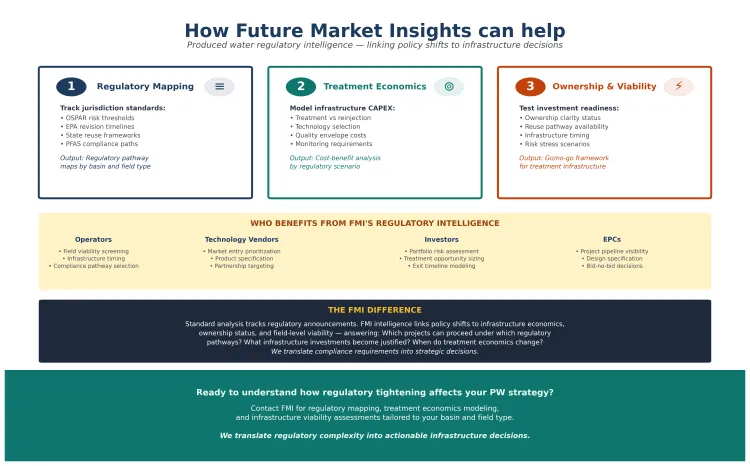
Future Market Insights can help operators, investors and regulators treat produced water as a strategic resource and liability rather than as a narrow compliance issue. That starts with mapping regulatory trajectories and enforcement practices across key basins, linking them to produced water volumes, quality profiles and infrastructure options. It continues with scenario work that tests how different policy choices, water scarcity conditions and technology cost curves affect the economics of reinjection, discharge and reuse.
On this basis, FMI can support decision makers in prioritising where to build modular, upgradable treatment systems, where to invest in shared infrastructure, and where to negotiate for clearer ownership and liability frameworks before committing capital. The aim is to ensure that tightening rules expand the option set for value creating uses of produced water instead of simply compressing margins through unplanned compliance spending.
Sources
- World Bank, Global produced water and wastewater management related material and regional studies
- OSPAR Commission, Recommendation 2001/1 for the Management of Produced Water and relevant assessments on produced water discharges and risk based approaches
- International Association of Oil and Gas Producers, Environmental performance indicators and produced water management data
- US Environmental Protection Agency, Oil and Gas Extraction Effluent Guidelines, Unconventional Oil and Gas Extraction Effluent Guidelines, Oil and Gas Extraction Wastewater Management reports and Effluent Guidelines Program Plans
- W Jiang et al, Analysis of Regulatory Framework for Produced Water Management, Water, 2022
- BR Scanlon et al, Can we beneficially reuse produced water from oil and gas extraction in the US, Science of the Total Environment, 2020
- A Ariana et al, Pathways for potential exposure to onshore oil and gas produced water in the United States, peer reviewed review article, 2025
- Produced Water Society and associated global produced water volume assessments
- IPIECA, API and IOGP, Water management frameworks and sustainability reporting guidance for the oil and gas industry
- State and regional working group reports on produced water reuse and recycling, including Oklahoma Water for 2060 Produced Water Working Group and similar initiatives

