


Key Takeaways
- Professional gear bags sit on top of the broader luggage and backpack market and typically price above mainstream outdoor or commuter backpacks because they add engineered protection, organisation and reliability around high-value equipment.
- The price ladder usually breaks into three broad tiers: semi-pro bags that overlap with performance backpacks, mid-tier specialist bags that add modular interiors and stronger protection, and a premium band where brand, warranty, and niche use-cases support a persistent markup.
- Input inflation in textiles, zippers, foams and labour, combined with higher complexity in cut-and-sew, has pushed retail prices for luggage and leather goods steadily upward over the last decade, which cascades into professional segments as well.
- Channel strategy is part of pricing: direct-to-consumer brands use higher list prices with fewer intermediaries and more visible promotions, while B2B suppliers to photographers, technicians or emergency services often price through distributors and framework contracts with lower headline discounts but higher configuration value.
- Over the next five to ten years, visible differentiation in materials, sustainability credentials, and lifetime repair or replacement policies will matter more for pricing power in professional gear bags than marginal design tweaks alone.
How is the price ladder structured from entry level to premium?
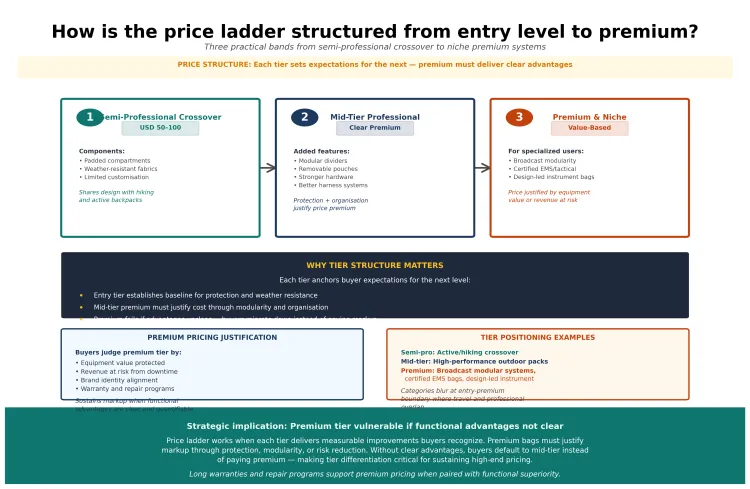
Across luggage and backpack markets, analysts often segment prices into economy, mid-range and premium tiers. Within that broader structure, professional gear bags typically show three practical bands:
The price ladder for professional gear bags runs from semi-professional crossover models up to niche premium systems, and each tier sets expectations for the next. At the entry end, semi-pro bags share components with active or hiking backpacks and typically sit in the USD 50-100 range found in many outdoor-gear studies; they offer padded compartments and weather-resistant fabrics but limited customisation or certification. The mid-tier commands a clear premium for protection and organisation, adding modular dividers, removable pouches, stronger hardware and better harness system features that align their pricing with higher-performance outdoor and travel packs where mid-range and entry-premium categories blur.
At the top, premium and niche professional bags are priced for users whose equipment value, downtime cost or brand identity justify a steep markup, including modular systems for broadcast crews, certified EMS or tactical bags, and design-led camera or instrument bags. In this tier, buyers judge price relative to the value of the equipment being protected or the revenue at risk, which sustains higher prices when paired with long warranties and repair programs. These tiers matter because they anchor expectations: if a premium bag fails to deliver clear functional or risk-reducing advantages, buyers migrate down to the mid-tier instead of paying the premium.
What actually drives cost and price in professional gear bags?
Behind the retail price of a professional gear bag sit three cost blocks: materials, labor and overhead, each growing with the complexity of the design. The materials alone set a higher floor than fashion or commuter backpacks. Most professional bags rely on high-denier nylon or polyester, sometimes in ballistic or Cordura-type weaves, along with multi-layer foam, frame sheets, reinforced zippers, buckles, and water-resistant coatings. Studies on active and outdoor packs show a steady shift toward stronger, lighter and sometimes recycled fabrics. These inputs cost more per meter and they raise the final price when durability or sustainability is part of what the buyer expects.
Labor is another major driver. Professional gear bags have many compartments and technical details. Every divider, pocket, zipper and padding panel adds cut-and-sew time. The tolerance around seams affects how equipment fits, which increases the risk of defects and raises the cost of quality control. This lines up with long-term data from luggage and leather-goods retailers, who report consistent increases in producer prices because of both input and labor inflation.
Design and compliance add more overhead. Many professional bags are built with informal expectations for drop protection, abrasion resistance or water ingress limits. In medical or industrial use, buyers may require specific layouts or material standards. That leads to more rounds of prototyping, stricter sourcing rules, and extra quality checks. Because production runs are smaller than mass-market luggage, these fixed costs are spread across fewer units, which raises the required margin.
The final cost layer is intangible but powerful. Professionals often carry equipment worth several months of income. They judge a bag on the likelihood of failure in the field. Brands with long manufacturing histories, controlled production, reliable repairs and multi-year warranties use that trust to support higher prices. This pattern shows up across the wider luggage market, where established premium brands maintain pricing power even as mid-tier competition grows.
How do channels and geography affect what buyers actually pay?
Professional gear bags reach the market through several channels: direct-to-consumer web stores, specialist photo or industrial dealers, general e-commerce platforms, and B2B distributors or integrators. Each route creates a different margin structure. Direct sales usually support higher list prices but rely on promotions, bundles or loyalty programs to close the sale. Dealer and distributor channels may show smaller discounts on the surface, but part of the price covers advice, setup and service. In B2B settings, framework agreements often bring the unit price below public retail, although buyers commit to minimum volumes or service terms.
Geography also shapes what customers pay. Import duties, taxes and currency movements can shift prices by a wide margin. Official statistics for luggage and leather goods show that retail price indices vary by region because of different inflation levels, tariff regimes and how quickly manufacturers pass costs through to consumers. The result is clear in practice. A mid-tier professional bag may be considered premium in an emerging market where incomes are lower and imports are taxed more heavily. That encourages some buyers to look for airport purchases, parallel channels or lower-cost domestic brands with simpler construction.
How do discounting and product life cycles interact with price?
Professional gear bags sit closer to tools than to fashion items, which changes how pricing behaves. Models often remain in a company’s catalogue for long periods, and updates tend to be incremental. Users value consistency because their equipment and workflow depend on predictable layout, padding geometry, and long-term compatibility. When a bag becomes part of someone’s working system, frequent redesigns create switching costs rather than excitement.
Pricing reflects this stability. Deep discounts usually appear only on colours or peripheral variants that are being phased out. The core models, the ones tied to a brand’s reputation among working professionals, hold their price. If a manufacturer were to cut prices sharply on these anchor products, buyers would read that as a signal that future support, replacement parts, or warranty coverage might not be reliable.
Replacement cycles follow equipment changes. When new drone sizes appear, when camera bodies grow thicker, or when airlines revise cabin-baggage templates, these external triggers create demand for updated bags. The timing is therefore shaped by technology and regulation rather than by fashion seasons.
How FMI can help
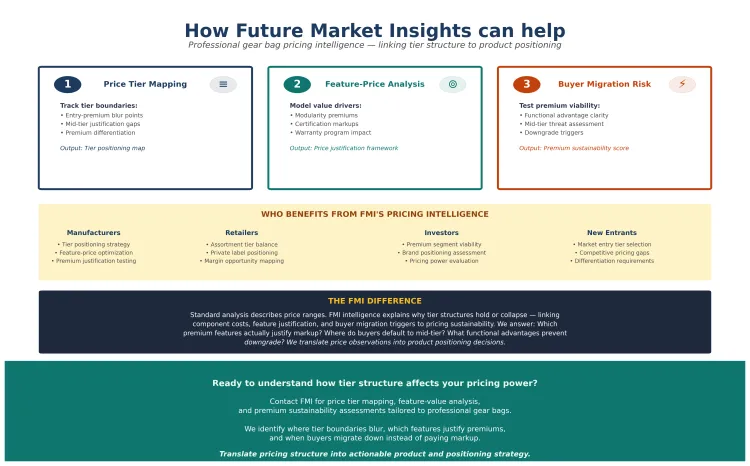
Future Market Insights can help clients in the professional gear bags space map where their current portfolio sits on the global price ladder and what drives that position. This includes benchmarking price bands across regions, decomposing ex-factory and retail prices into material, labour, overhead and brand components, and stress testing how changes in input costs or channel strategy would flow through to margins. By combining trade data, inflation and producer price indices with on-the-ground channel intelligence, FMI can support decisions on whether to compete as a high-value specialist, a robust mid-tier supplier or a volume player that borrows elements from professional design while staying close to mainstream backpack pricing.
Sources
- USA Bureau of Labor Statistics, Producer Price Index series for luggage and leather goods stores and related categories.
- Active and outdoor backpack market analyses that report price band shares and growth trends.
- Global luggage and bags market reports that segment by price range and channel.
- Industry commentary on the evolution of premium and mid-tier luggage, including design and pricing trends.
- Manufacturer and industry association materials describing technical backpack and camera bag construction and feature sets.

