


Key Takeaways
- Industrial ice cream is a tightly engineered dairy system. Pasteurisation, homogenisation, aging, continuous freezing and hardening tunnels define both quality and cost.
- In detailed plant-level studies, raw materials (milk, cream, sugar, stabilisers, inclusions and packaging) usually account for the majority of manufacturing cost, making procurement strategy the main profitability lever.
- Global demand is anchored in mature high-consumption markets like the USA and Europe, while India is in a build-out phase: low per-capita consumption but rapid capacity expansion and premiumisation.
- Recent investments - large automated plants, backward integration into cones and sleeves, and localised production in export markets - show capital chasing scale, supply-chain savings and proximity to demand.
- Energy-intensive freezing, hardening and cold-chain logistics are emerging cost and ESG pressure points, pushing manufacturers toward more efficient equipment and refrigerants.
- For investors and CEOs, the core story sits in four lines of the P&L: procurement cost, wages and salaries, other operating overheads and the profit margin that can be defended through brand, mix and utilisation.
- Comparing the USA, EU and India reveals three different strategic plays: mature indulgence, export-oriented scale and volume-led growth from a low base.
Ice cream as an engineered product, not just a treat
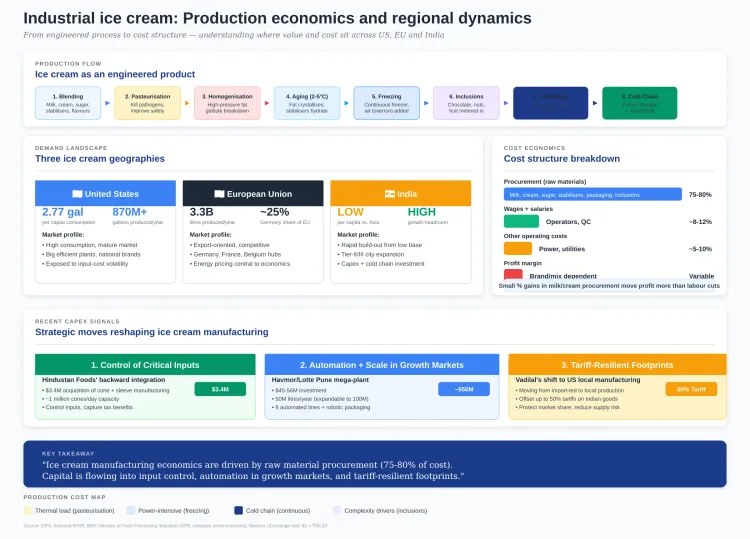
In an industrial setting, ice cream is built on a precise sequence of unit operations rather than a simple kitchen recipe. A liquid mix of milk, cream, sugar, stabilisers, emulsifiers and flavour bases is blended for consistency. That mix is pasteurised to kill pathogens and improve safety, then homogenised at high pressure to break fat globules into very fine particles and create a stable emulsion with a smoother mouthfeel.
The mix is then aged at low temperature, typically around 2-5 °C, so fat can crystallise and stabilisers can fully hydrate. This stage is critical for the body and texture of the finished product. Only after aging does the continuous freezer whip in air (overrun) while partially freezing the product. Inclusions such as chocolate pieces, nuts or fruit are metered in before the semi-frozen ice cream is extruded, filled and sent through hardening tunnels at deeply sub-zero temperatures.
Once hardened, the product moves into frozen storage and a temperature-controlled distribution chain. Every one of these stages has a cost footprint: stainless-steel processing lines, energy-intensive refrigeration, food-grade packaging and the cold-chain infrastructure required to keep quality intact until the point of sale.
Where demand sits today: from USA indulgence to India’s headroom
On the demand side, ice cream remains a resilient indulgence category. In the United States, industry statistics compiled from trade association data show annual per-capita frozen dairy consumption among the highest in the world and total ice cream output in the hundreds of millions of gallons each year. That supports large, efficient plants serving national brands and private labels through supermarkets, convenience stores and foodservice chains.
In the European Union, official production statistics indicate annual ice cream output in the billions of litres, with countries like Germany acting as major producers and exporters to neighbouring markets. European plants often run as regional hubs feeding cross-border retail and foodservice networks, which means that competitiveness, energy pricing and export logistics carry significant weight in plant economics.
India sits in a very different place on the curve. Policy and industry case studies describe a market shifting from seasonal, unorganised street vendors to a year-round, branded category supported by modern trade and dedicated cold chains. Per-capita consumption remains low compared with developed markets, but rising incomes, urbanisation and aggressive retail expansion are driving double-digit volume growth for organised players. For a manufacturer or investor, these three geographies translate into very different assumptions about volume, pricing power and capacity utilisation.
Comparing three ice-cream geographies: USA, EU and India
United States - high consumption, domestic scale
USA producers benefit from a large, relatively uniform market with well-developed supermarket and foodservice channels. High per-capita consumption underpins big, efficient plants that can run near optimal utilisation. The flipside is exposure to volatility in milk, cream and sugar prices, as well as wage and energy trends, which directly influence margins.
European Union - export-oriented and highly competitive
In the EU, overall output is comparable to or slightly below that of the USA in volume terms, but the structure is different. Several member states operate as export-oriented hubs, shipping significant volumes of ice cream across borders. Plant-level economics are therefore highly sensitive to energy costs, environmental regulation, and competition from both premium brands and aggressive private labels.
India - rapid build-out from a low base
India’s story is capacity creation and ecosystem building. Recent years have seen large investments in automated plants near major consumption clusters, often designed with room to double capacity as demand grows. At the same time, packaged cone and sleeve manufacturers are scaling to support both legacy brands and new entrants. Because per-capita consumption is still relatively low, the long-term upside is significant, but success depends on disciplined cold-chain execution and careful network design.
The production flow as a cost map
The technical flow inside the plant also provides a natural cost map. Preparation and pasteurisation require stainless-steel mix tanks, plate heat exchangers and homogenisers, along with steam or hot-water systems and automation. This is a major thermal load, which is why modern designs focus on regenerative heating and energy recovery.
Aging and freezing demand chilled storage and continuous freezers with robust refrigeration systems. Choice of compressor technology, refrigerants and control systems has a direct impact on both energy bills and environmental footprint. Hardening tunnels and deep-freeze storage need continuous operation at low temperatures, adding to base-load power demand and placing a premium on equipment reliability and maintenance practices.
Downstream, packaging formats such as sticks, cones, sandwiches and novelties introduce additional complexity. They require specialised molding, dosing and wrapping lines, but they can also justify higher per-unit prices and better margins when differentiated formats are executed well. For an investor, understanding where a plant sits on this equipment and energy curve is essential before forming a view on its cost base and upgrade requirements.
Cost structure: procurement, wages, other and margin
Government-linked project reports and academic studies on dairy processing plants converge on a similar pattern: raw material procurement is the single largest contributor to the cost of production, ahead of labour and utilities. In representative ice cream plant models, purchases of milk, cream, sugar, stabilisers, inclusions and packaging often account for the majority of manufacturing cost, with the remainder shared between wages, power and fuel, repairs and other overheads.
At a strategic level, it helps to group costs into four buckets:
- Procurement cost - all ingredients (dairy inputs, sweeteners, stabilisers, flavours, inclusions) and packaging, plus any energy purchased on a variable basis.
- Wages and salaries - operators, maintenance crews, quality and technical staff, and supervisory roles required to run the plant.
- Other operating costs - fixed and semi-fixed expenses including power and fuel, water, effluent treatment, cleaning chemicals, routine maintenance, quality systems, certifications, and cold-chain logistics.
- Profit margin - the return left after serving these costs, which depends on brand strength, product mix, channel strategy and utilisation.
In practical terms, this means that even small percentage improvements in ingredient yields, procurement terms or formulation efficiency can move the profit needle far more than modest changes in headcount. Labour and overhead absolutely matter, but procurement discipline and mix management are where most of the structural leverage sits.
Recent capex moves: what they signal about strategy
Recent investment announcements illustrate how industrial ice cream players are repositioning their cost and supply-chain footprints.
In India, one leading branded player backed by a global food group has committed hundreds of crores of rupees to a highly automated plant near Pune. Public commentary around the project highlights an initial capacity in the tens of millions of litres per year, with a design that allows the plant to double output as demand grows. Nine automated lines and robotic secondary packaging show a clear intent to capture scale efficiencies while maintaining flexibility across SKUs and formats.
In parallel, diversified contract manufacturers have been acquiring cone and sleeve facilities with capacities around one million cones per day. These moves are about backward integration into critical packaging components, capturing more of the value chain and de-risking supply for large-brand clients.
Elsewhere, established Indian brands active in export markets have announced plans to manufacture ice cream locally in North America, rather than relying solely on exports. Local production helps reduce exposure to import duties and shipping costs, shortens lead times and provides a more resilient base for serving mainstream and diaspora consumers in those markets.
Taken together, these strategies point to three themes: control over critical inputs, automation and scale in growth markets, and tariff-resilient footprints for international expansion.
How investors, CEOs and bankers should read this
For a C-level audience, the real value of this cost view lies in the decisions it unlocks. Three questions tend to matter more than the romance of flavours and brands.
- Can the plant secure milk, cream, sugar and key ingredients on competitive, reliable terms relative to its peers? Procurement excellence is not optional when ingredients dominate manufacturing cost.
- Is the capital investment aligned with realistic utilisation and product mix assumptions in its geography? Plants built for premium novelties behave very differently from plants focused on family tubs or contract manufacturing.
- How exposed is the cost base to energy, tariffs and logistics shocks? Location, energy efficiency and trade policy can reshape the profit and loss statement far faster than consumer trends alone.
Well-run ice cream manufacturers treat the category as a highly engineered, capital-intensive food system. The brands and flavours capture consumers’ emotions; the returns are written in procurement contracts, energy meters and utilisation curves.
How Future Market Insights (FMI) can help
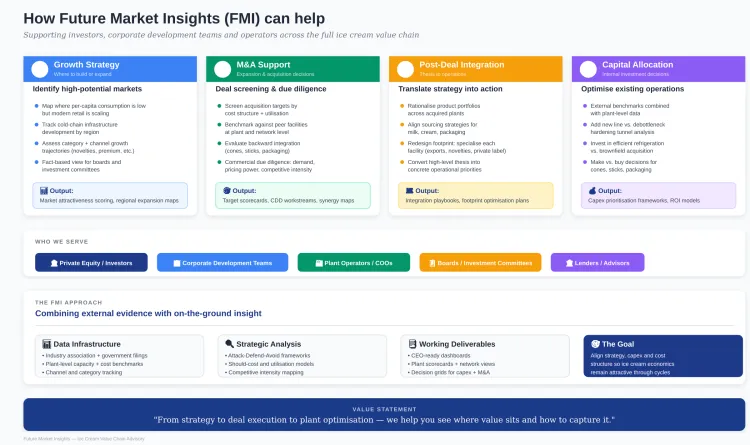
Future Market Insights can support investors, corporate development teams and operators across the full ice cream value chain, from strategy to deal execution and plant optimisation.
On the growth side, FMI can help identify which categories, channels and regions are likely to sustain demand for industrial ice cream capacity - for example, mapping where per-capita consumption is still low but modern retail and cold-chain infrastructure are scaling quickly. This work gives boards and investment committees a fact-based view of where new plants, additional lines or regional hubs are most likely to earn their cost of capital.
For expansion and acquisition decisions, FMI can build plant-by-plant and network-level views that combine external evidence with on-the-ground insight. That includes screening potential acquisition targets, benchmarking their cost structures and utilisation against peer facilities, and highlighting where backward integration into cones, sticks or packaging can genuinely improve economics. During deal processes, FMI can contribute to commercial due diligence, focusing on demand, pricing power, channel risk and competitive intensity around specific plants or networks.
Post-deal, FMI can work with management to translate a high-level investment thesis into concrete operational priorities. This might include rationalising product portfolios across acquired plants, aligning sourcing strategies, or redesigning the footprint so each facility plays to its strengths - for example, dedicating one plant to exports, another to novelties and a third to private-label tubs.
For existing operators, FMI can also support internal capital allocation. By combining external benchmarks with plant-level data, we help leadership teams decide whether to add a new line, debottleneck a hardening tunnel, invest in more efficient refrigeration, or pursue a brownfield acquisition instead. The goal is always the same: to align strategy, capex and cost structure so that the economics of industrial ice cream remain attractive through cycles, not just in good years.
Sources referenced
- Technical process descriptions: dairy processing handbooks and university training materials on ice cream manufacture (pasteurisation, homogenisation, aging, freezing, hardening).
- Plant-level cost structures: government-linked detailed project reports for ice cream and dairy plants, including cost breakdowns for raw materials, labour, power and overheads.
- Dairy manufacturing economics: academic studies on cost structure of milk and milk-product processing plants in India.
- USA and EU production and consumption: official statistics and trade-association summaries of ice cream output and per-capita frozen dairy consumption in the United States and European Union.
- India market and investment cases: policy case studies on India’s ice cream industry and public disclosures on recent greenfield plants, backward integration moves and local manufacturing initiatives by major brands.
- Energy and refrigeration: reports on ice-cream freezers and industrial refrigeration efficiency from international energy and refrigeration bodies, and technical notes from equipment suppliers.

