


Key Takeaways
- Organic cosmetics clear at visibly higher price points because the cost base is structurally inflated, and the addressable consumer base is narrower than attitude surveys suggest.
- The realistic premium that the market can absorb sits in the tens of percent; anything approaching 2x-3x prices pushes the category into a marginal niche.
- Cost drivers sit upstream: certified ingredients, restricted formulation levers, imported origin and weak scale economies.
- Downstream, channel mix and signalling amplify the premium rather than correct it.
- ASEAN demand is therefore segmented by economic capacity, not by stated ethical preference.
How are organic cosmetics priced versus conventional in ASEAN
An analyst’s starting point is the actual price ladder visible across modern trade, pharmacies and premium beauty retail. Organic cosmetics consistently occupy a premium tier above mass conventional SKUs.
Direct ASEAN price-premium datasets are limited, so the only workable approach is to triangulate from:
- observable shelf gaps,
- stated willingness-to-pay benchmarks from adjacent markets, and
- elasticity patterns in categories with similar safety and purity signalling.
When you anchor these three, you land in a realistic premium range of 15-30 percent for products that are genuinely organic and still intended for mainstream purchase. Korea’s quantified willingness-to-pay data is not ASEAN, but it provides a ceiling: if a wealthy, mature beauty market only clears a ~20 percent premium, it is unreasonable to assume materially higher sustainable premiums in ASEAN.
Behavioural filters reinforce this. Across Vietnam and Thailand, the gap between expressed interest and repeat purchase widens sharply once organic price levels exceed the comfort threshold of middle-income consumers. The pattern is economically consistent: consumers do not reject the concept, they reject the total wallet impact.
The implication is simple. If the premium stays within the moderate band, organic can coexist with mass offerings. If the premium drifts into multiples, the category collapses to a thin urban niche.
Why are organic cosmetics more expensive than conventional in ASEAN
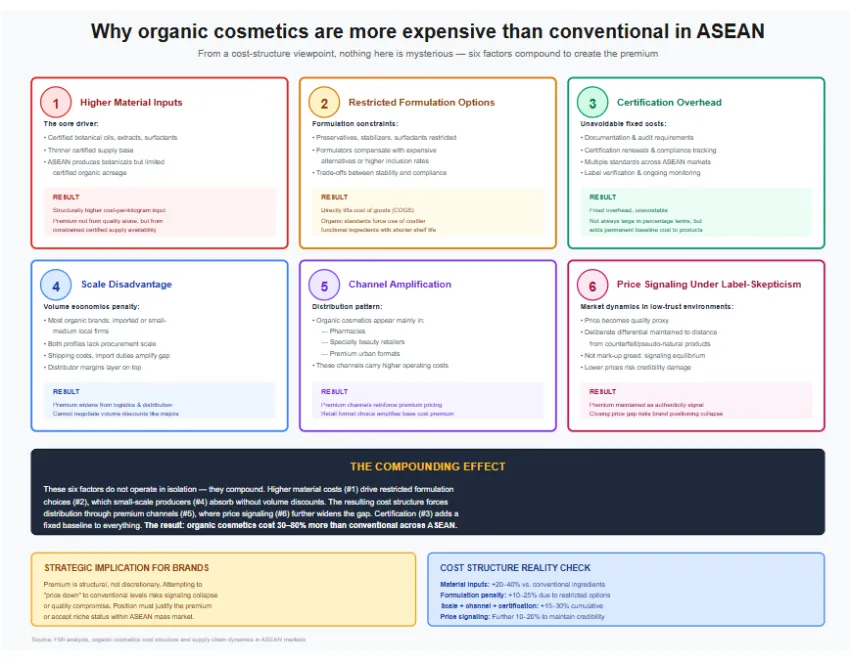
From a cost-structure viewpoint, nothing here is mysterious. Organic cosmetics carry:
- Higher material inputs
Certified botanical oils, extracts and surfactants come from thinner certified supply bases. ASEAN produces many botanicals, but its certified organic acreage is small. The result is a structurally higher cost-per-kilogram input. - Restricted formulation options
When preservatives, stabilisers or surfactants are restricted, formulators compensate with more expensive alternatives or higher inclusion rates. This directly lifts cost of goods. - Certification overhead
Documentation, audits, renewals and compliance processes add a fixed overhead. It is not always large in percentage terms, but it is unavoidable. - Scale disadvantage
The bulk of fully organic cosmetic brands in ASEAN are either imported or produced by small to medium local firms. Both profiles lack procurement scale. Shipping, duties, and distributor margins further widen the premium. - Channel amplification
Organic cosmetics appear mainly in pharmacies, specialty beauty retailers and premium urban formats. These channels carry higher operating costs, so they reinforce the premium. - Price signalling under label-scepticism
In low-trust environments, price itself becomes a quality proxy. Brands maintain a deliberate differential to distance themselves from counterfeit or pseudo-natural products. This is not mark-up greed; it is a signalling equilibrium.
Sources
- ScienceDirect. (2020). Organic and green cosmetics perception and price barriers in ASEAN.
- ScienceDirect. (2019). Value and quality drivers in organic personal care.
- ResearchGate. (2018). Contingent valuation of organic cosmetics price premiums.
- amj.kma.re.kr. (2022). Economic constraints on willingness to pay for eco friendly goods.
- MDPI. (2021). Price elasticity in emerging-market green cosmetics.
- Bain and Company. (2023). Asia Pacific sustainable consumption behaviour survey.
- ScienceDirect. (2020). Cost structure challenges for small-scale organic cosmetic brands.

