


Key Takeaways
- Connectivity gaps are no longer only about coverage. In many MENA countries, mobile broadband is widely available, but fixed broadband quality, affordability and rural access still lag, creating a structural ceiling on what can be digitised.
- Regulatory bottlenecks from the early broadband era persist: dominant incumbents, slow opening of wholesale markets and incomplete competition rules keep prices high and investment patterns skewed, especially outside the Gulf.
- Public sector digital projects often sit in silos led by IT departments rather than by centre of government, which limits integration of data, slows process redesign and weakens the link between digital spending and real productivity gains.
- Human capital and institutional capability are uneven. A few hubs have strong digital skills and ecosystems, but many administrations and SMEs still lack the mix of management, technical and change skills needed to absorb cloud, data and AI at scale.
- Trust, data governance and political risk act as quiet brakes. Unclear data protection rules, cyber security concerns, fragmented identity systems and, in some cases, conflict and fiscal pressure all reduce the willingness of firms and citizens to shift from paper and cash to fully digital processes.
How far has MENA actually come on digital infrastructure and usage
ITU and World Bank data show that the Arab States as a group have made steady progress: mobile cellular coverage is now close to universal and mobile broadband reaches most of the population, but internet usage still ranges from near universal in some Gulf states to well under half in parts of North Africa and fragile economies. Fixed broadband penetration, international bandwidth per user and average speeds lag OECD benchmarks in many markets.
The infrastructure map is highly unequal. Gulf countries have moved ahead with fibre rollout, 5G and data centres. Several North African and Levant economies still depend on older copper access networks, limited competition in backbones and international gateways, and a patchy last mile. The World Bank’s broadband work on MENA highlighted, years ago, that structural bottlenecks in wholesale markets, rights of way and access to alternative infrastructure were depressing investment and keeping prices high. Those legacies have not disappeared everywhere.
The implication for digital transformation is straightforward. For consumer services and basic e government, mobile works as a bridge. For enterprise cloud workloads, data intensive public services and serious industry 4.0, you still need reliable, affordable fixed broadband and domestic content infrastructure. Where that is missing, the digital roadmap has an invisible speed limit, no matter how ambitious the vision document looks.
How do these constraints differ across the region?
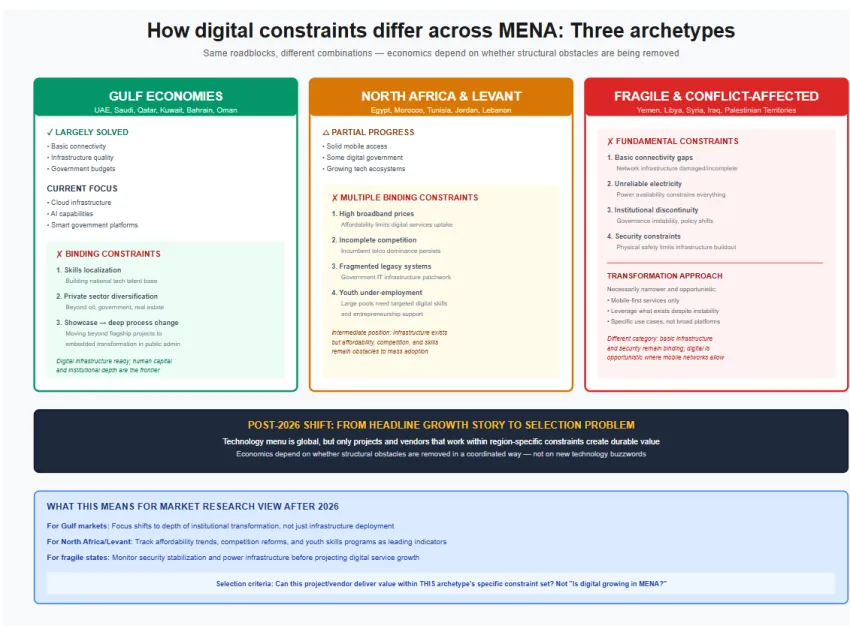
Where do the structural roadblocks actually sit?
The hard problems are now less physical and more institutional and economic. A few of the more important ones:
First, regulation and market structure. Early telecom liberalisation in MENA was partial. Many countries opened mobile retail competition but left backbone and wholesale markets under tight control of state incumbents. The World Bank’s broadband diagnostics for the region point to limited infrastructure sharing, slow licensing of alternative backbones and opaque spectrum policies as persistent drags on competition and investment.
Second, public sector digital maturity. OECD benchmarking of digital government in Egypt, Jordan, Lebanon, Morocco, Tunisia and the UAE finds that most have adopted strategies and portals, but less progress has been made on integrated digital identity, shared data platforms, cross ministry governance and systematic process redesign. Many digital programmes remain IT led, project based and weakly connected to core public administration reforms. That produces islands of e services rather than a full digital state.
Third, capacity and skills. ESCWA and UNDP work on the Arab region stresses that underdeveloped infrastructure combines with large disparities in human capabilities, from basic digital literacy to advanced data and cyber skills. Governments struggle to recruit and retain experienced digital talent, and SMEs often lack the internal skills to absorb cloud, analytics and automation tools even when the technology is available. The result is a productivity gap between a small set of frontier firms and a long tail of low digital intensity enterprises.
Fourth, SME structure and informality. In many MENA economies, small and micro firms dominate employment. They operate with thin margins, limited bookkeeping, heavy reliance on cash and, in some cases, semi formal status. Digital transformation for these firms is not just an IT upgrade. It implies tax visibility, new compliance obligations and exposure to cyber risk. Without targeted incentives, finance and business support, many will rationally delay serious digitisation, which slows diffusion of digital tools through the broader economy.
Fifth, data governance, trust and open government. ESCWA’s work on the digital divide and open government in the Arab region underlines that access gaps intersect with limited progress on open data, citizen participation and transparent digital processes. Where citizens do not trust that their data will be protected or used fairly, uptake of e services and digital payments stays below potential, even if the technical platforms exist. Cyber incidents and misinformation also erode confidence.
Sixth, macro, fiscal and political constraints. Several MENA countries face tight fiscal space, high debt and, in some cases, conflict or post conflict conditions. That constrains public investment in broadband, digital government and skills, and raises risk premia for private investors in data centres and cloud. ESCWA notes that fiscal and institutional fragilities limit the capacity to leverage digital technologies across all seven policy areas it tracks, from infrastructure to e applications.
Sources
- International Telecommunication Union. (2021). Digital trends in the Arab States region 2021. ITU.
- World Bank. (2014). Broadband networks in the Middle East and North Africa: Accelerating high speed internet access. World Bank.
- United Nations Economic and Social Commission for Western Asia. (2017). Arab Horizon 2030: Digital technologies for development. ESCWA.
- Organisation for Economic Co operation and Development. (2017). Benchmarking digital government strategies in MENA countries. OECD Publishing.
- United Nations Development Programme. (2023). Why digital for sustainable development in the Arab region. UNDP.
- Internet Society. (2024). Connectivity in the Middle East and North Africa: An overview of internet infrastructure, access and inclusion. Internet Society.
- Economic and Social Commission for Western Asia. (2020). The digital divide and open government in the Arab region. ESCWA.

