


Key Takeaways
- For primary total hip arthroplasty, large registry data shows similar all cause revision rates for 3D printed cups versus established cups.
- A well cited clinical series reports slightly higher 7 year survival for 3D printed acetabular cups versus a comparator group.
- For primary total knee arthroplasty, multiple cohorts report high survivorship for cementless systems using 3D printed porous tibial components, including 10 year data.
- Most revisions in published knee cohorts occur early, and late aseptic loosening appears uncommon once early fixation is achieved.
- Failures that do occur are usually about fixation mechanics, alignment, infection, or rare structural fatigue, not about the concept of additive manufacturing itself.
- The evidence base is deepening fast, but it is still concentrated in a limited set of widely used designs and health systems with strong registry capture.
What does success ratio actually mean for hip and knee implants?
In orthopedics, success is not a vibe, it is an endpoint. The cleanest definition is revision free survivorship, meaning the implant stays in place without needing a revision operation over a defined follow up window. Many studies also report survivorship for a specific failure mode such as aseptic loosening, because loosening is the problem 3D printed porous structures are most directly trying to reduce through better bone ingrowth. Other outcomes matter, like pain relief, function scores, radiographic fixation, and migration measured by radiostereometric analysis, but revision is the hardest endpoint and the most comparable across systems.
This matters because 3D printed is a manufacturing method, not a clinical indication. A 3D printed porous acetabular cup used in a straightforward primary hip replacement is a very different stress test than a custom or highly porous cup used to rebuild major bone loss in revision surgery. Mixing those populations and asking for one success ratio is like mixing city cars and rally cars and then grading the engine block. You can do it, but you will fool yourself unless you stratify by indication and difficulty.
The best global reality check comes from national registries, because they capture large numbers across many surgeons, hospitals, and patient types. Registries are not perfect, they can miss nuance like subtle radiographic loosening or the exact manufacturing method, and they can be confounded by who gets which implant, but they are excellent at answering one question: what happens at scale in real life. When registry signals and clinical cohort signals point the same way, you can be more confident that the observed success ratio is not just a single center success story.
How successful are 3D printed hip implants in primary and revision surgery?
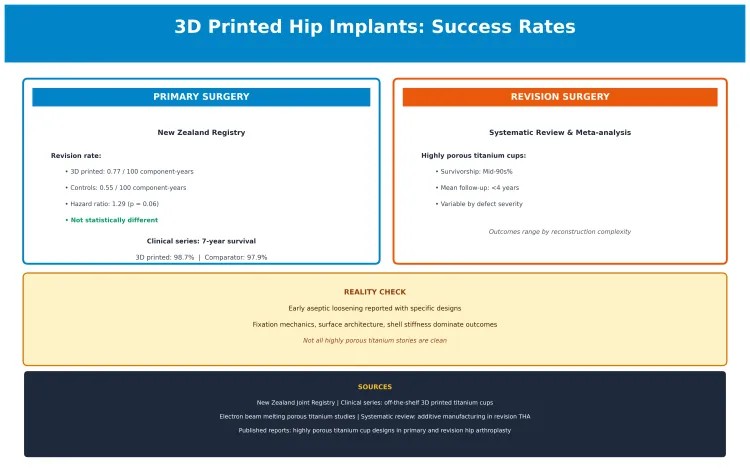
For primary total hip arthroplasty, the most useful global data point is the New Zealand registry comparison of 3D printed uncemented acetabular components versus established uncemented cups. The key finding is simple: the all cause revision rate for 3D printed cups was not statistically different from controls. The reported revision rates were 0.77 per 100 component years for 3D printed cups versus 0.55 for controls, with a hazard ratio around 1.29 and a p value near 0.06. The 3D printed cups were used in younger, fitter patients with higher average BMI, which is exactly why registry comparisons matter. They show you what happens when a new technology lands in a real selection environment rather than a perfectly matched lab world.
Clinical series add texture. One widely cited experience with off the shelf 3D printed titanium cups reported non stratified 7 year survival of 98.7 percent for the 3D printed cups versus 97.9 percent for the comparator group. That is a small absolute difference, but it is directionally reassuring because it does not show a penalty for the printed porous architecture. Another midterm series of electron beam melting porous coated titanium cups in primary hip arthroplasty reports strong satisfaction, good clinical function, and excellent survivorship, which is consistent with the broader cementless cup literature.
Now the honest part: not every highly porous titanium cup story is clean. There are published reports of early aseptic loosening and concerning radiographic loosening patterns with specific highly porous titanium cup designs. That does not prove 3D printing is the culprit. It suggests that early fixation mechanics, surface architecture, shell stiffness, liner locking design, and surgical technique can dominate the outcome even when the porous surface is theoretically pro ingrowth. In revision hip surgery, where bone loss is the whole game, outcomes are naturally more variable. A recent systematic review and meta analysis focused on off the shelf highly porous titanium cups made with additive manufacturing in revision total hip arthroplasty reports survivorship around the mid 90s over a mean follow up under four years, while individual complex reconstruction cohorts can range lower or higher depending on defect severity and whether additional augmentation is needed.
Do 3D printed knee components improve durability, or just shift the risk profile?
Knees are where the 3D printed story has gotten unusually concrete, because several cohorts report survivorship for cementless total knee arthroplasty systems using 3D printed porous tibial components. A midterm cohort reports overall survivorship about 97 percent with aseptic loosening survivorship about 98.4 percent, and the survivorship of the 3D printed tibial component itself about 99.5 percent. Ten year data from a 3D printed cementless total knee system reports overall survivorship 96.5 percent at 10 years, survivorship for aseptic loosening 98.2 percent, and tibial component survivorship about 99.1 percent, with an important pattern: revisions clustered in the first two years and no new loosening identified after two years. Another minimum 10 year follow up study of a current generation cementless highly porous titanium tibial baseplate reports survivorship of 96.7 percent with high satisfaction, which is a very respectable real world number for long follow up arthroplasty.
Mechanistically, the best evidence that a cementless porous tibial component is doing its job is stabilization of early migration. In a randomized controlled trial using radiostereometric analysis, a cementless 3D printed tibial component and a cemented tibial component with otherwise similar design showed no differences in migration at five years, with the cementless component continuing to stabilize over time. That is the kind of signal surgeons care about because early migration that does not settle is a known warning sign for later loosening.
The risk profile is not zero. Rare structural failures exist. A case series documents early fatigue fractures of a cementless 3D printed highly porous titanium tibial component, which is a reminder that porous architecture and load transfer have to be engineered for worst case alignment and patient loading, not the average case. Also, demand is not evenly spread. Cementless TKA has been rising in the United States, and registry based discussions increasingly focus on fixation type as an important driver of revision risk by patient subgroup. Expect the 2026 to 2036 demand to be pulled by younger patients, higher BMI cohorts, and surgeons looking for durable biologic fixation, while cemented fixation remains the default in many systems because it is familiar, forgiving, and well understood.
How FMI can Help
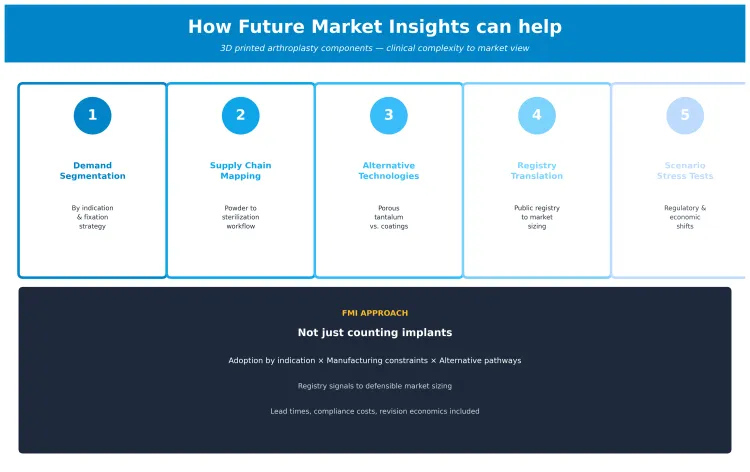
FMI can help you turn this clinical and regulatory complexity into a decision grade market view. For 3D printed arthroplasty components, the key is not just counting implants, it is mapping adoption by indication and by fixation strategy, then linking that to the manufacturing and quality control constraints that actually govern supply. We can segment demand by primary versus revision volumes, cemented versus cementless preference, age and BMI cohorts that correlate with cementless adoption, and regional differences driven by reimbursement, registry culture, and surgeon training pathways.
On the supply side, we can map the additive manufacturing value chain from titanium powder and powder bed fusion capacity to post processing, inspection, sterilization, and regulatory documentation workflows, then identify where lead times and compliance costs concentrate. We can also benchmark alternative technologies that compete for the same clinical promise, such as porous tantalum, conventional porous coatings, improved cementing techniques, and hybrid fixation approaches. Finally, FMI can translate public registry signals and peer reviewed evidence into market sizing assumptions you can defend, including scenarios that stress test what happens if a few implant designs dominate share, if regulatory scrutiny tightens on process validation, or if hospitals shift preference based on revision cost economics.
Bibliography
- Wyatt, M. C., Hooper, G. J., Frampton, C., & Rothwell, A. G. 2022. How do 3D printed primary uncemented acetabular components compare with established uncemented cups. Experience of the New Zealand National Joint Registry.
- Castagnini, F., Caternicchia, F., Biondi, F., Masetti, C., Faldini, C., & Traina, F. 2021. Off the shelf 3D printed titanium cups in primary total hip arthroplasty.
- Huang, Y., Zhou, Y. X., Tian, H., Wang, J. W., Liu, W. G., & Li, H. 2021. Minimum 7 year follow up of a porous coated trabecular titanium cup manufactured with electron beam melting technique in primary total hip arthroplasty. Orthopaedic Surgery. doi: 10.1111 os.12846
- Long, W. J., Dorr, L. D., Healy, B., Perry, K., Wan, Z., & Sirianni, L. 2018. Aseptic loosening of the Tritanium primary acetabular component. A retrospective cohort study.
- Bingham, J. S., Spitler, C. A., Arianjam, A., Abboud, J., & Nam, D. 2022. Radiographic loosening of a highly porous titanium acetabular component.
- Hosny, H. A., & Keenan, J. 2018. Highly porous titanium cups in revision hip arthroplasty. Outcomes and survivorship.
- Berlinberg, E. J., Anastasio, A. T., Orozco, F., Ong, A. C., & Schwarzkopf, R. 2022. Two year outcomes of a novel fully porous acetabular shell in revision total hip arthroplasty.
- Shichman, I., & Gkiatas, I. 2022. Outcomes of novel 3D printed fully porous titanium cup and cemented liner construct in revision total hip arthroplasty.
- Almeida, P. R., & colleagues. 2025. The use of highly porous 3D printed titanium acetabular implants in revision total hip arthroplasty. Systematic review and meta analysis.
- Sultan, A. A., et al. 2020. Short term results of cementless 3D printed titanium tibial baseplate in primary total knee arthroplasty.
- Restrepo, S., et al. 2021. Excellent mid term follow up for a new 3D printed cementless total knee arthroplasty.
- Zappley, N. R., et al. 2025. 10 year follow up for a new three dimensional printed cementless total knee arthroplasty.
- Stoltz, M. J., et al. 2025. Primary total knee arthroplasty using a cementless highly porous titanium tibial baseplate. Minimum 10 year follow up.
- van der Lelij, T. J. N., et al. 2023. Continued stabilization of a cementless 3D printed total knee arthroplasty. Five year randomized controlled trial using radiostereometric analysis. Journal of Bone and Joint Surgery.
- Lam, A. D., & Duffy, G. P. 2022. Early tibial component fractures in a cementless 3D printed titanium implant. Arthroplasty Today.
- King, B. A., et al. 2023. Cementless total knee arthroplasty using a highly porous tibial baseplate in morbidly obese patients. Five year outcomes.
- Mikashima, Y., et al. 2025. Low frequency of radiolucent lines in 3D printed porous coated tibial cementless baseplate at one year follow up.
- Roth, S., et al. 2024. Uncemented total knee arthroplasty is on the rise.
- American Academy of Orthopaedic Surgeons, American Joint Replacement Registry. 2024 Annual Report.
- American Academy of Orthopaedic Surgeons. 2024 AJRR Annual Report Highlights.
- New Zealand Orthopaedic Association, New Zealand Joint Registry. Twenty five year report.
- Australian Orthopaedic Association National Joint Replacement Registry. 2024 Annual Report.
- National Joint Registry for England, Wales, Northern Ireland and the Isle of Man. Annual Report 2024.
- LROI, Dutch Arthroplasty Register. Annual Report 2024.
- Swiss National Hip and Knee Joint Registry SIRIS. Annual Report 2024.
- US Food and Drug Administration. 2017. Technical considerations for additive manufactured medical devices. Guidance for industry and FDA staff. USA Food and Drug Administration+1
- International Medical Device Regulators Forum. 2018. Definitions for personalized medical devices. IMDRF PMD WG N49. IMDRF+1
- ISO. 2021. ISO ASTM 52900 additive manufacturing general principles fundamentals and vocabulary. ISO+1

