

- Industry Size (2025)
- USD 27.8 Mn
- Forecast (2035)
- USD 84.0 Mn
- CAGR (2025 to 2035)
- 11.7%
Demand for 3D Printed Surgical Models in Japan Forecast and Outlook 2025 to 2035
Demand for 3D printed surgical models in Japan is projected to grow from USD 27.8 million in 2025 to USD 84.0 million by 2035, reflecting a compound annual growth rate (CAGR) of 11.7%. This growth is driven by the increasing adoption of 3D printing technology in healthcare, especially in surgical planning, medical education, and personalized patient care. 3D printed surgical models allow for more precise preoperative planning, enabling surgeons to better understand the anatomy of their patients and improve surgical outcomes. As healthcare providers and hospitals seek more advanced and customized solutions for complex surgeries, the demand for 3D printed surgical models is expected to increase significantly.
The market is also supported by technological advancements in 3D printing materials, such as biocompatible and durable substances, and the growing acceptance of digital healthcare solutions. Japan’s advanced healthcare infrastructure and ongoing investment in medical technology further drive the adoption of 3D printed surgical models, making them an essential tool in modern medicine. As the technology becomes more cost-effective and accessible, its integration into surgical workflows is expected to expand over the next decade.
Quick Stats of the Demand for 3D Printed Surgical Models in Japan
- Demand for 3D Printed Surgical Models in Japan Value (2025): USD 27.8 million
- Demand for 3D Printed Surgical Models in Japan Forecast Value (2035): USD 84.0 million
- Demand for 3D Printed Surgical Models in Japan Forecast CAGR (2025 to 2035): 11.7%
- Demand for 3D Printed Surgical Models in Japan Leading Product: Organ Models (43%)
- Demand for 3D Printed Surgical Models in Japan Key Growth Regions: Kyushu & Okinawa, Kanto, Kansai, Chubu, Tohoku, Rest of Japan
- Demand for 3D Printed Surgical Models in Japan Key Players: 3D LifePrints, 3D Systems, Axial3D, Materialise, Anatomiz3D
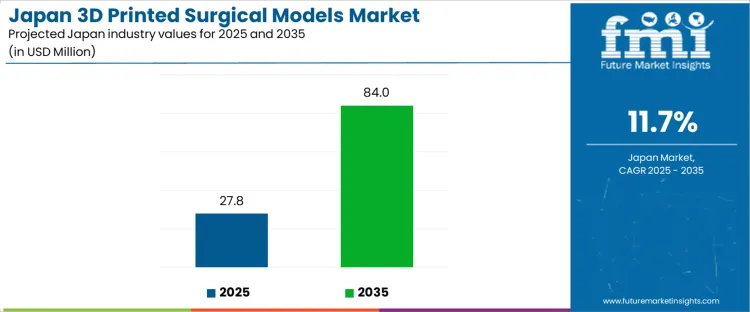
What is the Growth Forecast for the 3D Printed Surgical Models Market through 2035?
The peak-to-trough analysis of the 3D printed surgical models market in Japan shows steady growth with clear acceleration in the later stages of the forecast period. Starting at USD 27.8 million in 2025, the market grows to USD 31.0 million in 2026 and USD 34.7 million in 2027, indicating a gradual increase in demand driven by early adoption in specialized medical fields and the growing recognition of the benefits of 3D printed models for surgical planning.
In the following years, from 2027 to 2030, the market continues to rise steadily, reaching USD 38.7 million in 2028, USD 43.2 million in 2029, and USD 48.3 million in 2030. This period represents the maturation of the technology as it gains wider acceptance in hospitals, academic institutions, and clinics. By 2032, the market shows a noticeable acceleration, reaching USD 53.9 million and continuing to rise at a faster pace to USD 60.3 million in 2033 and USD 67.3 million in 2034. The final peak occurs in 2035, with the market reaching USD 84.0 million, reflecting full-scale adoption and integration of 3D printed surgical models into routine clinical practice. The analysis suggests that while the market grows steadily in the early years, the real acceleration happens as the technology becomes increasingly widespread and more critical to surgical practices, culminating in a significant rise toward the end of the forecast period.
Key Takeaways of 3D Printed Surgical Models Industry in Japan
| Metric | Value |
|---|---|
| Industry Sales Value (2025) | USD 27.8 million |
| Industry Forecast Value (2035) | USD 84 million |
| Industry Forecast CAGR (2025 to 2035) | 11.7% |
What Is Driving the Demand for 3D Printed Surgical Models in Japan?
The demand for 3D printed surgical models in Japan has been shaped by rising use of additive manufacturing in healthcare and growing complexity of surgical procedures. Hospitals and surgical centres have come to adopt patient specific anatomical models for preoperative planning, especially in specialties such as orthopedics, neurosurgery and reconstructive surgery. Use of these models supports visualization of patient anatomy derived from imaging data, which assists surgeons in planning complex operations and reduces intraoperative uncertainty. Medical institutions have increasingly accepted these models as tools to improve surgical precision, reduce operative time, and lower risks associated with interventions. The trend toward personalized medical solutions, combined with availability of 3D printing equipment and materials suitable for medical use, has encouraged gradual adoption across surgical disciplines in Japan.
Future demand for 3D printed surgical models in Japan is likely to rise significantly as adoption spreads across more surgical specialties and as the overall 3D printing in healthcare market expands. Growth will be supported by increasing demand for customized implants, complex reconstructions, and patient specific preoperative simulations. As technologies evolve-improved 3D printing methods, better biocompatible materials, enhanced imaging to model workflows-the utility of printed models will broaden. The trend toward minimally invasive and precision surgery will encourage wider use of models. The nascent demand in neurosurgery and reconstructive surgery is expected to grow faster, while orthopedics will likely remain a major segment. Long term demand will depend on integration of 3D printing into routine hospital workflows, cost effectiveness, and acceptance by surgical professionals and regulators.
What Are the Key Segments in 3D Printed Surgical Models Market in Japan?
The 3D printed surgical models market in Japan is segmented by product type and technology. Organ models lead the product segment, holding 43% of the market share. In terms of technology, stereolithography 3D printing is the dominant method, accounting for 30% of the market. The growing demand for personalized medicine and advanced surgical planning is driving the adoption of 3D printed surgical models in Japan, particularly in the fields of complex surgeries and preoperative planning.
Which Product Drives 3D Printed Surgical Models Demand in Japan?
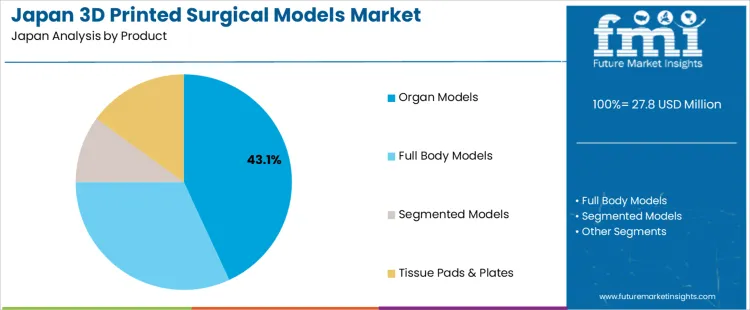
Organ models are the leading product type in the 3D printed surgical models market in Japan, representing 43% of the market share. These models are used for preoperative planning, allowing surgeons to visualize complex anatomical structures before performing procedures. Organ models provide highly accurate representations of individual patient anatomy, making them essential for improving surgical outcomes, particularly in delicate and intricate surgeries. They are widely used in fields such as neurosurgery, orthopedic surgery, and cardiology. The demand for organ models is driven by their ability to aid in surgical precision, reduce the risk of complications, and enhance patient-specific treatment planning. While full body models, segmented models, and tissue pads & plates also contribute to the market, organ models remain the most commonly used due to their critical role in personalized medical approaches.
Which Technology Drives 3D Printed Surgical Models Demand in Japan?
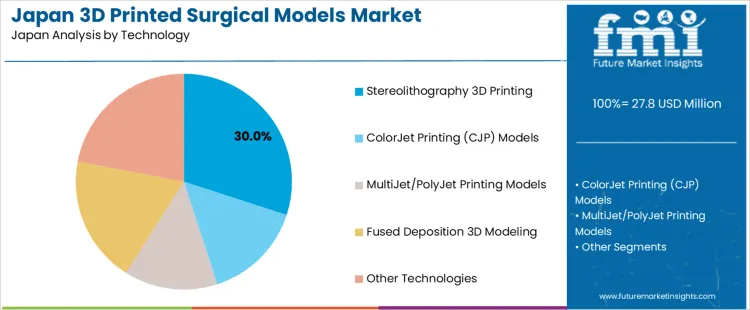
Stereolithography 3D printing is the most widely used technology in the 3D printed surgical models market in Japan, holding 30% of the market share. Stereolithography (SLA) allows for the creation of highly detailed, accurate, and durable models by using a laser to cure liquid resin into solid structures. This technology is preferred for its high resolution and precision, making it ideal for producing intricate organ models that require high anatomical accuracy. SLA is particularly valued in the medical field for its ability to replicate the fine details of human tissues and organs. While ColorJet Printing (CJP), MultiJet/PolyJet printing, and fused deposition 3D modeling are also used for creating 3D models, stereolithography remains the leading choice for surgical model production due to its superior resolution, which is essential for detailed surgical planning and simulation.
What is the Demand for 3D Printed Surgical Models in Japan?
The demand for 3D printed surgical models in Japan is increasing as advancements in 3D printing technology offer new possibilities in pre-surgical planning, education, and patient-specific care. These models, created from patient imaging data, are used by surgeons to better understand complex anatomical structures before performing surgeries. The growing focus on personalized medicine and the increasing complexity of surgeries, such as those involving tumors, complex fractures, or congenital conditions, is driving the adoption of 3D printed models in Japan. As the healthcare system strives for greater precision and improved patient outcomes, the demand for these innovative tools is expected to grow.
What are the Drivers of Demand for 3D Printed Surgical Models in Japan?
Several factors are driving the demand for 3D printed surgical models in Japan. First, the increasing complexity of surgeries, particularly in orthopedics, neurosurgery, and cardiovascular procedures, is creating a need for detailed and accurate pre-surgical planning tools. 3D printed models help surgeons visualize patient-specific anatomy and plan interventions more precisely, reducing surgical risks and improving outcomes. Second, Japan’s healthcare system is focusing on personalized medicine, where treatments are tailored to individual patients, further driving the demand for 3D models that reflect a patient's unique anatomy. Third, the rising adoption of minimally invasive surgeries, which require a high degree of precision and planning, is contributing to the increased use of 3D printed models to facilitate these procedures. Finally, the growing investment in medical technology and the availability of more affordable 3D printing solutions are making these models more accessible to healthcare providers.
What are the Restraints on Demand for 3D Printed Surgical Models in Japan?
Despite the growing demand, several challenges may limit the adoption of 3D printed surgical models in Japan. One major restraint is the high cost of 3D printing technology and the associated materials, which can make the creation of these models expensive for some healthcare providers, particularly smaller hospitals or clinics. Another challenge is the time required to create 3D models, as the process of converting imaging data into a printable format and producing the model can take time, potentially delaying urgent surgeries. Additionally, the need for specialized expertise and training in 3D printing technology and anatomical modeling can limit its use in some healthcare settings. Lastly, while 3D printed models can provide valuable insights for complex surgeries, they may not be applicable or necessary for all types of procedures, limiting their widespread use across various surgical specialties.
What are the Key Trends Influencing Demand for 3D Printed Surgical Models in Japan?
Several key trends are shaping the demand for 3D printed surgical models in Japan. One significant trend is the growing use of 3D printing in personalized medicine, where models are created based on individual patient data to plan surgeries and improve treatment outcomes. Another trend is the increasing use of 3D printed models in medical education, where they serve as valuable teaching tools to help students and practitioners understand complex anatomy and practice surgical techniques. The rise of digital health technologies, such as advanced imaging and 3D modeling software, is also driving the demand for 3D printed models, as these tools enhance the precision and efficiency of surgical planning. Additionally, the expanding use of 3D printed models in pre-surgical simulations and patient communication is encouraging their adoption, as they help improve patient understanding of their conditions and the proposed procedures. Lastly, the reduction in the cost of 3D printing technology is making it more accessible to a broader range of healthcare providers, further driving its use in surgical planning.
What is the Regional Demand Outlook for the 3D Printed Surgical Models Market in Japan?
The 3D Printed Surgical Models market in Japan is expected to experience significant growth, with Kyushu & Okinawa leading the way at a projected CAGR of 14.6%. Kanto follows with a growth rate of 13.5%, while Kansai is expected to grow at 11.8%. Chubu is projected to grow at a rate of 10.4%, while Tohoku and Rest of Japan show more moderate growth, with CAGRs of 9.1% and 8.7%, respectively. As the use of 3D printing in the medical field continues to gain traction for applications such as pre-surgical planning, medical training, and patient-specific modeling, the demand for 3D printed surgical models is expected to rise across Japan.
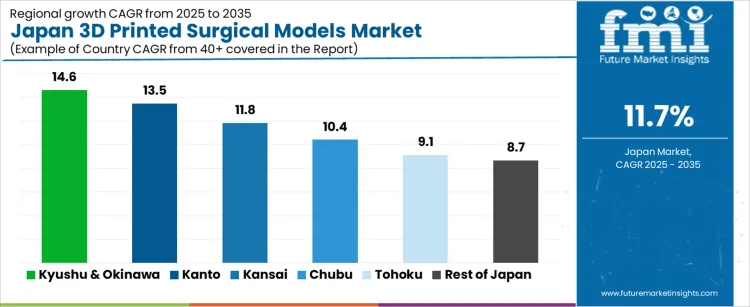
| Region | CAGR (2025-2035) |
|---|---|
| Kyushu & Okinawa | 14.6% |
| Kanto | 13.5% |
| Kansai | 11.8% |
| Chubu | 10.4% |
| Tohoku | 9.1% |
| Rest of Japan | 8.7% |
What is Driving the Growth of 3D Printed Surgical Models in Kyushu & Okinawa?
Kyushu & Okinawa is projected to experience the highest growth in the 3D Printed Surgical Models market, with a projected CAGR of 14.6%. The region's increasing adoption of advanced medical technologies, particularly in surgical planning and patient-specific modeling, is a key driver of this growth. Healthcare providers in Kyushu & Okinawa are embracing 3D printing to improve the accuracy and precision of surgeries, especially for complex procedures. The region's aging population, which often requires specialized surgical interventions, is further contributing to the rise in demand for customized surgical models. As hospitals and medical institutions in the region continue to invest in 3D printing technologies to enhance surgical outcomes, the market for 3D printed surgical models is expected to grow rapidly.
Why is the 3D Printed Surgical Models Market Expanding in Kanto?
In Kanto, the demand for 3D printed surgical models is projected to grow at a CAGR of 13.5%. Kanto, home to Japan's capital Tokyo, has a well-developed healthcare infrastructure and is a leader in the adoption of innovative medical technologies. The use of 3D printed surgical models in Kanto is growing rapidly, driven by the need for precision in complex surgeries and personalized medical treatments. Major hospitals and medical centers in Tokyo and surrounding areas are increasingly utilizing 3D printing for pre-surgical planning and simulation, which allows surgeons to visualize and practice procedures before performing them. Additionally, Kanto's large number of medical research institutions is contributing to the region's continued investment in 3D printing technology, further fueling the demand for surgical models.
How is the 3D Printed Surgical Models Market Growing in Kansai?
In Kansai, the 3D Printed Surgical Models market is projected to grow at a CAGR of 11.8%. The region, which includes cities like Osaka, Kyoto, and Kobe, has a well-established healthcare system with increasing adoption of 3D printing in medical procedures. Hospitals and medical institutions in Kansai are incorporating 3D printed models into their surgical planning processes to improve the accuracy and outcomes of complex surgeries. Kansai’s emphasis on improving healthcare services and adopting new technologies is driving the demand for personalized surgical models, particularly in fields such as orthopedics, cardiology, and neurosurgery. The growing recognition of the benefits of 3D printing in reducing surgery time and enhancing patient safety is further supporting the expansion of the market in Kansai.
What is Contributing to the Growth of 3D Printed Surgical Models in Chubu?
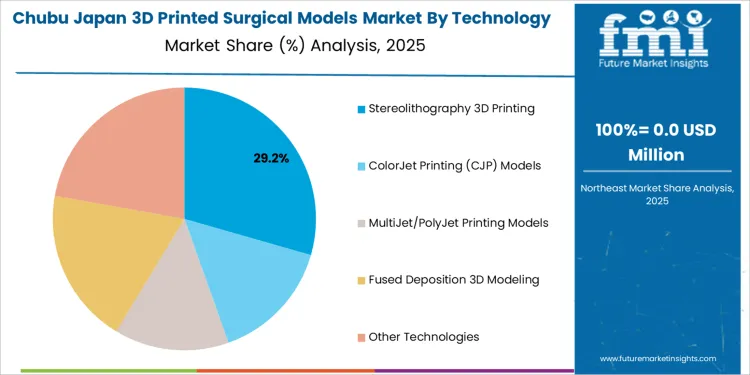
In Chubu, the 3D Printed Surgical Models market is expected to grow at a CAGR of 10.4%. The region, which includes cities like Nagoya, is investing heavily in healthcare technology to improve the quality of care provided to patients. Chubu’s healthcare providers are increasingly adopting 3D printed models for surgical planning, particularly in complex surgeries where traditional methods of planning may not be sufficient. The rise in the number of patients requiring specialized surgical interventions, combined with the increasing availability of 3D printing technology in hospitals and clinics, is driving the demand for 3D printed surgical models in Chubu. As the healthcare sector continues to evolve, the market for 3D printed models is expected to expand in the region.
What is Influencing the Growth of 3D Printed Surgical Models in Tohoku?
In Tohoku, the 3D Printed Surgical Models market is projected to grow at a CAGR of 9.1%. While the growth rate is more moderate compared to other regions, the demand for 3D printed surgical models is increasing due to the rising need for advanced medical technologies in the region. Tohoku’s healthcare providers are gradually adopting 3D printing to assist in complex surgeries, particularly in the fields of orthopedics and cardiology. The growing awareness of the benefits of 3D printed models, such as improved surgical precision and reduced recovery times, is contributing to the adoption of these technologies in Tohoku. As healthcare infrastructure improves and the population becomes more aware of the advantages of 3D printing, the market for 3D printed surgical models is expected to continue expanding at a steady pace.
What is Contributing to the Growth of 3D Printed Surgical Models in Rest of Japan?
In Rest of Japan, the 3D Printed Surgical Models market is expected to grow at a more moderate rate of 8.7%. While the region does not have as high a concentration of healthcare facilities as major metropolitan areas, there is still growing demand for advanced surgical planning tools. Hospitals in Rest of Japan are increasingly adopting 3D printing technologies for personalized medical solutions, particularly in rural areas where access to specialized care may be limited. The demand for 3D printed models is rising as healthcare providers recognize the benefits of these technologies in improving surgical outcomes and patient safety. As the healthcare infrastructure in these areas continues to expand and more medical professionals adopt advanced technologies, the market for 3D printed surgical models is expected to continue growing.
What is the Competitive Landscape for Demand for 3D Printed Surgical Models in Japan?
Demand for 3D printed surgical models in Japan is rising as healthcare providers increasingly adopt additive manufacturing for preoperative planning, surgical education, and patient specific treatment strategies. The market size for 3D printing medical devices - which includes surgical models - has recently been valued in Japan and is forecast to grow rapidly over the coming years. Aging population, increased rates of complex surgeries (neurosurgery, orthopaedics, reconstructive procedures), and a rising emphasis on personalized and precise surgical outcomes drive demand. 3D models help surgeons visualize patient specific anatomy, simulate procedures, choose optimal surgical approach and implants, and reduce intraoperative risks.
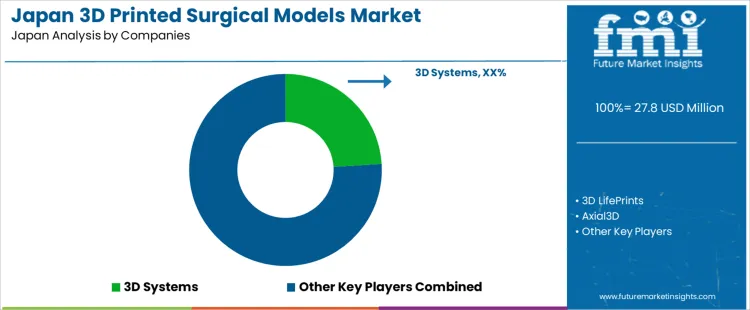
On the supply side, several global and specialized firms compete to meet this growing demand. According to your list, 3D Systems (with about 24% share), 3D LifePrints, Axial3D, Materialise, and Anatomiz3D are the main players targeting the Japanese market. These companies offer patient specific anatomical models, preoperative simulation tools, and surgical planning services. Competition centers on accuracy and realism of the printed models, speed of model production, compliance with medical quality and regulation standards in Japan, ability to support multiple surgical specialties (orthopaedics, neurosurgery, cardiovascular, etc.), and integration with hospital workflows. Firms that deliver high fidelity, clinically validated models with reliable delivery timelines and strong support for surgeons are best positioned to capture growth in the expanding Japanese market for 3D printed surgical models.
Key Players of the 3D Printed Surgical Models Industry in Japan
- 3D Systems
- 3D LifePrints
- Axial3D
- Materialise
- Anatomiz3D
Scope of the Report
| Items | Details |
|---|---|
| Quantitative Units | USD Million |
| Regions Covered | Japan |
| Product | Full Body Models; Segmented Models; Organ Models; Tissue Pads & Plates |
| Technology | Stereolithography (SLA) 3D Printing; ColorJet / CJP Models; MultiJet / PolyJet Printing; Fused Deposition Modeling (FDM); Other 3D printing Technologies |
| Application | Cardiac Surgery; Gastroenterology; Neurosurgery; Orthopedic Surgery; Reconstructive Surgery; Surgical Oncology; Transplant Surgery; Others |
| Material | Plastic; Metal; Polymer; Other Materials |
| End User | Hospitals; Ambulatory Surgical Centers (ASCs); Specialty Clinics; Others |
| Key Companies Profiled | 3D LifePrints; 3D Systems; Axial3D; Materialise; Anatomiz3D |
| Additional Attributes | Dollar sales by model type, technology, and application indicate rapid growth for organ models and orthopedic/neurosurgical models. Use of 3D printed models improves preoperative planning, patient specific implants, reduces surgical time and errors, supports training and education. Rising demand is driven by aging population, increasing volume of complex surgeries (orthopedic, neuro, oncology), and growing acceptance of personalized, precision surgical planning. |
Key Segments in the Demand for 3D Printed Surgical Models in Japan
Product:
- Full Body Models
- Segmented Models
- Organ Models
- Tissue Pads & Plates
Technology:
- Stereolithography 3D Printing
- ColorJet Printing (CJP) Models
- MultiJet/PolyJet Printing Models
- Fused Deposition 3D Modeling
- Other Technologies
Application:
- Cardiac Surgery
- Gastroenterology
- Neurosurgery
- Orthopedic Surgery
- Reconstructive Surgery
- Surgical Oncology
- Transplant Surgery
Material:
- Plastic
- Metal
- Polymer
- Others
End User:
- Hospitals
- Ambulatory Surgical Centers
- Specialty Clinics
- Others
Region:
- Kyushu & Okinawa
- Kanto
- Kansai
- Chubu
- Tohoku
- Rest of Japan
Frequently Asked Questions
How big is the demand for 3D printed surgical models in Japan in 2025?
The demand for 3D printed surgical models in Japan is estimated to be valued at USD 27.8 million in 2025.
What will be the size of 3D printed surgical models in Japan in 2035?
The market size for the 3D printed surgical models in Japan is projected to reach USD 84.0 million by 2035.
How much will be the demand for 3D printed surgical models in Japan growth between 2025 and 2035?
The demand for 3D printed surgical models in Japan is expected to grow at a 11.7% CAGR between 2025 and 2035.
What are the key product types in the 3D printed surgical models in Japan?
The key product types in 3D printed surgical models in Japan are organ models, full body models, segmented models and tissue pads & plates.
Which technology segment is expected to contribute significant share in the 3D printed surgical models in Japan in 2025?
In terms of technology, stereolithography 3D printing segment is expected to command 30.0% share in the 3D printed surgical models in Japan in 2025.
Preview the report firsthand - request a free sample
Get SampleGet the brochure for pricing and purchase details.
Get PDFTable of Content
- Executive Summary
- Japan Market Outlook
- Demand-side Trends
- Supply-side Trends
- Technology Roadmap Analysis
- Analysis and Recommendations
- Market Overview
- Market Coverage / Taxonomy
- Market Definition / Scope / Limitations
- Market Background
- Market Dynamics
- Drivers
- Restraints
- Opportunity
- Trends
- Scenario Forecast
- Demand in Optimistic Scenario
- Demand in Likely Scenario
- Demand in Conservative Scenario
- Opportunity Map Analysis
- Product Life Cycle Analysis
- Supply Chain Analysis
- Investment Feasibility Matrix
- Value Chain Analysis
- PESTLE and Porter’s Analysis
- Regulatory Landscape
- Regional Parent Market Outlook
- Production and Consumption Statistics
- Import and Export Statistics
- Market Dynamics
- Japan Market Analysis 2020 to 2024 and Forecast, 2025 to 2035
- Historical Market Size Value (USD Million) Analysis, 2020 to 2024
- Current and Future Market Size Value (USD Million) Projections, 2025 to 2035
- Y-o-Y Growth Trend Analysis
- Absolute $ Opportunity Analysis
- Japan Market Pricing Analysis 2020 to 2024 and Forecast 2025 to 2035
- Japan Market Analysis 2020 to 2024 and Forecast 2025 to 2035, By Product
- Introduction / Key Findings
- Historical Market Size Value (USD Million) Analysis By Product , 2020 to 2024
- Current and Future Market Size Value (USD Million) Analysis and Forecast By Product , 2025 to 2035
- Organ Models
- Full Body Models
- Segmented Models
- Tissue Pads & Plates
- Y-o-Y Growth Trend Analysis By Product , 2020 to 2024
- Absolute $ Opportunity Analysis By Product , 2025 to 2035
- Japan Market Analysis 2020 to 2024 and Forecast 2025 to 2035, By Technology
- Introduction / Key Findings
- Historical Market Size Value (USD Million) Analysis By Technology, 2020 to 2024
- Current and Future Market Size Value (USD Million) Analysis and Forecast By Technology, 2025 to 2035
- Stereolithography 3D Printing
- ColorJet Printing (CJP) Models
- MultiJet/PolyJet Printing Models
- Fused Deposition 3D Modeling
- Other Technologies
- Y-o-Y Growth Trend Analysis By Technology, 2020 to 2024
- Absolute $ Opportunity Analysis By Technology, 2025 to 2035
- Japan Market Analysis 2020 to 2024 and Forecast 2025 to 2035, By Application
- Introduction / Key Findings
- Historical Market Size Value (USD Million) Analysis By Application, 2020 to 2024
- Current and Future Market Size Value (USD Million) Analysis and Forecast By Application, 2025 to 2035
- Cardiac Surgery
- Gastroenterology
- Neurosurgery
- Orthopedic Surgery
- Reconstructive Surgery
- Surgical Oncology
- Transplant Surgery
- Y-o-Y Growth Trend Analysis By Application, 2020 to 2024
- Absolute $ Opportunity Analysis By Application, 2025 to 2035
- Japan Market Analysis 2020 to 2024 and Forecast 2025 to 2035, By Material
- Introduction / Key Findings
- Historical Market Size Value (USD Million) Analysis By Material, 2020 to 2024
- Current and Future Market Size Value (USD Million) Analysis and Forecast By Material, 2025 to 2035
- Plastic
- Metal
- Polymer
- Others
- Y-o-Y Growth Trend Analysis By Material, 2020 to 2024
- Absolute $ Opportunity Analysis By Material, 2025 to 2035
- Japan Market Analysis 2020 to 2024 and Forecast 2025 to 2035, By End User
- Introduction / Key Findings
- Historical Market Size Value (USD Million) Analysis By End User, 2020 to 2024
- Current and Future Market Size Value (USD Million) Analysis and Forecast By End User, 2025 to 2035
- Hospitals
- Ambulatory Surgical Centers
- Specialty Clinics
- Others
- Y-o-Y Growth Trend Analysis By End User, 2020 to 2024
- Absolute $ Opportunity Analysis By End User, 2025 to 2035
- Market Structure Analysis
- Competition Dashboard
- Competition Benchmarking
- Market Share Analysis of Top Players
- By Regional
- By Product
- By Technology
- By Application
- By Material
- By End User
- Competition Analysis
- Competition Deep Dive
- 3D Systems
- Overview
- Product Portfolio
- Profitability by Market Segments (Product/Age /Sales Channel/Region)
- Sales Footprint
- Strategy Overview
- Marketing Strategy
- Product Strategy
- Channel Strategy
- 3D LifePrints
- Axial3D
- Materialise
- Anatomiz3D
- 3D Systems
- Competition Deep Dive
- Assumptions & Acronyms Used
- Research Methodology


