


Key Takeaways
- Super absorbent polymers are designed to absorb and retain very large volumes of aqueous liquid, which keeps hygiene applications as the demand anchor.
- Adult incontinence demand tracks population ageing and care delivery expansion, making it a long-duration growth driver rather than a short cycle.
- Hygiene volumes can look mature while requirements tighten, shifting value toward higher performance, stronger documentation, and more stable quality.
- Circularity policies matter only when responsibility becomes economic, and that transition can rapidly force redesign and infrastructure investment.
- Diaper recycling becomes more viable when systems recover the high-impact materials, and SAP recovery can materially change lifecycle outcomes.
- Agriculture is an opportunity lane under water stress, but adoption depends on proven field economics, soil conditions, and environmental acceptability.
- The next inflection is likely to come from compliance and circular readiness, not simply from more units in already penetrated categories.
Why is hygiene still the base curve for SAP demand?
Super absorbent polymers are a solved necessity in absorbent hygiene because real absorption needs are not clean water tests. They are saline, under load, and expected to stay stable for hours. That combination is exactly where SAP earns its place in product design. The result is a large, persistent base of demand in baby diapers, femcare, and adult incontinence. This base behaves like a mature curve because penetration is already high and product architectures are industrialized. When a market reaches that stage, growth rarely comes from first-time adoption. It comes from population and income fundamentals, plus incremental redesign that preserves performance while reducing bulk, improving fit, and lowering total material use per unit.
In hygiene, the most meaningful shifts often come from specification tightening rather than volume shocks. Requirements for skin compatibility, odor control, gel stability, and leakage under pressure can quietly raise the bar for polymer consistency and testing discipline. This favors suppliers that can deliver repeatable performance at scale and provide documentation that survives audits and customer qualification cycles. In practice, the market can stay stable in headline volume while rotating toward higher grade SAP, tighter variability control, and stronger supply assurance, especially where brand owners cannot tolerate failure risk.
This is also why the hygiene base curve supports multiple sub-curves. Baby diapers can be steady while adult incontinence grows faster because it is linked to ageing and care needs. Within each segment, premiumization creates a separate curve driven by willingness to pay for thinness, comfort, and performance. The practical takeaway is that hygiene anchors SAP demand, but the real strategic movement is inside the anchor: mix, qualification barriers, compliance readiness, and reliability. That is where margins are defended and where the winners often change even when the category itself looks mature.
When do circularity rules turn into real economics for SAP and diapers?
Circularity begins as intent and becomes economics only when responsibility and cost are assigned and enforced. Extended producer responsibility is one of the clearest mechanisms because it shifts part of the post-consumer burden upstream. Once fees, targets, and enforcement tighten, producers face a new objective function. Performance and cost still matter, but so does end-of-life exposure. That is the moment circularity stops being a sustainability side project and starts behaving like a demand driver. It can force redesign, accelerate investment in collection and processing, and create new supplier qualification requirements that reward traceability and lifecycle advantage.
Diaper recycling is a stress test for circularity because it is logistically hard and politically visible. Systems must manage contamination, sterilization, separation, and stable end markets. The economics do not hinge on a single pilot existing. They hinge on repeatability at scale. The biggest structural difference between hobby pilots and scalable systems is whether the process meaningfully recovers and displaces high-impact materials. If a recycling route only captures low-value fractions and leaves the rest as waste or low-grade output, it often struggles to justify itself once the full cost stack is counted.
SAP matters here because it is not a trivial component from a lifecycle perspective, and its recovery can change the math of net benefit. That does not mean recycling automatically reduces virgin SAP demand. It means the market may start to demand SAP grades and product constructions that are compatible with separation and recovery, and it may start rewarding ecosystems that can prove environmental and cost outcomes rather than promises. When that shift happens, competitive advantage moves toward systems capability: partnerships, processing know-how, validation data, and compliance execution. In S-curve terms, the takeoff trigger is not awareness. It is enforcement plus infrastructure plus procurement pull that makes circular outcomes financially unavoidable.
Can agriculture become a durable growth lane for SAP under water stress?
Agriculture is an opportunity lane for SAP because water stress creates a real incentive to improve soil moisture retention and reduce irrigation volatility. The macro logic is straightforward. Agriculture is a dominant freshwater user, and climate impacts increasingly express themselves through water variability and drought risk. That creates pressure to adopt inputs and practices that stabilize yields under stress. SAP and related hydrogels can play a role by retaining water in the root zone and smoothing short-term moisture deficits, especially in high-value crops and in protected cultivation where the economics are more forgiving.
The adoption curve in agriculture is slower and more selective than hygiene because performance depends heavily on context. Soil texture, salinity, compaction, and irrigation regime all influence how a polymer behaves over time. Lab swelling results can mislead if they do not reflect saline conditions and real field loads. This means the purchase decision is not about polymer chemistry in the abstract. It is about outcomes: reduced crop stress events, improved water-use efficiency, and reliable yield stabilization that pays back cost per hectare. Without repeatable field proof, adoption stalls in Phase 1 trials.
Environmental scrutiny also shapes the ceiling. If large-scale deployment raises concerns about persistence or long-term soil effects, regulators and buyers may demand clearer evidence on fate and safety. That can slow the curve unless materials and application protocols evolve to address it. The most durable path to growth in agriculture is therefore application-specific: targeted regions, defined crop systems, validated dosage protocols, and measurable benefits that hold across seasons. If those conditions are met, agriculture can become a meaningful secondary curve for SAP, but it will not mirror the global scale and uniformity of diapers. It will look like a portfolio of local curves, each constrained by agronomy and economics.
How FMI can Help
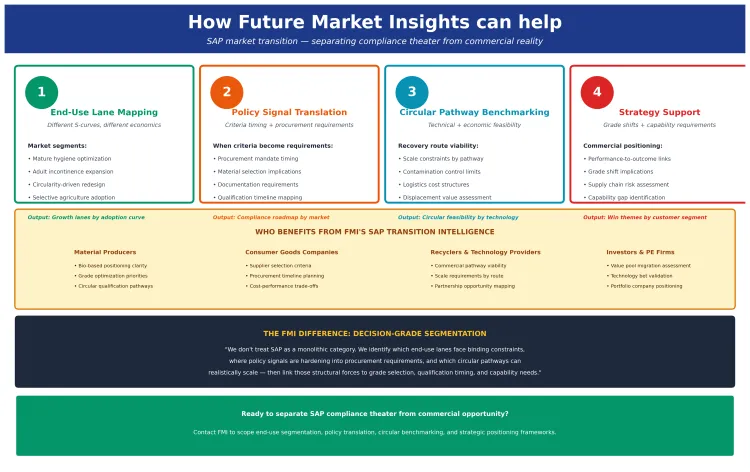
Future Market Insights can help decision-makers turn SAP drivers into a decision-grade view of where growth and defensible margins actually sit. The starting point is separating the market into end-use lanes with different S-curves: mature hygiene optimization, ageing-linked adult incontinence expansion, circularity-driven redesign and recycling, and selective agriculture adoption under water stress. FMI can then map which policy and criteria signals are likely to become procurement requirements and when, translating them into implications for material selection, documentation, and qualification timelines. FMI can also benchmark circular pathways using publicly available lifecycle and technical literature to identify which recovery routes can plausibly scale and which remain structurally constrained by contamination control, logistics costs, or weak displacement value. Finally, FMI can support supplier and buyer strategy by linking performance requirements to commercial outcomes, including grade shifts, supply chain risk, and the capabilities needed to win in a market where compliance and circular readiness increasingly define eligibility.
Bibliography
- Denagbe, W., Mazet, E., and Desbrieres, J. 2025. Superabsorbent polymers eco-friendliness and the gap between basic research and industrial applications. Reactive and Functional Polymers, 214, 106278. doi:10.1016/j.reactfunctpolym.2025.106278.
- European Commission. 2023. Commission Decision EU 2023 1809 establishing the EU Ecolabel criteria for absorbent hygiene products and for reusable menstrual cups. EUR-Lex.
- European Commission Joint Research Centre. 2023. User manual supporting the interpretation of the EU Ecolabel criteria for absorbent hygiene products. Publications Office of the European Union.
- Organisation for Economic Co-operation and Development. 2024. Extended producer responsibility basic facts and key design principles. OECD.
- Somers, M. J., and coauthors. 2021. Feasibility of superabsorbent polymer recycling and reuse in disposable absorbent hygiene products. Journal of Cleaner Production, 313, 127686. doi:10.1016/j.jclepro.2021.127686.
- Itsubo, N., and coauthors. 2020. Life cycle assessment of the closed-loop recycling of used disposable diapers. Resources, 9, 34. doi:10.3390/resources9030034.
- United Nations Department of Economic and Social Affairs Population Division. 2024. World Population Ageing 2023. United Nations.
- World Health Organization. 2025. Ageing and health. World Health Organization.
- Tran, L. N., and coauthors. 2023. Urinary incontinence. StatPearls. National Library of Medicine.
- Food and Agriculture Organization of the United Nations. 2023. Agriculture accounts for 70 percent of freshwater withdrawals worldwide. FAO.
- Intergovernmental Panel on Climate Change. 2022. AR6 Working Group II Chapter 4 Water. IPCC.
- Chang, L., and coauthors. 2021. Superabsorbent polymers used for agricultural water retention. Journal of Cleaner Production, 278. doi:10.1016/j.jclepro.2020.123.

