

- Industry Size (2026)
- USD 12.8 Bn
- Forecast (2036)
- USD 23.1 Bn
- CAGR (2026 to 2036)
- 6.1%
Superabsorbent Polymer Market Forecast and Outlook 2026 to 2036
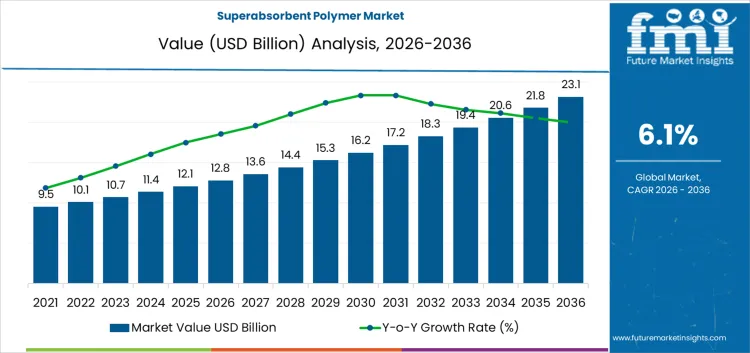
The superabsorbent polymer (SAP) market is projected to grow from USD 12.8 billion in 2026 to USD 23.1 billion by 2036, reflecting a compound annual growth rate (CAGR) of 6.1%. Superabsorbent polymers are widely used in applications such as diapers, adult incontinence products, feminine hygiene products, and agricultural applications due to their exceptional water-absorbing capabilities. The increasing demand for personal care products, coupled with the growing need for SAP in various industries, is expected to drive market growth. Furthermore, the growing focus on sustainability and environmentally friendly alternatives is fostering innovation in SAP formulations, contributing to market expansion.
The market is projected to experience steady growth, with values rising from USD 12.8 billion in 2026 to USD 13.5 billion in 2027, followed by USD 14.2 billion in 2028. In 2029, the market will grow to USD 15 billion, continuing to rise to USD 15.8 billion in 2030. By 2036, the market is expected to reach USD 23.1 billion, driven by rising demand for SAP in personal hygiene products, increased agricultural applications, and the growing need for water-retention products in various sectors.
Quick Stats for the Superabsorbent Polymer Market
- Superabsorbent Polymer Market Value (2026): USD 12.8 billion
- Superabsorbent Polymer Market Forecast Value (2036): USD 23.1 billion
- Superabsorbent Polymer Market Global Forecast CAGR 2026 to 2036: 6.1%
- Superabsorbent Polymer Market Leading Segment: Hygiene & Personal Care (70%)
- Key Growth Regions in Superabsorbent Polymer Market: China
- Top Players in Superabsorbent Polymer Market: Evonik Industries AG, Sumitomo Seika Chemicals Co., Ltd., Nippon Shokubai Co., Ltd., BASF SE, LG Chem Ltd., Formosa Plastics Group, Kao Corporation, Sartomer (Arkema Group), Eastman Chemical Company, SNF Floerger
What is the Half-Decade Weighted Growth for the Superabsorbent Polymer Market through 2036?
The half-decade weighted growth analysis of the superabsorbent polymer market reveals consistent and steady growth, with gradual increases in demand across the forecast period. Starting from USD 12.8 billion in 2026, the market will experience moderate but stable growth, reaching USD 14.2 billion by 2028. During this phase, volume growth will primarily drive the market, as personal care industries and agricultural sectors continue to adopt SAP for a range of applications, including diapers, incontinence products, and soil retention in agriculture.
From 2028 to 2032, the market will see continued growth, rising from USD 15 billion in 2029 to USD 17.5 billion by 2032. This acceleration will be fueled by innovations in SAP formulations, with more sustainable and eco-friendly variants becoming increasingly popular. Additionally, new applications for SAP in emerging markets will contribute to this phase of growth.
By 2036, the market will reach USD 23.1 billion, driven by increasing adoption in both developed and emerging markets, supported by ongoing advancements in SAP technology and greater demand across personal hygiene and agricultural sectors. The half-decade weighted growth analysis highlights the sustained expansion of the SAP market, with consistent volume-driven growth and an increasing role of technological innovation and sustainability in shaping market dynamics.
Superabsorbent Polymer Market Key Takeaways
| Metric | Value |
|---|---|
| Industry Sales Value (2026) | USD 12.8 billion |
| Industry Forecast Value (2036) | USD 23.1 billion |
| Industry Forecast CAGR 2026 to 2036 | 6.1% |
What Is Driving the Superabsorbent Polymer Market?
Historically, the superabsorbent polymer (SAP) market developed from the need for advanced absorbency solutions in personal care and hygiene products. Early SAPs were introduced to improve fluid retention in disposable diapers and adult incontinence products, replacing cellulose and fluff pulp blends that offered limited capacity. Conventional SAPs, primarily based on cross linked sodium polyacrylate, delivered dramatic improvements in gel strength and liquid uptake, enabling thinner, lighter hygiene products with better leakage control. Adoption spread quickly in baby care and feminine hygiene as manufacturers responded to consumer demand for comfort and performance. Industrial and agricultural sectors also began adopting SAPs for moisture management, though growth remained modest due to higher material cost relative to traditional absorbents. This phase clarified performance benchmarks for absorption rate, retention under pressure, and distribution, shaping formulation strategies and setting expectations for quality and reliability in early applications.
Future demand for the superabsorbent polymer market is expected to be shaped by expanding use cases beyond personal hygiene, rising demand for water retention in agriculture and landscaping, and growth in medical and industrial applications that require precise fluid management. Growth will be driven by innovations in biodegradable and bio sourced SAPs that aim to address environmental concerns associated with persistent acrylic based polymers. In agriculture, SAPs that improve soil moisture retention will support water conservation efforts in drought prone regions, while medical uses in wound dressings and surgical sponges will benefit from tailored absorption profiles and enhanced biocompatibility. Industrial growth will be supported by applications in spill containment, oil spill response, and packaging that require engineered absorbency under diverse conditions. Advances in nanostructured SAPs and composite formulations will improve performance characteristics such as rapid uptake, controlled release, and mechanical strength under load. Barriers include cost competition with traditional materials and the need for infrastructure to process newer biodegradable polymers at scale. Long term market expansion will depend on how effectively suppliers align product performance with sustainability objectives and evolving end use requirements across hygiene, agriculture, medical, and industrial segments.
What are the Key Segments in the Superabsorbent Polymer Market?
The Superabsorbent Polymer (SAP) market is segmented by polymer type and end-use industry. Polymer types include sodium polyacrylate, cross-linked polyacrylate, and other SAP chemistries, with sodium polyacrylate leading the market at 58%. End-use industries include hygiene & personal care, agriculture & horticulture, medical & healthcare, and industrial & others, with hygiene & personal care representing the largest share at 70%. The market is driven by the increasing demand for superabsorbent polymers, particularly in hygiene products like diapers and adult incontinence products, as well as in agricultural applications for water retention and soil conditioning.
What is Driving Growth in the Sodium Polyacrylate Segment?
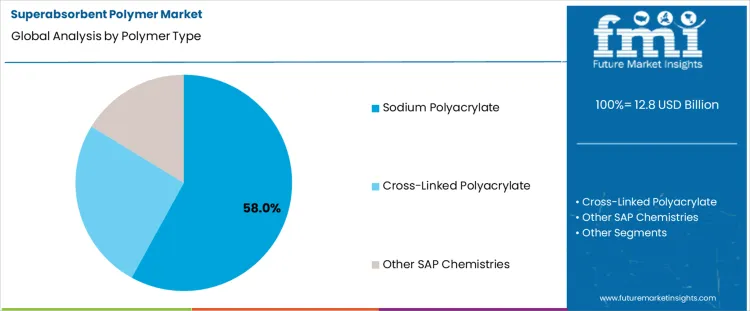
Sodium polyacrylate is the dominant polymer type in the Superabsorbent Polymer market, accounting for 58% of the market share. This growth is driven by its excellent absorption capabilities, which make it the preferred choice for various high-absorbency applications. Sodium polyacrylate is widely used in hygiene products such as diapers, sanitary napkins, and adult incontinence products, where its ability to absorb and retain large amounts of liquid is critical. The increasing demand for personal hygiene products, especially in emerging markets with growing populations, is significantly boosting the demand for sodium polyacrylate. Additionally, sodium polyacrylate’s versatility in agricultural applications for water retention and its use in medical and healthcare products are further contributing to its dominance in the market. As the demand for hygiene products continues to grow globally, particularly in regions such as Asia Pacific, the sodium polyacrylate segment is expected to remain the largest and continue to experience strong growth.
What is Driving the Demand for Hygiene & Personal Care in the End-Use Industry Segment?
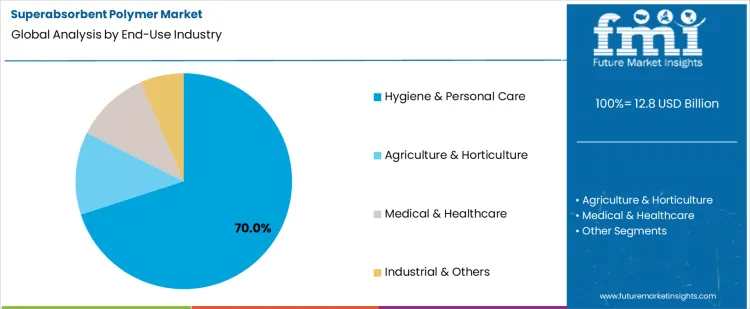
Hygiene & personal care is the largest end-use industry segment in the Superabsorbent Polymer market, holding 70% of the market share. This growth is driven by the increasing demand for superabsorbent products in personal hygiene items such as diapers, adult incontinence products, and sanitary napkins. The rising awareness of hygiene, especially in emerging economies with growing urban populations, is fueling the demand for these products. The global aging population, which is leading to a higher incidence of incontinence, also contributes to the growing need for superabsorbent polymers in adult care products. Furthermore, innovations in hygiene products, such as more absorbent, environmentally friendly, and skin-safe materials, are driving the demand for SAPs in the hygiene & personal care sector. As disposable income rises and awareness of hygiene improves, particularly in developing countries, the demand for SAPs in this sector is expected to continue expanding, making hygiene & personal care the dominant end-use industry segment in the market.
What are the Key Dynamics in the Superabsorbent Polymer Market?
The superabsorbent polymer (SAP) market is growing due to the increasing demand for SAPs in various applications, including personal care, healthcare, agriculture, and industrial sectors. SAPs are highly absorbent materials that can absorb and retain large quantities of liquids relative to their mass. They are most commonly used in products like diapers, adult incontinence products, feminine hygiene products, and agricultural applications like water retention in soil. The market is driven by the growing demand for hygiene products, the need for better water retention in agriculture, and advancements in SAP technologies that improve efficiency, sustainability, and functionality. Additionally, the rising global population, particularly in emerging economies, is contributing to the increasing demand for personal care and agricultural products, further fueling market growth.
What are the Key Drivers of Growth in the Superabsorbent Polymer Market?
The key drivers of growth in the superabsorbent polymer market include the rising global demand for hygiene products such as diapers, adult incontinence products, and feminine hygiene products, where SAPs are widely used for their absorbent properties. With the increasing awareness of hygiene and health, particularly in emerging markets, the demand for disposable personal care products is on the rise. Additionally, the growing need for efficient water management solutions in agriculture, driven by water scarcity and climate change, is driving the adoption of SAPs in agricultural applications for soil moisture retention and improved crop yield. The expansion of the healthcare sector, where SAPs are used in wound care products, is also contributing to market growth. Technological advancements in SAP production and the development of eco-friendlier, biodegradable SAPs that reduce environmental impact are further boosting the market, as consumers and industries seek sustainable alternatives. Moreover, the rise of e-commerce platforms for consumer products and increased spending on personal care is also fueling demand.
What are the Key Restraints in the Superabsorbent Polymer Market?
Despite its growth potential, the superabsorbent polymer market faces several challenges. One major restraint is the high cost of SAP production, particularly for advanced, high-performance SAPs. The cost of raw materials, manufacturing, and the technological expertise required to produce these polymers can make them expensive for manufacturers, which may increase the final product cost for consumers. Another challenge is the environmental impact of traditional SAPs, which are often made from petroleum-based products and can take a long time to degrade, contributing to waste. As a result, there is increasing pressure from both consumers and regulatory bodies for more sustainable and biodegradable alternatives. Additionally, the market faces competition from other absorbent materials, such as natural fibers and biodegradable polymers, which may be perceived as more environmentally friendly options. Furthermore, fluctuations in raw material prices and the reliance on fossil fuels for SAP production may affect the overall stability of the market.
What are the Key Trends in the Superabsorbent Polymer Market?
Several key trends are shaping the superabsorbent polymer market. One major trend is the increasing demand for sustainable, biodegradable, and eco-friendly SAPs. Manufacturers are focusing on developing bio-based or biodegradable superabsorbent polymers that provide the same high-performance absorption capabilities while reducing their environmental impact. Another trend is the innovation in SAP formulations to improve absorption capacity, retention, and release properties, catering to a broader range of applications in hygiene products, agriculture, and healthcare. The development of multifunctional SAPs that offer additional benefits, such as antimicrobial properties or the ability to release nutrients for agricultural use, is also gaining traction. Furthermore, there is growing interest in SAPs for use in water management solutions in agriculture, where they are being incorporated into hydrogel products to help retain moisture in soil and improve crop production in drought-prone areas. Lastly, the increasing popularity of online shopping platforms and growing disposable income in developing regions are driving the demand for SAP-based products in both personal care and industrial sectors. These trends highlight the ongoing innovation and shift towards more sustainable and functional superabsorbent materials.
What is the Country-Wise Analysis of the Superabsorbent Polymer Market?
The superabsorbent polymer (SAP) market is growing due to the increasing demand for high-performance materials used in hygiene products, agriculture, and industrial applications. SAPs are capable of absorbing and retaining large amounts of liquid relative to their own weight, making them ideal for use in products such as diapers, adult incontinence products, feminine hygiene products, and agricultural water retention systems. The market is driven by factors such as the rise in hygiene product consumption, advancements in SAP technology, and the growing focus on water conservation in agriculture. Countries like China, the USA, India, Germany, and Japan are seeing growth in this market due to strong industrial bases, increasing demand for SAP-based products, and technological innovations.
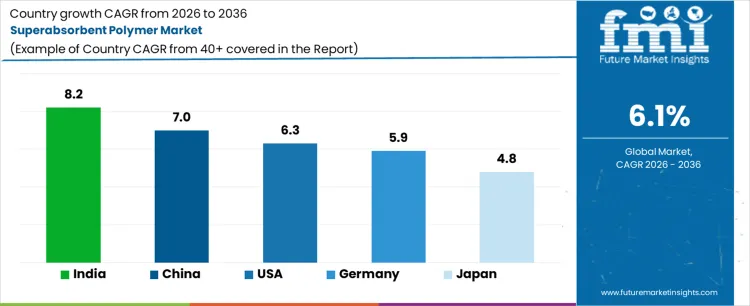
| Country | CAGR (%) |
|---|---|
| China | 7 |
| USA | 6.3 |
| India | 8.2 |
| Germany | 5.9 |
| Japan | 4.8 |
What is Driving the Growth of the Superabsorbent Polymer Market in India?
India’s superabsorbent polymer market is growing at a CAGR of 8.2%, the highest among the countries analyzed. The growth is driven by the increasing demand for hygiene products, especially in rapidly expanding urban areas. The rising awareness of personal hygiene, combined with India’s growing population, is fueling the demand for products like diapers and sanitary products, which rely heavily on superabsorbent polymers. Additionally, India’s agriculture sector is increasingly adopting SAPs for water retention in arid regions, further boosting market demand. As India continues to modernize and expand its healthcare and agricultural sectors, the demand for superabsorbent polymers is expected to rise steadily.
How is the Superabsorbent Polymer Market Performing in China?
China’s superabsorbent polymer market is growing at a CAGR of 7%. The market growth is primarily driven by the country’s strong demand for hygiene products such as diapers, adult incontinence products, and sanitary items. With the rapid urbanization and increasing disposable incomes, the demand for these products is rising, further driving the need for SAPs. Additionally, China’s large agricultural sector is increasingly adopting superabsorbent polymers for water retention in soils, particularly in regions facing water scarcity. As China continues to invest in infrastructure and industrial production, the demand for superabsorbent polymers is expected to maintain steady growth.
What Factors are Shaping the Superabsorbent Polymer Market in the USA?
The superabsorbent polymer market in the USA is growing at a CAGR of 6.3%. The growth is fueled by the high demand for hygiene products, particularly in the growing population of elderly individuals and babies. The USA’s advanced healthcare system and rising awareness of personal hygiene are contributing to the increasing consumption of SAPs in products like diapers, incontinence products, and sanitary goods. Additionally, the adoption of superabsorbent polymers in agriculture for moisture retention is gaining traction. As the USA continues to focus on sustainable practices in both healthcare and agriculture, the demand for superabsorbent polymers is expected to grow steadily.
How is the Superabsorbent Polymer Market Evolving in Germany?
Germany’s superabsorbent polymer market is growing at a CAGR of 5.9%. Germany’s demand for SAPs is driven by the strong need for hygiene products and the country’s focus on sustainability in both consumer goods and agriculture. The increasing adoption of SAPs in diapers, feminine hygiene products, and incontinence products is contributing to market growth. Additionally, Germany’s agricultural sector is exploring the use of SAPs for water retention in farming, particularly in regions with water management challenges. With the country’s focus on environmental sustainability and green technologies, the demand for superabsorbent polymers in both the hygiene and agricultural sectors is expected to rise steadily.
What is Contributing to the Growth of the Superabsorbent Polymer Market in Japan?
Japan’s superabsorbent polymer market is growing at a CAGR of 4.8%. The demand for SAPs in Japan is driven by the country’s aging population and increasing healthcare needs, particularly in the areas of incontinence products and adult diapers. Additionally, Japan’s strong focus on technological innovation and sustainability is contributing to the growth of the SAP market. The agricultural sector in Japan is also adopting superabsorbent polymers to address water conservation challenges, particularly in arid regions. As Japan continues to focus on providing high-quality healthcare solutions and sustainable agricultural practices, the demand for superabsorbent polymers is expected to grow at a steady pace.
What is the Competitive Landscape for the Superabsorbent Polymer Market?
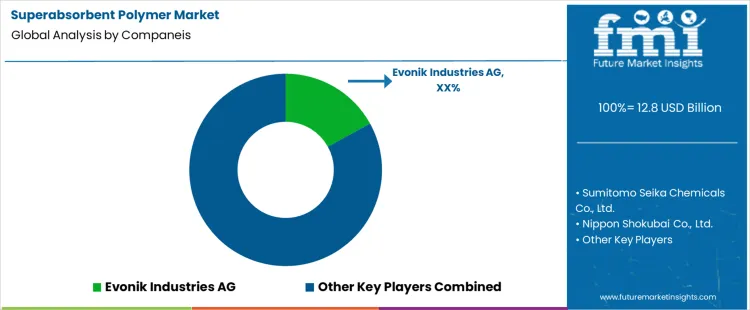
The superabsorbent polymer (SAP) market is growing as demand increases for absorbent materials in products such as diapers, feminine hygiene products, adult incontinence products, and medical applications. Evonik Industries AG leads the market, offering a wide range of high-performance SAP solutions known for their superior absorption capabilities, innovative technologies, and sustainable production processes. Evonik’s strong focus on research and development and its advanced production capabilities position it as a dominant player in the market. Sumitomo Seika Chemicals Co., Ltd. is another significant competitor, providing SAP solutions that are widely used in the hygiene industry, with a focus on innovation and high absorption rates.
Nippon Shokubai Co., Ltd. competes by offering advanced SAP products known for their high water retention capacity, which is critical for their application in hygiene and medical products. BASF SE is actively involved, providing high-quality SAP materials designed for various industrial applications, focusing on sustainability and improved performance. LG Chem Ltd. offers SAP solutions that focus on high absorption power and efficiency, catering to industries requiring high-performance absorbent materials. Formosa Plastics Group is a key player, supplying SAP products used in diapers, adult incontinence products, and other absorbent applications, with an emphasis on quality and cost-effectiveness.
Kao Corporation, known for its hygiene products, also plays a significant role in the SAP market, offering absorbent materials designed to meet the specific needs of hygiene applications. Sartomer (Arkema Group) provides SAP solutions that are used in a variety of industrial and medical applications, focusing on product innovation and customization. Eastman Chemical Company offers SAP materials that prioritize high absorption rates and environmental sustainability. SNF Floerger specializes in SAP products used in various applications, with a focus on providing reliable, high-quality materials to meet the demands of the personal care and medical industries.
To stay competitive in the superabsorbent polymer market, companies focus on technological innovation, sustainability, and product differentiation. Evonik Industries AG continues to lead by enhancing its SAP products with innovations that improve absorption capacity and reduce environmental impact, including bio-based and biodegradable SAP solutions. Sumitomo Seika Chemicals Co., Ltd. is expanding its product portfolio by offering SAP solutions that meet the growing demand for high absorption rates and environmentally friendly products.
Nippon Shokubai Co., Ltd. focuses on improving the quality and performance of its SAP products, ensuring superior efficiency in industrial and hygiene applications. BASF SE is investing in research and development to create more sustainable SAP products, with a focus on reducing environmental impact and improving production processes. LG Chem Ltd. continues to innovate by providing more efficient and high-performance SAP solutions for the personal care and medical sectors. Formosa Plastics Group is focusing on enhancing the quality and cost-effectiveness of its SAP materials, catering to the growing demand for absorbent products in various markets. Kao Corporation is enhancing its SAP offerings by focusing on environmentally sustainable production and improving the performance of absorbent materials in hygiene products.
Sartomer (Arkema Group) is refining its SAP products with greater customization options to meet the specific needs of various industries. Eastman Chemical Company is expanding its portfolio with SAP products that focus on high absorption rates and eco-friendly production methods. SNF Floerger continues to develop SAP solutions that provide superior absorbent capacity while maintaining a focus on quality and cost-efficiency. These strategies ensure that these companies remain leaders in the expanding superabsorbent polymer market, driven by the increasing demand for high-performance, sustainable absorbent materials across industries.
Key Players of the Superabsorbent Polymer Market
- Evonik Industries AG
- Sumitomo Seika Chemicals Co., Ltd.
- Nippon Shokubai Co., Ltd.
- BASF SE
- LG Chem Ltd.
- Formosa Plastics Group
- Kao Corporation
- Sartomer (Arkema Group)
- Eastman Chemical Company
- SNF Floerger
Scope of the Report
| Items | Values |
|---|---|
| Quantitative Units (2026) | USD Billion |
| Polymer Type | Sodium Polyacrylate, Cross-Linked Polyacrylate, Other SAP Chemistries |
| End-Use Industry | Hygiene & Personal Care, Agriculture & Horticulture, Medical & Healthcare, Industrial & Others |
| Form | Powder, Granules, Sheets & Fibers, Other |
| Companies | Evonik Industries AG, Sumitomo Seika Chemicals Co., Ltd., Nippon Shokubai Co., Ltd., BASF SE, LG Chem Ltd., Formosa Plastics Group, Kao Corporation, Sartomer (Arkema Group), Eastman Chemical Company, SNF Floerger |
| Regions Covered | North America, Latin America, Western Europe, Eastern Europe, South Asia and Pacific, East Asia, Middle East & Africa |
| Countries Covered | United States, Canada, Mexico, Brazil, Argentina, Germany, France, United Kingdom, Italy, Spain, Netherlands, China, India, Japan, South Korea, ANZ, GCC Countries, South Africa |
| Additional Attributes | Dollar by sales by polymer type, end-use industry, form, and region. Includes market trends towards sustainability, efficiency, and the role of superabsorbent polymers in various industries such as hygiene, agriculture, and healthcare. |
Superabsorbent Polymer Market Segmentation
Polymer Type
- Sodium Polyacrylate
- Cross-Linked Polyacrylate
- Other SAP Chemistries
End-Use Industry
- Hygiene & Personal Care
- Agriculture & Horticulture
- Medical & Healthcare
- Industrial & Others
Form
- Powder
- Granules
- Sheets & Fibers
- Other
Region
- Asia Pacific
- China
- Japan
- India
- Australia & New Zealand
- ASEAN
- Rest of Asia Pacific
- Europe
- Germany
- United Kingdom
- France
- Italy
- Spain
- Nordic
- BENELUX
- Rest of Europe
- North America
- United States
- Canada
- Mexico
- Latin America
- Brazil
- Argentina
- Rest of Latin America
- Middle East & Africa
- Kingdom of Saudi Arabia
- Other GCC Countries
- South Africa
- Rest of Middle East & Africa
Bibliography
- International Organization for Standardization. (2021). ISO 17190-1:2021 — Superabsorbent polymer for personal hygiene products — Part 1: Test methods for determining absorption characteristics. International Organization for Standardization.
- European Commission, Directorate-General for Research and Innovation. (2024). Sustainable polymers for the circular economy: Research and innovation perspective 2024. Publications Office of the European Union.
- United Nations Industrial Development Organization. (2023). Global chemicals and waste management programme: Sustainable polymers and circular materials innovation. UNIDO.
Frequently Asked Questions
How big is the superabsorbent polymer market in 2026?
The global superabsorbent polymer market is estimated to be valued at USD 12.8 billion in 2026.
What will be the size of superabsorbent polymer market in 2036?
The market size for the superabsorbent polymer market is projected to reach USD 23.1 billion by 2036.
How much will be the superabsorbent polymer market growth between 2026 and 2036?
The superabsorbent polymer market is expected to grow at a 6.1% CAGR between 2026 and 2036.
What are the key product types in the superabsorbent polymer market?
The key product types in superabsorbent polymer market are sodium polyacrylate, cross-linked polyacrylate and other sap chemistries.
Which end-use industry segment to contribute significant share in the superabsorbent polymer market in 2026?
In terms of end-use industry, hygiene & personal care segment to command 70.0% share in the superabsorbent polymer market in 2026.
Preview the report firsthand - request a free sample
Get SampleGet the brochure for pricing and purchase details.
Get PDFTable of Content
- Executive Summary
- Global Market Outlook
- Demand-side Trends
- Supply-side Trends
- Technology Roadmap Analysis
- Analysis and Recommendations
- Market Overview
- Market Coverage / Taxonomy
- Market Definition / Scope / Limitations
- Market Background
- Market Dynamics
- Drivers
- Restraints
- Opportunity
- Trends
- Scenario Forecast
- Demand in Optimistic Scenario
- Demand in Likely Scenario
- Demand in Conservative Scenario
- Opportunity Map Analysis
- Product Life Cycle Analysis
- Supply Chain Analysis
- Investment Feasibility Matrix
- Value Chain Analysis
- PESTLE and Porter’s Analysis
- Regulatory Landscape
- Regional Parent Market Outlook
- Production and Consumption Statistics
- Import and Export Statistics
- Market Dynamics
- Global Market Analysis 2021 to 2025 and Forecast, 2026 to 2036
- Historical Market Size Value (USD Million) Analysis, 2021 to 2025
- Current and Future Market Size Value (USD Million) Projections, 2026 to 2036
- Y-o-Y Growth Trend Analysis
- Absolute $ Opportunity Analysis
- Global Market Pricing Analysis 2021 to 2025 and Forecast 2026 to 2036
- Global Market Analysis 2021 to 2025 and Forecast 2026 to 2036, By Polymer Type
- Introduction / Key Findings
- Historical Market Size Value (USD Million) Analysis By Polymer Type, 2021 to 2025
- Current and Future Market Size Value (USD Million) Analysis and Forecast By Polymer Type, 2026 to 2036
- Sodium Polyacrylate
- Cross-Linked Polyacrylate
- Other SAP Chemistries
- Sodium Polyacrylate
- Y-o-Y Growth Trend Analysis By Polymer Type, 2021 to 2025
- Absolute $ Opportunity Analysis By Polymer Type, 2026 to 2036
- Global Market Analysis 2021 to 2025 and Forecast 2026 to 2036, By End-Use Industry
- Introduction / Key Findings
- Historical Market Size Value (USD Million) Analysis By End-Use Industry, 2021 to 2025
- Current and Future Market Size Value (USD Million) Analysis and Forecast By End-Use Industry, 2026 to 2036
- Hygiene & Personal Care
- Agriculture & Horticulture
- Medical & Healthcare
- Industrial & Others
- Hygiene & Personal Care
- Y-o-Y Growth Trend Analysis By End-Use Industry, 2021 to 2025
- Absolute $ Opportunity Analysis By End-Use Industry, 2026 to 2036
- Global Market Analysis 2021 to 2025 and Forecast 2026 to 2036, By Form
- Introduction / Key Findings
- Historical Market Size Value (USD Million) Analysis By Form, 2021 to 2025
- Current and Future Market Size Value (USD Million) Analysis and Forecast By Form, 2026 to 2036
- Powder
- Granules
- Sheets & Fibers
- Powder
- Y-o-Y Growth Trend Analysis By Form, 2021 to 2025
- Absolute $ Opportunity Analysis By Form, 2026 to 2036
- Global Market Analysis 2021 to 2025 and Forecast 2026 to 2036, By Region
- Introduction
- Historical Market Size Value (USD Million) Analysis By Region, 2021 to 2025
- Current Market Size Value (USD Million) Analysis and Forecast By Region, 2026 to 2036
- North America
- Latin America
- Western Europe
- Eastern Europe
- East Asia
- South Asia and Pacific
- Middle East & Africa
- Market Attractiveness Analysis By Region
- North America Market Analysis 2021 to 2025 and Forecast 2026 to 2036, By Country
- Historical Market Size Value (USD Million) Trend Analysis By Market Taxonomy, 2021 to 2025
- Market Size Value (USD Million) Forecast By Market Taxonomy, 2026 to 2036
- By Country
- USA
- Canada
- Mexico
- By Polymer Type
- By End-Use Industry
- By Form
- By Country
- Market Attractiveness Analysis
- By Country
- By Polymer Type
- By End-Use Industry
- By Form
- Key Takeaways
- Latin America Market Analysis 2021 to 2025 and Forecast 2026 to 2036, By Country
- Historical Market Size Value (USD Million) Trend Analysis By Market Taxonomy, 2021 to 2025
- Market Size Value (USD Million) Forecast By Market Taxonomy, 2026 to 2036
- By Country
- Brazil
- Chile
- Rest of Latin America
- By Polymer Type
- By End-Use Industry
- By Form
- By Country
- Market Attractiveness Analysis
- By Country
- By Polymer Type
- By End-Use Industry
- By Form
- Key Takeaways
- Western Europe Market Analysis 2021 to 2025 and Forecast 2026 to 2036, By Country
- Historical Market Size Value (USD Million) Trend Analysis By Market Taxonomy, 2021 to 2025
- Market Size Value (USD Million) Forecast By Market Taxonomy, 2026 to 2036
- By Country
- Germany
- UK
- Italy
- Spain
- France
- Nordic
- BENELUX
- Rest of Western Europe
- By Polymer Type
- By End-Use Industry
- By Form
- By Country
- Market Attractiveness Analysis
- By Country
- By Polymer Type
- By End-Use Industry
- By Form
- Key Takeaways
- Eastern Europe Market Analysis 2021 to 2025 and Forecast 2026 to 2036, By Country
- Historical Market Size Value (USD Million) Trend Analysis By Market Taxonomy, 2021 to 2025
- Market Size Value (USD Million) Forecast By Market Taxonomy, 2026 to 2036
- By Country
- Russia
- Poland
- Hungary
- Balkan & Baltic
- Rest of Eastern Europe
- By Polymer Type
- By End-Use Industry
- By Form
- By Country
- Market Attractiveness Analysis
- By Country
- By Polymer Type
- By End-Use Industry
- By Form
- Key Takeaways
- East Asia Market Analysis 2021 to 2025 and Forecast 2026 to 2036, By Country
- Historical Market Size Value (USD Million) Trend Analysis By Market Taxonomy, 2021 to 2025
- Market Size Value (USD Million) Forecast By Market Taxonomy, 2026 to 2036
- By Country
- China
- Japan
- South Korea
- By Polymer Type
- By End-Use Industry
- By Form
- By Country
- Market Attractiveness Analysis
- By Country
- By Polymer Type
- By End-Use Industry
- By Form
- Key Takeaways
- South Asia and Pacific Market Analysis 2021 to 2025 and Forecast 2026 to 2036, By Country
- Historical Market Size Value (USD Million) Trend Analysis By Market Taxonomy, 2021 to 2025
- Market Size Value (USD Million) Forecast By Market Taxonomy, 2026 to 2036
- By Country
- India
- ASEAN
- Australia & New Zealand
- Rest of South Asia and Pacific
- By Polymer Type
- By End-Use Industry
- By Form
- By Country
- Market Attractiveness Analysis
- By Country
- By Polymer Type
- By End-Use Industry
- By Form
- Key Takeaways
- Middle East & Africa Market Analysis 2021 to 2025 and Forecast 2026 to 2036, By Country
- Historical Market Size Value (USD Million) Trend Analysis By Market Taxonomy, 2021 to 2025
- Market Size Value (USD Million) Forecast By Market Taxonomy, 2026 to 2036
- By Country
- Kingdom of Saudi Arabia
- Other GCC Countries
- Turkiye
- South Africa
- Other African Union
- Rest of Middle East & Africa
- By Polymer Type
- By End-Use Industry
- By Form
- By Country
- Market Attractiveness Analysis
- By Country
- By Polymer Type
- By End-Use Industry
- By Form
- Key Takeaways
- Key Countries Market Analysis
- USA
- Pricing Analysis
- Market Share Analysis, 2025
- By Polymer Type
- By End-Use Industry
- By Form
- Canada
- Pricing Analysis
- Market Share Analysis, 2025
- By Polymer Type
- By End-Use Industry
- By Form
- Mexico
- Pricing Analysis
- Market Share Analysis, 2025
- By Polymer Type
- By End-Use Industry
- By Form
- Brazil
- Pricing Analysis
- Market Share Analysis, 2025
- By Polymer Type
- By End-Use Industry
- By Form
- Chile
- Pricing Analysis
- Market Share Analysis, 2025
- By Polymer Type
- By End-Use Industry
- By Form
- Germany
- Pricing Analysis
- Market Share Analysis, 2025
- By Polymer Type
- By End-Use Industry
- By Form
- UK
- Pricing Analysis
- Market Share Analysis, 2025
- By Polymer Type
- By End-Use Industry
- By Form
- Italy
- Pricing Analysis
- Market Share Analysis, 2025
- By Polymer Type
- By End-Use Industry
- By Form
- Spain
- Pricing Analysis
- Market Share Analysis, 2025
- By Polymer Type
- By End-Use Industry
- By Form
- France
- Pricing Analysis
- Market Share Analysis, 2025
- By Polymer Type
- By End-Use Industry
- By Form
- India
- Pricing Analysis
- Market Share Analysis, 2025
- By Polymer Type
- By End-Use Industry
- By Form
- ASEAN
- Pricing Analysis
- Market Share Analysis, 2025
- By Polymer Type
- By End-Use Industry
- By Form
- Australia & New Zealand
- Pricing Analysis
- Market Share Analysis, 2025
- By Polymer Type
- By End-Use Industry
- By Form
- China
- Pricing Analysis
- Market Share Analysis, 2025
- By Polymer Type
- By End-Use Industry
- By Form
- Japan
- Pricing Analysis
- Market Share Analysis, 2025
- By Polymer Type
- By End-Use Industry
- By Form
- South Korea
- Pricing Analysis
- Market Share Analysis, 2025
- By Polymer Type
- By End-Use Industry
- By Form
- Russia
- Pricing Analysis
- Market Share Analysis, 2025
- By Polymer Type
- By End-Use Industry
- By Form
- Poland
- Pricing Analysis
- Market Share Analysis, 2025
- By Polymer Type
- By End-Use Industry
- By Form
- Hungary
- Pricing Analysis
- Market Share Analysis, 2025
- By Polymer Type
- By End-Use Industry
- By Form
- Kingdom of Saudi Arabia
- Pricing Analysis
- Market Share Analysis, 2025
- By Polymer Type
- By End-Use Industry
- By Form
- Turkiye
- Pricing Analysis
- Market Share Analysis, 2025
- By Polymer Type
- By End-Use Industry
- By Form
- South Africa
- Pricing Analysis
- Market Share Analysis, 2025
- By Polymer Type
- By End-Use Industry
- By Form
- USA
- Market Structure Analysis
- Competition Dashboard
- Competition Benchmarking
- Market Share Analysis of Top Players
- By Regional
- By Polymer Type
- By End-Use Industry
- By Form
- Competition Analysis
- Competition Deep Dive
- Evonik Industries AG
- Overview
- Product Portfolio
- Profitability by Market Segments (Product/Age /Sales Channel/Region)
- Sales Footprint
- Strategy Overview
- Marketing Strategy
- Product Strategy
- Channel Strategy
- Sumitomo Seika Chemicals Co., Ltd.
- Nippon Shokubai Co., Ltd.
- BASF SE
- LG Chem Ltd.
- Formosa Plastics Group
- Kao Corporation
- Sartomer (Arkema Group)
- Evonik Industries AG
- Competition Deep Dive
- Assumptions & Acronyms Used
- Research Methodology


