

- Industry Size (2026)
- USD 5.8 Bn
- Forecast (2036)
- USD 8.4 Bn
- CAGR (2026 to 2036)
- 3.8%
Superheater Tubes Market size, market forecast and outlook by FMI
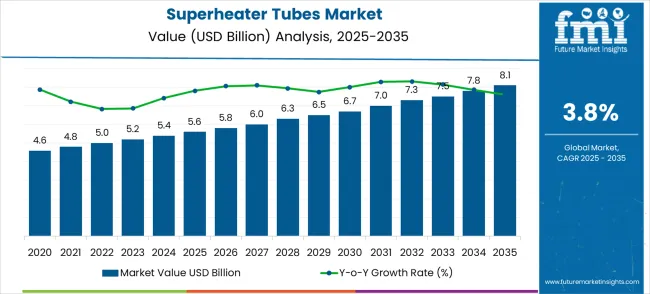
The superheater tubes market crossed a valuation of USD 5.6 billion in 2025, with demand set to reach USD 5.8 billion in 2026 and advance at a 3.8% CAGR through the forecast horizon. Market size is projected to reach USD 8.4 billion by 2036, reflecting the steady upgrade cycle across thermal power assets as operators prepare boilers for the higher steam temperatures required to maintain modern turbine efficiency.
Thermal fleet operators face growing compliance pressure as emission thresholds tighten. Plants operating older carbon‑steel components and steel pipes experience higher failure risk once exposed to supercritical and ultra‑supercritical conditions, which disrupts baseload availability and raises outage costs. Upgrading to high‑grade superheater tubes directly reduces this risk and becomes a primary driver of medium‑term demand. Procurement teams place greater weight on long‑term creep resistance, metallurgical stability, and predictable performance across outage cycles, since these factors determine operating continuity more than initial material cost.
Summary of Superheater Tubes Market
- Market Snapshot
- The superheater tubes market surpassed a value of USD 5.6 billion in 2025 and is projected to reach USD 8.4 billion by 2036, reflecting steady fleet‑driven replacement activity across global thermal assets.
- The industry is expected to grow at a 3.8% CAGR from 2026 to 2036, generating an incremental opportunity of USD 2.8 billion, largely tied to outage‑cycle requirements and long‑term fleet maintenance.
- The market encompasses high‑temperature, pressure‑rated tubing for boilers, industrial furnaces, and HRSG units operating above 540°C and 170 bar, where materials must maintain mechanical integrity under prolonged thermal stress.
- The category remains specification‑driven, as procurement decisions hinge on material grade, creep and corrosion performance, code compliance, and the ability to deliver consistent reliability across outage cycles.
- Demand and Growth Drivers
- Demand is anchored by the global installed thermal fleet, where replacement cycles continue irrespective of limited new‑build momentum in several regions.
- HRSG installations in combined‑cycle power plants add volume, supported by the continued role of gas‑fired generation in balancing grid stability and meeting mid‑merit load requirements.
- Coal-fired generation remains material for this category because coal supplied 35% of global electricity in 2024, sustaining a large installed base requiring ongoing superheater tube replacements.
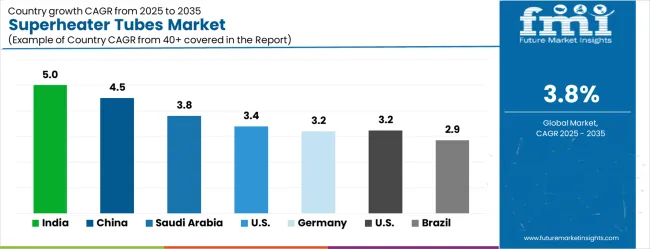
- Among major markets, India (5.0% CAGR) shows the fastest expansion, followed by China (4.5%), Saudi Arabia (3.8%), USA (3.4%), and Germany (3.2%), reflecting differing fleet ages and maintenance regimes.
- Growth is tempered by slower net capacity additions in mature thermal markets and by the higher qualification and cost burden associated with premium alloy grades.
- Product and Segment View
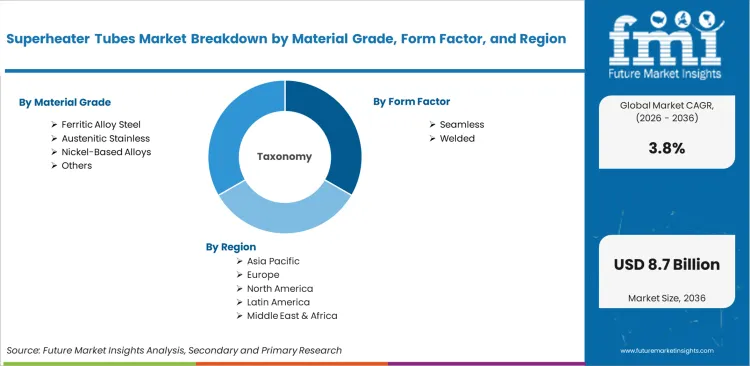
- The market covers superheater tubes manufactured from ferritic alloy steels, austenitic stainless steels, and nickel-based alloys, supplied in seamless or welded form for subcritical, supercritical, and ultra-supercritical boiler applications.
- These tubes serve coal-fired boilers, gas-fired combined-cycle plants, industrial furnaces, waste‑heat recovery systems, and biomass or steam-generation units across utility and industrial settings.
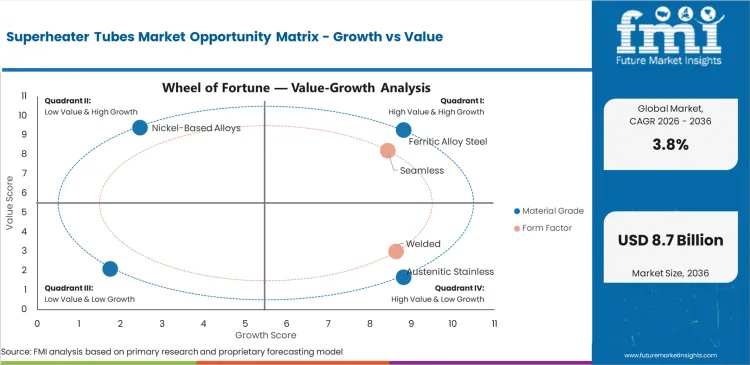
- Ferritic Alloy Steel leads the Material Grade segment with a 42.0% share in 2026, supported by established specifications, predictable performance, and cost advantages relative to higher-grade alloys.
- Seamless tubes lead the Form Factor segment with a 68.0% share in 2026, reflecting buyer preference for pressure integrity, dimensional stability, and reliability in high‑temperature environments.
- Supercritical systems hold an estimated 40.0% share in 2026 in the Pressure Regime segment, consistent with the global fleet mix and the balance these units deliver between thermal efficiency and capital intensity.
- The scope includes commercially traded superheater tubes classified by grade, form, and pressure regime, and excludes economizer tubes, waterwall tubes, reheater tubes, condenser tubing, boiler drums, headers, and non‑steam petrochemical heater tubes.
- Geography and Competitive Outlook
- India, China, and Saudi Arabia represent faster‑growing markets, driven by ongoing thermal capacity additions and higher utilization rates, while the USA and Germany remain stable, high‑value replacement markets governed by strict specifications and predictable maintenance intervals.
- Competition is defined by material science capability, premium‑alloy expertise, qualification track record, delivery reliability, and embedded relationships with boiler OEMs and major utility or EPC buyers.
- Key participants include Vallourec, Alleima, Benteler Steel/Tube, Jindal SAW, Maharashtra Seamless, Nippon Steel, and Tubacex.
- The market remains moderately fragmented, with Vallourec positioned among the leading participants, indicating a competitive field without dominant concentration
Efficiency-linked regulations accelerate full metallurgical replacement programs across the installed fleet. Moving from standard grades to advanced alloys resets supplier requirements, concentrating demand among manufacturers with qualification depth, alloy expertise, and reliable delivery performance. These shifts clarify where replacement cycles dominate consumption patterns and where limited greenfield additions still influence premium alloy demand.
Regional growth rates reflect each market’s balance between new thermal capacity and modernization intensity. India’s superheater tubes industry is expected to grow at a 5.0% CAGR due to ongoing supercritical capacity approvals and continuous boiler upgrades. China (4.5% CAGR) follows with extensive fleet-renewal initiatives aimed at higher thermal efficiency. Saudi Arabia (3.8% CAGR) maintains solid growth as gas-fired projects require consistent high‑temperature tubing. The USA (3.4% CAGR) grows through selective outage-driven replacements across utility boilers. Germany (3.2% CAGR) advances through efficiency-driven refurbishments in mature steam systems. The UK (3.0% CAGR) continues retrofits across remaining thermal units, while Japan (2.8%) sustains stable replacement cycles. Growth variations across these regions stem from differing degrees of greenfield expansion versus maintenance-led tube consumption.
Segmental Analysis
Superheater Tubes Market Analysis by Material Grade
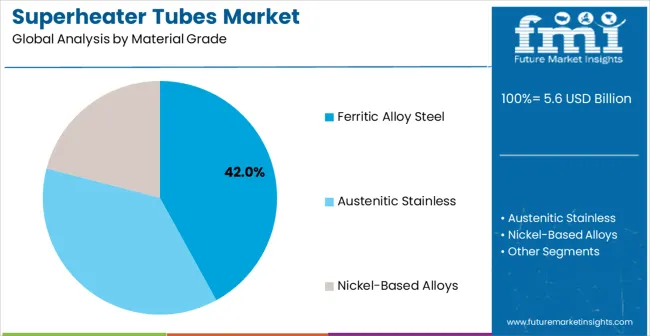
Metallurgical degradation continues to constrain operating lifespans across thermal generation fleets, pushing utilities to prioritise tube materials that balance durability with cost discipline. Ferritic alloy steel remains the default choice in many boiler sections where steam temperatures approach the 600°C range, supported by its predictable creep resistance and manageable qualification requirements. The ferritic segment is expected to account for 42.0% of total market share in 2026, reflecting how frequently operators select it as the practical midpoint between performance needs and budget limits. Engineering teams deploy ferritic grades strategically in lower‑temperature zones because adopting nickel‑based alternatives at scale would strain maintenance budgets and complicate outage planning. Replacement accuracy during scheduled turnarounds directly influences whether plants maintain their designed thermal efficiency profiles.
- Initial evaluation: Engineering teams select ferritic alloys when steam temperatures remain safely below oxidation thresholds. Utility directors balance material costs against baseline pipes replacement budgets during scheduled decadal reviews.
- Qualification hurdles: Metallurgists demand exhaustive creep rupture test data before approving any new superheater tube suppliers. Plant managers face severe liability if untested alloys fail during peak summer electrical load demands.
- Renewal triggers: Boiler operators automatically reorder identical ferritic grades during scheduled outages. Deviating from established material specifications requires multi-year engineering reviews that tight maintenance schedules rarely permit.
Superheater Tubes Market Analysis by Form Factor
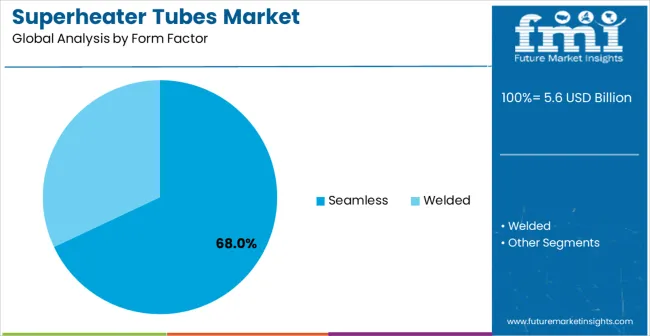
Extreme internal pressure dictates strict material reliability mandates for superheated environments. Seamless superheater tubes are projected to dominate with 68.0% share in 2026 as boiler engineers strictly prohibit longitudinal weld seams inside critical combustion zones. Forcing steam past critical pressure points eliminates any margin for manufacturing defects. High-pressure steam leaks instantly destroy surrounding infrastructure and halt generation. According to FMI's estimates, recent improvements in stainless steel welded pipes meet ASME code for specific subcritical applications, yet legacy utility policies categorically ban welded tubes regardless of advanced radiographic testing results. Delaying transitions to premium cold drawn seamless pipes forces industrial facilities to accept lower operational pressures and drastically reduced generating efficiencies over thirty-year horizons.
- Procurement baseline: Sourcing managers accept significant price premiums for seamless tubing because advanced extrusion processes eliminate longitudinal failure vectors entirely. Seamless structures provide guaranteed performance baselines for utilities evaluating seamless vs welded superheater tubes.
- Operational hidden-costs: Facilities deploying cheaper welded alternatives face skyrocketing ultrasonic inspection expenses during annual turnarounds. Maintenance chiefs burn through operational budgets continuously verifying long-term weld integrities under stress.
- Lifecycle reality: Seamless architectures deliver substantially lower total ownership costs over thirty-year horizons. Utilities avoiding initial extrusion premiums inevitably absorb high outage penalties when inferior seamed tubes rupture unexpectedly.
Superheater Tubes Market Analysis by Pressure Regime
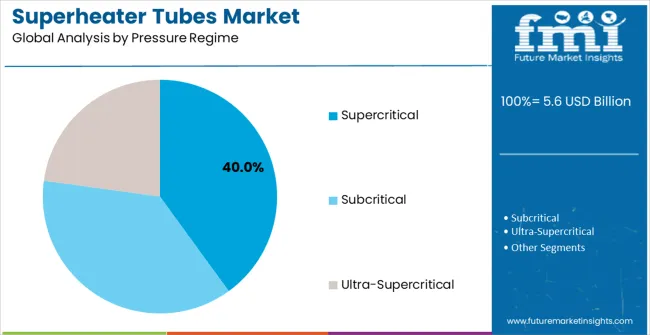
Base‑load generation economics depend heavily on raising steam temperatures beyond critical thermodynamic thresholds, which drives operators to prioritize tubing that can bear higher pressure regimes. Supercritical configurations form the reference point for most modern power plant boiler designs as utilities seek predictable efficiency gains under tighter fuel‑cost and emissions constraints. The supercritical segment is projected to secure 40.0% of market share in 2026, reflecting its role as the practical backbone of both new installations and upgrade programs across the global thermal fleet. Operators rely on supercritical‑rated tubes to maintain competitive heat‑rate performance and extend asset viability, especially as marginal fuel pricing erodes the profitability of subcritical units. Real market volume continues to concentrate in supercritical retrofits, where engineering teams incrementally elevate the performance envelope of legacy fire‑tube and chemical boiler systems without committing to full ultra‑supercritical rebuilds. Plants that delay pressure‑boundary upgrades risk rapid loss of dispatch relevance as grid coordinators increasingly favour higher‑efficiency assets during daily load balancing.
- Creep prevention: Supercritical pressure requires precise wall thickness calculations to prevent long-term plastic deformation. Reliability engineers must continuously monitor microscopic dimensional changes across thousands of individual boiler tubes to avoid failures.
- Residual vulnerability: Even perfectly specified ultra supercritical boiler tubes suffer rapid exfoliation if internal chemistry protocols drift slightly. Water treatment operators hold ultimate responsibility for preventing internal scaling and subsequent tube bursts.
- Capture maximization: Facilities only realize promised efficiency gains when daily operations perfectly match designed steam flows. Plant managers failing to maintain steady base-loads degrade high-pressure tubing exponentially faster through cyclic thermal stress.
Superheater Tubes Market Drivers, Restraints, and Opportunities
Grid dispatchers increasingly penalize inefficient thermal plants, forcing facility owners to execute immediate metallurgical upgrades to remain competitive. Upgrading raw efficiency requires pushing operating temperatures higher, a physical reality demanding advanced high-alloy tubing. Procurement directors face commercial pressure to secure specialized superalloys before global power generation gas turbine expansions consume available forging capacity. Delaying these critical material upgrades condemns power plants to lower dispatch priority, immediately eroding annual revenue while risking total regulatory shutdown due to excessive baseline emissions. Replacement demand for superheater tubes is closely linked to these efficiency requirements.
Lengthy material qualification cycles create high friction that slows adoption even when utilities possess budget approval. Integrating advanced austenitic materials into older boiler frames requires complex dissimilar metal welding protocols that few regional contractors master. Plant engineers hesitate to authorize complete material transitions because unexpected boiler control fluctuations easily stress unproven weld joints. While automated orbital welding solutions provide partial relief, a severe shortage of certified metallurgical inspectors keeps installation timelines extended.
Opportunities in the Superheater Tubes Market
- Biomass conversion: Retrofitting coal-fired assets for biomass combustion requires highly corrosion-resistant tubing. Specialized alloy producers capture premiums supplying components immune to aggressive chloride attack.
- Hydrogen blending: Integrating hydrogen into heat recovery system generator platforms alters combustion chemistry entirely. Tube manufacturers gain long-term lock-in by providing proprietary coatings that prevent high-temperature hydrogen embrittlement inside superheater tubes for HRSG.
- Small modular reactors: Miniaturized nuclear designs require incredibly compact, ultra-reliable steam generator tubes. Niche manufacturers secure exclusive, high-margin contracts by mastering extreme-tolerance seamless extrusion techniques.
Regional Analysis
Based on regional analysis, superheater tubes market is segmented into Asia Pacific, Middle East & Africa, North America, Europe, and Latin America across 40 plus countries.
.webp "Top Country Growth Comparison Superheater Tubes Market Cagr (2026 2036)")
| Country | CAGR (2026 to 2036) |
|---|---|
| India | 5.0% |
| China | 4.5% |
| Saudi Arabia | 3.8% |
| USA | 3.4% |
| Germany | 3.2% |
| UK | 3.0% |
| Japan | 2.8% |
Source: Future Market Insights (FMI) analysis, based on proprietary forecasting model and primary research
Asia Pacific Superheater Tubes Market Analysis
Base-load power demands across Asia Pacific force utility operators to construct entirely new supercritical thermal fleets while simultaneously overhauling legacy grid assets. State-sponsored infrastructure budgets bypass standard, lengthy approval cycles, resulting in rapid deployment of advanced APAC waste heat recovery systems. Regional steel manufacturers rapidly scale local forging capacities to meet domestic utility consumption, drastically reducing import reliance. Directors managing these mega-projects negotiate directly with regional tier-one mills, effectively freezing out foreign suppliers lacking domestic extrusion plants. FMI's analysis indicates local content requirements heavily dictate final contract awards for large-scale boiler projects.
- India: Power ministries continually authorize supercritical thermal expansions alongside continuous boiler modernizations. Demand for superheater tubes across India is anticipated to rise at a CAGR of 5.0% through 2036. Directors secure long-term alloy supply contracts to ensure uninterrupted plant construction. Local heavy engineering firms capture dominant regional market shares through aggressive pricing strategies that sustain this steady project pipeline.
- China: The China superheater tubes segment is poised to expand at a CAGR of 4.5% through 2036. Extensive fleet replacement programs prioritize high-efficiency thermal output over maintaining legacy assets. Plant managers completely swap subcritical systems for advanced ultra-supercritical platforms to meet strict targets. This steady domestic consumption shifts local boiler manufacturers into globally dominant export positions over the long term.
- Japan: Steady replacement-led demand cycles dictate material consumption rates rather than greenfield construction. Maintenance heads mandate exact metallurgical replacements during scheduled outages to maintain baseline operations. Superheater tube adoption in the country is likely to advance at a CAGR of 2.8% by 2036. Aging infrastructure forces continuous high-margin component replacement despite entirely stagnant overall capacity growth across the national grid.
FMI's report includes South Korea, Australia, and Indonesia. Surging regional demand for customized industrial steam applications creates secondary growth vectors separate from primary utility-scale grid expansions.
Middle East & Africa Superheater Tubes Market Analysis
Gas-fired facility investments dictate continuous high-temperature tubing consumption across Middle Eastern infrastructure networks. Extreme ambient temperatures drastically lower overall combined-cycle efficiency, forcing engineering teams to push industrial boilers to absolute material limits to maintain output. Utilities bypass standard protocols to secure premium nickel-based alloys capable of surviving harsh local operating conditions without frequent failure. Based on FMI's assessment, localization mandates increasingly force global tube manufacturers to establish regional finishing facilities to qualify for lucrative government tenders.
- Saudi Arabia: Gas-fired facility investments dictate continuous high-temperature tubing consumption across sprawling desalination networks. The market for superheater tubes in Saudi Arabia is expected to grow at a CAGR of 3.8% during the study period. Reliability engineers prioritize components displaying high resistance to internal scaling. This focused procurement allows regional operators to achieve localized supply chain security for critical thermal assets.
FMI's report includes UAE, South Africa, and Egypt. Expanding regional petrochemical hubs demand specialized tube geometries explicitly engineered for continuous extreme-temperature cracking operations.
North America & Europe Superheater Tubes Market Analysis
Strict efficiency compliance requirements for legacy steam systems define consumption patterns across Western economies, shaping the Europe superheater tubes market. Environmental regulations effectively prohibit new coal-fired construction, forcing utility owners to extract maximum possible lifespan from existing assets through sophisticated metallurgical retrofits. Plant engineers selectively specify advanced austenitic grades to replace failing carbon steel sections, carefully balancing high upgrade costs against looming retirement dates. In FMI's view, specialized service centers capturing rapid-response outage contracts dominate regional supply dynamics, easily outcompeting basic water tube food processing boiler manufacturers lacking specialized alloy inventories.
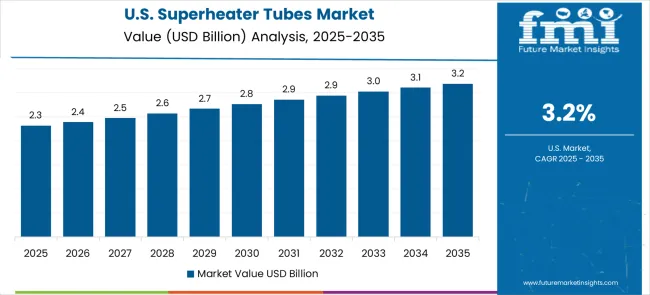
- USA: Superheater tube sales in the USA are poised to grow at a CAGR of 3.4% during the assessment period. Utilities execute selective outage maintenance, demanding premium creep-resistant alloys for aging fleets. Sourcing directors strictly purchase from verified domestic suppliers to maintain rapid emergency response times. Agile specialty steel service centers leverage this proximity to capture highly lucrative rapid-turnaround maintenance contracts.
- Germany: Strict efficiency compliance requirements target legacy industrial steam systems across heavy manufacturing zones. Engineering managers authorize complete boiler tube replacements to avoid carbon emission penalties. Germany is forecast to record steady growth in superheater tubes at a CAGR of 3.2% through 2036. This transition signals a profound shift away from bulk steel towards highly engineered specialized superalloys across the industrial base.
- UK: Operators selectively retrofit remaining thermal capacity to stabilize grid fluctuations caused by intermittent renewable sources. Demand for superheater tubes across the UK is set to rise at a 3.0% CAGR through 2036. Maintenance chiefs heavily depend on specialized third-party inspectors to verify tubing integrity. The mature environment focuses entirely on maximizing baseline reliability rather than expanding total baseload generation capacity.
FMI's report includes Canada, France, and Italy. Advanced non-destructive testing requirements alter how regional maintenance teams evaluate and replace pressure components.
Competitive Aligners for Market Players
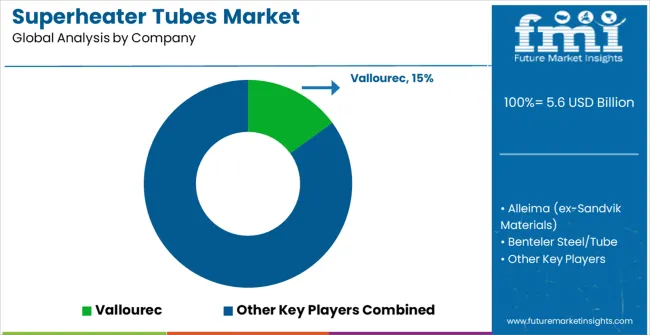
Supplier consolidation fundamentally reshapes procurement strategies as Vallourec and Nippon Steel dominate specialized extrusion capacity for extreme high-temperature alloys. Niche regional manufacturers increasingly abandon bulk carbon steel production, recognizing considerable margin advantages exist strictly within highly engineered superalloy segments. Utilities face severe supply bottlenecks because certifying new mills for ASME code compliance requires years of exhaustive destructive testing. Finding reliable power plant boiler tube suppliers demands navigating these tight regulatory frameworks.
Incumbent tier-one superheater tube manufacturers possess significant proprietary libraries of long-term creep rupture data spanning decades. Challengers cannot mathematically compress thirty-year material degradation tests into short qualification cycles, effectively locking them out of lucrative ultra-supercritical project tenders. Established players like Alleima leverage these historical datasets to guarantee tube lifespans, providing plant operators with mandatory insurance against boiler failures. Engineering firms naturally route major plate heat exchanger and boiler contracts exclusively to approved boiler tube vendors holding these irreplaceable historical metallurgical records.
Large procurement organizations actively resist this vendor lock-in by designing new boiler architectures utilizing standardized tube geometries wherever physically possible. Sourcing directors intentionally split significant project awards across Tubacex and Jindal SAW to maintain competitive pricing tension. Utilities increasingly demand open-source material testing data alongside physical tube deliveries, slowly eroding proprietary data advantages historically held by legacy superheater tube suppliers in European and Japanese steel hubs. Evaluating the boiler tube procurement strategy reveals a constant struggle between securing guaranteed reliability and preventing monopolistic pricing.
Key Players in Superheater Tubes Market
- Vallourec
- Alleima
- Benteler Steel/Tube
- Jindal SAW
- Maharashtra Seamless
- Nippon Steel
- Tubacex
Scope of the Report
| Metric | Value |
|---|---|
| Quantitative Units | USD 5.8 billion to USD 8.4 billion, at a CAGR of 3.8% |
| Market Definition | Superheater tubing comprises high-temperature pressure components engineered to transform saturated steam into dry superheated steam. |
| Segmentation | By Material Grade, Form Factor, Pressure Regime, and Region |
| Regions Covered | North America, Latin America, Europe, Asia Pacific, Middle East and Africa |
| Countries Covered | USA, Canada, Germany, UK, France, Italy, Japan, China, India, Australia, South Korea, Indonesia, Saudi Arabia, UAE, South Africa, Egypt |
| Key Companies Profiled | Vallourec, Alleima, Benteler Steel/Tube, Jindal SAW, Maharashtra Seamless, Nippon Steel, Tubacex |
| Forecast Period | 2026 to 2036 |
| Approach | Quantitative models anchored to annual thermal megawatt additions and verified industrial boiler sales data. |
Source: Future Market Insights (FMI) analysis, based on proprietary forecasting model and primary research
Superheater Tubes Market by Segments
Material Grade:
- Ferritic Alloy Steel
- Austenitic Stainless
- Nickel-Based Alloys
- Others
Form Factor:
- Seamless
- Welded
Pressure Regime:
- Supercritical
- Subcritical
- Ultra-Supercritical
Region:
- North America
- United States
- Canada
- Europe
- Germany
- United Kingdom
- France
- Italy
- Spain
- Asia Pacific
- China
- Japan
- South Korea
- Taiwan
- Singapore
- Latin America
- Brazil
- Mexico
- Argentina
- Middle East & Africa
- GCC Countries
- South Africa
Bibliography
- Alleima. (2025). Alleima receives order of steam generator tubes for small modular reactors.
- Central Electricity Authority. (2025). All India electricity statistics 2025.
- Wang, Z., Zhao, J., Cai, H., & Chai, G. (2024). Failure analysis of a 12Cr1MoV superheater tube after 280,000 h of service. Nuclear Materials and Energy, 40, 101707.
- Press Information Bureau, Government of India. (2024). Department of Atomic Energy year end review 2024.
- ASTM International. (2024). Standard specification for seamless ferritic and austenitic alloy-steel boiler, superheater, and heat-exchanger tubes (A213/A213M-23).
This bibliography is provided for reader reference. The full FMI report contains the complete reference list with primary source documentation.
This Report Addresses
- Heavy metallurgical requirements driving global industrial thermal facility upgrades.
- Precise ultrasonic inspection protocols impacting baseline welded tube economics.
- Decadal baseline outage cycles dictating long-term procurement planning horizons.
- Dissimilar metal welding complications arising from rushed austenitic tube replacements.
- Creep resistance validation blocking challenger manufacturers from lucrative utility contracts.
- Biomass conversion chemistry demanding specialized highly corrosion-resistant alloy tubes.
- Legacy capacity forcing operators to push old components past subcritical limits.
- Regional local content mandates restructuring utility supply chain dependency dynamics.
Frequently Asked Questions
What are superheater tubes used for?
Superheater tubing comprises high-temperature pressure components engineered to transform saturated steam into dry superheated steam within industrial generating environments. These components withstand extreme thermal stress and internal pressure across power generation and high industrial manufacturing facilities globally.
How large is the superheater tubes market in 2026 and 2036?
The superheater tubes market size reaches USD 5.8 billion in 2026 and expands to USD 8.4 billion by 2036. This expansion reflects compounding demand for high-grade replacement alloys as operators upgrade legacy thermal assets globally.
Which material grade leads the superheater tubes market?
Ferritic alloy steel superheater tubes capture 42.0% volume share because they offer acceptable creep resistance for mid-tier temperatures at a fraction of nickel-alloy costs. Utility buyers depend heavily on these grades to balance tight maintenance budgets during scheduled turnarounds.
Why are seamless superheater tubes preferred?
Seamless extrusion physically removes longitudinal weld seams, which constitute primary failure vectors under extreme steam pressure. Plant engineers universally mandate seamless construction for supercritical zones to prevent ruptures and guarantee safety.
What drives replacement demand for superheater tubes?
Decadal asset replacement cycles fundamentally restrict volume. Plants only consume vast quantities of specialized tubes during major scheduled turnarounds, creating sporadic but considerable demand spikes driven by strict thermal efficiency mandates.
Which countries are growing fastest in superheater tubes?
India leads at 5.0% compound growth by aggressively building new greenfield supercritical capacity. China tracks closely at 4.5% driven by extensive fleet replacement programs prioritizing high-efficiency thermal output over legacy assets.
Who are the key companies in the superheater tubes market?
Leading companies shaping the superheater tubes industry analysis include Vallourec, Alleima, Benteler Steel/Tube, Jindal SAW, Maharashtra Seamless, Nippon Steel, and Tubacex. These tier-one manufacturers control specialized extrusion capacity for extreme high-temperature alloys globally.
What is the difference between superheater tubes and reheater tubes?
While reheaters operate at similar extreme temperatures to superheaters, they handle much lower internal steam pressures. This pressure differential requires distinct metallurgical specifications and separate procurement channels for basic reheater components.
Which pressure regime leads superheater tube demand?
Supercritical boiler tubes represent 40.0% of configurations by creating extreme thermodynamic efficiencies. Operators must deploy high-grade alloys because subcritical carbon steel physically degrades instantly under supercritical pressure and heat.
How do ASME standards affect superheater tube procurement?
ASME boiler tube standards mandate exhaustive destructive testing procedures and strict ASME SA213 tubes compliance. Manufacturers spend years securing metallurgical certifications before utility engineers even allow them to submit basic project bids.
Why is ferritic alloy steel dominant in superheater tubes?
Ferritic grades provide the exact cost-to-performance ratio required for standard boiler sections operating below 600°C. Upgrading entirely to advanced austenitic variants destroys maintenance budgets, forcing engineers to deploy ferritic grades strategically.
What creates regional differences between India and Germany?
India aggressively builds new greenfield supercritical capacity. Germany relies purely on retrofitting existing legacy plants to satisfy strict efficiency targets, generating lower total volume but higher-grade alloy demand.
What hidden factor delays material upgrades?
Utility maintenance teams lack specialized welders capable of joining advanced austenitic replacement tubes to older ferritic boiler headers. This skill gap prevents rapid field installation during tightly scheduled outages.
Why do utilities resist welded tubing?
Despite improved radiographic testing verifying modern weld integrity, utility liability policies categorically ban welded tubes in high-stress combustion zones. Managers refuse to risk billion-dollar assets on seam reliability.
How do proprietary testing libraries protect incumbents?
Tier-one manufacturers hold decades of historical creep rupture data validating their specific alloys. Challengers cannot mathematically fake thirty-year degradation tests, locking them out of major utility tenders.
What dictates alloy selection during planned outages?
Engineers universally order identical replacement grades to match existing manifold geometries. Switching to superior metallurgy requires complete redesigns, forcing utilities to stick with legacy materials.
How does biomass conversion affect tube procurement?
Switching legacy plants to biomass introduces aggressive corrosive chlorides into combustion chambers. Utilities must immediately purchase specialized corrosion-resistant tubes or face rapid internal wall thinning.
Why do operators push legacy systems past design limits?
Grid dispatchers heavily favor efficient generators. Plant managers intentionally push old subcritical boilers into higher pressure regimes to secure dispatch priority, accelerating tube degradation.
What forces rapid adoption of nickel-based alloys?
Ultra-supercritical power blocks push steam temperatures beyond 600°C, instantly destroying standard stainless steel. Engineers must use specialized nickel superalloys simply to keep high-temperature zones intact.
How do localization policies impact procurement?
Middle Eastern utilities mandate local manufacturing content for major infrastructure contracts. Global tube suppliers must build local finishing plants to access lucrative regional desalination and power tenders.
What defines the Asian market trajectory?
Significant state-sponsored infrastructure budgets completely bypass standard lengthy approval cycles. Regional tier-one mills rapidly scale domestic forging capacities to meet immediate local utility consumption needs.
Why do procurement directors split large contracts?
Relying on single suppliers for highly engineered tubing creates high risk. Sourcing teams intentionally split major awards to maintain competitive pricing tension across multiple certified mills.
How do emergency outages alter purchasing behavior?
When tubes burst unexpectedly, standard procurement protocols collapse. Service centers holding specialized localized alloy inventory command high price premiums supplying rapid-response replacement components.
What prevents rapid qualification of new suppliers?
Boiler code compliance requires exhaustive testing procedures. Manufacturers spend years securing metallurgical certifications before utility engineers even allow them to submit basic project bids.
Preview the report firsthand - request a free sample
Get SampleGet the brochure for pricing and purchase details.
Get PDFTable of Content
- Executive Summary
- Global Market Outlook
- Supply-side Trends
- Technology Roadmap Analysis
- Analysis and Recommendations
- Market Overview
- Market Coverage / Taxonomy
- Market Definition / Scope / Limitations
- Research Methodology
- Market Sizing, Forecasting, and Opportunity Mapping
- Research Design and Evidence Framework
- Desk Research Programme (Secondary Evidence)
- Company Annual and Sustainability Reports
- Peer-reviewed Journals and Academic Literature
- Corporate Websites, Product Literature, and Technical Notes
- Earnings Decks and Investor Briefings
- Statutory Filings and Regulatory Disclosures
- Technical White Papers and Standards Notes
- Trade Journals, Industry Magazines, and Analyst Briefs
- Conference Proceedings, Webinars, and Seminar Materials
- Government Statistics Portals and Public Data Releases
- Press Releases and Reputable Media Coverage
- Specialist Newsletters and Curated Briefings
- Sector Databases and Reference Repositories
- FMI Internal Proprietary Databases and Historical Market Datasets
- Subscription Datasets and Paid Sources
- Social Channels, Communities, and Digital Listening Inputs
- Additional Desk Sources
- Expert Input and Fieldwork (Primary Evidence)
- Primary Modes
- Focus Groups
- Observational and In-context Research
- Social and Community Interactions
- Stakeholder Universe Engaged
- C-suite Leaders
- Board Members
- Presidents and Vice Presidents
- R&D and Innovation Heads
- Technical Specialists
- Domain Subject-matter Experts
- Scientists
- Physicians and Other Healthcare Professionals
- Governance, Ethics, and Data Stewardship
- Research Ethics
- Data Integrity and Handling
- Primary Modes
- Tooling, Models, and Reference Databases
- Desk Research Programme (Secondary Evidence)
- Data Engineering and Model Build
- Data Acquisition and Ingestion
- Cleaning, Normalisation, and Verification
- Synthesis, Triangulation, and Analysis
- Quality Assurance and Audit Trail
- Market Background
- Market Dynamics
- Drivers
- Restraints
- Opportunity
- Trends
- Scenario Forecast
- Demand in Optimistic Scenario
- Demand in Likely Scenario
- Demand in Conservative Scenario
- Opportunity Map Analysis
- Product Life Cycle Analysis
- Supply Chain Analysis
- Investment Feasibility Matrix
- Value Chain Analysis
- PESTLE and Porter’s Analysis
- Regulatory Landscape
- Regional Parent Market Outlook
- Production and Consumption Statistics
- Import and Export Statistics
- Market Dynamics
- Global Market Analysis 2021 to 2025 and Forecast, 2026 to 2036
- Historical Market Size Value (USD Million) Analysis, 2021 to 2025
- Current and Future Market Size Value (USD Million) Projections, 2026 to 2036
- Y-o-Y Growth Trend Analysis
- Absolute $ Opportunity Analysis
- Global Market Pricing Analysis 2021 to 2025 and Forecast 2026 to 2036
- Global Market Analysis 2021 to 2025 and Forecast 2026 to 2036, By Material Grade
- Introduction / Key Findings
- Historical Market Size Value (USD Million) Analysis By Material Grade , 2021 to 2025
- Current and Future Market Size Value (USD Million) Analysis and Forecast By Material Grade , 2026 to 2036
- Ferritic Alloy Steel
- Austenitic Stainless
- Nickel-Based Alloys
- Others
- Ferritic Alloy Steel
- Y-o-Y Growth Trend Analysis By Material Grade , 2021 to 2025
- Absolute $ Opportunity Analysis By Material Grade , 2026 to 2036
- Global Market Analysis 2021 to 2025 and Forecast 2026 to 2036, By Form Factor
- Introduction / Key Findings
- Historical Market Size Value (USD Million) Analysis By Form Factor, 2021 to 2025
- Current and Future Market Size Value (USD Million) Analysis and Forecast By Form Factor, 2026 to 2036
- Seamless
- Welded
- Seamless
- Y-o-Y Growth Trend Analysis By Form Factor, 2021 to 2025
- Absolute $ Opportunity Analysis By Form Factor, 2026 to 2036
- Global Market Analysis 2021 to 2025 and Forecast 2026 to 2036, By Pressure Regime
- Introduction / Key Findings
- Historical Market Size Value (USD Million) Analysis By Pressure Regime, 2021 to 2025
- Current and Future Market Size Value (USD Million) Analysis and Forecast By Pressure Regime, 2026 to 2036
- Supercritical
- Ultra-Supercritical
- Subcritical
- Supercritical
- Y-o-Y Growth Trend Analysis By Pressure Regime, 2021 to 2025
- Absolute $ Opportunity Analysis By Pressure Regime, 2026 to 2036
- Global Market Analysis 2021 to 2025 and Forecast 2026 to 2036, By Region
- Introduction
- Historical Market Size Value (USD Million) Analysis By Region, 2021 to 2025
- Current Market Size Value (USD Million) Analysis and Forecast By Region, 2026 to 2036
- North America
- Latin America
- Western Europe
- Eastern Europe
- East Asia
- South Asia and Pacific
- Middle East & Africa
- Market Attractiveness Analysis By Region
- North America Market Analysis 2021 to 2025 and Forecast 2026 to 2036, By Country
- Historical Market Size Value (USD Million) Trend Analysis By Market Taxonomy, 2021 to 2025
- Market Size Value (USD Million) Forecast By Market Taxonomy, 2026 to 2036
- By Country
- USA
- Canada
- Mexico
- By Material Grade
- By Form Factor
- By Pressure Regime
- By Country
- Market Attractiveness Analysis
- By Country
- By Material Grade
- By Form Factor
- By Pressure Regime
- Key Takeaways
- Latin America Market Analysis 2021 to 2025 and Forecast 2026 to 2036, By Country
- Historical Market Size Value (USD Million) Trend Analysis By Market Taxonomy, 2021 to 2025
- Market Size Value (USD Million) Forecast By Market Taxonomy, 2026 to 2036
- By Country
- Brazil
- Chile
- Rest of Latin America
- By Material Grade
- By Form Factor
- By Pressure Regime
- By Country
- Market Attractiveness Analysis
- By Country
- By Material Grade
- By Form Factor
- By Pressure Regime
- Key Takeaways
- Western Europe Market Analysis 2021 to 2025 and Forecast 2026 to 2036, By Country
- Historical Market Size Value (USD Million) Trend Analysis By Market Taxonomy, 2021 to 2025
- Market Size Value (USD Million) Forecast By Market Taxonomy, 2026 to 2036
- By Country
- Germany
- UK
- Italy
- Spain
- France
- Nordic
- BENELUX
- Rest of Western Europe
- By Material Grade
- By Form Factor
- By Pressure Regime
- By Country
- Market Attractiveness Analysis
- By Country
- By Material Grade
- By Form Factor
- By Pressure Regime
- Key Takeaways
- Eastern Europe Market Analysis 2021 to 2025 and Forecast 2026 to 2036, By Country
- Historical Market Size Value (USD Million) Trend Analysis By Market Taxonomy, 2021 to 2025
- Market Size Value (USD Million) Forecast By Market Taxonomy, 2026 to 2036
- By Country
- Russia
- Poland
- Hungary
- Balkan & Baltic
- Rest of Eastern Europe
- By Material Grade
- By Form Factor
- By Pressure Regime
- By Country
- Market Attractiveness Analysis
- By Country
- By Material Grade
- By Form Factor
- By Pressure Regime
- Key Takeaways
- East Asia Market Analysis 2021 to 2025 and Forecast 2026 to 2036, By Country
- Historical Market Size Value (USD Million) Trend Analysis By Market Taxonomy, 2021 to 2025
- Market Size Value (USD Million) Forecast By Market Taxonomy, 2026 to 2036
- By Country
- China
- Japan
- South Korea
- By Material Grade
- By Form Factor
- By Pressure Regime
- By Country
- Market Attractiveness Analysis
- By Country
- By Material Grade
- By Form Factor
- By Pressure Regime
- Key Takeaways
- South Asia and Pacific Market Analysis 2021 to 2025 and Forecast 2026 to 2036, By Country
- Historical Market Size Value (USD Million) Trend Analysis By Market Taxonomy, 2021 to 2025
- Market Size Value (USD Million) Forecast By Market Taxonomy, 2026 to 2036
- By Country
- India
- ASEAN
- Australia & New Zealand
- Rest of South Asia and Pacific
- By Material Grade
- By Form Factor
- By Pressure Regime
- By Country
- Market Attractiveness Analysis
- By Country
- By Material Grade
- By Form Factor
- By Pressure Regime
- Key Takeaways
- Middle East & Africa Market Analysis 2021 to 2025 and Forecast 2026 to 2036, By Country
- Historical Market Size Value (USD Million) Trend Analysis By Market Taxonomy, 2021 to 2025
- Market Size Value (USD Million) Forecast By Market Taxonomy, 2026 to 2036
- By Country
- Kingdom of Saudi Arabia
- Other GCC Countries
- Turkiye
- South Africa
- Other African Union
- Rest of Middle East & Africa
- By Material Grade
- By Form Factor
- By Pressure Regime
- By Country
- Market Attractiveness Analysis
- By Country
- By Material Grade
- By Form Factor
- By Pressure Regime
- Key Takeaways
- Key Countries Market Analysis
- USA
- Pricing Analysis
- Market Share Analysis, 2025
- By Material Grade
- By Form Factor
- By Pressure Regime
- Canada
- Pricing Analysis
- Market Share Analysis, 2025
- By Material Grade
- By Form Factor
- By Pressure Regime
- Mexico
- Pricing Analysis
- Market Share Analysis, 2025
- By Material Grade
- By Form Factor
- By Pressure Regime
- Brazil
- Pricing Analysis
- Market Share Analysis, 2025
- By Material Grade
- By Form Factor
- By Pressure Regime
- Chile
- Pricing Analysis
- Market Share Analysis, 2025
- By Material Grade
- By Form Factor
- By Pressure Regime
- Germany
- Pricing Analysis
- Market Share Analysis, 2025
- By Material Grade
- By Form Factor
- By Pressure Regime
- UK
- Pricing Analysis
- Market Share Analysis, 2025
- By Material Grade
- By Form Factor
- By Pressure Regime
- Italy
- Pricing Analysis
- Market Share Analysis, 2025
- By Material Grade
- By Form Factor
- By Pressure Regime
- Spain
- Pricing Analysis
- Market Share Analysis, 2025
- By Material Grade
- By Form Factor
- By Pressure Regime
- France
- Pricing Analysis
- Market Share Analysis, 2025
- By Material Grade
- By Form Factor
- By Pressure Regime
- India
- Pricing Analysis
- Market Share Analysis, 2025
- By Material Grade
- By Form Factor
- By Pressure Regime
- ASEAN
- Pricing Analysis
- Market Share Analysis, 2025
- By Material Grade
- By Form Factor
- By Pressure Regime
- Australia & New Zealand
- Pricing Analysis
- Market Share Analysis, 2025
- By Material Grade
- By Form Factor
- By Pressure Regime
- China
- Pricing Analysis
- Market Share Analysis, 2025
- By Material Grade
- By Form Factor
- By Pressure Regime
- Japan
- Pricing Analysis
- Market Share Analysis, 2025
- By Material Grade
- By Form Factor
- By Pressure Regime
- South Korea
- Pricing Analysis
- Market Share Analysis, 2025
- By Material Grade
- By Form Factor
- By Pressure Regime
- Russia
- Pricing Analysis
- Market Share Analysis, 2025
- By Material Grade
- By Form Factor
- By Pressure Regime
- Poland
- Pricing Analysis
- Market Share Analysis, 2025
- By Material Grade
- By Form Factor
- By Pressure Regime
- Hungary
- Pricing Analysis
- Market Share Analysis, 2025
- By Material Grade
- By Form Factor
- By Pressure Regime
- Kingdom of Saudi Arabia
- Pricing Analysis
- Market Share Analysis, 2025
- By Material Grade
- By Form Factor
- By Pressure Regime
- Turkiye
- Pricing Analysis
- Market Share Analysis, 2025
- By Material Grade
- By Form Factor
- By Pressure Regime
- South Africa
- Pricing Analysis
- Market Share Analysis, 2025
- By Material Grade
- By Form Factor
- By Pressure Regime
- USA
- Market Structure Analysis
- Competition Dashboard
- Competition Benchmarking
- Market Share Analysis of Top Players
- By Regional
- By Material Grade
- By Form Factor
- By Pressure Regime
- Competition Analysis
- Competition Deep Dive
- Vallourec
- Overview
- Product Portfolio
- Profitability by Market Segments (Product/Age /Sales Channel/Region)
- Sales Footprint
- Strategy Overview
- Marketing Strategy
- Product Strategy
- Channel Strategy
- Alleima
- Benteler Steel/Tube
- Jindal SAW
- Maharashtra Seamless
- Nippon Steel
- Tubacex
- Vallourec
- Competition Deep Dive
- Assumptions & Acronyms Used


