

- Industry Size (2025)
- USD 516.9 Mn
- Forecast (2035)
- USD 730.3 Mn
- CAGR (2025 to 2035)
- 3.5%
Lotion Tubes Market Size and Share Forecast Outlook 2025 to 2035
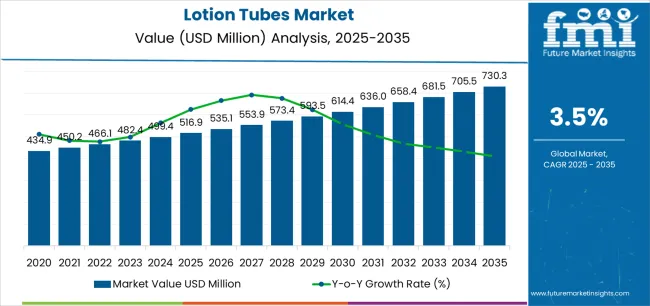
The Lotion Tubes Market is estimated to be valued at USD 516.9 million in 2025 and is projected to reach USD 730.3 million by 2035, registering a compound annual growth rate (CAGR) of 3.5% over the forecast period.
The Lotion Tubes market is experiencing steady growth driven by increasing consumer demand for convenient and hygienic personal care packaging solutions. The future outlook of this market is shaped by innovations in tube materials and designs that enhance product protection, usability, and sustainability. Rising awareness of product safety and contamination prevention has accelerated the adoption of advanced packaging, particularly in cosmetics and skincare sectors.
Continuous growth in the personal care industry, coupled with expanding e-commerce distribution channels, has further fueled demand for lotion tubes that are durable, lightweight, and easy to handle. The increasing preference for travel-friendly and single-use packaging formats has also supported market expansion.
Furthermore, the shift towards environmentally conscious and recyclable packaging solutions is opening opportunities for innovation in materials and coatings As personal care brands continue to emphasize brand differentiation through premium and functional packaging, the lotion tubes market is expected to witness sustained growth, driven by both emerging and established markets, while responding to evolving consumer expectations and regulatory requirements.
Quick Stats for Lotion Tubes Market
- Lotion Tubes Market Industry Value (2025): USD 516.9 million
- Lotion Tubes Market Forecast Value (2035): USD 730.3 million
- Lotion Tubes Market Forecast CAGR: 3.5%
- Leading Segment in Lotion Tubes Market in 2025: Plastic Barrier Laminated (PBL) Tubes (31.2%)
- Key Growth Region in Lotion Tubes Market: North America, Asia-Pacific, Europe
- Top Key Players in Lotion Tubes Market: Essel Propack Ltd, Montebello Packaging, Alltub SAS, Hoffman Neopac AG, Albea S.A., CCL Industries Inc., Berry Global Group, Inc., Precision Concepts Inc, Pack-Tubes, Antilla Propack, Ctl-Th Packaging, Tubopress Italia Spa, Huhtamaki Oyj, ALPLA Group, Quadpack Company, Glenroy, Inc, Jsn Industries Inc, Prisha Tubes Pvt Ltd, Auber Packaging Co., Ouxinmay Packaging Co., Ltd., Lixin Packaging Material Co., Ltd., Guanyu Plastic Tube Co., Ltd.
| Metric | Value |
|---|---|
| Lotion Tubes Market Estimated Value in (2025 E) | USD 516.9 million |
| Lotion Tubes Market Forecast Value in (2035 F) | USD 730.3 million |
| Forecast CAGR (2025 to 2035) | 3.5% |
Segmental Analysis
The market is segmented by Product, Material, and Capacity and region. By Product, the market is divided into Plastic Barrier Laminated (PBL) Tubes, Aluminum Barrier Laminated (ABL) Tubes, Aluminum Tubes, and Plastic Co-Extrusion Tubes. In terms of Material, the market is classified into Aluminum, Ethylene Vinyl Alcohol (EVOH), and Polyester (PET). Based on Capacity, the market is segmented into Less Than 50 Ml, 51 To 100 Ml, and Above 100 Ml. Regionally, the market is classified into North America, Latin America, Western Europe, Eastern Europe, Balkan & Baltic Countries, Russia & Belarus, Central Asia, East Asia, South Asia & Pacific, and the Middle East & Africa.
Insights into the Plastic Barrier Laminated Tubes Product Segment
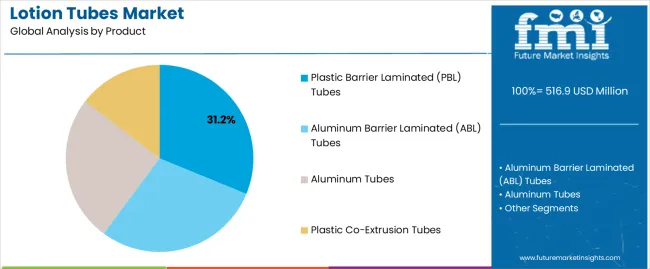
Plastic Barrier Laminated Tubes are projected to hold 31.2% of the Lotion Tubes market revenue share in 2025, making them the leading product type. This dominance is attributed to their ability to combine the flexibility of plastic with barrier properties that protect formulations from air, moisture, and light exposure.
The segment has benefited from advancements in multilayer lamination technologies that improve durability, shelf life, and resistance to product leakage. The ease of printing and branding on laminated surfaces has also contributed to its preference in personal care and cosmetic products.
Additionally, the lightweight and cost-effective nature of these tubes supports both manufacturing efficiency and consumer convenience, reinforcing their adoption in global markets.
Insights into the Aluminum Material Segment
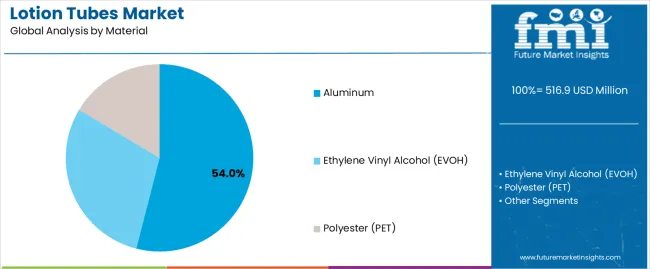
Aluminum is expected to account for 54.0% of the Lotion Tubes market revenue in 2025, establishing it as the leading material segment. This growth has been driven by its superior barrier properties, protecting contents from contamination and extending product shelf life.
Aluminum tubes are valued for their recyclable nature and premium appearance, which aligns with increasing consumer focus on sustainability and luxury packaging.
The material's resistance to corrosion and chemical interaction with formulations has made it a preferred choice across diverse lotion types, supporting its continued dominance in the market.
Insights into the Less Than 50 Ml Capacity Segment
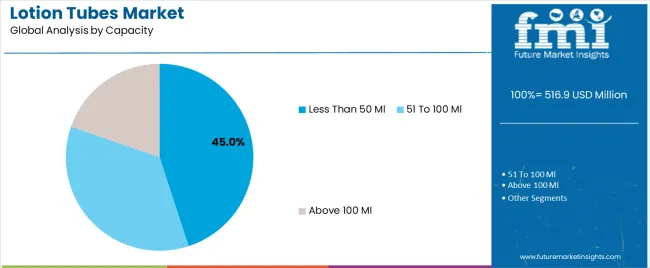
The less than 50 Ml capacity segment is projected to hold 45.0% of the Lotion Tubes market revenue share in 2025, making it the leading capacity segment. This growth is driven by rising demand for travel-sized, single-use, and sample packaging formats that offer convenience and portability.
The segment is favored by consumers seeking easy-to-carry products for personal care, on-the-go applications, and trial purposes.
Additionally, brands are leveraging small-capacity tubes to introduce new formulations and limited editions without incurring high production costs, reinforcing the popularity of this size segment.
Semi Annual Market Update
The below table presents the expected CAGR for the global lotion tubes market over several semi-annual periods spanning from 2025 to 2035. In the first half (H1) of the year from 2025 to 2035, the business is predicted to surge at a CAGR of 3.9%, followed by a slightly lower growth rate of 3.5% in the second half (H2) of the same year.
| Particular | Value CAGR |
|---|---|
| H1 | 3.9% (2025 to 2035) |
| H2 | 3.5% (2025 to 2035) |
| H1 | 3.4% (2025 to 2035) |
| H2 | 3.8% (2025 to 2035) |
Moving into the subsequent period, from H1 2025 to H2 2035, the CAGR is projected to decrease slightly to 3.4% in the first half and remain relatively moderate at 3.8% in the second half. In the first half (H1) the market witnessed a decrease of 50 BPS while in the second half (H2), the market witnessed an increase of 30 BPS.
Key Industry Highlights
Increasing Demand for Beauty Care Products and Packaging Solutions
Beauty packaging is referred to for its physical appearance that maintains and packages the different beauty items such as skin care, hair care, colour cosmetics, fragrances, and personal care. Approximately 57% of women in the world are shopping for beauty products regularly.
The appearance of the beauty packaging is essential to maintain a long-lasting impression on consumers. Beauty packaging must be flexible to accommodate any type of product without any limitations. Branding has become an important factor in differentiating the products out of the shelf and it has become a priority for the cosmetics brands to stand out.
Companies and brands are focusing on gaining complete features including material, printing, shape, and texture to make the optimum packaging design for the products to gain attention. Beauty packaging that suits aesthetic purpose and operations ability ensures the complete integrity of the product, along with convenience and safety. The skincare packaging must enhance the visual appeal and brand image of the products.
Inclination towards Convenient and Easy-to-Use Packaging Solutions
Consumers are increasingly inclined towards convenient packaging solutions which is highly contributing to the growth of lotion tubes. The easy-to-use features and simplified application of lotion tubes are attracting customers who need convenience. The lightweight of the lotion tubes makes them ideal for on-the-go applications for mobility purposes. Lotion tubes also offer portability which is in great demand from the end users.
The flexibility and ease of carrying the lotion tubes in bags and pockets facilitate the consumers. The compactness and ease of use allow it to carry during travelling and for everyday use uplifting the demand for lotion tubes in the market.
Lotion tubes protect the package contents from outside conditions such as moisture, light, and air. Lotion tube packaging offers freshness and maintains the product conditions which can ensure customer satisfaction. The convenient features offered by the laminated tubes fulfill the demand of consumers leading to market growth.
Inclination towards Alternative Packaging Solitons
Oral care, personal care, and cosmetics products are packed in various packaging formats as per the customer’s requirement, convenience and pricing capabilities. The rising trend towards unit-dose application has created ample scope for pouches, sachets, and stick packs.
Considering the more steady demand but at a lower quantity, many FMCG companies sell shampoo, food products, and washing powders in sachets. The sachets are economical and convenient in packaging as they consume less shipping space than tubes. Additionally, the tube packaging is primarily selected for thick paste-like products; it is not convenient for liquid products.
Consequently, the hand wash, airless pumps, and sprays are rigid containers used to pack liquid products like hand wash, deodorants, lotions, etc. The competition from alternative or substitute packaging such as small sachets and pouches could restrict the tube packaging market.
2020 to 2025 Global Lotion Tubes Sales Outlook Compared to Demand Forecast from 2025 to 2035
The global lotion tube industry recorded a CAGR of 2.5% during the historical period between 2020 and 2025. The growth of the lotion tube industry was positive as it reached a value of USD 516.9 million in 2025 from USD 434.9 million in 2020.
Lotion tubes give excellent barrier protection and increase the shelf life of the product. Due to these features, the demand for lotion tubes is expected to experience a tremendous growth in volume from various industries such as food, personal care & cosmetics and pharmaceuticals over the forecast period.
Tremendous demand for lotion tubes from particular industries such as pharmaceuticals and cosmetics has retained the target markets profitable. The global pharmaceuticals industry is growing continuously in recent years which has positively impacted the sales of lotion tubes.
Plastic tubes are becoming more popular, because of their great flexibility and inexpensive price. Additionally, the growing use of plastic tubes in the personal care sector is a significant reason that is propelling the sales of lotion tubes in all geographical areas. These are fitted with a wide variety of caps & closures which provide another good feature contributing to the increasing demand for lotion tubes and the product.
The main elements driving the sales of lotion tubes are observed to be an increase in the number of end-use industries and a rise in the need for affordable and efficient packaging solutions. The worldwide demand for lotion tubes is predicted to keep expanding in the near term owing to the expanding healthcare companies. In addition, the demand for lotion tubes is mainly for storing pharmaceutical products.
Moreover, another factor supporting the sales of the lotion tube market is its high barrier protection capability. Also, the ability to find plastic tubes in the widest range of shapes and sizes to satisfy all packaging needs is anticipated to increase demand for lotion tubes throughout the projection period.
Market Concentration
Tier 1 companies comprise market leaders with a market revenue of above USD 10 million capturing a significant market share of 15% to 20% in the global market. These market leaders are characterized by high production capacity and a wide product portfolio.
These players are distinguished by their extensive expertise in manufacturing across multiple products across different applications and a broad geographical reach, underpinned by a robust consumer base. They provide a wide range of products utilizing the latest technology and meeting the regulatory standards providing the highest quality.
Prominent companies within Tier 1 encompass Berry Global Inc., CCL Industries, ALPLA Group, Albéa S.A., EPL Limited, Huhtamaki Oyj, Hoffmann Neopac AG, and CTL Packaging.
Tier 2 companies include mid-size players with revenue of USD 5 to 10 million having presence in specific regions and highly influencing the regional market. These are characterized by a limited international presence and well-maintained market knowledge.
These market players have good technology and ensure regulatory compliance but may not have advanced technology and wide global reach. Prominent companies in tier 2 include Alltub SAS, Montebello Packaging, Glenroy, Inc, Precision Concepts Inc., Antilla Propack, LINHARDT GmbH & Co. KG, and Quadpack Company.
Tier 3 includes the majority of small-scale companies operating at the local presence and serving niche markets having revenue below USD 5 million. These companies are notably oriented towards fulfilling local market demands and are consequently classified within the tier 3 share segment.
They are small-scale players and have very limited geographical reach. Tier 3, within this context, is recognized as an unorganized market, denoting a sector characterized by a lack of extensive structure and formalization when compared to organized competitors.
Country-wise Insights
The section below covers the industry analysis of the lotion tubes market for different countries. Market demand analysis on key countries in several regions of the globe, including North America, South Asia & Pacific, East Asia, Western Europe, Eastern Europe, and others, is provided. In Europe, Germany is anticipated to register a moderate growth at 1.6% through 2035.
China in East Asia and India in South Asia is expected to continue at the forefront in terms of market share and growth rate of lotion tubes. In North America, USA is projected to witness a growth rate of 2.2% by 2035 end.
| Countries | Value CAGR (2025 to 2035) |
|---|---|
| USA | 2.2% |
| Germany | 1.6% |
| UK | 1.7% |
| Canada | 1.3% |
| India | 5.8% |
| China | 4.9% |
| Japan | 2.4% |
| Thailand | 4.5% |
China’s Personal Care Industry Fuels the Market Growth
China is anticipated to create lucrative growth opportunities for the skincare packaging industry. As per the International Trade Administration, the USA Department of Commerce, the beauty and personal care industry in China recorded sales worth USD 88 billion with y-o-y growth of 10% from the previous years.
Colour cosmetics and fragrances have specifically shown impressive growth in China resulting in premium sales increase and product upgradation. The evolution of the e-commerce sector, social media, and digitization in China has been increasingly influencing Chinese consumers to buy more beauty products. China can be one of the significant markets for the growth of the lotion tube market. China is set to capture almost 55% market share in 2035, with a growing CAGR of 4.9%.
Cosmetic and Personal Care Industry in Germany
The lotion tube market in Germany is estimated to reach 20% of value share and grow at 1.6% by the end of 2035. Germany is expected to be one of the top market shareholders in Europe for the lotion tubes industry.
According to the European Tube Manufacturing Association, the primary market for plastic tubes in Europe is the cosmetics industry. Plastic tubes account for 25% of all tubes produced in Europe. Additionally, laminated tubes made from plastic also account for 40% of total tubes. The squeezable plastic tubes offer excellent opportunities for printing, design and decorative features.
The visual appearance of the brand and strong communicative presence are expected to create a conducive environment for the plastic tube market. Sales of plastic tubes are expected to surpass on the back of several applications such as cosmetics, dental care, commercial products, and others in Germany.
As per Cosmetics Europe (The Personal Care Association), the cosmetic and personal care industry in Germany was USD 516.9 billion in 2025. Increasing disposable income and significant expenditure on beauty and lifestyle products in Germany are creating massive demand for cosmetic packaging, including lotion tubes.
Category-wise Insights
The section contains information about the leading segments in the industry. By product type, Plastic barrier laminated (PBL) Tubes are anticipated to capture 31.2% of value share through 2035. Among materials, aluminium is projected to showcase significant growth at 54% of the market share through 2035.
Plastic Barrier Laminated (PBL) Tubes leads in Global Lotion Tubes
| Product Type | Plastic Barrier Laminated (PBL) Tubes |
|---|---|
| Value Share (2035) | 31.2% |
Plastic barrier laminated tubes are used in many industries due to their various properties. The tubes are largely used in the cosmetics and personal care industries. They are also used in the pharmaceutical industry. They are versatile and can be used in for wide range of industries from food to chemical. PBL tubes can be printed with different colors and premium surface treatments.
They also offer unmatched clarity and artwork solutions which are useful for branding purposes. PBL tubes are used in the cosmetics industry, especially for packaging shampoos, conditioners, lotions, skin creams, and UV sunscreens.
Aluminium is Mostly Used Material
| Material | Aluminum |
|---|---|
| Value Share (2035) | 54% |
Aluminium is mostly used in lotion tubes and it is the most preferred tube in industry because of its premium product protection. Aluminum has excellent barrier qualities and reliability to protect the products from external factors such as UV rays, water vapors, and oxygen.
Aluminium-based tubes are malleable. It prevents the contamination of bacteria and microorganisms in the products from air. Aluminium tubes enhance the shelf life of the products even after opening the tube. These tubes are highly collapsible which enables those to fully empty even for vicious products like masks and creams. The recycling ability of aluminium without losing its qualities makes it the most attractive material in the lotion tube industry.
Competitive Landscape
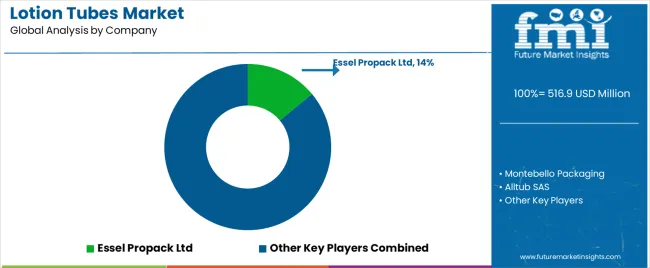
Several prominent players in the lotion tubes market are significantly investing in innovation, research, and development to discover new functions and enhance their offerings. Leveraging technology, these companies prioritize safety, product quality, and customer satisfaction to expand their customer base.
Key manufacturers of lotion tubes are focusing on developing recycled material packaging and developing packaging solutions to meet sustainability demand. They are adopting a merger & acquisition strategy to expand their resources and are developing new products to meet customer needs.
Recent Industry Developments in Lotion Tubes Market
- In June 2025, LINHARDT Group acquired Pioneer Extruders Pvt. Ltd and Jeevanlakshmi Packaging Solutions Pvt. Ltd.
- In May 2025, Hoffmann Neopac AG launched a new cosmetics tube line at its Wilson, NC plant with the name Polyfoil Sensation.
- In March 2025, Berry Global Group Inc. partnered with Mitsubishi Gas Chemical Company, Inc. and launched MXD6, a recyclable barrier solution for thermoformed articles, plastic tubes, jars, and bottles.
Key Players of Lotion Tubes Industry
- Essel Propack Ltd
- Montebello Packaging
- Alltub SAS
- Hoffman Neopac AG
- Albea S.A.
- CCL Industries Inc.
- Berry Global Group, Inc.
- Precision Concepts Inc
- Pack-Tubes
- Antilla Propack
- Ctl-Th Packaging
- Tubopress Italia Spa
- Huhtamaki Oyj
- ALPLA Group
- Quadpack Company
- Glenroy, Inc
- Jsn Industries Inc
- Prisha Tubes Pvt Ltd
- Auber Packaging Co.
- Ouxinmay Packaging Co., Ltd.
- Lixin Packaging Material Co., Ltd.
- Guanyu Plastic Tube Co., Ltd.
Key Segments of Lotion Tubes Industry
By Product:
In terms of product, the industry is divided into aluminum barrier laminated (ABL) tubes, plastic barrier laminated (PBL) tubes, aluminum tubes, and plastic co-extrusion tubes.
By Material:
In terms of material, the industry is segregated aluminum, ethylene vinyl alcohol (EVOH), and polyester (PET).
By Capacity:
The industry is classified by capacity as less than 50 ml, 51 to 100 ml, and above 100 ml.
By Region:
Key countries of North America, Latin America, Western Europe, Eastern Europe, South Asia & Pacific, East Asia, and Middle East and Africa (MEA), have been covered in the report.
Frequently Asked Questions
How big is the lotion tubes market in 2025?
The global lotion tubes market is estimated to be valued at USD 516.9 million in 2025.
What will be the size of lotion tubes market in 2035?
The market size for the lotion tubes market is projected to reach USD 730.3 million by 2035.
How much will be the lotion tubes market growth between 2025 and 2035?
The lotion tubes market is expected to grow at a 3.5% CAGR between 2025 and 2035.
What are the key product types in the lotion tubes market?
The key product types in lotion tubes market are plastic barrier laminated (pbl) tubes, aluminum barrier laminated (abl) tubes, aluminum tubes and plastic co-extrusion tubes.
Which material segment to contribute significant share in the lotion tubes market in 2025?
In terms of material, aluminum segment to command 54.0% share in the lotion tubes market in 2025.
Preview the report firsthand - request a free sample
Get SampleGet the brochure for pricing and purchase details.
Get PDFTable of Content
- Executive Summary
- Global Market Outlook
- Demand-side Trends
- Supply-side Trends
- Technology Roadmap Analysis
- Analysis and Recommendations
- Market Overview
- Market Coverage / Taxonomy
- Market Definition / Scope / Limitations
- Market Background
- Market Dynamics
- Drivers
- Restraints
- Opportunity
- Trends
- Scenario Forecast
- Demand in Optimistic Scenario
- Demand in Likely Scenario
- Demand in Conservative Scenario
- Opportunity Map Analysis
- Product Life Cycle Analysis
- Supply Chain Analysis
- Investment Feasibility Matrix
- Value Chain Analysis
- PESTLE and Porter’s Analysis
- Regulatory Landscape
- Regional Parent Market Outlook
- Production and Consumption Statistics
- Import and Export Statistics
- Market Dynamics
- Global Market Analysis 2020 to 2024 and Forecast, 2025 to 2035
- Historical Market Size Value (USD Million) Analysis, 2020 to 2024
- Current and Future Market Size Value (USD Million) Projections, 2025 to 2035
- Y-o-Y Growth Trend Analysis
- Absolute $ Opportunity Analysis
- Global Market Pricing Analysis 2020 to 2024 and Forecast 2025 to 2035
- Global Market Analysis 2020 to 2024 and Forecast 2025 to 2035, By Product
- Introduction / Key Findings
- Historical Market Size Value (USD Million) Analysis By Product , 2020 to 2024
- Current and Future Market Size Value (USD Million) Analysis and Forecast By Product , 2025 to 2035
- Plastic Barrier Laminated (PBL) Tubes
- Aluminum Barrier Laminated (ABL) Tubes
- Aluminum Tubes
- Plastic Co-Extrusion Tubes
- Y-o-Y Growth Trend Analysis By Product , 2020 to 2024
- Absolute $ Opportunity Analysis By Product , 2025 to 2035
- Global Market Analysis 2020 to 2024 and Forecast 2025 to 2035, By Material
- Introduction / Key Findings
- Historical Market Size Value (USD Million) Analysis By Material, 2020 to 2024
- Current and Future Market Size Value (USD Million) Analysis and Forecast By Material, 2025 to 2035
- Aluminum
- Ethylene Vinyl Alcohol (EVOH)
- Polyester (PET)
- Y-o-Y Growth Trend Analysis By Material, 2020 to 2024
- Absolute $ Opportunity Analysis By Material, 2025 to 2035
- Global Market Analysis 2020 to 2024 and Forecast 2025 to 2035, By Capacity
- Introduction / Key Findings
- Historical Market Size Value (USD Million) Analysis By Capacity, 2020 to 2024
- Current and Future Market Size Value (USD Million) Analysis and Forecast By Capacity, 2025 to 2035
- Less Than 50 Ml
- 51 To 100 Ml
- Above 100 Ml
- Y-o-Y Growth Trend Analysis By Capacity, 2020 to 2024
- Absolute $ Opportunity Analysis By Capacity, 2025 to 2035
- Global Market Analysis 2020 to 2024 and Forecast 2025 to 2035, By Region
- Introduction
- Historical Market Size Value (USD Million) Analysis By Region, 2020 to 2024
- Current Market Size Value (USD Million) Analysis and Forecast By Region, 2025 to 2035
- North America
- Latin America
- Western Europe
- Eastern Europe
- East Asia
- South Asia and Pacific
- Middle East & Africa
- Market Attractiveness Analysis By Region
- North America Market Analysis 2020 to 2024 and Forecast 2025 to 2035, By Country
- Historical Market Size Value (USD Million) Trend Analysis By Market Taxonomy, 2020 to 2024
- Market Size Value (USD Million) Forecast By Market Taxonomy, 2025 to 2035
- By Country
- USA
- Canada
- Mexico
- By Product
- By Material
- By Capacity
- By Country
- Market Attractiveness Analysis
- By Country
- By Product
- By Material
- By Capacity
- Key Takeaways
- Latin America Market Analysis 2020 to 2024 and Forecast 2025 to 2035, By Country
- Historical Market Size Value (USD Million) Trend Analysis By Market Taxonomy, 2020 to 2024
- Market Size Value (USD Million) Forecast By Market Taxonomy, 2025 to 2035
- By Country
- Brazil
- Chile
- Rest of Latin America
- By Product
- By Material
- By Capacity
- By Country
- Market Attractiveness Analysis
- By Country
- By Product
- By Material
- By Capacity
- Key Takeaways
- Western Europe Market Analysis 2020 to 2024 and Forecast 2025 to 2035, By Country
- Historical Market Size Value (USD Million) Trend Analysis By Market Taxonomy, 2020 to 2024
- Market Size Value (USD Million) Forecast By Market Taxonomy, 2025 to 2035
- By Country
- Germany
- UK
- Italy
- Spain
- France
- Nordic
- BENELUX
- Rest of Western Europe
- By Product
- By Material
- By Capacity
- By Country
- Market Attractiveness Analysis
- By Country
- By Product
- By Material
- By Capacity
- Key Takeaways
- Eastern Europe Market Analysis 2020 to 2024 and Forecast 2025 to 2035, By Country
- Historical Market Size Value (USD Million) Trend Analysis By Market Taxonomy, 2020 to 2024
- Market Size Value (USD Million) Forecast By Market Taxonomy, 2025 to 2035
- By Country
- Russia
- Poland
- Hungary
- Balkan & Baltic
- Rest of Eastern Europe
- By Product
- By Material
- By Capacity
- By Country
- Market Attractiveness Analysis
- By Country
- By Product
- By Material
- By Capacity
- Key Takeaways
- East Asia Market Analysis 2020 to 2024 and Forecast 2025 to 2035, By Country
- Historical Market Size Value (USD Million) Trend Analysis By Market Taxonomy, 2020 to 2024
- Market Size Value (USD Million) Forecast By Market Taxonomy, 2025 to 2035
- By Country
- China
- Japan
- South Korea
- By Product
- By Material
- By Capacity
- By Country
- Market Attractiveness Analysis
- By Country
- By Product
- By Material
- By Capacity
- Key Takeaways
- South Asia and Pacific Market Analysis 2020 to 2024 and Forecast 2025 to 2035, By Country
- Historical Market Size Value (USD Million) Trend Analysis By Market Taxonomy, 2020 to 2024
- Market Size Value (USD Million) Forecast By Market Taxonomy, 2025 to 2035
- By Country
- India
- ASEAN
- Australia & New Zealand
- Rest of South Asia and Pacific
- By Product
- By Material
- By Capacity
- By Country
- Market Attractiveness Analysis
- By Country
- By Product
- By Material
- By Capacity
- Key Takeaways
- Middle East & Africa Market Analysis 2020 to 2024 and Forecast 2025 to 2035, By Country
- Historical Market Size Value (USD Million) Trend Analysis By Market Taxonomy, 2020 to 2024
- Market Size Value (USD Million) Forecast By Market Taxonomy, 2025 to 2035
- By Country
- Kingdom of Saudi Arabia
- Other GCC Countries
- Turkiye
- South Africa
- Other African Union
- Rest of Middle East & Africa
- By Product
- By Material
- By Capacity
- By Country
- Market Attractiveness Analysis
- By Country
- By Product
- By Material
- By Capacity
- Key Takeaways
- Key Countries Market Analysis
- USA
- Pricing Analysis
- Market Share Analysis, 2024
- By Product
- By Material
- By Capacity
- Canada
- Pricing Analysis
- Market Share Analysis, 2024
- By Product
- By Material
- By Capacity
- Mexico
- Pricing Analysis
- Market Share Analysis, 2024
- By Product
- By Material
- By Capacity
- Brazil
- Pricing Analysis
- Market Share Analysis, 2024
- By Product
- By Material
- By Capacity
- Chile
- Pricing Analysis
- Market Share Analysis, 2024
- By Product
- By Material
- By Capacity
- Germany
- Pricing Analysis
- Market Share Analysis, 2024
- By Product
- By Material
- By Capacity
- UK
- Pricing Analysis
- Market Share Analysis, 2024
- By Product
- By Material
- By Capacity
- Italy
- Pricing Analysis
- Market Share Analysis, 2024
- By Product
- By Material
- By Capacity
- Spain
- Pricing Analysis
- Market Share Analysis, 2024
- By Product
- By Material
- By Capacity
- France
- Pricing Analysis
- Market Share Analysis, 2024
- By Product
- By Material
- By Capacity
- India
- Pricing Analysis
- Market Share Analysis, 2024
- By Product
- By Material
- By Capacity
- ASEAN
- Pricing Analysis
- Market Share Analysis, 2024
- By Product
- By Material
- By Capacity
- Australia & New Zealand
- Pricing Analysis
- Market Share Analysis, 2024
- By Product
- By Material
- By Capacity
- China
- Pricing Analysis
- Market Share Analysis, 2024
- By Product
- By Material
- By Capacity
- Japan
- Pricing Analysis
- Market Share Analysis, 2024
- By Product
- By Material
- By Capacity
- South Korea
- Pricing Analysis
- Market Share Analysis, 2024
- By Product
- By Material
- By Capacity
- Russia
- Pricing Analysis
- Market Share Analysis, 2024
- By Product
- By Material
- By Capacity
- Poland
- Pricing Analysis
- Market Share Analysis, 2024
- By Product
- By Material
- By Capacity
- Hungary
- Pricing Analysis
- Market Share Analysis, 2024
- By Product
- By Material
- By Capacity
- Kingdom of Saudi Arabia
- Pricing Analysis
- Market Share Analysis, 2024
- By Product
- By Material
- By Capacity
- Turkiye
- Pricing Analysis
- Market Share Analysis, 2024
- By Product
- By Material
- By Capacity
- South Africa
- Pricing Analysis
- Market Share Analysis, 2024
- By Product
- By Material
- By Capacity
- USA
- Market Structure Analysis
- Competition Dashboard
- Competition Benchmarking
- Market Share Analysis of Top Players
- By Regional
- By Product
- By Material
- By Capacity
- Competition Analysis
- Competition Deep Dive
- Essel Propack Ltd
- Overview
- Product Portfolio
- Profitability by Market Segments (Product/Age /Sales Channel/Region)
- Sales Footprint
- Strategy Overview
- Marketing Strategy
- Product Strategy
- Channel Strategy
- Montebello Packaging
- Alltub SAS
- Hoffman Neopac AG
- Albea S.A.
- CCL Industries Inc.
- Berry Global Group, Inc.
- Precision Concepts Inc
- Pack-Tubes
- Antilla Propack
- Ctl-Th Packaging
- Tubopress Italia Spa
- Huhtamaki Oyj
- ALPLA Group
- Quadpack Company
- Glenroy, Inc
- Jsn Industries Inc
- Prisha Tubes Pvt Ltd
- Auber Packaging Co.
- Ouxinmay Packaging Co., Ltd.
- Essel Propack Ltd
- Competition Deep Dive
- Assumptions & Acronyms Used
- Research Methodology


