


Key Takeaways
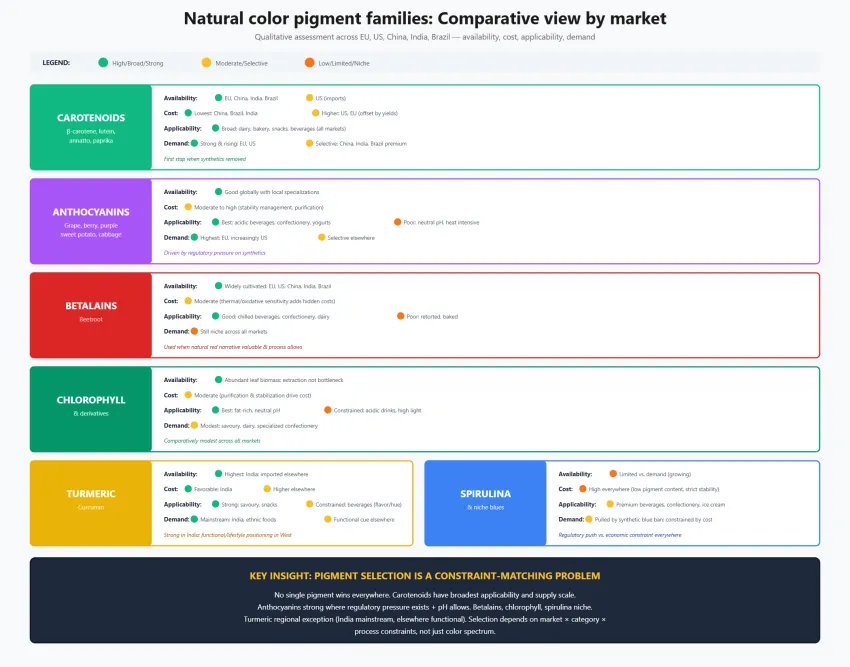
- Globally, carotenoids and anthocyanins carry most of the commercial natural-colour load, while betalains, chlorophylls and spirulina-type blues sit in narrower, higher cost niches.
- Europe and the US are demand engines shaped by regulation and clean label pressure; China and India are major processing and agricultural bases; Brazil is a hybrid case with strong carotenoid crops and a regulatory push away from synthetics.
- Extraction cost is driven less by the plant itself and more by pigment density, stability, required purification and formulation work; that is why blue and bright green shades remain expensive in every market.
- Applicability is constrained by chemistry: anthocyanins are pH sensitive, betalains are heat sensitive, chlorophylls dislike acid, and carotenoids want fat; these constraints decide which regions can replace synthetics at scale in beverages, bakery and dairy.
- End user demand is not uniform: EU multinationals treat natural colours as a default in many new launches, while mass segments in India, China and Brazil still accept synthetics where regulators allow them and margins are thin.
How availability and extraction economics differ by market
United States
Availability
The US has strong domestic agriculture for beetroot, grapes, spinach, spirulina and some paprika, but many natural colour preparations are still imported from Europe and Asia. FDA treats plant, mineral and animal derived colourants that meet specific criteria as exempt from certification, which reduces some transaction cost for manufacturers using established natural colours.
Extraction cost
Labour and energy costs are relatively high, so a lot of extraction and early stage processing is located offshore. US value tends to sit in blending, standardisation and application support rather than primary pigment extraction. Complexity and low yield keep blues and some greens firmly in the premium cost tier.
Applicability
Natural colours are now standard in many children oriented products, dairy lines, cereals and snacks, with synthetics being squeezed first in categories that are regulatory or reputational flashpoints. Carotenoids and anthocyanins are widely applicable here; betalains and spirulina are used more in beverages, confectionery and novelty items rather than in heavy processed staples.
End user demand
Consumer and regulatory pressure has created a de facto requirement for natural colours in new branded launches, especially where children are a core audience. Price sensitivity still exists in value private label and food service, but the baseline expectation in major brands is that red and yellow synthetics will be displaced over the next planning cycle. Natural options with better cost and stability profiles therefore win most incremental demand.
European Union
Availability
The EU has both agricultural raw materials and long standing industrial capacity for natural colours. Paprika, carrot, beet, safflower and grape pomace feed carotenoid and anthocyanin extraction. Europe has also been a first mover in commercialising concentrated colouring foods, which sit between classic additives and whole foods in regulatory treatment.
Extraction cost
Decades of experience and scale keep extraction unit costs comparatively competitive, especially for carotenoids and anthocyanins. Environmental and labour standards are strict, so low margin extraction steps that can be offshored often are, but high value purification and formulation remains in region.
Applicability
EU regulation and industry practice have normalised the use of natural colours in many categories for more than two decades. Dairy, confectionery, beverages and meat alternatives show very high penetration of natural solutions. Synthetic dyes are still permitted but consumer facing brands risk a labelling and perception penalty if they lean on them.
End user demand
European demand is driven by retailer pressure, private label strategies and regulatory scrutiny. Here, the question for end users is less whether to use natural colours and more which shade families are affordable and stable enough. Carotenoids and anthocyanins dominate volumes; betalains and spirulina offer differentiation but at a clear cost premium.
China
Availability
China is a major origin and processing base for several natural pigments, including paprika oleoresin, marigold derived lutein, gardenia yellow and some spirulina. The country also grows beetroot and fruit sources for anthocyanins, though global supply is more diversified for those.
Recent standards define colouring food ingredients as naturally pigmented plant materials processed through physical methods without synthetic colorants or solvents. That formalises a category similar to European colouring foods and supports further development of natural options.
Extraction cost
China combines relatively lower labour and energy costs with large scale extraction facilities. This makes bulk carotenoids and some anthocyanin preparations cost competitive. However, as domestic standards tighten on solvents, contaminants and traceability, the low end of cost curves will rise for exporters who rely solely on compliance arbitrage.
Applicability
Natural colours are well established in beverages, instant drinks, snacks and some dairy, but synthetic colours remain widely used where regulations permit. Application decisions are pragmatic: natural where export markets or premium local positioning demand it, synthetics where price and colour intensity matter more.
End user demand
Domestic demand is stratified. Urban premium and export oriented manufacturers have strong incentives to adopt natural colours that satisfy EU and US customers. Mass and rural facing segments remain highly price sensitive. That split means China is simultaneously a major exporter of natural colour preparations and a large internal user of synthetics.
India
Availability
India is structurally advantaged in turmeric, chilli, paprika and various spices, as well as fruits and vegetables that can supply anthocyanins and betalains. FSSAI has created an explicit category for colouring foods based on fruits, vegetables, spices and herbs, which legitimises naturally pigmented ingredients alongside classic additives.
Extraction cost
Local extraction of turmeric oleoresin, paprika and some mixed carotenoids benefits from inexpensive agricultural inputs and labour. However, a significant share of higher value natural colour blends is still imported. Heat stability demands and cold chain gaps add stress for delicate pigments.
Applicability
Natural yellows and oranges have a cultural and culinary anchor, so turmeric and paprika based systems fit snacks, savoury items and some beverages. Bright reds, stable purples and natural blues are more difficult: these often rely on imported anthocyanins, beet extracts or spirulina, which can make them too expensive for mass sweets and beverages outside metro areas.
End user demand
Consumer interest in natural and plant based colours is growing in urban middle and upper segments, but price elasticity in mainstream confectionery, bakery and beverages remains high. For many brands, the feasible strategy is partial substitution and the use of colouring foods where they can support a cleaner label without full replacement of synthetic colours.
Brazil
Availability
Brazil has a strong agricultural base for annatto, turmeric and various tropical fruits that provide carotenoids and anthocyanins. Regulatory frameworks managed by ANVISA allow natural colourants as food additives and supervise their use, while recent work on artificial colours and additives keeps pressure on synthetic usage.
Extraction cost
Annatto and paprika type extracts benefit from proximity to raw materials. Energy and logistics costs vary by region, but Brazil can be cost competitive for regional supply of orange to yellow shades. More complex purification and stabilisation steps for high purity pigments often rely on imported technology and equipment.
Applicability
Natural carotenoids are widely compatible with dairy, snacks, processed meats and beverages, and Brazil fits that pattern. Anthocyanin and betalain use is expanding in beverages, confectionery and dairy with a clean label positioning. Strict thermal processes and challenging distribution conditions still push some brands toward synthetics where shelf life is long and margins thin.
End user demand
There is visible growth in clean label products and scrutiny of artificial colours, but as in India and China, mass consumers remain price anchored. Many brands therefore deploy naturals in premium and export lines first, then cascade into mid tier products when extraction cost and stability improve.
Sources
- Lehto, S. M., et al. (2017). Food additive colours - A review of their chemistry, properties and EU regulation. Food Additives and Contaminants: Part A.
- Silva, M. M., & Barreira, J. C. M. (2022). Food colour additives of natural origin. Encyclopedia.
- Masyita, A., et al. (2025). Natural pigments: Innovative extraction technologies and potential applications. Frontiers in Pharmacology.
- Import Promotion Desk. (2023). Natural colourants - Market and product overview for Europe.
- Centre for the Promotion of Imports from developing countries. (2022). The European market potential for natural food colours.
- Food Safety and Standards Authority of India. (2020). Food Products Standards and Food Additives - Tenth Amendment Regulations, recognition of colouring foods.
- China National Food Industry Association. (2024). QB/T 6500-2024 - Coloring food ingredients for food industry.
- Agência Nacional de Vigilância Sanitária. (2024). Monitoring of additives and contaminants in food and regulations on food colour additives.
- Nabeshima, E. H., et al. (2024). Emerging ingredients for clean label products and food safety. Instituto de Tecnologia de Alimentos.
- Soutelino, M. E. M., et al. (2024). Natural food dyes on dairy products: A critical approach. Trends in Food Science and Technology.

