


Key Takeaways
- Industrial Vacuum Cleaner leadership is driven by application specific design rather than generic cleaning performance
- Hazardous dust and explosive environment compliance creates high entry barriers
- Continuous duty motors, filtration depth and build quality define lifecycle value
- Serviceability and spare parts availability shape total cost of ownership
- Buyers prioritise uptime, safety certification and long term reliability over purchase price
Why is leadership in Industrial Vacuum Cleaners concentrated among specialised manufacturers?
Industrial vacuum cleaning addresses fundamentally different challenges than commercial applications. Metalworking facilities generate ferrous particles, swarf and coolant contaminated debris that damage standard vacuum motors. Pharmaceutical manufacturing requires particulate capture efficiency exceeding 99.995 percent to prevent cross contamination between production batches. Food processing demands sanitary design with tool free disassembly for cleaning validation. Hazardous dust cleanup in chemical plants requires explosion proof construction and static dissipation to prevent ignition sources.
Generic vacuum equipment designed for office or retail cleaning lacks the motor thermal capacity, filtration efficiency and material compatibility for these environments. A commercial vacuum rated for 30 minutes of operation per hour fails within weeks when subjected to continuous duty metalworking cleanup. Standard filtration allows fine powder to bypass and contaminate pharmaceutical cleanrooms. Plastic housings create static discharge risks in combustible dust environments. These application specific requirements concentrate leadership among manufacturers that invest in specialised engineering.
Nilfisk, Karcher and Delfin Industrial Vacuums maintain broad product portfolios addressing diverse industrial use cases. Nilfisk offers ATEX certified systems for explosive atmospheres, pharmaceutical grade units with FDA compliant materials and heavy duty models for foundries and steel mills. Karcher provides industrial wet and dry systems with continuous duty ratings up to eight hours. Delfin specialises in hazardous dust collection with comprehensive compliance certifications. This application depth creates switching barriers as buyers rely on proven performance in specific operational contexts.
How do safety regulations and compliance requirements shape Industrial Vacuum Cleaner design and vendor selection?
ATEX directives governing equipment for explosive atmospheres impose rigorous design requirements on industrial vacuum systems used in environments with combustible dust. Zone 22 certification requires grounded conductive housings, sealed motors without brush arcing and static dissipative hoses and accessories. Temperature rise limits prevent hot surfaces that could ignite suspended dust. Compliance testing and certification costs exceed $50,000 per product variant, creating barriers that exclude manufacturers without sufficient scale.
OSHA regulations mandate specific filtration efficiency for silica dust, asbestos and other hazardous materials. Vacuum systems used for regulated substances must capture 99.97 percent of particles at 0.3 microns, equivalent to HEPA filtration standards. Disposal procedures require sealed containment preventing worker exposure during filter changes. Manufacturers must document design features that enable compliant operation, including filtration test reports and safe disposal procedures.
IEC 60335 standards address electrical safety for industrial cleaning equipment. Continuous duty motors require thermal protection, insulation coordination and protection against ingress of dust and liquids. Pharmaceutical and food processing applications add sanitary design requirements from 3A standards and EHEDG guidelines. Stainless steel construction, crevice free joints and validated cleaning procedures become mandatory. These layered compliance requirements mean industrial vacuum procurement must verify certification depth, not simply compare suction specifications and pricing.
How do durability engineering and continuous duty performance create pricing power?
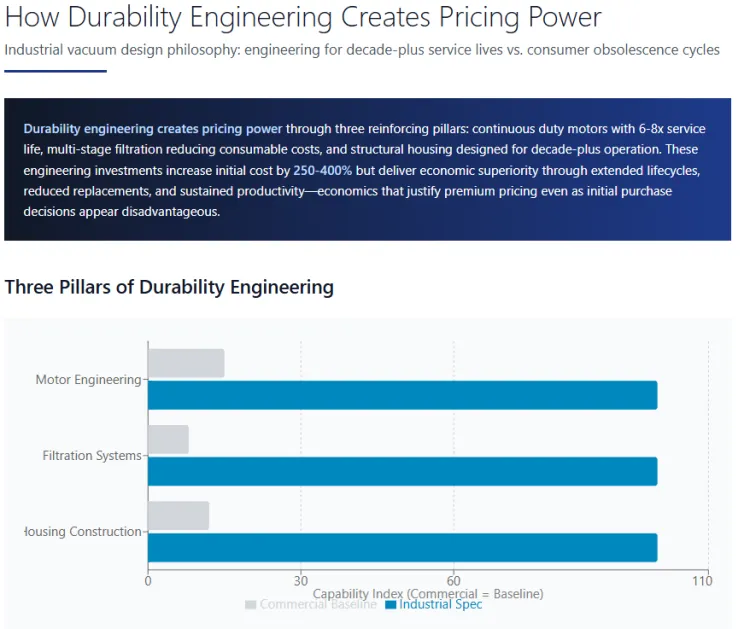
Industrial vacuum motors rated for continuous duty operation incorporate thermal management features absent in commercial equipment. Three phase induction motors with class F or H insulation tolerate sustained high temperatures. Oversized cooling fans and ventilation channels dissipate heat during extended run times. Ball bearings replace sleeve bearings to handle radial loads from heavy debris. These engineering enhancements increase motor cost by 200 to 300 percent compared to fractional horsepower commercial motors, but enable 4,000 to 8,000 hour service lives versus 500 to 1,000 hours for standard duty motors.
Filtration systems in industrial vacuums use multiple stages to balance airflow, capacity and efficiency. Primary cyclonic separators capture bulk debris before it reaches fine filters, extending filter service life. Pleated polyester or PTFE coated cartridge filters provide 10 to 15 square metres of media area compared to 0.5 square metres in shop vacuums. Automatic filter cleaning using reverse pulse air or mechanical shaking maintains consistent suction without manual intervention. This filtration depth costs $2,000 to $5,000 per system but reduces consumable expenses and maintains productivity.
Housing construction uses welded steel or stainless alloys rather than injection moulded plastics. Structural integrity supports vacuum forces without deformation, enables modular filter access and provides crash protection in industrial environments. Powder coated finishes resist chemical exposure and mechanical abuse. A 100 litre industrial vacuum weighs 80 to 120 kilograms compared to 10 kilograms for a commercial unit. This mass reflects engineering for decade plus service lives rather than consumer product obsolescence cycles.
Why do service networks and spare parts availability influence vendor leadership?
Downtime cost in manufacturing environments makes service responsiveness critical. A pharmaceutical packaging line producing $50,000 of product per hour cannot tolerate extended vacuum system failures during sterile filling operations. Metalworking shops generating swarf continuously require rapid filter replacement or motor service. Preventive maintenance schedules demand local technician availability and predictable parts delivery. Manufacturers with regional service centres and committed spare parts inventory provide measurable value beyond equipment specifications.
Filter replacement represents the largest recurring maintenance expense. HEPA and ultrafine filters cost $200 to $800 depending on media area and efficiency rating. Replacement intervals range from three months in high loading applications to 12 months in lighter duty. Motor rebuilds at 5,000 to 8,000 hours require bearing replacement, brush servicing if applicable and electrical testing. Labour costs for these services often exceed parts costs, making service network efficiency economically significant.
Spare parts availability over 10 to 15 year equipment lifespans determines lifecycle viability. Manufacturers that discontinue product lines or exit business segments strand buyers with unsupported equipment. Leading vendors maintain component compatibility across product generations and commit to parts availability horizons. This serviceability assurance justifies premium pricing as buyers calculate total ownership costs including maintenance predictability and replacement risk.
How do leading companies differentiate through application focused product portfolios?
Combustible dust applications require systems specifically engineered for metal powders, wood dust, pharmaceutical actives or grain handling. Each material category has unique ignition energy thresholds, minimum explosive concentrations and combustion behaviours. Nilfisk offers distinct product lines for aluminium dust versus organic materials, optimising filter media and airflow to prevent accumulation risks. This specialisation demonstrates engineering depth that generic industrial vacuum suppliers cannot replicate.
Liquid recovery systems separate free liquids from debris using internal baffles, float shutoffs and drain valves. Karcher designs wet pickup units with sealed electrical compartments, corrosion resistant tanks and separate liquid discharge pumps. Dual motor configurations maintain suction for solids while pumping collected liquids. Food processing and chemical cleanup applications depend on these capabilities, creating distinct product categories within industrial vacuum portfolios.
Cleanroom environments demand particulate control, static dissipation and material compatibility beyond standard industrial requirements. Delfin provides ISO Class 5 compatible systems with stainless construction, ULPA filtration and conductive components throughout. Pharmaceutical manufacturers validate these systems as part of contamination control strategies. This application focus creates customer relationships based on regulatory alignment rather than transactional equipment purchases.
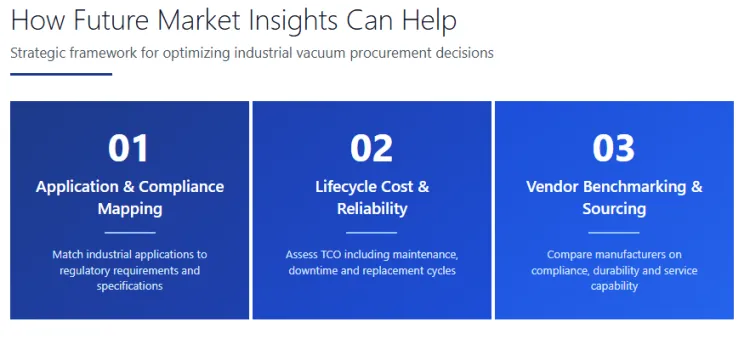
How Future Market Insights Can Help
Sources
- Nilfisk Group. (2024). Industrial vacuum systems for hazardous dust: ATEX compliance and combustible material handling. Nilfisk Holding A/S.
- Nilfisk Group. (2023). Pharmaceutical and cleanroom vacuum solutions: Contamination control and regulatory compliance. Nilfisk Holding A/S.
- Karcher. (2024). Continuous duty industrial vacuum cleaners: Technical specifications and application guide. Alfred Karcher SE & Co. KG.

