


Key Takeaways
- Automotive coatings require extreme colour consistency and particle size control OEM specifications demand batch-to-batch reproducibility and multi-angle colour travel performance that eliminates decorative-grade suppliers from qualification.
- Cosmetic regulations impose hard purity limits on heavy metals and allergens FDA, EU Cosmetics Regulation, and international standards create technical barriers that only vertically integrated or certified producers can meet economically.
- Synthetic mica substrates increasingly displace natural mica Controlled crystal structure, elimination of iron and silica impurities, and ethical sourcing concerns drive premium cosmetic and automotive formulators toward synthetic fluorophlogopite.
- Coating layer precision determines optical performance and price realization Titanium dioxide, iron oxide, and multi-layer interference stacks applied via chemical vapor deposition or liquid phase methods separate commodity from specialty-grade pigments.
- High-specification applications capture disproportionate value Automotive and prestige cosmetic segments represent 40-50% of volume but 65-75% of industry revenue, with price premiums of 3-8× over decorative grades.
Why Do Automotive Coatings Demand Stricter Pearlescent Pigment Specifications?
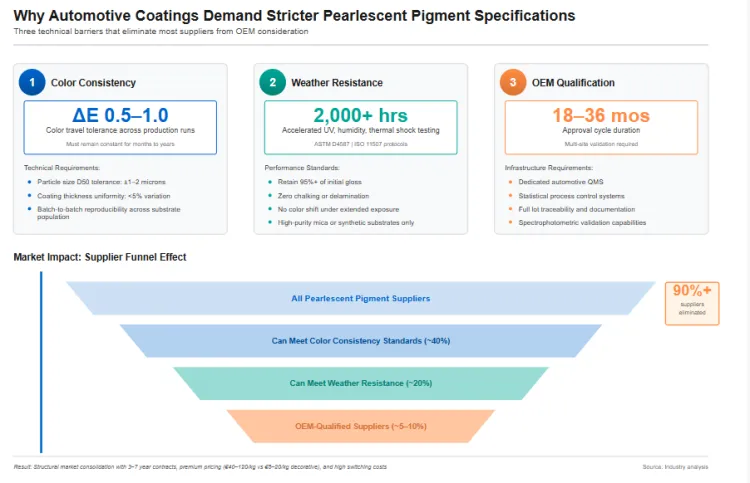
Automotive original equipment manufacturers impose tolerances that eliminate most pearlescent pigment suppliers from consideration. Colour travel, the shift in hue and brightness as viewing angle changes, must remain within ΔE values of 0.5-1.0 across production runs spanning months or years. This requires particle size distributions held to D50 tolerances of ±1-2 microns and coating thickness uniformity better than 5% across the substrate population.
Weather resistance testing under ASTM D4587 or ISO 11507 protocols subjects pigmented coatings to 2,000+ hours of accelerated UV exposure, humidity cycling, and thermal shock. Pearlescent pigments must retain 95%+ of initial gloss and show no chalking, delamination, or colour shift. Only high-purity mica or synthetic substrates with dense, chemically stable titanium dioxide coatings survive these conditions without formulation compensation that adds cost or reduces durability.
OEM approval cycles extend 18-36 months and involve multi-site application trials, spectrophotometric validation under controlled illumination geometries, and compatibility testing with clearcoats, primers, and cathodic electrodeposition systems. Suppliers lacking dedicated automotive quality management systems, statistical process control, and lot traceability cannot meet documentation and audit requirements. This structural barrier consolidates the automotive pigment supply base and rewards technical investment with long-term contract stability and premium pricing.
How Do Cosmetic Safety and Purity Standards Affect Pigment Production?
Regulatory frameworks governing cosmetic ingredients impose quantitative limits that drive production economics. The EU Cosmetics Regulation (EC) No 1223/2009 restricts lead to <20 ppm, arsenic to <3 ppm, and cadmium to <5 ppm in finished products. USA FDA guidance, while less prescriptive, follows similar thresholds through Color Additives Amendment enforcement and voluntary industry standards. Natural mica substrates from lower-quality deposits routinely contain 50-200 ppm iron, 10-50 ppm lead, and trace rare earth elements that require acid leaching or solvent extraction to reach compliance.
Allergen control extends beyond heavy metals. Nickel release must remain below 1 ppm for leave-on cosmetics under EU directive requirements, and chromium compounds face restrictions due to sensitization concerns. Prestige and dermatologically tested cosmetic lines demand analytical certificates of analysis for every batch, substantiated by ICP-MS or XRF testing to sub-ppm detection limits. Suppliers without dedicated analytical laboratories or ISO 22716 (GMP for cosmetics) certification face qualification barriers that preclude market access.
Traceability requirements compound cost pressures. The EU and California Transparency in Supply Chains Act mandate documentation of mica sourcing to exclude child labour and unsafe mining practices. Cosmetic brands increasingly audit pigment suppliers for Responsible Mica Initiative compliance or source exclusively from synthetic mica producers to eliminate reputational risk. The resulting supply chain segmentation bifurcates the market into certified, premium-priced pigments for branded cosmetics and lower-cost, less-documented materials for unregulated decorative applications.
Why Is Synthetic Mica Gaining Importance Over Natural Mica?
Synthetic fluorophlogopite, manufactured via high-temperature fusion of potassium carbonate, magnesium oxide, aluminium oxide, and silicon dioxide, offers structural advantages that natural mica cannot match. Crystal habit, cleavage plane uniformity, and refractive index fall within ±0.002 tolerances across production batches, eliminating the 5-15% optical variability inherent in mined mica from Indian, Chinese, or South American deposits.
Impurity elimination drives adoption in high-value applications. Synthetic mica contains <5 ppm total heavy metals and zero iron oxide inclusions that cause yellowing or reduce interference effect intensity. Coating adhesion improves due to hydroxyl group density and surface energy consistency, reducing titanium dioxide layer defects that compromise gloss and weather resistance. For cosmetic formulators targeting hypoallergenic or "clean beauty" positioning, synthetic mica's transparent supply chain and absence of mining-related contaminants justify cost premiums of 30-60% over natural substrates.
Ethical sourcing pressures accelerate the transition. Investigative reporting on child labour in Jharkhand and Rajasthan mica mines has prompted L'Oréal, Estée Lauder, and Shiseido to mandate certified or synthetic mica in new product launches. Automotive OEMs, while less publicly exposed, increasingly reference supply chain audits in sustainability reporting. As synthetic mica production scales in Japan, China, and Europe, cost differentials narrow while quality and compliance advantages widen, shifting competitive dynamics toward integrated producers controlling substrate synthesis.
How Does Coating Technology Define Optical Performance?
Interference colour generation in pearlescent pigments depends on constructive and destructive wave interference created by titanium dioxide or iron oxide layers deposited on translucent substrates. Layer thickness determines dominant wavelength: 60-80 nm coatings produce silver-white effects, 80-120 nm yield gold-bronze tones, and 120-160 nm generate red-violet hues. Thickness uniformity within ±3 nm across particle populations prevents colour muddiness and maintains saturation.
Chemical vapor deposition and liquid-phase hydrolysis methods dominate high-performance pigment production. CVD processes apply titanium tetrachloride in controlled atmospheres at 400-800°C, producing anatase or rutile crystal structures with refractive indices of 2.55-2.75. Liquid-phase methods precipitate titanium hydroxide from aqueous titanyl sulfate, offering lower capital costs but requiring calcination and surface treatment to match CVD optical density. Multi-layer stacks combining titanium dioxide base layers with iron oxide or chromium oxide overcoats create variable colour-travel effects and higher chroma intensities that decorative single-layer pigments cannot replicate.
Brilliance, quantified as specular reflectance at 20° geometry, correlates directly with coating density and substrate smoothness. Automotive-grade pigments achieve >80% reflectance through substrate screening to exclude particles with surface roughness >0.5 microns and coating process controls maintaining <2% porosity. Decorative grades, with reflectance values of 50-65%, result from less stringent substrate selection and thicker, less uniform coatings that scatter rather than reflect incident light. This performance gap sustains pricing differentiation and application segmentation across the value chain.
Why Do High-Specification Applications Dominate Value Capture?
Pricing tiers in pearlescent pigments reflect technical barriers and customer qualification investments. Automotive grades command €40-80/kg for silver-white and €60-120/kg for colour-travel effects, versus €8-20/kg for decorative grades used in plastics, paints, and low-end cosmetics. Cosmetic-certified pigments price at €30-70/kg, with prestige beauty lines paying premiums for synthetic substrates and enhanced safety documentation.
Customer qualification processes create switching costs that protect margins. Automotive OEMs require 12-24 months of trials, spectral characterization, and multi-site validation before approving new suppliers. Cosmetic brands demand stability testing, preservative compatibility verification, and regulatory dossier support that smaller pigment producers cannot economically provide. Once qualified, suppliers enjoy 3-7 year contract durations with annual price adjustments tied to raw material indices rather than competitive rebidding.
Formulation dependence amplifies value capture. High-performance pigments function as active ingredients rather than fillers — they define product identity and cannot be easily substituted without reformulation, retesting, and regulatory re-notification. Decorative applications tolerate broader pigment substitution, commoditizing supply and compressing margins. The strategic value of automotive and cosmetic segments explains industry consolidation around Merck, BASF, and specialty producers maintaining technical leadership through R&D investment in coating chemistry and substrate optimization.
How Future Market Insights Can Help
Bibliography
- Color Research & Application. Wiley-Blackwell, in partnership with Inter-Society Color Council. ISSN: 0361-2317. Available at: https://onlinelibrary.wiley.com/journal/15206378
- Journal of Coatings Technology and Research. Springer Science+Business Media. ISSN: 1547-0091 (print), 1935-3804 (online). Available at: https://www.springer.com/journal/11998
- Progress in Organic Coatings. Elsevier B.V. ISSN: 0300-9440. Available at: https://www.sciencedirect.com/journal/progress-in-organic-coatings
- Surface and Coatings Technology. Elsevier B.V. ISSN: 0257-8972. Available at: https://www.sciencedirect.com/journal/surface-and-coatings-technology
- Coloration Technology (formerly Journal of the Society of Dyers and Colourists). Wiley-Blackwell, published for the Society of Dyers and Colourists. ISSN: 1472-3581. Available at: https://onlinelibrary.wiley.com/journal/14784408

