


Key Takeaways
- Barcode printer hardware is often priced competitively to secure installed base scale
- Labels and ribbons generate recurring revenue and margin stability
- Firmware validation and media certification limit third party consumables substitution
- Software integration and device management raise switching costs
- Lifetime service and support contracts define long term value capture
Why is barcode printer hardware often priced aggressively compared with lifetime cost?
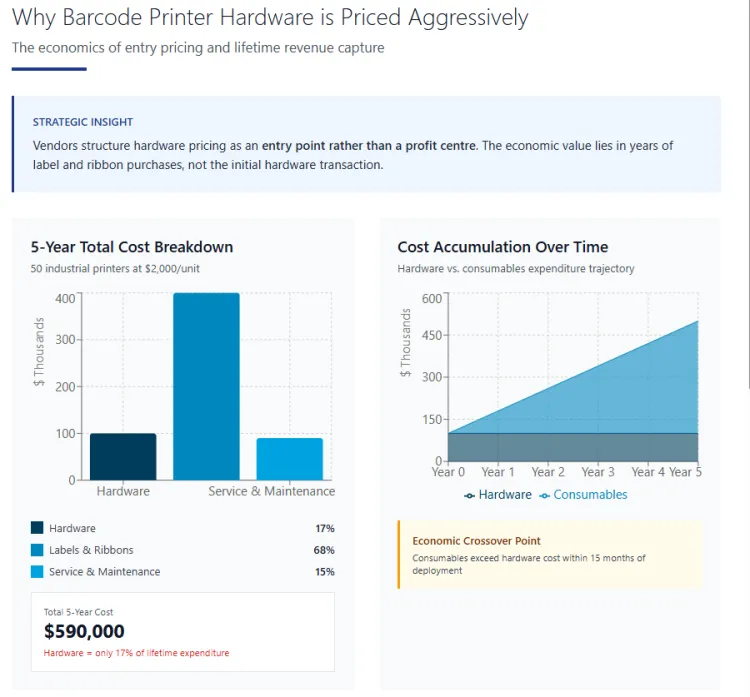
Barcode printer vendors structure hardware pricing as an entry point rather than a profit centre. Manufacturing scale and competition have compressed margins on print engines, thermal printheads and mechanical assemblies. Leading vendors price desktop and industrial models to win fleet deployments, recognising that the economic value lies in years of label and ribbon purchases, not the initial hardware transaction.
A warehouse deploying 50 industrial printers at $2,000 per unit commits $100,000 in capital expenditure. Over five years, those same printers will consume labels and ribbons worth $300,000 to $500,000, depending on throughput and media specifications. Hardware represents 15 to 25 percent of total cost. Vendors accept lower hardware margins to secure recurring revenue streams that deliver predictable cash flow and higher lifetime profitability.
Volume buyers negotiate hardware discounts but find limited flexibility on consumables pricing. The installed base becomes a captive revenue stream. Once printheads are calibrated for certified media and warehouse management systems are configured for specific printer models, switching costs rise sharply. Hardware pricing reflects this calculation: vendors compete aggressively for placement, knowing economics tilt in their favour once deployment is complete.
How do labels and ribbons create consumables lock in for Barcode Printer users?
Media certification programmes tie consumables to warranty protection. Vendors specify approved label facestocks, adhesives and ribbon formulations that meet printhead durability standards. Using non certified media voids printhead warranties, which can represent 40 percent of hardware replacement cost. Operations managers avoid unauthorised consumables to protect warranty coverage and maintain service agreements.
Thermal transfer ribbons must match printhead temperature profiles and label coating chemistry. Wax, wax resin and full resin ribbons are engineered for specific throughput speeds and environmental durability requirements. Labels certified for cold storage, outdoor exposure or chemical resistance require validated consumables. Substituting generic media introduces print quality variation, barcode scan failures and potential printhead damage.
Printhead lifespan correlates directly with media quality. Premium ribbons extend printhead life to 50 million linear inches or more, while lower grade alternatives may cause failure at 20 million inches. Replacement printheads cost $200 to $800 depending on print width and resolution. Warranty exclusions for non certified media shift this cost to the buyer. The financial risk of using third party consumables often exceeds potential savings, reinforcing vendor lock in.
How does software and device management integration reinforce vendor control?
Printer drivers, firmware updates and device management platforms create technical dependencies that extend beyond hardware. Zebra Technologies offers Link OS, a software ecosystem that integrates printers with enterprise resource planning systems, warehouse management platforms and cloud based monitoring. Honeywell provides Operational Intelligence software for fleet visibility and predictive maintenance. These tools become embedded in daily operations, raising switching costs substantially.
Enterprise deployments require consistent printer language compatibility across hundreds of devices. ZPL, EPL and proprietary command sets must align with label design software, inventory systems and automated workflows. Replacing a printer fleet means reconfiguring software integrations, retraining staff and validating new workflows. For a 200 printer deployment, this represents weeks of IT resources and operational disruption.
Remote device management enables centralised firmware updates, supply level monitoring and diagnostic troubleshooting. These capabilities reduce downtime but deepen vendor dependence. Cloud based platforms track consumables usage, predict maintenance needs and automate reordering. Once these systems are integrated with procurement and inventory management, migration to a different vendor requires rebuilding the entire management infrastructure.
Why do service, maintenance and printhead replacement shape total cost of ownership?
Thermal printheads wear predictably based on media quality, print volume and operating environment. Industrial printers in high throughput distribution centres may require printhead replacement every 12 to 18 months. Desktop models in lower volume retail settings extend this to three years or longer. Printhead cost, labour and downtime combine to create significant operational expense.
Preventive maintenance contracts provide scheduled cleaning, calibration and component inspection. Vendors offer tiered service agreements ranging from next business day parts delivery to four hour on site response. Premium contracts include consumables management, remote diagnostics and dedicated support engineers. These services reduce unplanned downtime but commit buyers to multi year vendor relationships.
Downtime cost varies by deployment context. A warehouse processing 5,000 shipments per day cannot tolerate printer failures during peak periods. Service level agreements that guarantee uptime deliver measurable value. Vendors price these contracts to reflect buyer criticality, creating differentiated revenue streams. Hardware commoditisation has shifted profit pools toward services, where vendor expertise and support networks provide defensible competitive advantages.
How do leading vendors defend pricing power despite similar hardware specifications?
Zebra Technologies commands premium pricing through ecosystem depth and global service reach. The company maintains 10,000 channel partners, offers same day spare parts delivery in major logistics hubs and provides multilingual technical support. SATO differentiates on software integration for retail and healthcare applications. Honeywell leverages its broader portfolio of sensors, scanners and mobile computers to create integrated identification and data capture solutions.
Print quality consistency across diverse environments builds long term customer relationships. Vendors that deliver reliable performance in cold storage, harsh manufacturing conditions and high volume logistics operations earn renewals despite higher consumables pricing. Technical support responsiveness during critical failures reinforces value perception beyond hardware specifications.
Certification programmes for labels and ribbons create quality assurance but also supplier dependencies. Third party consumables manufacturers must navigate compatibility testing and warranty compliance. Leading vendors control certification processes, limiting substitution options and maintaining pricing discipline. This governance over the consumables ecosystem sustains margins even as hardware competition intensifies.
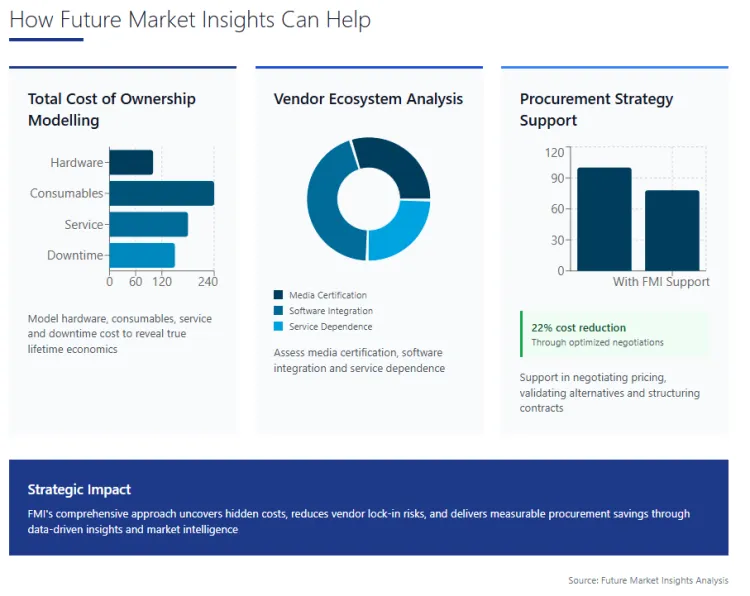
How can Future Market Insights Help?
Sources
- Zebra Technologies. (2023).Thermal printing fundamentals: Printhead wear, media interaction, and image durability. Zebra Technologies Corporation.
- Zebra Technologies. (2024).Link OS developer guide and device management overview. Zebra Technologies Corporation.
- Honeywell. (2023).Operational Intelligence user documentation: Printer fleet visibility and predictive maintenance. Honeywell International Inc.

