

- Industry Size (2026)
- USD 1.7 Bn
- Forecast (2036)
- USD 3.4 Bn
- CAGR (2026 to 2036)
- 6.5%
Demand for Barcode Printers in USA Forecast and Outlook 2026 to 2036
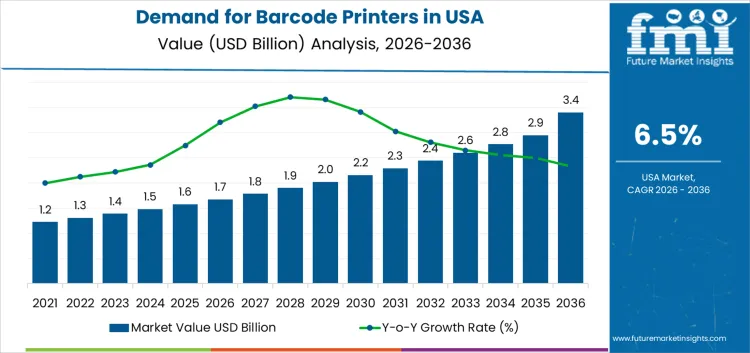
The demand for barcode printers in the USA is set to grow from USD 1.7 billion in 2026 to USD 3.4 billion in 2036, reflecting a 6.5% CAGR. Barcode printers are crucial for efficient inventory management across sectors like retail, logistics, healthcare, and manufacturing. The rising trend of automation in warehouses and retail environments, along with the growing need for real-time tracking of inventory, assets, and shipments, is driving the demand for barcode printers. Desktop barcode printers, which account for 89.9% of the demand, are the most widely used due to their affordability and compact size, making them ideal for small-scale operations and environments with limited space. Retail is the dominant end-use sector, benefiting from barcode printers for inventory tracking, labeling, and point-of-sale applications, especially in e-commerce and omnichannel retail environments.
Quick Stats of the Demand for Barcode Printers in USA
- Demand for Barcode Printers in USA Value (2026): USD 1.7 billion
- Demand for Barcode Printers in USA Forecast Value (2036): USD 3.4 billion
- Demand for Barcode Printers in USA Forecast CAGR (2026-2036): 6.5%
- Demand for Barcode Printers in USA Leading Product Type: Desktop Barcode Printers
- Demand for Barcode Printers in USA Key Growth Regions: West USA, South USA, Northeast USA, Midwest USA
- Demand for Barcode Printers in USA Top Players: Honeywell International Inc, Toshiba Tec Corporation, TVS ELECTRONICS, AVERY DENNISON CORPORATION, Canon Finetech Nisca Inc.
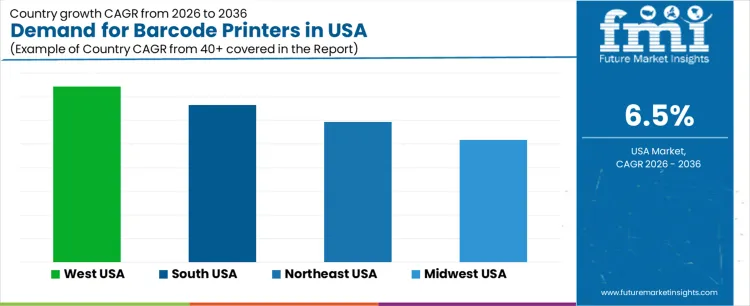
West USA leads the demand for barcode printers, growing at a 7.4% CAGR, driven by technological innovation and a strong e-commerce and logistics sector. The region’s focus on automation in industries such as retail and healthcare also contributes to this growth. South USA follows with a 6.7% CAGR, supported by expanding retail, logistics, and manufacturing sectors. Northeast USA, growing at a 5.9% CAGR, has strong demand from healthcare and manufacturing, where barcode printers are critical for asset tracking and inventory management. Midwest USA experiences a 5.2% CAGR, with steady growth driven by the region’s manufacturing base and increased adoption of automation technologies.
Demand for Barcode Printers in USA Key Takeaways
| Metric | Value |
|---|---|
| Demand for Barcode Printers in USA Value (2026) | USD 1.7 billion |
| Demand for Barcode Printers in USA Forecast Value (2036) | USD 3.4 billion |
| Demand for Barcode Printers in USA Forecast CAGR (2026-2036) | 6.5% |
Why is the Demand for Barcode Printers in USA Growing?
The demand for barcode printers in the USA is growing due to the increasing need for efficient and accurate inventory management across a variety of industries, including retail, logistics, healthcare, and manufacturing. Barcode printers play a crucial role in streamlining operations by enabling businesses to print barcodes that help in tracking products, assets, and shipments. As the need for real-time data and streamlined workflows rises, barcode printers are becoming an essential tool for businesses aiming to enhance operational efficiency, reduce errors, and improve customer satisfaction. The rising trend of e-commerce and the growth of supply chain management are further driving the demand for barcode printers to handle increased volumes of orders and inventory.
Key drivers for this growth include the increasing adoption of automation technologies in warehouses, retail stores, and distribution centers, where barcode printers are vital for labeling and scanning products. The push for faster and more accurate inventory tracking, along with the need for better data integration into business operations, is boosting demand. Barcode printers are critical for compliance with industry regulations, which require businesses to label products and track shipments efficiently. The shift towards wireless and mobile-enabled barcode printing solutions is also expanding the potential applications and convenience for users.
Innovations in printing technology, such as the development of thermal barcode printers, which offer faster print speeds, durability, and lower operational costs, are contributing to industry growth. While challenges such as competition from alternative technologies like RFID may pose some barriers, the continued demand for cost-effective, reliable, and high-performance labeling solutions across various industries is expected to support steady growth in the demand for barcode printers in the USA through 2036.
What is the Segment-Wise Analysis of Demand for Barcode Printers in USA?
Demand for barcode printers in the USA is segmented by product type, end use, printing type, and printing speed. By product type, desktop barcode printers lead with 89.9% of the demand, followed by industrial barcode printers and mobile barcode printers. In terms of end use, retail, manufacturing & industrial, transportation & logistics, healthcare & hospitality, government, and other industries contribute to the demand. Regarding printing type, dot matrix, inkjet, laser, and thermal are the primary methods used. For printing speed, the demand is distributed across different speeds, including up to 4 inches per second, 5-8 inches per second, and greater than 8 inches per second.
How Do Desktop Barcode Printers Lead the Demand for Barcode Printers in USA?
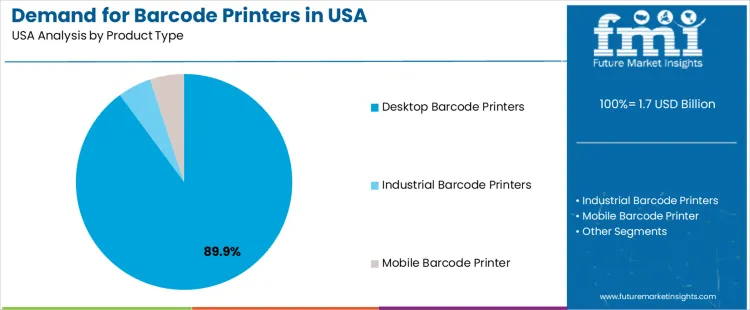
Desktop barcode printers account for 89.9% of the demand for barcode printers in the USA, driven by their affordability, compact size, and ease of use. These printers are widely used in retail, healthcare, and small-scale industrial settings where space is limited, and high-volume printing is not required. Desktop barcode printers offer reliable, high-quality label printing for applications such as inventory management, shipping, and asset tracking. Their versatility in handling different types of barcode labels and ease of integration with existing systems further enhances their appeal. The growing need for efficient tracking and inventory control, especially in retail and healthcare, continues to drive the demand for desktop barcode printers. As businesses continue to prioritize streamlined operations and data accuracy, desktop barcode printers will remain the dominant choice for labeling and barcode printing in the USA.
How Does Retail End Use Lead the Demand for Barcode Printers in USA?
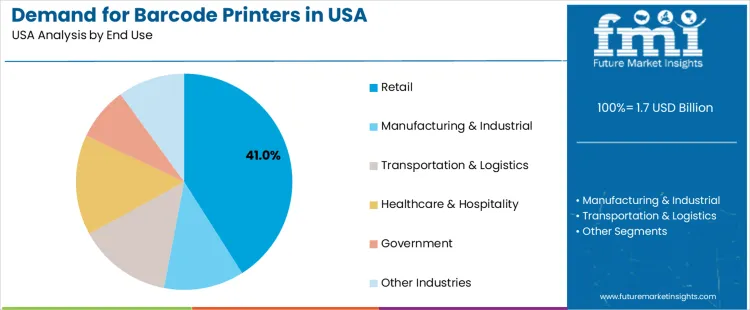
The retail sector drives a significant portion of the demand for barcode printers in the USA, as accurate and efficient labeling is essential for inventory management, point-of-sale systems, and product tracking. Barcode printers, particularly desktop models, are critical in retail environments for producing labels for price tags, product identification, and shelf management. With the growing trend of e-commerce and omnichannel retailing, the need for reliable barcode printers that can manage high volumes of transactions and track inventory seamlessly continues to rise. Demand for thermal and inkjet printing technologies in retail settings ensures quick and cost-effective label production. As the retail sector continues to expand, especially in online and brick-and-mortar stores, the demand for barcode printers in retail applications is expected to remain strong, solidifying its role as the leading end-use segment in the barcode printer industry.
What are the Key Trends, Drivers and Restraints in Demand for Barcode Printers in USA?
Demand for barcode printers in the USA is growing as businesses across retail, logistics, healthcare, and manufacturing seek efficient tracking and inventory management. Key trends include mobile and wireless printing, integration with inventory systems, and support for two‑dimensional codes like QR and data matrix. Drivers include rapid growth of e‑commerce, emphasis on supply chain visibility, and compliance requirements for traceability. Restraints include cost‑sensitive small businesses delaying upgrades, competition from third‑party label services, and occasional integration challenges with existing enterprise technology. Some organizations may prioritize software upgrades over hardware, which can temper demand.
Why is Demand for Barcode Printers Growing in USA?
Retailers use barcode printers for price tags, promotions, and product information, while warehouses rely on them for picking, packing, and shipment labeling. Healthcare providers use barcodes to track patients, medications, and equipment, reducing errors. Growth in e‑commerce and omnichannel fulfillment drives investment in automated labeling and scanning to improve turnaround times. Barcode printers help maintain inventory accuracy, which supports customer satisfaction and reduces shrinkage. As businesses modernize and expand, barcode printers become an essential tool for seamless operations across sectors.
How are Technological and Industry Innovations Driving Barcode Printer Demand in USA?
Technological advances are supporting demand for barcode printers in the USA by making devices faster, smarter, and more flexible. Modern printers offer better connectivity options such as Wi‑Fi, Bluetooth, and cloud integration, enabling remote and mobile printing. Printable label materials now include durable options for harsh environments, food safety, and long‑term storage. Software improvements allow seamless integration with enterprise resource planning, inventory management, and point‑of‑sale systems. Enhanced printer interfaces and diagnostics reduce downtime and simplify maintenance. Emerging applications like printing two‑dimensional codes and serialized labels for traceability in pharmaceuticals and aerospace further boost demand.
What is the Regional Demand Outlook for Barcode Printers in USA?
| Region | CAGR (%) |
|---|---|
| West USA | 7.4% |
| South USA | 6.7% |
| Northeast USA | 5.9% |
| Midwest USA | 5.2% |
Demand for barcode printers in the USA is growing steadily, with West USA leading at a 7.4% CAGR, driven by the region’s focus on e-commerce, logistics, and automation. South USA follows with a 6.7% CAGR, fueled by the region’s expanding retail and distribution sectors. Northeast USA shows a 5.9% CAGR, supported by strong industries in retail, healthcare, and manufacturing. Midwest USA experiences a 5.2% CAGR, with steady growth driven by the region’s manufacturing base and increasing adoption of automation technologies. As industries continue to prioritize inventory accuracy, automation, and operational efficiency, the demand for barcode printers will remain strong across all regions.
How is Demand for Barcode Printers Growing in West USA?
West USA leads the demand for barcode printers, growing at a 7.4% CAGR. The region’s emphasis on technological innovation and its substantial e-commerce and retail sectors are major factors driving this growth. States like California, Washington, and Oregon, which have large tech hubs and retail industries, are at the forefront of using barcode printers for inventory management, logistics, and point-of-sale (POS) systems. As e-commerce continues to rise, the need for efficient supply chain management and real-time inventory tracking becomes increasingly critical, pushing demand for barcode printing solutions. West’s focus on automation, which is evident in various industries such as manufacturing, logistics, and healthcare, further contributes to the growth in barcode printer usage. As businesses in the region aim to enhance operational efficiency and reduce manual errors, barcode printing technology becomes integral. With the continued expansion of digital operations and automation, demand for barcode printers will continue to rise, particularly in sectors like retail, logistics, and warehouse management.
Why is Demand for Barcode Printers Rising in South USA?
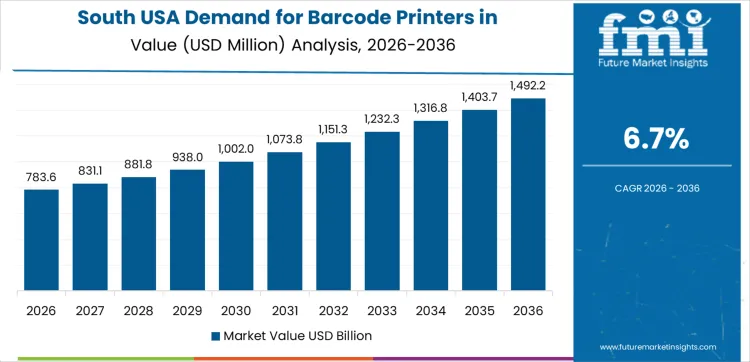
South USA is experiencing strong demand for barcode printers, growing at a 6.7% CAGR. The region’s expanding retail and logistics sectors, coupled with the presence of large-scale manufacturing and distribution networks in states like Texas, Florida, and Georgia, are driving this demand. Barcode printers are critical for inventory tracking, order fulfillment, and POS systems, helping businesses streamline operations and improve accuracy. The rise of omnichannel retailing and the expanding e-commerce industry in the South are also contributing to the growing need for efficient product identification and management. With increased focus on improving operational efficiency and implementing supply chain automation, the demand for barcode printing solutions is growing. The region’s adoption of advanced technologies and automation across manufacturing, logistics, and retail sectors makes barcode printers essential to meeting the need for faster processing and enhanced customer service.
How is Demand for Barcode Printers Expanding in Northeast USA?
Northeast USA is seeing steady demand for barcode printers, growing at a 5.9% CAGR. The region’s strong retail, healthcare, and manufacturing industries are major drivers behind this growth. States like New York, Massachusetts, and Pennsylvania, with their high concentrations of businesses across these sectors, rely heavily on barcode printers for tracking products, managing inventory, and streamlining order processing. In the healthcare industry, barcode printers play an essential role in labeling medications, patient identification, and asset tracking, contributing significantly to industry expansion. The growing trend of digital transformation and the shift towards automation in retail and logistics further supports the adoption of barcode printing technology. The region’s focus on efficiency, accuracy, and product traceability is pushing industries to incorporate barcode printing solutions into their supply chains.
How is Demand for Barcode Printers Growing in Midwest USA?
Midwest USA is experiencing moderate demand for barcode printers, with a 5.2% CAGR. The region’s strong manufacturing base, particularly in states like Michigan, Ohio, and Illinois, is contributing to the growth in barcode printer adoption for inventory management, asset tracking, and logistics. Industries such as automotive, manufacturing, and retail rely heavily on barcode printing technology to streamline supply chains, improve product traceability, and increase efficiency in warehouses and distribution centers. As automation becomes more integrated into manufacturing and retail operations, the demand for barcode printers is rising. The Midwest’s manufacturing hubs are increasingly adopting more advanced technologies, which are driving the need for barcode printing solutions. With businesses focusing on enhancing operational efficiency and reducing manual errors, barcode printers are becoming essential tools in managing inventory, improving logistics, and ensuring accurate order fulfillment.
What is the Competitive Landscape of Barcode Printers Demand in USA?
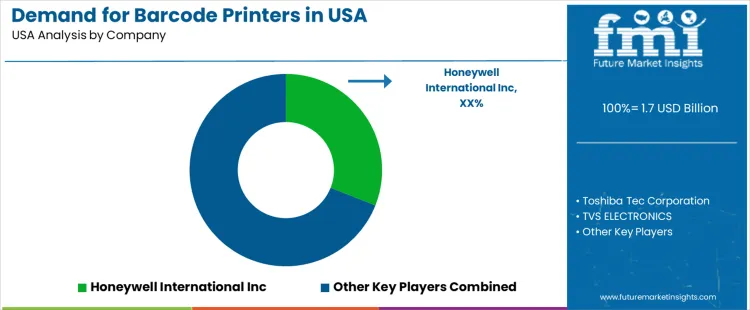
Demand for barcode printers in the USA is rising, driven by the increasing need for efficient inventory management, tracking, and automation in industries such as retail, logistics, manufacturing, and healthcare. Barcode printers play a crucial role in ensuring accurate labeling, quick scanning, and seamless operation of supply chains. As businesses look to optimize operations, reduce errors, and improve productivity, the industry for barcode printers continues to grow, particularly with the increasing adoption of RFID and barcode-based systems in various sectors.
Honeywell International Inc. is a leading player in the barcode printer industry, offering a wide range of high-performance printers for industrial and retail applications. The company’s strategy focuses on providing versatile, durable, and efficient printing solutions that cater to various industries' needs, from small businesses to large enterprises. Honeywell’s reputation for reliable, innovative technology ensures its strong position in the competitive landscape.
Toshiba Tec Corporation and TVS ELECTRONICS also contribute significantly to the industry, offering affordable and reliable barcode printing solutions. Toshiba Tec specializes in providing both thermal and direct thermal printers that are widely used across logistics and retail industries. TVS ELECTRONICS focuses on delivering compact and cost-effective barcode printers, catering to smaller businesses while ensuring high-quality output and durability.
AVERY DENNISON CORPORATION, a well-known name in the labeling industry, offers advanced barcode printers designed for high-speed printing, with an emphasis on ease of integration and user-friendly features. Canon Finetech Nisca Inc. is another significant player, providing specialized barcode and card printers for secure and high-volume printing needs, such as identification cards and membership cards.
Key Players in USA Barcode Printers Demand
- Honeywell International Inc
- Toshiba Tec Corporation
- TVS ELECTRONICS
- AVERY DENNISON CORPORATION
- Canon Finetech Nisca Inc.
Scope of Report
| Items | Values |
|---|---|
| Quantitative Units (2026) | USD billion |
| Key Segments | Up to 4 inch/second, 5-8 inch/second, >8 inch/second |
| Product Type | Desktop Barcode Printers, Industrial Barcode Printers, Mobile Barcode Printer |
| Printing Type | Dot Matrix, Inkjet, Laser, Thermal |
| End Use | Retail, Manufacturing & Industrial, Transportation & Logistics, Healthcare & Hospitality, Government, Other Industries |
| Key Country | USA |
| Region | West USA, South USA, Northeast USA, Midwest USA |
| Key Players Profiled | Honeywell International Inc, Toshiba Tec Corporation, TVS ELECTRONICS, AVERY DENNISON CORPORATION, Canon Finetech Nisca Inc. |
| Additional Attributes | Dollar sales by printing speed, product type, printing type, and end use; regional CAGR and growth trends in barcode printers demand in the USA |
USA Barcode Printers Demand by Key Segments
Printing Speed
- Upto 4 inch/second
- 5-8 inch/second
- >8 inch/second
Product Type
- Desktop Barcode Printers
- Industrial Barcode Printers
- Mobile Barcode Printer
Printing Type
- Dot Matrix
- Inkjet
- Laser
- Thermal
End Use
- Retail
- Manufacturing & Industrial
- Transportation & Logistics
- Healthcare & Hospitality
- Government
- Other Industries
Region
- West USA
- South USA
- Northeast USA
- Midwest USA
Frequently Asked Questions
How big is the demand for barcode printers in USA in 2026?
The demand for barcode printers in USA is estimated to be valued at USD 1.7 billion in 2026.
What will be the size of barcode printers in USA in 2036?
The market size for the barcode printers in USA is projected to reach USD 3.4 billion by 2036.
How much will be the demand for barcode printers in USA growth between 2026 and 2036?
The demand for barcode printers in USA is expected to grow at a 6.5% CAGR between 2026 and 2036.
What are the key product types in the barcode printers in USA?
The key product types in barcode printers in USA are upto 4 inch/second, 5-8 inch/second and >8 inch/second.
Which product type segment is expected to contribute significant share in the barcode printers in USA in 2026?
In terms of product type, desktop barcode printers segment is expected to command 89.9% share in the barcode printers in USA in 2026.
Preview the report firsthand - request a free sample
Get SampleGet the brochure for pricing and purchase details.
Get PDFTable of Content
- Executive Summary
- USA Market Outlook
- Demand-side Trends
- Supply-side Trends
- Technology Roadmap Analysis
- Analysis and Recommendations
- Market Overview
- Market Coverage / Taxonomy
- Market Definition / Scope / Limitations
- Market Background
- Market Dynamics
- Drivers
- Restraints
- Opportunity
- Trends
- Scenario Forecast
- Demand in Optimistic Scenario
- Demand in Likely Scenario
- Demand in Conservative Scenario
- Opportunity Map Analysis
- Product Life Cycle Analysis
- Supply Chain Analysis
- Investment Feasibility Matrix
- Value Chain Analysis
- PESTLE and Porter’s Analysis
- Regulatory Landscape
- Regional Parent Market Outlook
- Production and Consumption Statistics
- Import and Export Statistics
- Market Dynamics
- USA Market Analysis 2020 to 2024 and Forecast, 2025 to 2035
- Historical Market Size Value (USD Million) Analysis, 2020 to 2024
- Current and Future Market Size Value (USD Million) Projections, 2025 to 2035
- Y-o-Y Growth Trend Analysis
- Absolute $ Opportunity Analysis
- USA Market Pricing Analysis 2020 to 2024 and Forecast 2025 to 2035
- USA Market Analysis 2020 to 2024 and Forecast 2025 to 2035, By Printing Speed
- Introduction / Key Findings
- Historical Market Size Value (USD Million) Analysis By Printing Speed , 2020 to 2024
- Current and Future Market Size Value (USD Million) Analysis and Forecast By Printing Speed , 2025 to 2035
- Upto 4 inch/second
- 5-8 inch/second
- >8 inch/second
- Y-o-Y Growth Trend Analysis By Printing Speed , 2020 to 2024
- Absolute $ Opportunity Analysis By Printing Speed , 2025 to 2035
- USA Market Analysis 2020 to 2024 and Forecast 2025 to 2035, By Product Type
- Introduction / Key Findings
- Historical Market Size Value (USD Million) Analysis By Product Type, 2020 to 2024
- Current and Future Market Size Value (USD Million) Analysis and Forecast By Product Type, 2025 to 2035
- Desktop Barcode Printers
- Industrial Barcode Printers
- Mobile Barcode Printer
- Y-o-Y Growth Trend Analysis By Product Type, 2020 to 2024
- Absolute $ Opportunity Analysis By Product Type, 2025 to 2035
- USA Market Analysis 2020 to 2024 and Forecast 2025 to 2035, By Printing Type
- Introduction / Key Findings
- Historical Market Size Value (USD Million) Analysis By Printing Type, 2020 to 2024
- Current and Future Market Size Value (USD Million) Analysis and Forecast By Printing Type, 2025 to 2035
- Dot Matrix
- Inkjet
- Laser
- Thermal
- Y-o-Y Growth Trend Analysis By Printing Type, 2020 to 2024
- Absolute $ Opportunity Analysis By Printing Type, 2025 to 2035
- USA Market Analysis 2020 to 2024 and Forecast 2025 to 2035, By End Use
- Introduction / Key Findings
- Historical Market Size Value (USD Million) Analysis By End Use, 2020 to 2024
- Current and Future Market Size Value (USD Million) Analysis and Forecast By End Use, 2025 to 2035
- Retail
- Manufacturing & Industrial
- Transportation & Logistics
- Healthcare & Hospitality
- Government
- Other Industries
- Y-o-Y Growth Trend Analysis By End Use, 2020 to 2024
- Absolute $ Opportunity Analysis By End Use, 2025 to 2035
- Market Structure Analysis
- Competition Dashboard
- Competition Benchmarking
- Market Share Analysis of Top Players
- By Regional
- By Printing Speed
- By Product Type
- By Printing Type
- By End Use
- Competition Analysis
- Competition Deep Dive
- Honeywell International Inc
- Overview
- Product Portfolio
- Profitability by Market Segments (Product/Age /Sales Channel/Region)
- Sales Footprint
- Strategy Overview
- Marketing Strategy
- Product Strategy
- Channel Strategy
- Toshiba Tec Corporation
- TVS ELECTRONICS
- AVERY DENNISON CORPORATION
- Canon Finetech Nisca Inc.
- Honeywell International Inc
- Competition Deep Dive
- Assumptions & Acronyms Used
- Research Methodology


