


Key Takeaways
- Dehydrated vegetables economics are driven by drying yield and energy intensity
- Processing losses matter more than farm gate vegetable pricing
- Contract farming stabilises raw material quality and volume
- Technology choice determines colour, flavour, and rehydration performance
- Supply chain reliability supports foodservice and industrial demand
How do drying technologies shape dehydrated vegetable cost and quality?
Processing technology selection determines both the economic viability and functional performance of dehydrated vegetables. Air drying, the most common commercial method, exposes sliced or diced vegetables to heated air at temperatures between 50°C and 70°C for several hours. This approach delivers acceptable yields and moderate energy consumption, but causes predictable degradation in colour and some loss of volatile aromatics. Capital costs remain relatively low, making air drying suitable for high volume operations producing ingredients for soups, seasoning blends, and ready meal applications where some quality compromise is acceptable.
Freeze drying operates through sublimation, removing water from frozen vegetables under vacuum conditions. This method preserves cellular structure, maintains original colour intensity, and protects heat sensitive compounds. Rehydration performance significantly exceeds air dried alternatives, with products returning close to fresh texture. However, freeze drying requires substantial capital investment and consumes three to four times more energy per kilogram of finished product compared to air drying. Economics typically restrict freeze dried vegetables to premium instant meals, expedition foods, and specific foodservice applications where quality commands price premiums.
Drum drying passes vegetable purees or slurries across heated rotating drums, producing flakes or powders in seconds. Speed and throughput make drum drying highly efficient for producing vegetable powders used in sauces, seasonings, and processed foods. The method works well for products where particle structure matters less than flavour concentration and dispersibility. Each technology imposes distinct yield patterns, with air drying typically achieving 8 to 12 percent finished weight from fresh input, while processing losses through trimming, blanching, and moisture removal determine final unit economics more decisively than raw material purchase price.
Why is energy intensity a critical cost driver in vegetable dehydration?
Energy consumption during drying often represents 40 to 60 percent of total processing costs, making fuel selection and thermal efficiency central to processor profitability. Air drying systems require continuous heat input to maintain drying chamber temperatures and sufficient airflow to carry moisture away from product surfaces. Natural gas remains the preferred fuel in regions with pipeline infrastructure, offering stable pricing and clean combustion. Where gas access is limited, processors may use biomass, coal, or electricity, each carrying distinct cost and carbon intensity implications.
Regional energy pricing creates significant geographic advantage or disadvantage in dehydration economics. Processors located in areas with subsidised industrial power rates or access to agricultural waste biomass can achieve substantially lower operating costs than competitors dependent on imported fuels or expensive grid electricity. A facility in northern Europe paying premium natural gas rates during winter months faces energy costs per tonne of finished product double or triple those of a processor in a gas rich region with stable year round supply.
Energy recovery systems and process optimisation deliver meaningful cost reduction. Multi stage drying, where partially dried product moves through zones of decreasing temperature, improves thermal efficiency by reducing overheating of already dry material. Heat exchangers capturing warm exhaust air for preheating incoming fresh air can reduce fuel consumption by 15 to 25 percent. Investment in such systems requires capital but generates rapid payback in high volume facilities. Processors operating at scale with modern equipment demonstrate significantly better energy productivity than smaller or older installations, creating competitive barriers based on thermal efficiency rather than agricultural sourcing.
How does raw material sourcing discipline affect dehydration efficiency?
The physical and chemical characteristics of incoming vegetables determine processing yield, energy requirement, and finished product quality more than any operational adjustment can compensate for. Solids content at harvest directly affects the water load that must be removed. Onions containing 12 percent dry matter require less energy per kilogram of finished product than those with 8 percent solids, even when purchased at identical fresh weight pricing. Varietal selection aligned with dehydration rather than fresh consumption delivers meaningful economic advantage.
Contract farming arrangements allow processors to specify varieties, cultivation practices, and harvest windows that optimise dehydration performance. Contracts typically cover planting schedules staggered to extend processing season, agronomic protocols ensuring consistent solids, and harvest timing coordinated with facility capacity. This approach reduces spot buying risk, stabilises raw material quality, and allows investment in seed selection and field management that improves processing outcomes. Processors with strong contract farming programmes report 10 to 20 percent better yields and more consistent colour and flavour retention than those dependent on open procurement.
Geographic proximity between growing regions and processing facilities matters significantly. Vegetables with high moisture content deteriorate rapidly after harvest, with enzymatic activity and respiration consuming sugars and degrading texture. Processing within 24 hours of harvest preserves quality and maximises yield. Transportation costs for bulky fresh vegetables also favour local sourcing, making regional clusters of contract farming and processing infrastructure common. Processors located distant from production areas face higher raw material costs from both logistics and quality degradation during transit.
Why do quality specifications drive application specific processing choices?
Different end uses impose distinct performance requirements that determine appropriate dehydration methods and acceptable cost structures. Soup mixes and bouillon products tolerate moderate colour fading and some flavour loss, allowing economic air drying to dominate. Finished products rehydrate in boiling water where some texture variation is acceptable. Specifications focus on microbial safety, consistent particle size for blending, and shelf stability under ambient storage.
Instant noodle seasoning packets and ready meal components demand better colour retention and faster rehydration, often justifying freeze dried vegetables despite higher costs. Consumer expectations for visual appeal and texture performance in premium convenience foods support price points that absorb processing premiums. Some applications blend air dried and freeze dried components, using expensive freeze dried vegetables as visual highlights while relying on air dried material for bulk.
Snack applications such as vegetable crisps or trail mixes require intact structure, intense colour, and immediate eating quality without rehydration. These products often use specialised vacuum frying or other methods that preserve cellular integrity while removing moisture. Industrial ingredients for sauces and processed foods prioritise flavour concentration and dispersibility over appearance, making drum dried powders or air dried products suitable. Understanding application requirements allows processors to match technology and input costs to achievable selling prices and volume potential.
How do logistics and shelf stability influence commercial adoption?
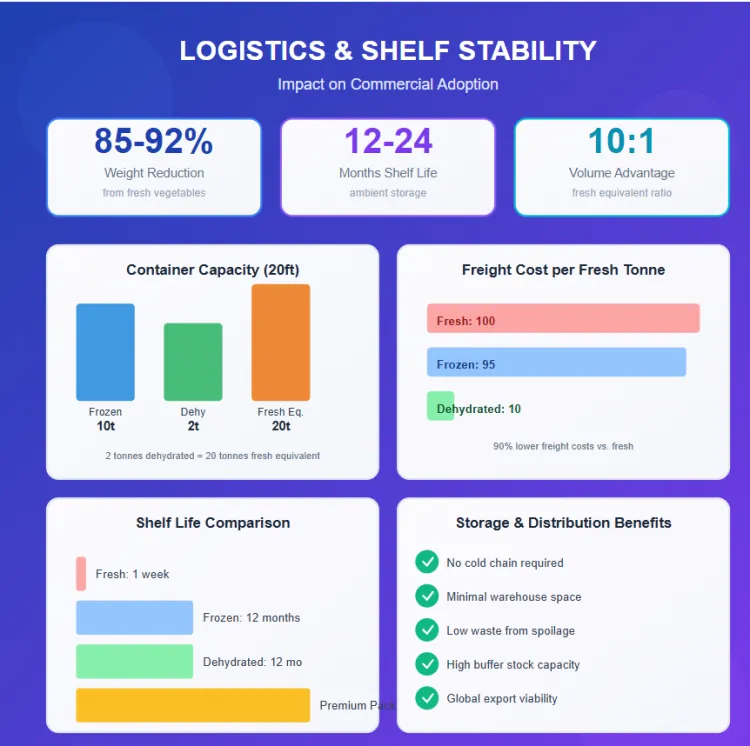
Dehydration reduces product weight by 85 to 92 percent and volume by similar proportions, transforming logistics economics compared to fresh or frozen alternatives. A twenty foot container that holds 10 tonnes of frozen mixed vegetables can transport 2 tonnes of dehydrated equivalent, representing approximately 20 tonnes of fresh vegetable content. Ocean freight costs per tonne of fresh equivalent drop dramatically, making long distance export viable and allowing processors to serve global customers from centralised production locations.
Shelf stability under ambient conditions eliminates cold chain requirements throughout distribution, warehousing, and retail handling. Products maintain quality for 12 to 24 months when properly packaged with moisture barriers and oxygen absorbers. This stability reduces waste from temperature excursions, allows buffer inventory for demand variability, and simplifies storage in foodservice and institutional settings. Emergency food supplies, military rations, and humanitarian relief operations rely heavily on dehydrated vegetables specifically because of storage resilience.
Moisture control during storage determines whether promised shelf life is realised. Dehydrated products are hygroscopic and readily absorb humidity from ambient air, accelerating degradation and risking microbial growth if moisture content rises above critical thresholds. Packaging technology using aluminium laminate pouches or metallised films, combined with desiccants or nitrogen flushing, maintains product integrity. Processors must balance packaging cost against the value of extended shelf life and geographic reach, with export oriented operations justifying higher packaging investment than those serving local foodservice distributors.
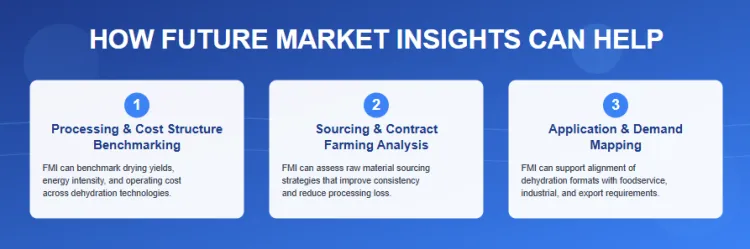
How Future Market Insights Can Help
Bibliography
- Sagar, V. R., and Suresh Kumar, P. Recent advances in drying and dehydration of fruits and vegetables. Critical Reviews in Food Science and Nutrition, Vol. 50, Issue 5, pp. 455-473.
- Mujumdar, A. S. Handbook of industrial drying. Third Edition. CRC Press, Academic reference work used across food dehydration research.
- Ratti, C. Hot air and freeze drying of high value foods A review. Journal of Food Engineering, Vol. 49, Issues 4, pp. 311-319.
- Wang, B., Jia, Y., Li, Y., Wang, Z., Wen, L., He, Y., Xu, X. Dehydration and rehydration behavior of vegetables Quality evaluation and processing challenges. Food Chemistry X, Vol. 20.
- Scholten, H., Verdouw, C., Beulens, A., van der Vorst, J. Traceability and resilience in food supply chains Concepts and applications. International Journal of Production Economics, Vol. 196, pp. 13-26.

