


Key Takeaways
- Butyl Glycol pricing reflects upstream integration rather than solvent demand alone
- Asia benefits from deeper ethylene oxide and alcohol integration
- Europe faces higher energy and compliance driven cost floors
- North America pricing is shaped by feedstock availability and logistics reach
- Delivered cost differs materially despite comparable product specifications
Butyl Glycol, also known as ethylene glycol monobutyl ether or 2-butoxyethanol, serves as a critical solvent in coatings, cleaning products, and industrial applications across global regions. Despite standardized product specifications and similar end-use demand patterns, pricing for Butyl Glycol exhibits persistent regional divergence that conventional supply-demand analysis fails to explain. Asia-Pacific prices typically range USD 100 to USD 300 per metric ton below European levels, while North American pricing occupies an intermediate position reflecting distinct cost drivers.
This regional price dispersion stems not from product differentiation or demand imbalances but from fundamental differences in production economics. The synthesis of Butyl Glycol requires two key feedstocks: ethylene oxide and n-butanol. Regional variations in feedstock integration depth, sourcing models, energy cost structures, and logistics economics create persistent cost differentials that translate directly into pricing behavior. Integrated producers managing global portfolios optimize margin capture across regions while maintaining price floors determined by local cost structures. Understanding these regional dynamics requires examining the technical and commercial factors that separate Butyl Glycol production economics across Asia, Europe, and North America.
How does ethylene oxide integration influence Butyl Glycol pricing by region?
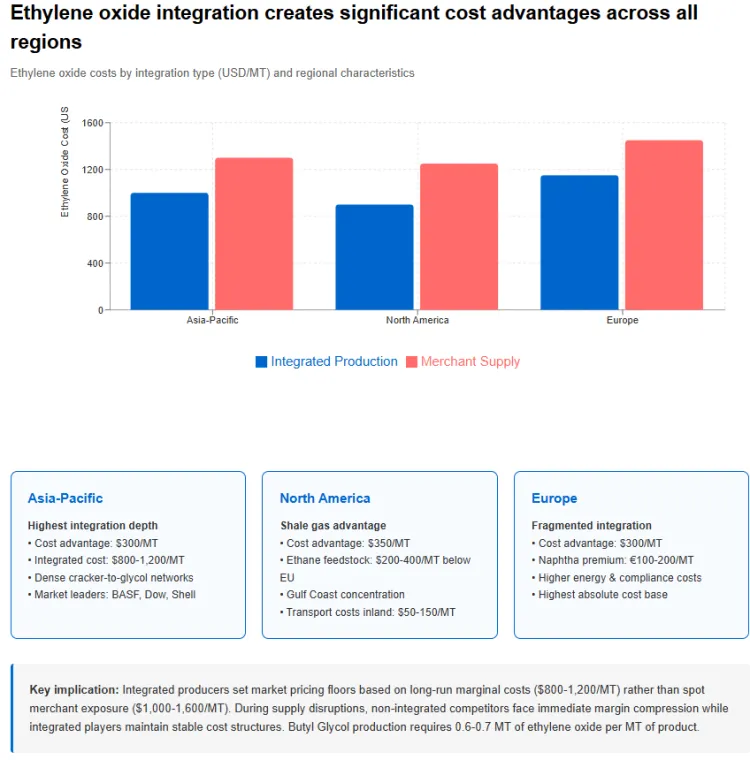
Ethylene oxide integration determines production cost stability and pricing floors across regions through captive feedstock supply, cost pass-through dynamics, and operational flexibility. Butyl Glycol production consumes approximately 0.6 to 0.7 metric tons of ethylene oxide per metric ton of final product. Producers with captive ethylene oxide plants benefit from internal transfer pricing, elimination of market price volatility, and optimization of production scheduling that merchant buyers cannot replicate.
Asia-Pacific hosts the highest concentration of integrated ethylene oxide and glycol ether facilities, particularly in China, South Korea, and Taiwan. Major producers including BASF, Dow, Shell, and Asian petrochemical companies operate crackers producing ethylene, which feeds ethylene oxide plants directly linked to downstream glycol ether production. This vertical integration delivers ethylene oxide at cash production costs of USD 800 to USD 1,200 per metric ton depending on regional ethylene pricing and plant efficiency, compared to merchant prices that fluctuate between USD 1,000 and USD 1,600 per metric ton based on supply-demand dynamics.
European producers face more fragmented integration. While several large producers maintain ethylene oxide capacity, the region exhibits lower integration depth compared to Asia. European ethylene oxide pricing reflects higher feedstock costs from naphtha-based crackers, elevated energy expenses, and tighter environmental compliance requirements. Base ethylene costs in Europe typically run EUR 100 to EUR 200 per metric ton above Asian levels on an FOB basis, translating directly into higher ethylene oxide costs and downstream Butyl Glycol pricing floors.
North American integration patterns reflect shale gas advantages and Gulf Coast petrochemical concentration. Ethane-based crackers in the US Gulf Coast produce ethylene at costs USD 200 to USD 400 per metric ton below European naphtha-based production during periods of favorable natural gas pricing. However, North American ethylene oxide capacity concentrates in fewer integrated sites compared to Asia, and inland producers often rely on merchant ethylene oxide supply. Transportation costs from Gulf Coast production to Midwest or West Coast consumption centers add USD 50 to USD 150 per metric ton in delivered ethylene oxide costs.
Integration depth also affects pricing volatility and responsiveness. Integrated producers absorb ethylene oxide price movements through internal accounting rather than immediate market exposure. When ethylene oxide merchant prices spike due to supply disruptions or demand surges, integrated Butyl Glycol producers maintain stable costs while non-integrated competitors face immediate margin compression. This dynamic creates pricing discipline where integrated producers set market floors based on long-run marginal costs rather than spot feedstock exposure.
Why does n-butanol sourcing differ across Asia, Europe, and North America?
N-butanol sourcing patterns diverge regionally due to oxo alcohol capacity distribution, propylene versus syngas production routes, and import reliance that creates distinct cost structures and volatility exposure. Butyl Glycol production requires 0.5 to 0.6 metric tons of n-butanol per metric ton of output, making butanol costs a primary variable in total production economics.
Asia-Pacific maintains the largest n-butanol production capacity globally, with substantial plants in China, South Korea, Taiwan, and Southeast Asia. Chinese capacity expansion over the past decade created regional self-sufficiency and export availability. Most Asian n-butanol production follows the oxo process using propylene and syngas derived from coal gasification or natural gas reforming. Coal-based syngas routes in China deliver particularly low-cost n-butanol production, with cash costs reaching USD 700 to USD 900 per metric ton compared to USD 900 to USD 1,200 per metric ton for propylene-based routes. This cost advantage translates directly into lower Butyl Glycol production costs across the region.
European n-butanol capacity remains adequate for regional demand but faces higher production costs. European producers predominantly use propylene-based oxo processes with natural gas-derived syngas. Propylene pricing in Europe typically exceeds Asian levels by USD 50 to USD 150 per metric ton, while natural gas costs for syngas production run two to four times Asian levels during periods of energy market stress. These feedstock disadvantages establish higher European n-butanol pricing of EUR 1,000 to EUR 1,400 per metric ton, directly impacting Butyl Glycol cost structures.
North American n-butanol production concentrates in the US Gulf Coast with several major oxo alcohol complexes. The region benefits from low-cost propylene availability as a byproduct of ethane cracker operations and natural gas liquids processing. Additionally, natural gas-based syngas production costs remain competitive despite recent price increases. North American n-butanol pricing typically ranges USD 1,000 to USD 1,300 per metric ton, positioning between Asian and European levels and reflecting feedstock advantages offset by lower economies of scale compared to Asian mega-plants.
Import dynamics further differentiate regional sourcing. Europe imports n-butanol from the US and Asia when regional supply tightens, adding freight costs of USD 80 to USD 120 per metric ton and creating pricing volatility. North American imports from Asia occur primarily on the West Coast, where freight costs of USD 100 to USD 150 per metric ton plus longer lead times influence local pricing. Asia generally operates as a net exporter, providing pricing stability and cost advantages for regional Butyl Glycol producers.
How do energy and operating cost structures shape regional pricing floors?
Energy and operating cost structures establish regional pricing floors through direct production energy intensity, utilities expenses, and compliance-driven operating costs that vary substantially across regions. Butyl Glycol production via catalytic reaction of ethylene oxide and n-butanol requires heating, cooling, separation, and purification steps that consume 2 to 4 gigajoules of thermal energy and 150 to 300 kilowatt-hours of electricity per metric ton of product depending on process configuration and plant efficiency.
European energy costs create the highest regional cost floors. Industrial natural gas prices in Europe ranged from EUR 25 to EUR 80 per megawatt-hour between 2021 and 2024, with electricity prices reaching EUR 80 to EUR 200 per megawatt-hour during peak periods. A Butyl Glycol plant consuming 3 gigajoules thermal energy and 200 kilowatt-hours electricity per metric ton faces energy costs of EUR 25 to EUR 60 per metric ton at these price levels, compared to USD 10 to USD 25 per metric ton in Asia and USD 15 to USD 35 per metric ton in North America during the same period. These differentials establish baseline cost advantages for Asian and North American producers.
Asia-Pacific energy costs benefit from diversified fuel sources including coal, natural gas, and renewable power. Chinese industrial electricity prices average CNY 0.5 to CNY 0.8 per kilowatt-hour (USD 0.07 to USD 0.11), while natural gas costs range USD 6 to USD 12 per million BTU depending on domestic supply versus LNG imports. Southeast Asian producers access even lower energy costs through natural gas resources in Indonesia, Malaysia, and Thailand. These energy advantages compound with feedstock integration to deliver total Butyl Glycol production costs USD 150 to USD 300 per metric ton below European levels.
North American energy positioning reflects natural gas abundance and regional variation. US Gulf Coast industrial natural gas prices averaged USD 2 to USD 6 per million BTU through most periods, providing significant advantages over Europe though less pronounced than during peak European gas crises. Electricity costs range USD 0.05 to USD 0.10 per kilowatt-hour for industrial customers with competitive regional power supply. However, inland locations face higher delivered energy costs that narrow advantages versus coastal export-oriented plants.
Compliance and operating costs add regional differentiation. European REACH regulations, emissions monitoring, workplace safety requirements, and sustainability reporting create fixed cost burdens of EUR 10 to EUR 30 per metric ton for chemical facilities. Asian compliance costs remain lower though rising, while North American regulatory costs fall between European and Asian levels. These operating cost differentials reinforce pricing floors established by energy and feedstock economics.
Why do logistics and trade flows amplify regional price divergence?
Logistics and trade flows amplify price divergence through bulk liquid handling requirements, storage costs, regulatory documentation, and limited arbitrage despite theoretical global trade availability. Butyl Glycol ships in ISO tanks, tank containers, and bulk vessels with specialized handling for flammable liquid classification under UN 2369. Regional infrastructure for bulk liquid storage, blending, and distribution creates delivered cost variations that often exceed production cost differentials.
Intercontinental freight for bulk liquids ranges USD 80 to USD 150 per metric ton from Asia to Europe and USD 100 to USD 180 per metric ton from Asia to North American West Coast depending on shipping rates, routing, and container availability. These freight costs, combined with insurance, financing, and inventory carrying costs, create arbitrage thresholds that must be exceeded before cross-regional trade becomes economically attractive. When Asian prices sit USD 100 to USD 200 below European levels, freight costs consume most or all of the apparent arbitrage opportunity.
Storage and handling infrastructure requirements further limit arbitrage. Butyl Glycol requires heated storage in winter climates to maintain fluidity, specialized pumping equipment, and segregated tankage to prevent contamination. Establishing distribution infrastructure in new regions demands capital investments of USD 1 million to USD 10 million depending on scale, creating barriers for opportunistic traders seeking to exploit price differentials. Existing regional distributors maintain established customer relationships and technical service capabilities that new entrants struggle to replicate.
Regulatory documentation and product registration create non-tariff barriers to trade. European REACH registration requires extensive safety and environmental data costing EUR 50,000 to EUR 200,000 per substance. US EPA TSCA compliance, Chinese chemical registration, and country-specific product approvals add time and cost barriers to cross-border trade. These requirements favor established producers with existing registrations and delay or prevent smaller producers from accessing regional arbitrage opportunities.
Product quality specifications and customer qualification processes further constrain trade flows. While Butyl Glycol meets standardized specifications, customers in coatings and cleaning applications often qualify specific producers through performance testing, stability evaluation, and supply reliability assessment. Switching suppliers requires requalification processes spanning 3 to 12 months, creating switching costs that reduce price sensitivity and limit arbitrage responsiveness. End users prioritize supply reliability over marginal cost savings, supporting regional pricing structures.
How do integrated producers manage pricing and margins across regions?
Integrated producers manage global portfolios through transfer pricing optimization, regional margin balancing, and strategic allocation of production volumes that maximize enterprise profitability rather than individual plant margins. Global producers including BASF, Dow, Shell, and Asian conglomerates operate Butyl Glycol capacity across multiple regions with varying integration depths, energy costs, and competitive positions.
Transfer pricing between internal business units allows integrated producers to allocate profits strategically across tax jurisdictions, manage reported segment profitability, and optimize global tax efficiency. Ethylene oxide and n-butanol transferred from upstream units to downstream Butyl Glycol plants use accounting prices that may differ from market prices, affecting reported regional margins without changing total enterprise profitability. This flexibility enables producers to show consistent profitability across regions despite underlying cost differentials.
Regional margin balancing involves pricing decisions that optimize total enterprise profit rather than maximizing volume or margin in individual regions. When Asian prices fall due to competitive pressure, integrated producers may reduce export volumes while maintaining higher European and North American pricing where competition remains less intense. Conversely, when Asian demand strengthens, producers shift volumes from export to domestic sales, supporting prices across all regions. This portfolio approach creates price discipline and reduces volatility compared to fragmented regional producers.
Production allocation across integrated sites responds to feedstock costs, energy prices, and regional demand shifts. A global producer with Butyl Glycol plants in Asia, Europe, and North America adjusts operating rates and export patterns based on relative economics. During periods of high European energy costs, producers run Asian plants at higher utilization and increase exports to Europe. When North American propylene costs fall due to shale gas dynamics, producers shift production to US sites and reduce imports. This flexibility smooths regional price volatility while maintaining global supply-demand balance.
Customer segmentation and contract structures support regional pricing strategies. Long-term contracts with major coatings and cleaning product manufacturers establish volume commitments and formula-based pricing tied to published feedstock indices. Spot sales serve to balance supply, price-discover, and respond to short-term demand fluctuations. By managing contract versus spot mix across regions, producers maintain stable base revenues while capturing margin opportunities in tighter regional conditions. This approach supports the persistent pricing dispersion observed across regions.
How Future Market Insights Can Help
Sources
- Procurement Resource. (2024). Butyl Glycol Price Trend and Market Analysis Reports Q1-Q4 2024. Quarterly pricing intelligence covering Asia Pacific, North America, Europe, and Middle East regional price movements, ethylene oxide and n-butanol feedstock cost impacts, downstream demand patterns from paints and coatings sectors, supply chain disruptions including Red Sea shipping route impacts, and regional supply-demand balance shifts affecting delivered pricing across major consumption centers.
- BASF SE. (2023). Annual Report 2023 and Ethylene Oxide Complex Expansion at Antwerp Verbund Site. Corporate financial reporting and technical documentation on EUR 500 million investment adding 400,000 metric tons per year ethylene oxide and derivatives capacity, integration strategies for alkoxylates production, and regional market positioning in European glycol ethers and downstream derivatives operations with startup completion in October 2023.
- Dow Inc. (2024-2025). Glycol Ether Price Adjustments and Feedstock Integration Commentary. Price announcement documentation for USD 110 per metric ton increase effective January 2025 for Butyl Cellosolve and related glycol ethers, analysis of ethylene oxide feedstock constraints from mono ethylene glycol demand for automotive antifreeze applications, energy cost impacts on North American production economics, and supply chain management during peak winter demand periods.

