

- Industry Size (2025)
- USD 4.1 Bn
- Forecast (2035)
- USD 6.7 Bn
- CAGR (2025 to 2035)
- 5.1%
Butyl Acrylate Market Size and Share Forecast Outlook 2025 to 2035
The Butyl Acrylate Market is estimated to be valued at USD 4.1 billion in 2025 and is projected to reach USD 6.7 billion by 2035, registering a compound annual growth rate (CAGR) of 5.1% over the forecast period.
Quick Stats for Butyl Acrylate Market
- Butyl Acrylate Market Value (2025): USD 4.1 billion
- Butyl Acrylate Market Forecast Value (2035): USD 6.7 billion
- Butyl Acrylate Market Forecast CAGR: 5.1%
- Leading Segment in Butyl Acrylate Market in 2025: I-Butyl Acrylate (40.2%)
- Key Growth Regions in Butyl Acrylate Market: North America, Asia-Pacific, Europe
- Top Key Players in Butyl Acrylate Market: Dow, Basf, Arkema, LG Chem, Nippon Shokubai, TASNEE, Sasol, Mitsubishi Chem, TOAGOSEI (SG), Formosa, Sibur, Idemitsu, Jurong, Huayi, CNOOC, BASF-YPC
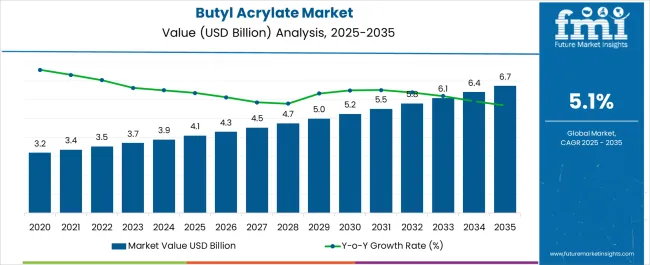
Butyl Acrylate Market Key Takeaways
| Metric | Value |
|---|---|
| Butyl Acrylate Market Estimated Value in (2025 E) | USD 4.1 billion |
| Butyl Acrylate Market Forecast Value in (2035 F) | USD 6.7 billion |
| Forecast CAGR (2025 to 2035) | 5.1% |
Why is the Butyl Acrylate Market Growing?
The Butyl Acrylate market is experiencing steady growth, driven by the increasing demand for versatile polymer intermediates used in coatings, adhesives, textiles, and construction materials. Rising industrialization and urbanization are supporting adoption across a wide range of applications, including paints, coatings, and specialty chemicals. The market is further bolstered by advancements in polymerization technologies, which improve the performance, durability, and environmental compatibility of butyl acrylate-based products.
Growing emphasis on high-performance adhesives and sealants in both commercial and residential construction is creating additional demand. Regulatory frameworks promoting low-emission, sustainable chemical products are also influencing market dynamics, encouraging manufacturers to optimize production processes and develop eco-friendly solutions.
The increasing need for improved bonding, flexibility, and resistance properties in industrial applications is contributing to the adoption of butyl acrylate As demand for high-performance polymers continues to rise globally, the market is expected to witness sustained growth, with opportunities emerging from innovations in specialty chemicals and the expansion of downstream applications across multiple industries.
Segmental Analysis
The butyl acrylate market is segmented by product type, application, and geographic regions. By product type, butyl acrylate market is divided into I-Butyl Acrylate, N-Butyl Acrylate, and T-Butyl Acrylate. In terms of application, butyl acrylate market is classified into Adhesives & Sealants, Plastics, Paint & Coatings, Textiles, and Others (Consumer Goods, Water Treatment). Regionally, the butyl acrylate industry is classified into North America, Latin America, Western Europe, Eastern Europe, Balkan & Baltic Countries, Russia & Belarus, Central Asia, East Asia, South Asia & Pacific, and the Middle East & Africa.
Insights into the I-Butyl Acrylate Product Type Segment
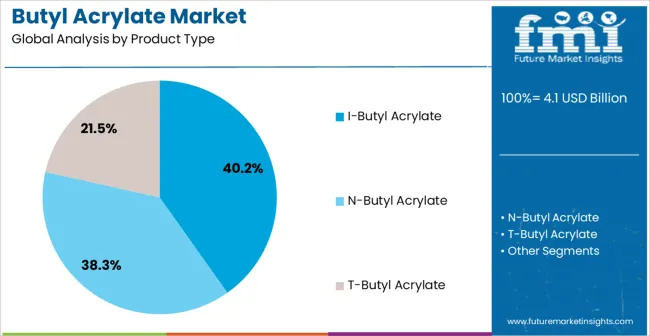
The I-Butyl Acrylate product type segment is projected to hold 40.2% of the market revenue in 2025, establishing it as the leading product type. Its dominance is being driven by superior performance characteristics, including high flexibility, low glass transition temperature, and excellent compatibility with copolymers and other resins.
These properties make it highly suitable for applications in adhesives, coatings, paints, and sealants where durability, elasticity, and adhesion are critical. Its adaptability to various polymerization techniques and formulations enables manufacturers to meet diverse industrial requirements while optimizing process efficiency.
Additionally, I-Butyl Acrylate offers advantages in energy-efficient production and environmentally friendly formulations, which is further supporting adoption With increasing demand for high-performance and sustainable polymer solutions, this segment is expected to maintain its leadership, supported by continuous advancements in chemical synthesis, process efficiency, and downstream integration across industries where robust polymer performance is essential.
Insights into the Adhesives and Sealants Application Segment
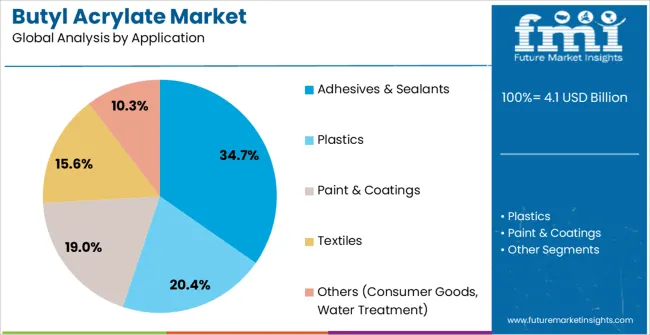
The adhesives and sealants application segment is anticipated to account for 34.7% of the market revenue in 2025, making it the leading application area. Growth in this segment is being driven by the expanding construction, packaging, and automotive sectors, which demand high-performance bonding materials. Butyl acrylate-based adhesives provide enhanced adhesion, elasticity, and chemical resistance, making them ideal for diverse industrial and commercial applications.
The increasing focus on lightweight and durable bonding solutions is further propelling adoption. These adhesives also support regulatory compliance by enabling low volatile organic compound formulations and sustainable material usage.
Additionally, the ability to integrate butyl acrylate into waterborne and solvent-based formulations offers manufacturers flexibility in product design and performance optimization As the construction, automotive, and packaging industries continue to expand globally, adhesives and sealants are expected to remain the primary application driving market growth, reinforced by ongoing technological innovations and the demand for environmentally sustainable bonding solutions.
Market Overview
Introduction
Butyl Acrylate falls under the category of unsaturated hydrocarbons. Butyl Acrylate is available in clear colorless liquid and having a characteristic fruity odor, colorless and hygroscopic crystalline solid. Furthermore the butyl acrylate is soluble in organic solvents but shows limited solubility in water, also exhibit less density than water. Butyl Acrylate can readily polymerized and further exhibits wide range of properties depending upon the reaction condition and monomer selection.
Butyl acrylate is manufactured and formulated by different process and reaction such as carbon monoxide, nickel carbonyl, acetylene and butyl alcohol reacts together to make butyl acrylate. Commercially butyl acrylate is available in different types and formulation and manufactures tailor-made the formulation according to the end user needs.
Butyl acrylate found adoption on large scale in different application such as formulation of adhesives & sealants, paint & coatings, plastic processing, textile and also used in water treatment application. Furthermore, butyl acrylate is commercially used for the formulation and synthesis of co polymers and homopolymers such as acrylic acid and its esters, salts, amides and unsaturated polyesters.
The different concentration of the monomer during the formulations of butyl acrylate based acrylic polymers enables the excellent properties such as low temperature flexibility, superior sunlight and weathering resistance & better water resistance. These properties makes the solution as a material of choice in paint & coating formulation. Butyl acrylate also used in cleaning products, paper finishes and antioxidant agents.
The double bond present in the compound enables quick reactivity and also allows this product to be adopted as a chemical intermediary.
Analysis of Butyl Acrylate Market By Key Countries
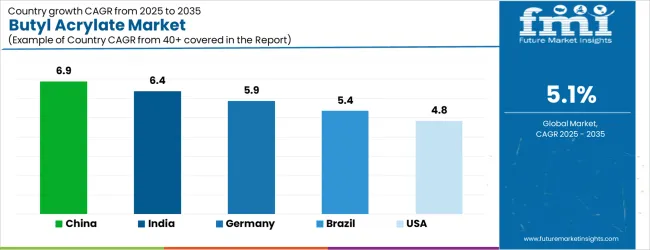
| Country | CAGR |
|---|---|
| China | 6.9% |
| India | 6.4% |
| Germany | 5.9% |
| Brazil | 5.4% |
| USA | 4.8% |
| UK | 4.3% |
| Japan | 3.8% |
Country-wise Analysis
The Butyl Acrylate Market is expected to register a CAGR of 5.1% during the forecast period, exhibiting varied country level momentum. China leads with the highest CAGR of 6.9%, followed by India at 6.4%. Developed markets such as Germany, France, and the UK continue to expand steadily, while the USA is likely to grow at consistent rates. Japan posts the lowest CAGR at 3.8%, yet still underscores a broadly positive trajectory for the global Butyl Acrylate Market. In 2024, Germany held a dominant revenue in the Western Europe market and is expected to grow with a CAGR of 5.9%. The USA Butyl Acrylate Market is estimated to be valued at USD 1.5 billion in 2025 and is anticipated to reach a valuation of USD 1.5 billion by 2035. Sales are projected to rise at a CAGR of 0.0% over the forecast period between 2025 and 2035. While Japan and South Korea markets are estimated to be valued at USD 200.8 million and USD 135.6 million respectively in 2025.
Key Players in the Butyl Acrylate Market
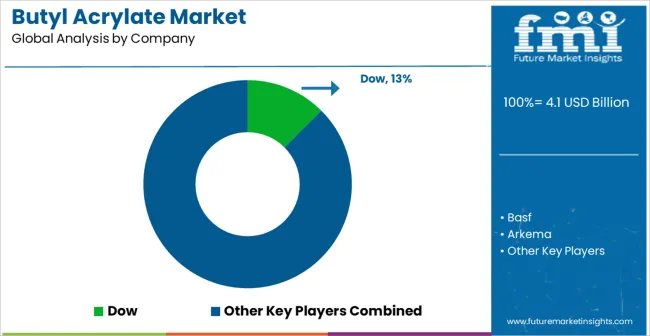
- Dow
- Basf
- Arkema
- LG Chem
- Nippon Shokubai
- TASNEE
- Sasol
- Mitsubishi Chem
- TOAGOSEI (SG)
- Formosa
- Sibur
- Idemitsu
- Jurong
- Huayi
- CNOOC
- BASF-YPC
Scope of the Report
| Item | Value |
|---|---|
| Quantitative Units | USD 4.1 Billion |
| Product Type | I-Butyl Acrylate, N-Butyl Acrylate, and T-Butyl Acrylate |
| Application | Adhesives & Sealants, Plastics, Paint & Coatings, Textiles, and Others (Consumer Goods, Water Treatment) |
| Regions Covered | North America, Europe, Asia-Pacific, Latin America, Middle East & Africa |
| Country Covered | United States, Canada, Germany, France, United Kingdom, China, Japan, India, Brazil, South Africa |
| Key Companies Profiled | Dow, Basf, Arkema, LG Chem, Nippon Shokubai, TASNEE, Sasol, Mitsubishi Chem, TOAGOSEI (SG), Formosa, Sibur, Idemitsu, Jurong, Huayi, CNOOC, and BASF-YPC |
Butyl Acrylate Market by Segments
Product Type:
- I-Butyl Acrylate
- N-Butyl Acrylate
- T-Butyl Acrylate
Application:
- Adhesives & Sealants
- Plastics
- Paint & Coatings
- Textiles
- Others (Consumer Goods, Water Treatment)
Region:
- North America
- USA
- Canada
- Mexico
- Latin America
- Brazil
- Chile
- Rest of Latin America
- Western Europe
- Germany
- UK
- Italy
- Spain
- France
- Nordic
- BENELUX
- Rest of Western Europe
- Eastern Europe
- Russia
- Poland
- Hungary
- Balkan & Baltic
- Rest of Eastern Europe
- East Asia
- China
- Japan
- South Korea
- South Asia and Pacific
- India
- ASEAN
- Australia & New Zealand
- Rest of South Asia and Pacific
- Middle East & Africa
- Kingdom of Saudi Arabia
- Other GCC Countries
- Turkiye
- South Africa
- Other African Union
- Rest of Middle East & Africa
Frequently Asked Questions
How big is the butyl acrylate market in 2025?
The global butyl acrylate market is estimated to be valued at USD 4.1 billion in 2025.
What will be the size of butyl acrylate market in 2035?
The market size for the butyl acrylate market is projected to reach USD 6.7 billion by 2035.
How much will be the butyl acrylate market growth between 2025 and 2035?
The butyl acrylate market is expected to grow at a 5.1% CAGR between 2025 and 2035.
What are the key product types in the butyl acrylate market?
The key product types in butyl acrylate market are i-butyl acrylate, n-butyl acrylate and t-butyl acrylate.
Which application segment to contribute significant share in the butyl acrylate market in 2025?
In terms of application, adhesives & sealants segment to command 34.7% share in the butyl acrylate market in 2025.
Preview the report firsthand - request a free sample
Get SampleGet the brochure for pricing and purchase details.
Get PDFTable of Content
- Executive Summary
- Global Market Outlook
- Demand-side Trends
- Supply-side Trends
- Technology Roadmap Analysis
- Analysis and Recommendations
- Market Overview
- Market Coverage / Taxonomy
- Market Definition / Scope / Limitations
- Market Background
- Market Dynamics
- Drivers
- Restraints
- Opportunity
- Trends
- Scenario Forecast
- Demand in Optimistic Scenario
- Demand in Likely Scenario
- Demand in Conservative Scenario
- Opportunity Map Analysis
- Product Life Cycle Analysis
- Supply Chain Analysis
- Investment Feasibility Matrix
- Value Chain Analysis
- PESTLE and Porter’s Analysis
- Regulatory Landscape
- Regional Parent Market Outlook
- Production and Consumption Statistics
- Import and Export Statistics
- Market Dynamics
- Global Market Analysis 2020 to 2024 and Forecast, 2025 to 2035
- Historical Market Size Value (USD Million) Analysis, 2020 to 2024
- Current and Future Market Size Value (USD Million) Projections, 2025 to 2035
- Y-o-Y Growth Trend Analysis
- Absolute $ Opportunity Analysis
- Global Market Pricing Analysis 2020 to 2024 and Forecast 2025 to 2035
- Global Market Analysis 2020 to 2024 and Forecast 2025 to 2035, By Product Type
- Introduction / Key Findings
- Historical Market Size Value (USD Million) Analysis By Product Type , 2020 to 2024
- Current and Future Market Size Value (USD Million) Analysis and Forecast By Product Type , 2025 to 2035
- I-Butyl Acrylate
- N-Butyl Acrylate
- T-Butyl Acrylate
- Y-o-Y Growth Trend Analysis By Product Type , 2020 to 2024
- Absolute $ Opportunity Analysis By Product Type , 2025 to 2035
- Global Market Analysis 2020 to 2024 and Forecast 2025 to 2035, By Application
- Introduction / Key Findings
- Historical Market Size Value (USD Million) Analysis By Application, 2020 to 2024
- Current and Future Market Size Value (USD Million) Analysis and Forecast By Application, 2025 to 2035
- Adhesives & Sealants
- Plastics
- Paint & Coatings
- Textiles
- Others (Consumer Goods, Water Treatment)
- Y-o-Y Growth Trend Analysis By Application, 2020 to 2024
- Absolute $ Opportunity Analysis By Application, 2025 to 2035
- Global Market Analysis 2020 to 2024 and Forecast 2025 to 2035, By Region
- Introduction
- Historical Market Size Value (USD Million) Analysis By Region, 2020 to 2024
- Current Market Size Value (USD Million) Analysis and Forecast By Region, 2025 to 2035
- North America
- Latin America
- Western Europe
- Eastern Europe
- East Asia
- South Asia and Pacific
- Middle East & Africa
- Market Attractiveness Analysis By Region
- North America Market Analysis 2020 to 2024 and Forecast 2025 to 2035, By Country
- Historical Market Size Value (USD Million) Trend Analysis By Market Taxonomy, 2020 to 2024
- Market Size Value (USD Million) Forecast By Market Taxonomy, 2025 to 2035
- By Country
- USA
- Canada
- Mexico
- By Product Type
- By Application
- By Country
- Market Attractiveness Analysis
- By Country
- By Product Type
- By Application
- Key Takeaways
- Latin America Market Analysis 2020 to 2024 and Forecast 2025 to 2035, By Country
- Historical Market Size Value (USD Million) Trend Analysis By Market Taxonomy, 2020 to 2024
- Market Size Value (USD Million) Forecast By Market Taxonomy, 2025 to 2035
- By Country
- Brazil
- Chile
- Rest of Latin America
- By Product Type
- By Application
- By Country
- Market Attractiveness Analysis
- By Country
- By Product Type
- By Application
- Key Takeaways
- Western Europe Market Analysis 2020 to 2024 and Forecast 2025 to 2035, By Country
- Historical Market Size Value (USD Million) Trend Analysis By Market Taxonomy, 2020 to 2024
- Market Size Value (USD Million) Forecast By Market Taxonomy, 2025 to 2035
- By Country
- Germany
- UK
- Italy
- Spain
- France
- Nordic
- BENELUX
- Rest of Western Europe
- By Product Type
- By Application
- By Country
- Market Attractiveness Analysis
- By Country
- By Product Type
- By Application
- Key Takeaways
- Eastern Europe Market Analysis 2020 to 2024 and Forecast 2025 to 2035, By Country
- Historical Market Size Value (USD Million) Trend Analysis By Market Taxonomy, 2020 to 2024
- Market Size Value (USD Million) Forecast By Market Taxonomy, 2025 to 2035
- By Country
- Russia
- Poland
- Hungary
- Balkan & Baltic
- Rest of Eastern Europe
- By Product Type
- By Application
- By Country
- Market Attractiveness Analysis
- By Country
- By Product Type
- By Application
- Key Takeaways
- East Asia Market Analysis 2020 to 2024 and Forecast 2025 to 2035, By Country
- Historical Market Size Value (USD Million) Trend Analysis By Market Taxonomy, 2020 to 2024
- Market Size Value (USD Million) Forecast By Market Taxonomy, 2025 to 2035
- By Country
- China
- Japan
- South Korea
- By Product Type
- By Application
- By Country
- Market Attractiveness Analysis
- By Country
- By Product Type
- By Application
- Key Takeaways
- South Asia and Pacific Market Analysis 2020 to 2024 and Forecast 2025 to 2035, By Country
- Historical Market Size Value (USD Million) Trend Analysis By Market Taxonomy, 2020 to 2024
- Market Size Value (USD Million) Forecast By Market Taxonomy, 2025 to 2035
- By Country
- India
- ASEAN
- Australia & New Zealand
- Rest of South Asia and Pacific
- By Product Type
- By Application
- By Country
- Market Attractiveness Analysis
- By Country
- By Product Type
- By Application
- Key Takeaways
- Middle East & Africa Market Analysis 2020 to 2024 and Forecast 2025 to 2035, By Country
- Historical Market Size Value (USD Million) Trend Analysis By Market Taxonomy, 2020 to 2024
- Market Size Value (USD Million) Forecast By Market Taxonomy, 2025 to 2035
- By Country
- Kingdom of Saudi Arabia
- Other GCC Countries
- Turkiye
- South Africa
- Other African Union
- Rest of Middle East & Africa
- By Product Type
- By Application
- By Country
- Market Attractiveness Analysis
- By Country
- By Product Type
- By Application
- Key Takeaways
- Key Countries Market Analysis
- USA
- Pricing Analysis
- Market Share Analysis, 2024
- By Product Type
- By Application
- Canada
- Pricing Analysis
- Market Share Analysis, 2024
- By Product Type
- By Application
- Mexico
- Pricing Analysis
- Market Share Analysis, 2024
- By Product Type
- By Application
- Brazil
- Pricing Analysis
- Market Share Analysis, 2024
- By Product Type
- By Application
- Chile
- Pricing Analysis
- Market Share Analysis, 2024
- By Product Type
- By Application
- Germany
- Pricing Analysis
- Market Share Analysis, 2024
- By Product Type
- By Application
- UK
- Pricing Analysis
- Market Share Analysis, 2024
- By Product Type
- By Application
- Italy
- Pricing Analysis
- Market Share Analysis, 2024
- By Product Type
- By Application
- Spain
- Pricing Analysis
- Market Share Analysis, 2024
- By Product Type
- By Application
- France
- Pricing Analysis
- Market Share Analysis, 2024
- By Product Type
- By Application
- India
- Pricing Analysis
- Market Share Analysis, 2024
- By Product Type
- By Application
- ASEAN
- Pricing Analysis
- Market Share Analysis, 2024
- By Product Type
- By Application
- Australia & New Zealand
- Pricing Analysis
- Market Share Analysis, 2024
- By Product Type
- By Application
- China
- Pricing Analysis
- Market Share Analysis, 2024
- By Product Type
- By Application
- Japan
- Pricing Analysis
- Market Share Analysis, 2024
- By Product Type
- By Application
- South Korea
- Pricing Analysis
- Market Share Analysis, 2024
- By Product Type
- By Application
- Russia
- Pricing Analysis
- Market Share Analysis, 2024
- By Product Type
- By Application
- Poland
- Pricing Analysis
- Market Share Analysis, 2024
- By Product Type
- By Application
- Hungary
- Pricing Analysis
- Market Share Analysis, 2024
- By Product Type
- By Application
- Kingdom of Saudi Arabia
- Pricing Analysis
- Market Share Analysis, 2024
- By Product Type
- By Application
- Turkiye
- Pricing Analysis
- Market Share Analysis, 2024
- By Product Type
- By Application
- South Africa
- Pricing Analysis
- Market Share Analysis, 2024
- By Product Type
- By Application
- USA
- Market Structure Analysis
- Competition Dashboard
- Competition Benchmarking
- Market Share Analysis of Top Players
- By Regional
- By Product Type
- By Application
- Competition Analysis
- Competition Deep Dive
- Dow
- Overview
- Product Portfolio
- Profitability by Market Segments (Product/Age /Sales Channel/Region)
- Sales Footprint
- Strategy Overview
- Marketing Strategy
- Product Strategy
- Channel Strategy
- Basf
- Arkema
- LG Chem
- Nippon Shokubai
- TASNEE
- Sasol
- Mitsubishi Chem
- TOAGOSEI (SG)
- Formosa
- Sibur
- Idemitsu
- Jurong
- Huayi
- CNOOC
- BASF-YPC
- Dow
- Competition Deep Dive
- Assumptions & Acronyms Used
- Research Methodology


