


Key Takeaways
- Aquaculture leadership differs between production volume and value creation
- China dominates global output through freshwater and low value species
- Norway leads in salmon aquaculture through feed efficiency and automation
- Regulation and species selection shape national aquaculture models
- Technology intensity determines margins and export competitiveness
Why does China dominate global aquaculture production volume?
China accounts for approximately 60 percent of global aquaculture production by weight, a dominance built on freshwater farming systems supporting domestic food security. Carp species, tilapia, and other freshwater fish form the backbone of Chinese production, raised in ponds, rice paddies, and inland water bodies across rural regions. Production scale reflects both geographic advantage and policy prioritization of aquatic protein availability.
Freshwater aquaculture requires lower capital investment per tonne than marine systems. Pond construction costs remain accessible to smallholder farmers, and natural water sources reduce operational expenses. This enables decentralized production across thousands of small to medium operations rather than consolidated industrial facilities. The resulting production network generates enormous aggregate volume through distributed capacity.
Carp species demonstrate rapid growth rates, tolerance of variable water quality, and efficient conversion of plant based feeds. Silver carp, grass carp, and common carp varieties reach harvest weight quickly on low cost feed inputs, making them economically viable for producers operating on thin margins. Tilapia similarly thrives in warm freshwater environments with modest feeding requirements.
Food security objectives drive policy support for aquaculture expansion. Government programs provide technical assistance, access to fingerlings, and infrastructure development to rural fish farmers. Domestic consumption of freshwater fish remains high, creating stable demand that absorbs production without dependence on export channels. This internal consumption base supports continued volume growth.
However, production volume does not translate directly into economic value. Freshwater species command lower prices than premium marine fish, and domestic pricing reflects local purchasing power rather than international luxury seafood valuations. High volume at low margin characterizes the Chinese aquaculture model, prioritizing food availability over profit per unit.
Why does Norway lead aquaculture technology and economic performance?
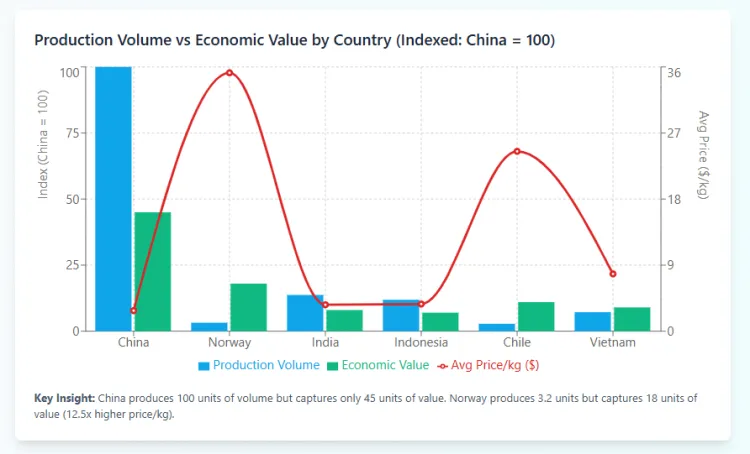
Norwegian aquaculture focuses on Atlantic salmon production in marine net pens, a species commanding premium pricing in global export channels. Salmon farming generates substantially higher revenue per tonne than freshwater species, creating economic rationale for capital intensive production systems. Norway produces less than 2 percent of global aquaculture volume by weight but captures disproportionate value share.
Feed conversion efficiency in Norwegian salmon operations significantly exceeds typical freshwater farming ratios. Advanced pelleted feeds optimized for salmon nutrition deliver feed conversion rates near 1.2 kilograms of feed per kilogram of fish growth, compared to ratios often exceeding 2.0 in traditional freshwater systems. This efficiency reduces feed cost per tonne produced and minimizes environmental loading from uneaten feed and waste.
Biosecurity protocols and health management systems distinguish Norwegian operations. Strict regulations govern stocking density, disease monitoring, and treatment protocols. Investment in veterinary oversight, vaccination programs, and early detection systems reduces mortality and maintains fish health throughout production cycles. These measures protect asset value in systems where each fish represents significant invested capital.
Automation penetration reaches levels uncommon in other aquaculture systems. Automated feeding systems using cameras and sensors adjust feed delivery based on fish behavior and appetite, optimizing growth while minimizing waste. Underwater cameras, environmental sensors, and data platforms provide continuous monitoring, enabling rapid response to water quality changes or health issues.
Export orientation shapes technology adoption. Norwegian salmon targets affluent consumers in Europe, North America, and Asia willing to pay premium prices for consistent quality. Meeting international food safety standards, maintaining cold chain integrity, and delivering uniform product specifications requires systematic process control. Technology investments deliver the consistency and traceability demanded by export channels.
How does species choice define national aquaculture leadership models?
Species biology determines feasible production systems and economic outcomes. Salmon require cold, oxygenated seawater and cannot tolerate the warm, sometimes turbid conditions where carp and tilapia thrive. This biological constraint limits salmon farming to specific coastal regions with appropriate water temperatures and oceanic conditions, concentrating production geographically.
Growth rates and feed costs interact to shape profitability. Salmon reach harvest weight of 4 to 6 kilograms in 18 to 24 months on high protein feeds. Carp achieve similar weights in comparable timeframes on cheaper, plant heavy diets. The difference lies in sale price: salmon may command 8 to 12 dollars per kilogram wholesale, while carp sells for 2 to 4 dollars. This price differential justifies higher feed costs and capital investment in salmon operations.
Mortality risk varies by species and production intensity. Salmon farming in marine environments faces disease challenges including sea lice, infectious salmon anemia, and bacterial infections. Dense stocking and shared water between sites enable rapid disease transmission. Carp cultured in ponds experience different pathogen pressures but generally demonstrate hardiness against environmental stress and disease.
Automation suitability differs across species and systems. Salmon in controlled net pens lend themselves to sensor based monitoring, automated feeding, and mechanical delousing systems. Dispersed pond based carp farming offers fewer opportunities for automation given variable site conditions and smaller scale operations. The return on technology investment depends on production value density and facility standardization.
Why do regulation and environmental controls shape aquaculture outcomes differently by country?
Norwegian aquaculture operates under comprehensive licensing and environmental regulations. Production licenses limit biomass per site, stocking density caps prevent overcrowding, and fallowing requirements mandate periodic site rest to reduce pathogen accumulation. Environmental monitoring tracks waste deposition, water quality impacts, and interaction with wild fish populations. These constraints force efficiency improvements and technology adoption to maximize output within regulatory limits.
Licensing scarcity creates asset value. Limited permits available for new salmon farms drive consolidation toward larger operators with capital and expertise to optimize production within allocated capacity. License holders invest heavily in maximizing yield per permitted tonne, incentivizing feed efficiency, mortality reduction, and growth optimization. Regulatory constraint becomes a driver of operational excellence.
Environmental monitoring requirements generate data used to refine production practices. Mandatory reporting on feed use, mortality, treatment applications, and waste levels creates transparency and accountability. Regulators and producers both use this data to identify performance gaps and environmental risks, enabling targeted improvements.
Chinese aquaculture faces less stringent site level regulation in many regions, though environmental concerns increasingly drive policy change. Lower regulatory pressure historically enabled rapid capacity expansion but also allowed practices that compromised water quality, increased disease risk, and degraded local ecosystems. Recent policy shifts toward sustainability and pollution control may drive consolidation and technology adoption similar to patterns observed in Norway.
Stricter regulation paradoxically improves competitiveness in premium segments. Norwegian salmon benefits from reputation for quality and sustainability built partly on regulatory oversight. Buyers pay premiums for fish from well regulated origins, viewing regulation as assurance of production standards and environmental responsibility.
How do capital intensity and technology adoption separate scale leaders from value leaders?
Investment per tonne produced differs dramatically between systems. Norwegian salmon operations may require 15,000 to 25,000 dollars in capital investment per tonne of annual production capacity, covering net pens, feeding systems, monitoring equipment, processing facilities, and support vessels. Chinese freshwater operations may involve capital outlays of 1,000 to 3,000 dollars per tonne, primarily for pond construction and basic equipment.
This capital intensity gap reflects different economic models. High investment in salmon farming targets high value output where margins justify capital costs and service debt. Low investment in freshwater farming pursues volume where margins are thin but capital requirements are modest. Each model succeeds within its economic context.
Automation adoption follows capital intensity. Norwegian producers deploy sensor networks, automated feeders, and data analytics because the value at risk justifies investment. A single salmon cohort in a marine pen may represent hundreds of thousands of dollars in inventory. Protecting this asset through early problem detection and optimized feeding delivers measurable returns.
Data driven decision making characterizes technology intensive systems. Norwegian farms collect continuous data on fish behavior, growth rates, feed consumption, and environmental conditions. Analysis of this data informs feeding schedules, harvest timing, and health interventions. Chinese operations, particularly smaller farms, rely more on experience and visual observation than systematic data collection.
Health monitoring technology demonstrates the investment divide. Norwegian operations increasingly use underwater cameras with computer vision to detect lice infestations, monitor fish welfare, and estimate biomass. Acoustic systems track fish distribution and behavior. Chinese operations generally lack these technologies, managing health through visual inspection and reactive treatment.
The trajectory differs by system economics. As Chinese aquaculture pursues higher value species and export channels, capital intensity and technology adoption may increase. Conversely, Norwegian efficiency gains from technology may enable volume expansion where biology and regulation permit. However, the fundamental distinction between volume focused and value focused models persists.
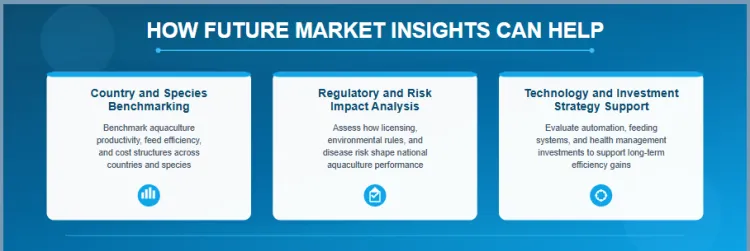
How Future Market Insights Can Help
Sources
- China Fishery Statistical Yearbook. National Bureau of Statistics of China and Ministry of Agriculture and Rural Affairs. Beijing: China Agriculture Press, 2024.
- Directorate of Fisheries Norway. Norwegian Aquaculture Analysis 2024: Production Efficiency and Technology Benchmarks. Bergen: Norwegian Directorate of Fisheries, 2024.
- Food and Agriculture Organization. The State of World Fisheries and Aquaculture 2024: Blue Transformation in Action. Rome: FAO, 2024.

