


Key Takeaways
- Germany integrates variable oil pumps to meet EU fleet CO₂ reduction requirements
- Premium OEMs rely on adaptive lubrication to reduce friction and improve engine efficiency
- Technology adoption ties to turbocharged, downsized, high-performance engines
- Germany hosts advanced Tier-1 pump manufacturers and system integrators
- Regulatory pressure converts variable pump integration into a qualification standard rather than an optional feature
How do EU CO₂ fleet rules influence German OEM decisions to adopt Automotive Variable Oil Pump systems?
The European Union's fleet-average CO₂ targets create direct financial pressure on German OEMs to reduce emissions across their entire vehicle portfolio. Current regulations mandate fleet averages of 95 grams of CO₂ per kilometer for passenger cars, with penalties of €95 per gram per vehicle for non-compliance. For premium manufacturers producing 1.5 to 2.5 million vehicles annually, even a single gram of excess CO₂ translates into penalties exceeding €140 million per year. Variable oil pumps contribute 0.8 to 1.5 grams of CO₂ reduction per vehicle by lowering parasitic engine losses, making them a cost-effective compliance tool.
Traditional fixed-displacement oil pumps operate at maximum flow regardless of engine load, consuming energy unnecessarily during low-speed or partial-load conditions. Variable displacement pumps or electronically controlled pumps adjust flow and pressure based on real-time operating conditions, reducing pump work by 30 to 50 percent across typical drive cycles. This efficiency gain directly reduces fuel consumption by 0.3 to 0.6 percent, which appears modest but becomes significant when multiplied across an entire production fleet and combined with other friction-reduction measures.
German OEMs face particularly acute compliance pressure because their product portfolios skew toward larger, heavier vehicles with higher baseline CO₂ emissions. BMW, Mercedes-Benz and Audi must extract efficiency improvements from every available system to offset the emissions profile of their SUVs and performance sedans. Variable oil pumps represent low-risk, proven technology that delivers measurable CO₂ benefits without compromising durability or customer-facing performance attributes, making adoption nearly universal across new gasoline engine platforms developed since 2018.
Why are German engine architectures especially suited to adaptive lubrication systems?
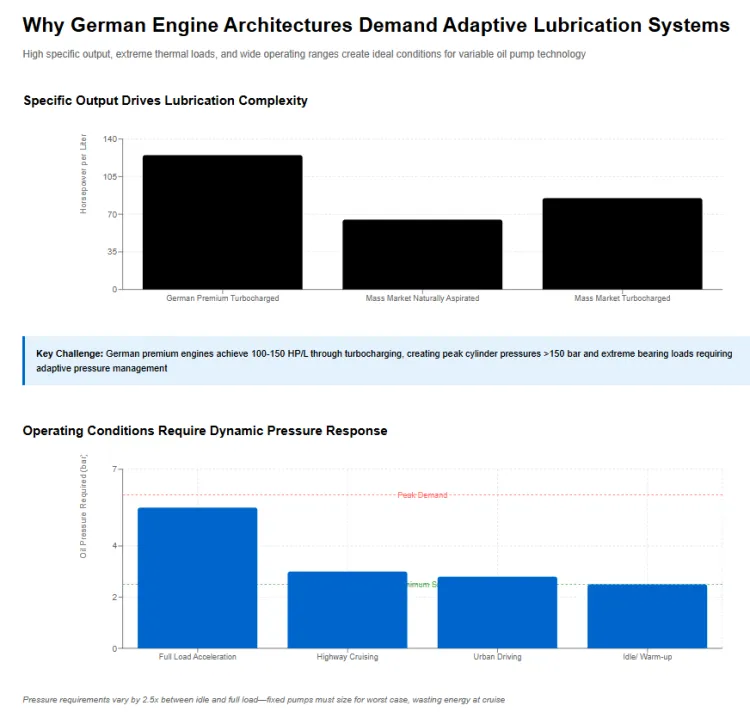
German premium engines prioritize high specific output, often producing 100 to 150 horsepower per liter through turbocharging and direct injection. These downsized, turbocharged architectures experience extreme thermal and mechanical loads, with peak cylinder pressures exceeding 150 bar and turbocharger speeds reaching 250,000 RPM. Variable oil pumps address the challenge of maintaining adequate lubrication under high load while avoiding excess pumping losses during cruising or urban driving conditions.
The operating profile of turbocharged engines demands adaptive pressure management. During full-load acceleration, critical components including turbocharger bearings, piston-ring interfaces and camshaft lobes require oil pressure of 4.5 to 6.0 bar to prevent wear and maintain film strength. During highway cruising at 2,000 to 3,000 RPM with minimal throttle, 2.5 to 3.5 bar suffices, and maintaining higher pressure wastes energy. Variable pumps modulate output continuously, matching supply to instantaneous demand and reducing average pump work by 35 to 45 percent compared to fixed systems sized for worst-case conditions.
Thermal management complexity further supports variable pump adoption. High-output engines generate substantial heat, and oil serves dual roles as lubricant and coolant. Variable pumps enable thermal-management strategies such as increased flow during warm-up to accelerate thermal stabilization, followed by reduced flow at operating temperature to minimize viscous losses. German OEMs integrate these systems with electronically controlled thermostats and variable-speed coolant pumps, creating coordinated thermal architectures that optimize efficiency across transient and steady-state operation.
How does Germany's Tier-1 ecosystem support innovation in precision hydraulic components for variable pumps?
Germany's concentration of advanced Tier-1 suppliers provides the engineering depth and manufacturing precision required for adaptive lubrication systems. Companies specializing in hydraulic components, electric actuators and control algorithms collaborate directly with OEM powertrain teams during engine development, co-designing pumps that integrate seamlessly with lubrication galleries, oil pans and electronic control units. This proximity enables rapid iteration cycles and allows suppliers to tailor pump characteristics to specific engine families.
Variable pump technologies require precise machining tolerances, advanced coating processes and robust electronic controls. Vane-type variable pumps demand clearances within 5 to 10 microns between rotor and housing to minimize internal leakage while maintaining smooth displacement modulation. Electrically driven pumps require brushless motors, power electronics and thermal management capable of operating continuously in 140°C oil environments. German suppliers possess specialized machining centers, coating deposition systems and validation facilities that support these requirements, creating a localized capability difficult to replicate elsewhere.
Integration within BMW, Mercedes-Benz and Volkswagen Group platforms accelerates technology maturation. When an OEM commits to variable pump integration across its four-cylinder and six-cylinder engine families, suppliers gain production volumes of 1.5 to 3.0 million units annually, justifying investments in automation, process optimization and next-generation designs. This volume-driven learning creates cost reductions of 15 to 25 percent across successive platform generations while improving reliability and expanding operating envelopes, reinforcing Germany's position as both adopter and technology developer.
Why does variable pump integration become a qualification requirement for Germany's premium vehicles?
Premium vehicle buyers expect refinement, durability and efficiency, and variable oil pumps contribute to all three attributes. Fixed-displacement pumps generate pressure oscillations and flow noise that transmit through engine structure and into the cabin, particularly at idle and low speeds. Variable pumps operating at reduced displacement produce lower acoustic emissions, contributing 1 to 2 decibels of NVH improvement that aligns with premium brand expectations. In vehicles where cabin noise targets fall below 38 decibels at idle, every noise source matters.
Durability expectations for premium engines extend to 250,000 kilometers or more, and adaptive lubrication supports longevity by preventing both over-lubrication and under-lubrication across the operating envelope. Over-lubrication at low loads churns oil unnecessarily, generating foam and accelerating thermal degradation. Under-lubrication during transient high-load events risks boundary lubrication conditions that accelerate wear. Variable pumps with closed-loop pressure control maintain optimal conditions continuously, extending component life and reducing long-term warranty exposure for OEMs selling engines with extended service intervals.
Efficiency commitments embedded in brand positioning drive variable pump adoption beyond regulatory compliance. German OEMs market their vehicles on engineering excellence and technological leadership, and adaptive lubrication serves as tangible evidence of optimization depth. When competitors integrate variable pumps as standard equipment, non-adoption becomes a competitive disadvantage that undermines efficiency claims and product differentiation. This dynamic converts variable pumps from optional efficiency features into baseline expectations for any engine launched after 2020.
How is Germany shaping broader adoption trends for Automotive Variable Oil Pump technology across Europe?
German engine platforms establish de facto specifications that influence component design throughout Europe and beyond. When BMW develops a modular four-cylinder turbocharged engine family incorporating variable oil pumps, the same base architecture often appears in vehicles produced by partner OEMs or serves as a benchmark for competing designs. Component suppliers tailor their product portfolios to German OEM requirements, and these standardized interfaces and control strategies propagate across other European manufacturers seeking compatible, proven solutions.
Qualification standards originating in German OEM programs set industry baselines for durability, performance and integration requirements. Suppliers pursuing business with Mercedes-Benz or Volkswagen Group must demonstrate pump performance across extreme temperature ranges, validate pressure-response characteristics under transient loads, and meet stringent contamination tolerance levels. These qualification hurdles become reference standards that other OEMs adopt, creating harmonized expectations that simplify cross-platform component sharing and reduce validation burdens for suppliers serving multiple customers.
Regional technology diffusion accelerates as French, Italian and British OEMs observe efficiency gains achieved by German competitors. CO₂ regulations apply equally across the EU, and OEMs face identical compliance pressures. When German manufacturers demonstrate consistent 0.3 to 0.6 percent fuel economy improvements from variable pumps without reliability penalties, other manufacturers adopt similar systems to maintain competitive parity. This imitation effect, combined with shared supplier relationships and cross-licensed technologies, drives Europe-wide adoption patterns that originate from German engineering priorities and regulatory responses.
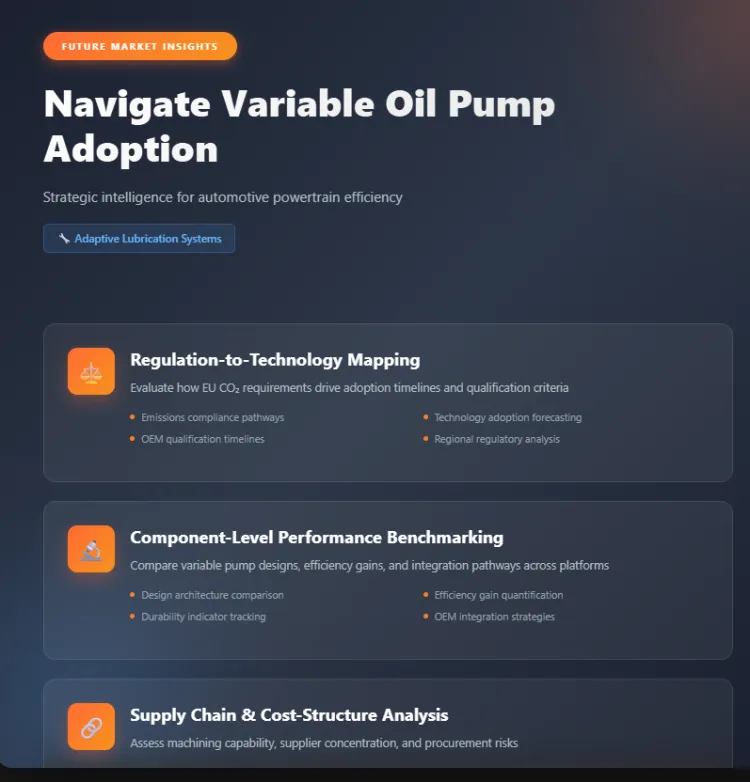
How can Future Market Insights support decisions in Automotive Variable Oil Pump adoption
Sources
- European Commission CO₂ emissions regulations: Fleet-average targets, compliance rules and efficiency-credit frameworks
- German OEM efficiency and powertrain documentation: Technical papers on friction-reduction strategies and component integration
- Tier-1 supplier publications on oil pump technologies: Specifications, hydraulic profiling and adaptive lubrication system design
- Automotive engineering and powertrain research journals: Studies on pump efficiency, thermal management and friction reduction
- Reputable automotive and regulatory media: Reporting on efficiency strategies, compliance pressures and engine-technology evolution

