


Key Takeaways
- Japan maintains very low drug prevalence yet high institutional testing volume.
- Corporate governance, safety culture and regulatory audits drive demand, not incidence rates.
- Aviation, rail and public transport require regular screening for safety-critical roles.
- Low tolerance means failure consequences are severe, increasing legal defensibility needs.
- Premium is paid for accredited, chain-of-custody compliant testing with strict documentation.
Why does workplace governance in Japan sustain routine drug testing despite minimal reported misuse?
Japan's corporate culture operates on risk prevention rather than incident response. Major employers embed drug testing into employment contracts as standard protocol, independent of actual abuse prevalence. Zero-tolerance policies reflect broader expectations around workplace conduct and employee reliability. Testing serves as preventive governance, demonstrating institutional commitment to risk management before problems emerge. This approach aligns with quality assurance frameworks common in Japanese manufacturing and service industries, where systems exist to prevent defects rather than detect them after occurrence.
Formal labor agreements increasingly incorporate screening requirements. Companies cite due diligence obligations to shareholders, customers and regulatory authorities. Annual or periodic testing becomes contractual expectation rather than discretionary measure. Employers view testing programs as insurance against reputational damage and operational disruption. Even industries without explicit regulatory mandates adopt testing protocols to satisfy audit requirements and corporate governance standards. Business continuity planning includes substance screening as component of workforce risk mitigation.
Audit requirements tie testing to broader compliance frameworks. Japanese corporations undergo internal and external audits covering safety management systems, quality controls and workforce governance. Drug testing documentation demonstrates systematic risk management. Auditors verify that screening protocols exist, operate consistently and produce defensible records. Absence of testing programs raises questions about corporate oversight even in low-prevalence environments. Testing volume thus reflects governance expectations rather than detection objectives, sustaining commercial demand regardless of positive result rates.
How do safety-critical sectors like aviation and public transport define the commercial baseline for testing?
Aviation regulations mandate comprehensive screening for flight crew, cabin attendants, maintenance personnel and ground operations staff. The Civil Aviation Bureau requires pre-employment testing and random screening throughout employment for roles affecting flight safety. Airlines implement testing frequencies exceeding minimum regulatory requirements to maintain operational certification and insurance compliance. Pilot programs typically include quarterly or semi-annual random selection plus post-incident testing. Cabin crew face similar protocols. Maintenance engineers undergo testing before certifying aircraft as airworthy.
Rail operators follow parallel mandates. Train drivers, conductors and signal operators submit to regular screening under transport safety regulations. Shinkansen operators maintain particularly rigorous protocols given high-speed operations and passenger volumes. Testing occurs at hiring, during employment at scheduled intervals, and after any safety incident regardless of suspected cause. Port authorities require similar screening for crane operators, cargo handlers and vessel traffic controllers. These safety-critical roles establish baseline testing volumes that anchor commercial demand.
Public transport extends screening broadly. Bus drivers, taxi operators and commercial vehicle drivers face regulatory and insurance-driven testing requirements. Fleet operators implement programs covering entire driver populations rather than targeted subsets. Testing becomes cost of maintaining operating licenses and liability coverage. The aggregate volume from transportation sectors creates sustained demand for laboratory capacity, certified testing personnel and documentation infrastructure. Safety-critical sectors define premium segment expectations around accreditation, turnaround time and result defensibility that influence testing standards across industries.
How does Japan's legal and reputational risk environment reinforce premium pricing for certified labs?
Chain-of-custody documentation determines result admissibility in disciplinary proceedings. Japanese labor law permits termination for policy violations, but employers must demonstrate procedural correctness. Testing documentation provides evidentiary foundation for dismissal decisions. Certified laboratories maintain unbroken custody records from sample collection through analysis and reporting. Each transfer, storage period and analytical step receives documentation. This paper trail withstands legal challenge when employees contest termination or file wrongful dismissal claims.
Result defensibility requires accreditation and technical competence. Employers favor ISO/IEC 17025 accredited laboratories whose quality systems undergo external audit. Accreditation signals analytical reliability and procedural rigor that non-certified providers cannot claim. Legal proceedings scrutinize testing methodology, equipment calibration, analyst qualifications and quality control measures. Certified labs maintain documentation proving technical compliance, while informal testing operations lack supporting evidence. Premium pricing reflects the compliance infrastructure required to produce legally defensible results.
Reputational consequences amplify risk avoidance. Japanese corporations face severe reputational damage from workplace scandals, safety incidents or governance failures. A positive drug test linked to employee misconduct or accident triggers intense media scrutiny and public criticism. Companies prioritize testing quality over cost to minimize false positive risk and ensure accurate results. Choosing cheaper, uncertified testing creates liability if results prove unreliable or procedurally flawed. Businesses pay premium rates for certified laboratories because reputational protection and legal defensibility justify higher per-test costs compared to accuracy uncertainties of budget options.
Why is front-line testing in Japan concentrated in hospitals and certified labs rather than retail kits or clinic kiosks?
Cultural stigma around substance abuse shapes testing preferences. Drug use carries profound social disapproval in Japan, where conformity and group harmony dominate cultural norms. Self-testing implies personal concern about potential abuse, creating stigma employees avoid. Corporate programs use centralized testing managed through occupational health departments or contracted laboratories, removing individual agency from the process. Employees submit to employer-directed testing rather than voluntarily purchasing retail kits. This cultural context suppresses consumer testing demand while concentrating volume in institutional channels.
Legal admissibility requirements favor laboratory testing. Rapid test kits provide preliminary screening but lack documentation standards necessary for disciplinary action. Employment termination based on rapid test alone invites legal challenge. Employers require confirmatory testing through certified laboratories using gas chromatography-mass spectrometry or liquid chromatography-mass spectrometry methods. These definitive techniques identify specific substances and quantify concentrations, supporting legally defensible conclusions. Rapid kits serve limited utility in Japanese compliance programs because they cannot satisfy evidentiary standards.
Corporate preference for centralized management drives institutional concentration. Large employers contract with occupational health providers or laboratories offering comprehensive program administration. These vendors handle scheduling, sample collection, custody documentation, analysis and confidential reporting. Centralized programs ensure consistency across facilities, standardize procedures and maintain audit trails. Decentralized approaches using retail kits or clinic kiosks complicate documentation, create inconsistency and undermine defensibility. Japanese corporate culture favors systematic, centralized solutions over distributed, individual-responsibility models. Testing volume concentrates in certified laboratories and hospital occupational health departments because these channels align with cultural preferences and legal requirements.
How does Japan influence APAC premium-segment dynamics in drug testing?
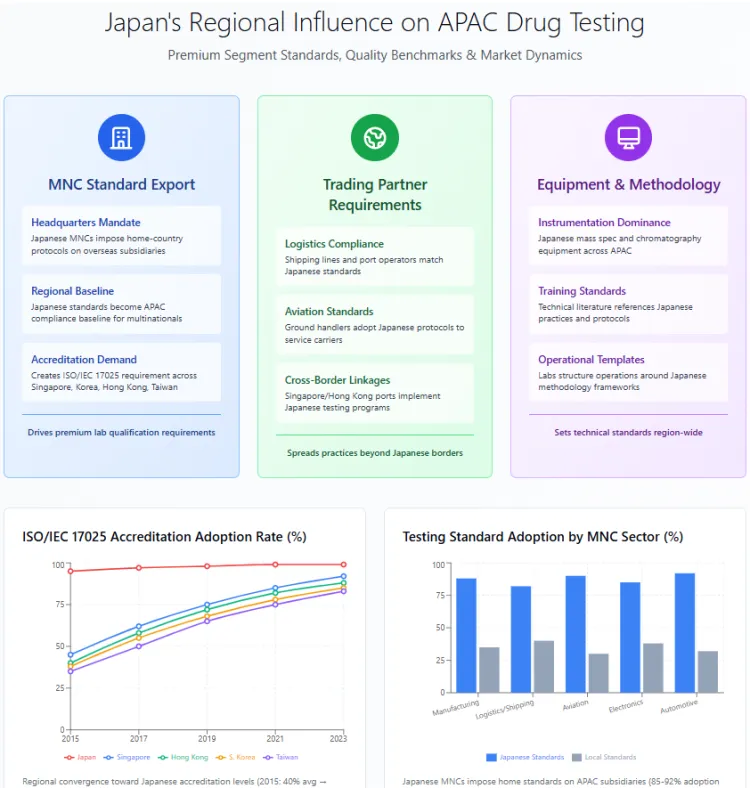
Japan establishes accreditation and quality benchmarks that neighboring economies reference. Multinational corporations operating across APAC adopt Japanese testing standards as regional baseline. Companies headquartered in Japan impose home-country protocols on overseas subsidiaries, exporting compliance expectations to other territories. This standardization creates demand for ISO/IEC 17025 accredited laboratories in Singapore, South Korea, Hong Kong and Taiwan. Regional testing providers pursue accreditation to qualify for contracts with Japanese multinational clients, elevating quality standards across APAC premium segments.
Trading partner requirements transmit Japanese expectations. Logistics companies, shipping lines and aviation partners operating between Japan and other APAC countries face Japanese regulatory scrutiny. Port operators in Singapore and Hong Kong implement testing programs matching Japanese standards to maintain business relationships. Aviation ground handlers throughout APAC adopt Japanese-style protocols to service Japanese carriers. These cross-border compliance linkages spread Japanese testing practices beyond national borders, creating regional demand for premium-tier services.
Japanese laboratory equipment and methodology set technical standards. Japanese manufacturers dominate analytical instrumentation supply across APAC. Laboratories throughout the region use Japanese mass spectrometry equipment, chromatography systems and quality control materials. Training programs and technical literature often reference Japanese standards and practices. This technological influence shapes how testing laboratories across APAC structure operations, pursue accreditation and position services. Japan's combination of strict compliance culture, advanced analytical capabilities and regional economic integration makes it reference point for premium testing segments throughout APAC, influencing pricing expectations and quality standards in multiple territories.
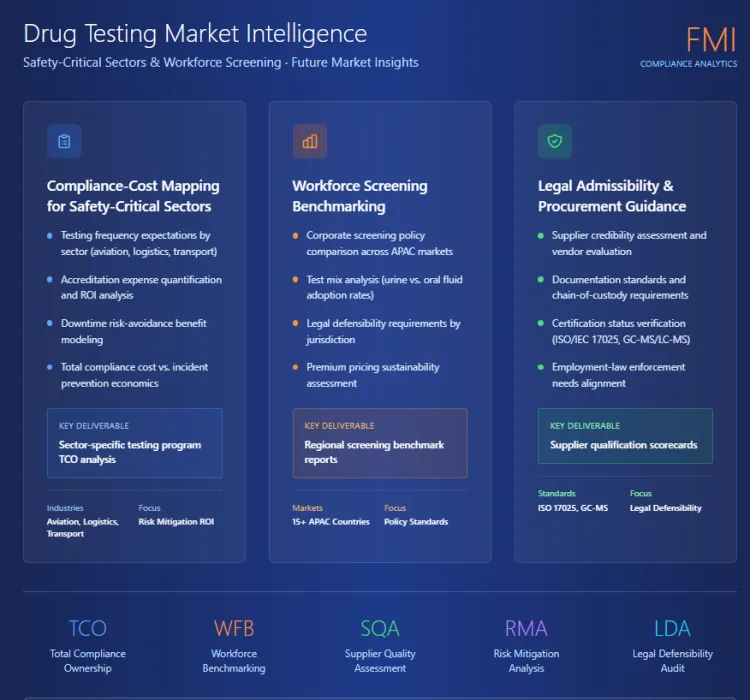
How can Future Market Insights support corporate and forensic testing strategies in Japan and APAC?
Sources
- Japan Ministry of Health, Labour and Welfare (mhlw.go.jp): Official regulations on workplace substance screening, employer compliance guidelines, and occupational health standards governing corporate drug testing programs.
- Civil Aviation Bureau and Ministry of Land, Infrastructure, Transport and Tourism (mlit.go.jp): Mandatory drug-testing rules for pilots, cabin crew, maintenance personnel, rail operators, and transport safety-critical roles with specific screening frequency requirements.
- ISO/IEC 17025 accreditation bodies and Japan Accreditation Board (jab.or.jp): Chain-of-custody protocols, laboratory accreditation standards, quality management requirements, and legal admissibility criteria for workplace drug testing.
- Japanese Society of Clinical Chemistry and forensic toxicology associations: Technical literature on confirmatory testing methodologies, analytical equipment standards, and best practices for legally defensible workplace screening programs.
- Nikkei Asia, Japan Times, and regional business publications: Coverage of aviation safety incidents, corporate governance trends, compliance audit requirements, and institutional drug testing adoption across Japanese industries.

