

- Industry Size (2026)
- USD 6.69 Bn
- Forecast (2036)
- USD 10.50 Bn
- CAGR (2026 to 2036)
- 4.6%
Employer and Workplace Drug Testing Market Size, Market Forecast and Outlook By FMI
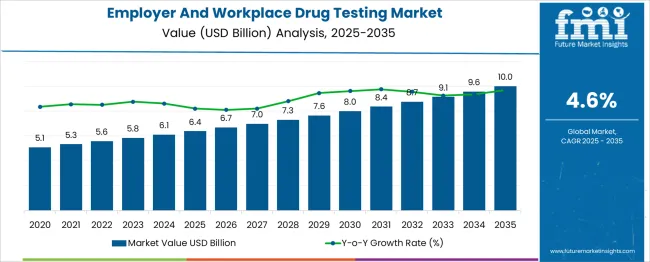
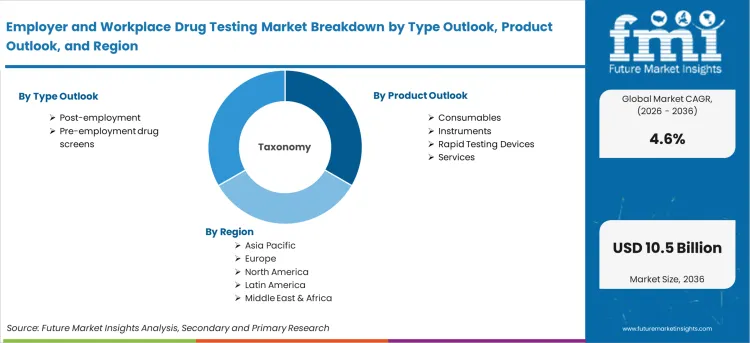
The employer and workplace drug testing market was valued at USD 6.40 billion in 2025, projected to reach USD 6.69 billion in 2026, and is forecast to expand to USD 10.50 billion by 2036 at a 4.6% CAGR. As per FMI, expanding workplace safety mandates across transportation, construction, and manufacturing sectors are sustaining recurring demand for both laboratory-based and point-of-care drug screening programmes. The regulatory baseline set by DOT-mandated testing in the United States, combined with growing adoption of workplace testing protocols in Europe and Asia Pacific, is converting drug screening from a pre-hire formality into a continuous workforce risk management function.
Summary of Employer and Workplace Drug Testing Market
- Market snapshot
- The employer and workplace drug testing market is valued at USD 6.40 billion in 2025 and is projected to reach USD 10.50 billion by 2036.
- The industry is expected to grow at a 4.6% CAGR from 2026 to 2036, creating an incremental opportunity of USD 3.81 billion.
- The market is a regulated compliance services category where occupational safety mandates, substance legalisation complexities, and specimen collection technology evolution define procurement patterns.
- Demand and growth drivers
- Demand is sustained by expanding workplace safety mandates requiring drug screening in transportation, construction, manufacturing, and mining sectors.
- Oral fluid and hair-based collection methods are gaining adoption as alternatives to urine panels, particularly in jurisdictions with specimen privacy restrictions.
- Cannabis legalisation has not reduced testing volumes but has increased demand for compliance advisory services that navigate conflicting federal and state frameworks.
- Among key countries, China leads at 6.2% CAGR, followed by India at 5.8%, Germany at 5.3%, France at 4.8%, the UK at 4.4%, the USA at 3.9%, and Brazil at 3.5%.
- Product and segment view
- The market comprises consumables (specimen cups, test strips, adulterant checks), analytical instruments, rapid testing devices, and laboratory and advisory services for workplace drug screening programmes.
- Testing modes include urine, hair, oral fluid, and instant testing, with applications spanning pre-employment screening and ongoing post-employment monitoring.
- Post-employment leads by Type Outlook with 77.8% share in 2026 as random, post-accident, and reasonable suspicion testing programmes generate recurring volumes beyond one-time pre-hire screens.
- Urine leads by Mode Outlook with 40.9% share in 2026, though oral fluid and hair testing are gaining share in jurisdictions with privacy-driven collection protocol changes.
- Scope includes drug testing consumables, devices, instruments, and services; excludes clinical diagnostic toxicology, forensic drug analysis, and drug rehabilitation programmes.
- Geography and competitive outlook
- China and India are the fastest-growing markets as workplace safety regulations expand mandatory testing to new industry sectors. The USA anchors the largest absolute market under federal DOT mandates.
- Competition is shaped by laboratory network coverage, rapid testing device accuracy, and compliance advisory depth across multi-jurisdictional testing programme design.
- Key players include First Advantage, Labcorp, Draegerwerk AG & Co. KGaA, Bio-Rad Laboratories Inc., Abbott, Clinical Reference Laboratory Inc., Quest Diagnostics, Cordant Health Solutions, DISA Global Solutions, HireRight LLC, OraSure Technologies Inc., Omega Laboratories, and Psychemedics Corporation.
- Analyst opinion at FMI
- Sabyasachi Ghosh, Principal Consultant for Healthcare observe that: 'Based on FMI's report, employer drug testing programmes are evolving from binary pass/fail pre-hire gates into continuous workforce risk monitoring platforms. Employers that limit screening to the onboarding stage miss the post-accident and reasonable suspicion testing volumes that now constitute the majority of programme spend. Service providers without oral fluid collection capabilities face exclusion from construction and logistics contracts where observed urine collection protocols create site-level operational delays. Laboratories that have not developed cannabis-specific quantitative interpretation frameworks risk losing federal contractor accounts where THC threshold compliance requires defensible chain-of-custody documentation.'
- Strategic implications / Executive takeaways
- Occupational health directors must expand testing programmes beyond pre-employment to include random, post-accident, and return-to-duty protocols to meet updated insurer and contractor compliance requirements.
- Laboratory service providers should invest in oral fluid and hair analysis capabilities to capture share from urine-dominant programmes transitioning under privacy regulation pressure.
- Compliance advisory teams must develop jurisdiction-specific cannabis interpretation frameworks that reconcile state legalisation with federal workplace safety mandates for multi-state employer clients.
Employer and Workplace Drug Testing Market key takeaways
| Metric | Details |
|---|---|
| Industry Size (2026) | USD 6.69 billion |
| Industry Value (2036) | USD 10.50 billion |
| CAGR (2026 to 2036) | 4.6% |
Source: Future Market Insights, 2026
The testing mode landscape is shifting as oral fluid and hair-based specimen collection gain adoption over traditional urine panels in jurisdictions where observed collection protocols face privacy objections. FMI analysts note that rapid testing device accuracy has reached laboratory-comparable sensitivity for primary drug classes, enabling on-site screening at construction sites, logistics hubs, and remote work locations where specimen transport to centralised laboratories creates unacceptable turnaround delays. Cannabis legalisation across multiple US states and Canada has not reduced employer testing volumes; instead, it has complicated panel interpretation frameworks and increased demand for consultancy services that help employers navigate conflicting federal and state compliance requirements.
China leads with a 6.2% CAGR through 2036 as industrial workplace safety regulations expand mandatory testing coverage to hazardous occupation categories. India follows at 5.8%, driven by IT services and manufacturing sector adoption of pre-employment screening standards aligned with multinational client requirements. Germany registers a 5.3% pace as occupational health regulations in transportation and heavy industry tighten. France expands at 4.8% on the back of updated code du travail provisions for safety-critical roles. The United Kingdom maintains a 4.4% trajectory as construction and logistics operators adopt contractor drug screening requirements. The United States tracks at 3.9%, reflecting mature federal mandate coverage with incremental growth from oral fluid panel adoption. Brazil records a 3.5% expansion as mining and energy sector employers formalise workforce testing programmes.
Employer and Workplace Drug Testing Market definition
Employer and workplace drug testing encompasses the consumables, instruments, rapid testing devices, and professional services used by employers to screen current and prospective employees for substance use. Testing programmes operate under regulatory mandates (DOT, OSHA, sector-specific rules) and voluntary employer policies, covering specimen collection, laboratory analysis, medical review officer interpretation, and compliance programme management across safety-sensitive and general workforce populations.
Employer and Workplace Drug Testing Market inclusions
Market scope includes specimen collection consumables, immunoassay and chromatography instruments, point-of-care rapid testing devices, laboratory analysis services, and programme management advisory services. The report covers global and regional market sizes for the forecast period 2026 to 2036, with segment breakdowns by type, product, testing mode, drug class, and end-use industry.
Employer and Workplace Drug Testing Market exclusions
The scope excludes clinical diagnostic toxicology performed for medical treatment, forensic drug analysis for law enforcement, drug rehabilitation and treatment programme services, and alcohol breath testing devices used exclusively for traffic enforcement rather than workplace programmes.
Employer and Workplace Drug Testing Market research methodology
- Primary research:Analysts engaged with corporate occupational health programme managers, third-party administrator (TPA) executives, and laboratory operations directors to map testing volume drivers and procurement decision cycles.
- Desk research:Data collection aggregated DOT testing rule updates, SAMHSA oral fluid guidelines, EU occupational safety directives, and published laboratory network capacity disclosures.
- Market sizing and forecasting:Baseline values derive from a bottom-up aggregation of employer testing programme volumes by industry, applying regulatory mandate expansion schedules and oral fluid adoption penetration curves.
- Data validation and update cycle:Projections are cross-validated against published revenue guidance from listed laboratory services companies and rapid testing device manufacturers.
Why is the Employer and Workplace Drug Testing Market is Growing?
Market expansion is being supported by the increasing workplace safety regulations across industries and the corresponding need for comprehensive drug testing programs to maintain safe working environments. Companies across sectors require systematic testing protocols to comply with occupational safety standards and reduce liability risks associated with substance abuse in the workplace.
The growing complexity of substance abuse patterns and increasing regulatory scrutiny are driving demand for advanced testing technologies that can detect multiple drug types and provide accurate results within required timeframes. Employers are investing in comprehensive testing programs to reduce workplace accidents, improve productivity, and ensure regulatory compliance across multiple jurisdictions while maintaining employee safety standards.
Segmental Analysis
The market is segmented by type outlook, product outlook, mode outlook, drug outlook, end use outlook, and region. By type outlook, the market is divided into post-employment and pre-employment drug screens. Based on product outlook, the market is categorized into consumables, instruments, rapid testing devices, and services. In terms of mode outlook, the market is segmented into urine, hair, oral fluid, and instant testing. By drug outlook, the market is classified into cannabis/marijuana, alcohol, cocaine, opioids, amphetamine & methamphetamine, LSD, and others. Based on end use outlook, the market is divided into other professional services, manufacturing, transportation, construction, retail and hospitality, healthcare, education, and IT/finance. Regionally, the market is divided into China, India, Germany, France, UK, US, and Brazil.
By Type Outlook, Post-employment Segment Accounts for 78% Market Share
Post-employment testing is projected to account for 78% of the Employer and Workplace Drug Testing market in 2025. This leading share is supported by the widespread adoption of ongoing workplace monitoring programs that ensure continued compliance with drug-free workplace policies. Post-employment testing provides continuous oversight of employee substance use patterns while maintaining workplace safety standards across various industries. The segment benefits from established testing protocols and comprehensive service networks that support regular monitoring requirements.
By Mode Outlook, Urine Testing Segment Accounts for 41% Market Share
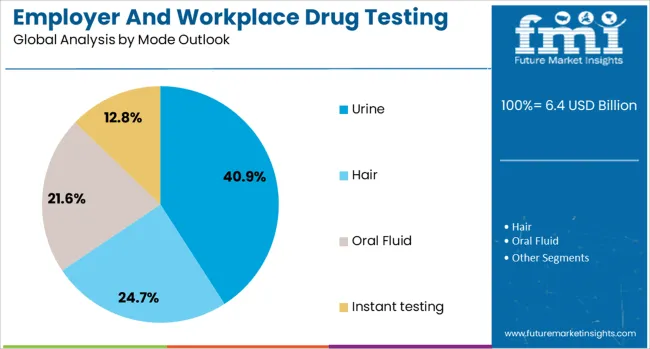
Urine testing is expected to represent 41% of drug testing mode demand in 2025. This dominant share reflects the widespread acceptance of urine analysis as the gold standard for workplace drug testing due to its accuracy, reliability, and comprehensive drug detection capabilities. Urine testing provides effective detection of recent drug use across multiple substance categories while offering cost-effective implementation for employers. The segment benefits from established collection procedures and standardized laboratory analysis protocols that ensure consistent results.
By Product Outlook, Consumables Segment Accounts for 33% Market Share
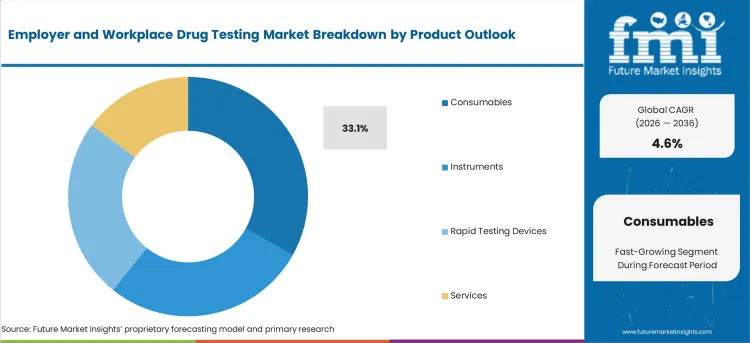
Consumables are projected to contribute 33% of the market in 2025, representing the ongoing materials and supplies required for drug testing operations. This segment includes testing kits, collection containers, reagents, and other disposable materials essential for testing procedures. Consumables provide recurring revenue streams for suppliers while ensuring consistent testing quality and compliance with regulatory standards. The segment benefits from continuous demand driven by regular testing requirements across various workplace environments.
By Drug Outlook, Cannabis/Marijuana Segment Accounts for 58% Market Share
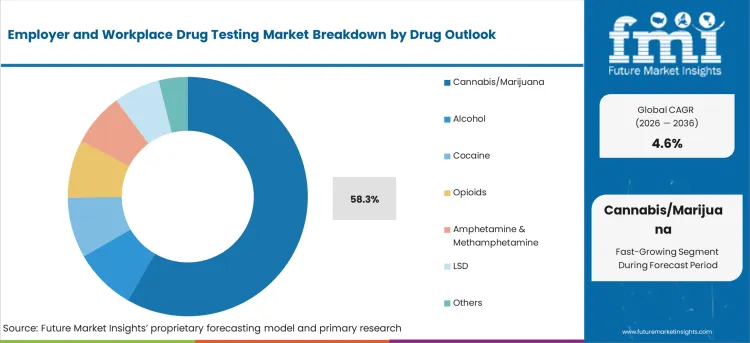
Cannabis/marijuana testing is estimated to hold 58% of the drug-specific testing market share in 2025. This dominance reflects the widespread focus on marijuana detection in workplace testing programs despite changing legal landscapes in various jurisdictions. Employers continue to maintain cannabis testing requirements due to workplace safety concerns and federal regulatory obligations. The segment provides comprehensive detection capabilities for both recent use and longer-term consumption patterns.
By End Use Outlook, Other Professional Services Segment Accounts for 38% Market Share
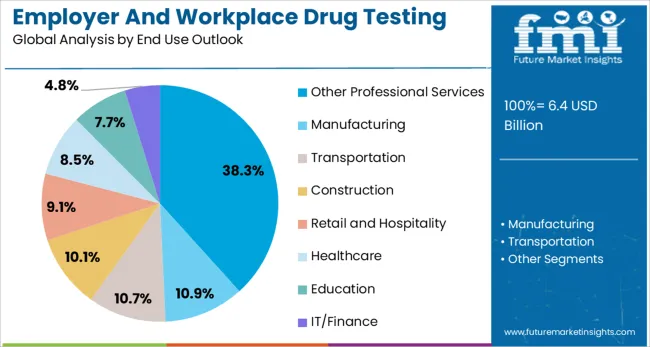
Other professional services are expected to represent 38% of end-use demand in 2025. This segment encompasses diverse professional industries that require drug testing for safety, security, and regulatory compliance purposes. Professional service organizations implement testing programs to maintain workplace standards while meeting client requirements and industry regulations. The segment benefits from growing awareness of substance abuse impacts on professional performance and liability concerns across service industries.
What are the Drivers, Restraints, and Key Trends of the Employer and Workplace Drug Testing Market?
The employer and workplace drug testing market is advancing steadily due to increasing workplace safety awareness and growing recognition of substance abuse impacts on productivity and safety. The market faces challenges, including privacy concerns, legal complexities regarding testing policies, and varying regulatory requirements across different jurisdictions. Technological advancement and standardization efforts continue to influence testing accuracy and market development patterns.
Integration of Rapid Testing Technologies
The growing deployment of rapid testing systems is enabling immediate results for workplace testing programs while reducing administrative delays and improving decision-making capabilities. Point-of-care testing devices provide instant screening results that allow employers to make timely personnel decisions while maintaining testing accuracy standards. These technologies are particularly valuable for transportation, construction, and manufacturing industries that require immediate safety assessments.
Development of Comprehensive Substance Monitoring Programs
Modern testing providers are incorporating advanced analytical capabilities that detect emerging drug threats and synthetic substances while providing comprehensive substance abuse monitoring. Integration of multiple testing methodologies and expanded drug panels enables complete substance abuse detection across traditional and emerging drug categories. Advanced programs also support employee assistance initiatives and rehabilitation monitoring services.
Analysis of Employer and Workplace Drug Testing Market by Key Country
.webp "Top Country Growth Comparison Employer And Workplace Drug Testing Market Cagr (2026 2036)")
| Countries | CAGR (2026-2036) |
|---|---|
| China | 6.2% |
| India | 5.8% |
| Germany | 5.3% |
| France | 4.8% |
| United Kingdom | 4.4% |
| United States | 3.9% |
| Brazil | 3.5% |
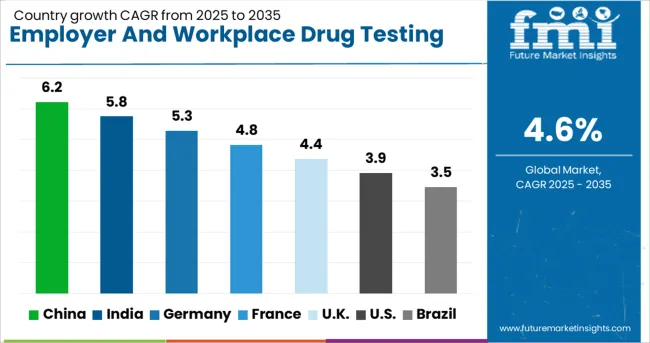
The global market is expected to grow at a CAGR of 4.6% between 2026 and 2036, reflecting increasing regulatory compliance and workplace safety requirements. China leads with 6.2% growth, supported by expanding industrial workforce and stricter government regulations on employee testing. India follows at 5.8%, driven by growing awareness among employers and rising adoption of workplace safety protocols. Germany records 5.3%, reflecting focus on regulatory compliance and advanced testing technologies. France is projected at 4.8%, supported by government-mandated drug testing programs and workplace monitoring initiatives. The United Kingdom grows at 4.4% with increasing corporate adoption of employee testing solutions, while the USA expands at 3.9%, influenced by established safety standards and routine screening practices. Brazil shows 3.5%, reflecting gradual adoption of workplace testing regulations.
Market Potential of Employer and Workplace Drug Testing in China
China is forecasted to register the highest CAGR of 6.2% between 2026 and 2036, driven by growing corporate compliance requirements and industrial safety regulations. Large manufacturing, construction, and logistics firms have increasingly adopted pre-employment and random drug testing programs. Government campaigns focusing occupational safety have accelerated testing in high-risk sectors. Local testing laboratories and service providers have expanded capacity to meet rising corporate demand. Integration of technology in testing workflows, including digital record keeping and faster sample processing, has contributed to operational efficiency. Multinational corporations operating in China have been adopting global compliance standards, increasing market penetration. Despite a moderate regulatory framework compared with Western markets, testing adoption is expected to rise steadily over the forecast period.
- Industrial sector compliance programs increased corporate testing adoption by 2024
- Multinationals implemented standardized drug testing policies across China
- Local labs expanded capacity for pre-employment and random testing services
Market Expansion of Employer and Workplace Drug Testing in India
India is expected to grow at a CAGR of 5.8% from 2026 to 2036, with adoption influenced by rapid industrialization and corporate safety initiatives. Testing programs have been increasingly implemented in manufacturing, logistics, and IT sectors to mitigate operational risks. Both pre-employment and periodic employee testing are being employed by leading companies to ensure workplace safety. Laboratory infrastructure is being scaled to support rising demand, with private service providers playing a key role in expanding market reach. Awareness campaigns on drug-free workplaces have encouraged adoption among mid-sized and large corporations. With compliance enforcement gradually improving, India’s market is positioned for steady growth over the forecast period.
- Pre-employment and random testing increased in manufacturing and logistics sectors
- Private laboratories expanded service coverage nationwide
- Awareness campaigns by industry associations promoted drug-free workplace initiatives
Market Analysis of Employer and Workplace Drug Testing in Germany
Germany is projected to grow at a CAGR of 5.3% during 2026-2036, supported by strict labor regulations and a strong focus on workplace safety. Large industrial, logistics, and transportation companies have implemented drug testing protocols to ensure compliance and reduce accidents. Testing methods include urine, saliva, and hair sample analysis, with focus on accuracy and traceability. Technological adoption in lab automation and digital reporting has increased efficiency. Market growth has been influenced by a culture of employee safety and regulatory compliance rather than mandatory legislation for all sectors. Laboratory service providers and specialized testing firms continue to compete on service speed, accuracy, and coverage.
- Industrial and logistics sectors implemented comprehensive drug testing programs
- Hair and saliva testing gained preference for long-term substance detection
- Lab automation increased efficiency and accuracy of test results
Future Prospects of Employer and Workplace Drug Testing Market in France
France is expected to expand at a CAGR of 4.8% between 2026 and 2036, shaped by labor safety laws and growing awareness of workplace productivity risks. Pre-employment testing and periodic screening have been gradually adopted in industrial and transportation sectors. While strict privacy regulations limit widespread testing, companies in high-risk operations have maintained regular monitoring programs. Laboratory services and point-of-care testing are being deployed to ensure compliance and fast results. Multinational firms operating in France have contributed to market development by introducing standardized global drug testing protocols. Corporate focus on employee well-being, risk mitigation, and legal liability continues to drive adoption in selected sectors.
- Pre-employment testing was implemented by industrial and transport companies
- Privacy regulations influenced testing frequency and reporting practices
- Multinational firms introduced global compliance standards
Adoption of Employer and Workplace Drug Testing Market in the United Kingdom
The United Kingdom is forecasted to grow at a CAGR of 4.4% during 2026-2036, influenced by health and safety legislation and corporate compliance programs. Companies in transportation, construction, and manufacturing sectors have adopted drug testing to reduce workplace incidents and maintain regulatory compliance. Testing services include urine, hair, and oral fluid analysis, supported by accredited laboratories. Digital reporting and automated result systems have been increasingly deployed for efficiency. The market is shaped by private service providers offering rapid testing solutions and multinational corporations enforcing global policies. Adoption has been gradual due to privacy concerns and voluntary corporate compliance frameworks.
- Industrial and construction sectors increased drug testing adoption
- Hair and oral fluid testing preferred for workplace compliance
- Digital reporting enhanced efficiency in large scale testing programs
Growth Outlook of Employer and Workplace Drug Testing Market in the United States
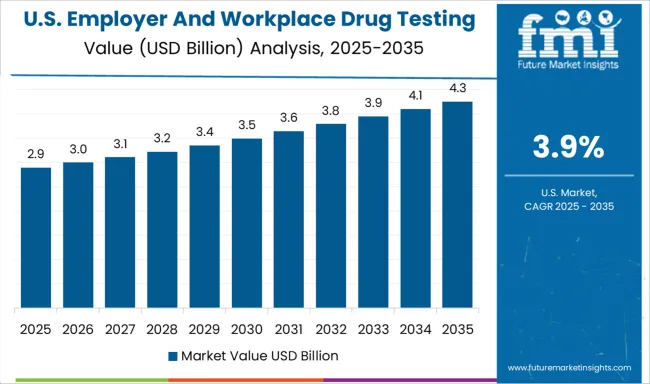
The market in the United States is projected to grow at a CAGR of 3.9% between 2026 and 2036, supported by federal and state regulations governing workplace safety. Testing adoption has been driven by occupational safety standards, transportation industry compliance, and employee wellness initiatives. Companies have increasingly implemented both pre-employment and random drug testing programs to reduce liability and enhance productivity. Laboratory services and point-of-care testing have been leveraged to provide rapid and accurate results. The competitive landscape has been shaped by firms such as Laboratory Corporation of America and Quest Diagnostics, offering integrated testing solutions. While market growth is moderate due to regulatory saturation, technological adoption in testing methods and automation has supported efficiency improvements across sectors.
- Over 70% of USA employers conducted some form of workplace drug testing in 2024
- Point-of-care testing adoption increased by 15% in corporate settings
- LabCorp and Quest Diagnostics dominated large-scale testing services
Growth Assessment of Employer and Workplace Drug Testing Market in Brazil
Brazil is expected to grow at a CAGR of 3.5% between 2026 and 2036, with adoption concentrated in industrial, logistics, and mining sectors. Drug testing has been implemented primarily as part of safety management programs to reduce workplace accidents. Private laboratories provide both on-site and centralized testing solutions, while multinational corporations have introduced standardized drug-free policies across subsidiaries. Regulatory oversight is moderate, with testing primarily guided by sector-specific safety standards rather than nationwide legislation. Market growth is moderate but steady, supported by increased awareness of employee safety and corporate risk management.
- Industrial and mining sectors prioritized drug-free workplace programs
- Private laboratories expanded regional testing services
- Multinational companies enforced global compliance standards
Europe Market Split by Country
Europe’s market is led by Germany, which commands the largest revenue share due to strict regulations and extensive implementation across industries, supporting robust market growth and technological advancements in testing. The UK registers the fastest CAGR, propelled by rising workplace safety awareness and strong adoption of drug screening policies, particularly in safety-critical sectors. France sees expanding adoption driven by increasing concern over workplace productivity and public safety, with particular focus in sectors such as transportation and heavy industry. Southern European, Eastern European, and Nordic countries demonstrate rising uptake as regulatory measures and workplace safety focus strengthen across the region.
Competitive Landscape of Employer and Workplace Drug Testing Market
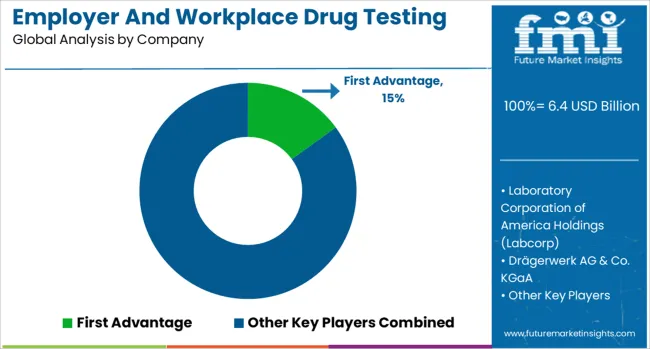
The market has been shaped by global diagnostics leaders and specialized testing providers, competing on accuracy, speed, and compliance.
First Advantage, Labcorp, Quest Diagnostics, and Abbott have focused on high-throughput laboratory testing, leveraging advanced immunoassay and chromatography technologies to ensure reliable detection of substances. Their strategies focus on regulatory compliance, fast turnaround times, and integration with employer health programs. Drägerwerk AG, Bio-Rad Laboratories, and OraSure Technologies have concentrated on on-site and point-of-collection testing, providing portable solutions and oral fluid or hair-based analyses for immediate screening results.
Regional and niche players including Clinical Reference Laboratory, Cordant Health Solutions, DISA Global Solutions, HireRight, Omega Laboratories, and Psychemedics Corporation have differentiated through specialized services such as forensic-grade testing, tailored employee screening programs, and long-term monitoring. Product brochures highlight sensitivity, specificity, and multi-panel testing capabilities. Focus is placed on accuracy, tamper-proof collection methods, and compliance with federal and state workplace safety regulations. Quest Diagnostics and Labcorp emphasize laboratory scalability, while Drägerwerk and OraSure showcase portable, user-friendly testing devices suitable for diverse workplace environments.
Key Players in the Employer and Workplace Drug Testing Market
- First Advantage
- Laboratory Corporation of America Holdings (Labcorp)
- Drägerwerk AG & Co. KGaA
- Bio-Rad Laboratories Inc.
- Abbott
- Clinical Reference Laboratory Inc.
- Quest Diagnostics
- Cordant Health Solutions
- DISA Global Solutions
- HireRight LLC
- OraSure Technologies Inc.
- Omega Laboratories
- Psychemedics Corporation
Scope of the report
| Metric | Value |
|---|---|
| Quantitative Units | USD 6.69 billion to USD 10.50 billion, at a CAGR of 4.6% |
| Market Definition | Employer and workplace drug testing covers consumables, instruments, rapid devices, and services for screening employees and candidates for substance use under regulatory mandates and voluntary employer policies. |
| Type Outlook Segmentation | Post-employment, Pre-employment Drug Screens |
| Product Outlook Segmentation | Consumables, Instruments, Rapid Testing Devices, Services |
| Mode Outlook Segmentation | Urine, Hair, Oral Fluid, Instant Testing |
| Drug Outlook Segmentation | Cannabis/Marijuana, Alcohol, Cocaine, Opioids, Amphetamine & Methamphetamine, LSD, Others |
| End Use Outlook Segmentation | Other Professional Services, Manufacturing, Transportation, Construction, Retail and Hospitality, Healthcare, Education, IT/Finance |
| Regions Covered | North America, Latin America, Europe, East Asia, South Asia, Oceania, Middle East & Africa |
| Countries Covered | China, India, Germany, France, UK, USA, Brazil, and 40 plus countries |
| Key Companies Profiled | First Advantage, Labcorp, Draegerwerk AG & Co. KGaA, Bio-Rad Laboratories Inc., Abbott, Clinical Reference Laboratory Inc., Quest Diagnostics, Cordant Health Solutions, DISA Global Solutions, HireRight LLC, OraSure Technologies Inc., Omega Laboratories, Psychemedics Corporation |
| Forecast Period | 2026 to 2036 |
| Approach | Forecasting models apply a bottom-up methodology starting with employer testing programme volumes by industry vertical, projecting regulatory mandate expansion and oral fluid adoption rates. |
Employer and Workplace Drug Testing Market by Segments
Type Outlook:
- Post-employment
- Pre-employment drug screens
Product Outlook:
- Consumables
- Instruments
- Rapid Testing Devices
- Services
Mode Outlook:
- Urine
- Hair
- Oral Fluid
- Instant testing
Drug Outlook:
- Cannabis/Marijuana
- Alcohol
- Cocaine
- Opioids
- Amphetamine & Methamphetamine
- LSD
- Others
End Use Outlook:
- Other Professional Services
- Manufacturing
- Transportation
- Construction
- Retail and Hospitality
- Healthcare
- Education
- IT/Finance
Region:
- North America
- United States
- Canada
- Mexico
- Europe
- Germany
- United Kingdom
- France
- Italy
- Spain
- Nordic
- BENELUX
- Rest of Europe
- Asia Pacific
- China
- Japan
- South Korea
- India
- ASEAN
- Australia & New Zealand
- Rest of Asia Pacific
- Latin America
- Brazil
- Chile
- Rest of Latin America
- Middle East & Africa
- Kingdom of Saudi Arabia
- Other GCC Countries
- Turkey
- South Africa
- Other African Union
- Rest of Middle East & Africa
Bibliography
- 1. Substance Abuse and Mental Health Services Administration. (2024). Mandatory guidelines for federal workplace drug testing programs: Oral fluid update. SAMHSA.
- 2. United States Department of Transportation. (2024). 49 CFR Part 40: Procedures for transportation workplace drug and alcohol testing. DOT.
- 3. International Labour Organization. (2024). Workplace substance use policies: A global review. ILO.
- 4. European Agency for Safety and Health at Work. (2024). Managing substance-related risks in the workplace. EU-OSHA.
- 5. World Health Organization. (2024). Global status report on alcohol and health. WHO.
- 6. Organisation for Economic Co-operation and Development. (2024). Health at a Glance 2024: OECD indicators. OECD Publishing.
This bibliography is provided for reader reference. The full Future Market Insights report contains the complete reference list with primary research documentation.
Frequently Asked Questions
How large is the demand for employer and workplace drug testing in the global market in 2026?
Demand for employer and workplace drug testing in the global market is estimated to be valued at USD 6.69 billion in 2026.
What will be the market size of employer and workplace drug testing by 2036?
Market size for employer and workplace drug testing is projected to reach USD 10.50 billion by 2036.
What is the expected demand growth between 2026 and 2036?
Demand for employer and workplace drug testing is expected to grow at a CAGR of 4.6% between 2026 and 2036.
Which Type Outlook is poised to lead global sales by 2026?
Post-employment accounts for 77.8% in 2026 as random, post-accident, and reasonable suspicion testing programmes generate recurring volumes that surpass one-time pre-hire screening.
Which Mode Outlook leads in 2026?
Urine accounts for 40.9% of Mode share in 2026, though oral fluid and hair testing are gaining ground in jurisdictions adopting privacy-driven collection protocol changes.
What is driving demand in China?
Industrial workplace safety regulations are expanding mandatory drug testing coverage to hazardous occupation categories across manufacturing, transportation, and mining sectors.
What is India's growth outlook in this report?
India is projected to grow at a CAGR of 5.8% during 2026 to 2036, driven by IT services and manufacturing sector adoption of pre-employment screening aligned with multinational client compliance requirements.
What is included in the scope of this report?
The scope covers drug testing consumables, instruments, rapid devices, and services for employer programmes; excludes clinical toxicology, forensic drug analysis, and drug rehabilitation services.
Preview the report firsthand - request a free sample
Get SampleGet the brochure for pricing and purchase details.
Get PDFTable of Content
- Executive Summary
- Global Market Outlook
- Demand-side Trends
- Supply-side Trends
- Technology Roadmap Analysis
- Analysis and Recommendations
- Market Overview
- Market Coverage / Taxonomy
- Market Definition / Scope / Limitations
- Research Methodology
- Chapter Orientation
- Analytical Lens and Working Hypotheses
- Market Structure, Signals, and Trend Drivers
- Benchmarking and Cross-market Comparability
- Market Sizing, Forecasting, and Opportunity Mapping
- Research Design and Evidence Framework
- Desk Research Programme (Secondary Evidence)
- Company Annual and Sustainability Reports
- Peer-reviewed Journals and Academic Literature
- Corporate Websites, Product Literature, and Technical Notes
- Earnings Decks and Investor Briefings
- Statutory Filings and Regulatory Disclosures
- Technical White Papers and Standards Notes
- Trade Journals, Industry Magazines, and Analyst Briefs
- Conference Proceedings, Webinars, and Seminar Materials
- Government Statistics Portals and Public Data Releases
- Press Releases and Reputable Media Coverage
- Specialist Newsletters and Curated Briefings
- Sector Databases and Reference Repositories
- FMI Internal Proprietary Databases and Historical Market Datasets
- Subscription Datasets and Paid Sources
- Social Channels, Communities, and Digital Listening Inputs
- Additional Desk Sources
- Expert Input and Fieldwork (Primary Evidence)
- Primary Modes
- Qualitative Interviews and Expert Elicitation
- Quantitative Surveys and Structured Data Capture
- Blended Approach
- Why Primary Evidence is Used
- Field Techniques
- Interviews
- Surveys
- Focus Groups
- Observational and In-context Research
- Social and Community Interactions
- Stakeholder Universe Engaged
- C-suite Leaders
- Board Members
- Presidents and Vice Presidents
- R&D and Innovation Heads
- Technical Specialists
- Domain Subject-matter Experts
- Scientists
- Physicians and Other Healthcare Professionals
- Governance, Ethics, and Data Stewardship
- Research Ethics
- Data Integrity and Handling
- Primary Modes
- Tooling, Models, and Reference Databases
- Desk Research Programme (Secondary Evidence)
- Data Engineering and Model Build
- Data Acquisition and Ingestion
- Cleaning, Normalisation, and Verification
- Synthesis, Triangulation, and Analysis
- Quality Assurance and Audit Trail
- Market Background
- Market Dynamics
- Drivers
- Restraints
- Opportunity
- Trends
- Scenario Forecast
- Demand in Optimistic Scenario
- Demand in Likely Scenario
- Demand in Conservative Scenario
- Opportunity Map Analysis
- Product Life Cycle Analysis
- Supply Chain Analysis
- Investment Feasibility Matrix
- Value Chain Analysis
- PESTLE and Porter’s Analysis
- Regulatory Landscape
- Regional Parent Market Outlook
- Production and Consumption Statistics
- Import and Export Statistics
- Market Dynamics
- Global Market Analysis 2021 to 2025 and Forecast, 2026 to 2036
- Historical Market Size Value (USD Million) Analysis, 2021 to 2025
- Current and Future Market Size Value (USD Million) Projections, 2026 to 2036
- Y-o-Y Growth Trend Analysis
- Absolute $ Opportunity Analysis
- Global Market Pricing Analysis 2021 to 2025 and Forecast 2026 to 2036
- Global Market Analysis 2021 to 2025 and Forecast 2026 to 2036, By Type Outlook
- Introduction / Key Findings
- Historical Market Size Value (USD Million) Analysis By Type Outlook , 2021 to 2025
- Current and Future Market Size Value (USD Million) Analysis and Forecast By Type Outlook , 2026 to 2036
- Post-employment
- Pre-employment drug screens
- Post-employment
- Y-o-Y Growth Trend Analysis By Type Outlook , 2021 to 2025
- Absolute $ Opportunity Analysis By Type Outlook , 2026 to 2036
- Global Market Analysis 2021 to 2025 and Forecast 2026 to 2036, By Product Outlook
- Introduction / Key Findings
- Historical Market Size Value (USD Million) Analysis By Product Outlook, 2021 to 2025
- Current and Future Market Size Value (USD Million) Analysis and Forecast By Product Outlook, 2026 to 2036
- Consumables
- Instruments
- Rapid Testing Devices
- Services
- Consumables
- Y-o-Y Growth Trend Analysis By Product Outlook, 2021 to 2025
- Absolute $ Opportunity Analysis By Product Outlook, 2026 to 2036
- Global Market Analysis 2021 to 2025 and Forecast 2026 to 2036, By Mode Outlook
- Introduction / Key Findings
- Historical Market Size Value (USD Million) Analysis By Mode Outlook, 2021 to 2025
- Current and Future Market Size Value (USD Million) Analysis and Forecast By Mode Outlook, 2026 to 2036
- Urine
- Hair
- Oral Fluid
- Instant testing
- Urine
- Y-o-Y Growth Trend Analysis By Mode Outlook, 2021 to 2025
- Absolute $ Opportunity Analysis By Mode Outlook, 2026 to 2036
- Global Market Analysis 2021 to 2025 and Forecast 2026 to 2036, By Drug Outlook
- Introduction / Key Findings
- Historical Market Size Value (USD Million) Analysis By Drug Outlook, 2021 to 2025
- Current and Future Market Size Value (USD Million) Analysis and Forecast By Drug Outlook, 2026 to 2036
- Cannabis/Marijuana
- Alcohol
- Cocaine
- Opioids
- Amphetamine & Methamphetamine
- LSD
- Others
- Cannabis/Marijuana
- Y-o-Y Growth Trend Analysis By Drug Outlook, 2021 to 2025
- Absolute $ Opportunity Analysis By Drug Outlook, 2026 to 2036
- Global Market Analysis 2021 to 2025 and Forecast 2026 to 2036, By End Use Outlook
- Introduction / Key Findings
- Historical Market Size Value (USD Million) Analysis By End Use Outlook, 2021 to 2025
- Current and Future Market Size Value (USD Million) Analysis and Forecast By End Use Outlook, 2026 to 2036
- Other Professional Services
- Manufacturing
- Transportation
- Construction
- Retail and Hospitality
- Healthcare
- Education
- IT/Finance
- Other Professional Services
- Y-o-Y Growth Trend Analysis By End Use Outlook, 2021 to 2025
- Absolute $ Opportunity Analysis By End Use Outlook, 2026 to 2036
- Global Market Analysis 2021 to 2025 and Forecast 2026 to 2036, By Region
- Introduction
- Historical Market Size Value (USD Million) Analysis By Region, 2021 to 2025
- Current Market Size Value (USD Million) Analysis and Forecast By Region, 2026 to 2036
- North America
- Latin America
- Western Europe
- Eastern Europe
- East Asia
- South Asia and Pacific
- Middle East & Africa
- Market Attractiveness Analysis By Region
- North America Market Analysis 2021 to 2025 and Forecast 2026 to 2036, By Country
- Historical Market Size Value (USD Million) Trend Analysis By Market Taxonomy, 2021 to 2025
- Market Size Value (USD Million) Forecast By Market Taxonomy, 2026 to 2036
- By Country
- USA
- Canada
- Mexico
- By Type Outlook
- By Product Outlook
- By Mode Outlook
- By Drug Outlook
- By End Use Outlook
- By Country
- Market Attractiveness Analysis
- By Country
- By Type Outlook
- By Product Outlook
- By Mode Outlook
- By Drug Outlook
- By End Use Outlook
- Key Takeaways
- Latin America Market Analysis 2021 to 2025 and Forecast 2026 to 2036, By Country
- Historical Market Size Value (USD Million) Trend Analysis By Market Taxonomy, 2021 to 2025
- Market Size Value (USD Million) Forecast By Market Taxonomy, 2026 to 2036
- By Country
- Brazil
- Chile
- Rest of Latin America
- By Type Outlook
- By Product Outlook
- By Mode Outlook
- By Drug Outlook
- By End Use Outlook
- By Country
- Market Attractiveness Analysis
- By Country
- By Type Outlook
- By Product Outlook
- By Mode Outlook
- By Drug Outlook
- By End Use Outlook
- Key Takeaways
- Western Europe Market Analysis 2021 to 2025 and Forecast 2026 to 2036, By Country
- Historical Market Size Value (USD Million) Trend Analysis By Market Taxonomy, 2021 to 2025
- Market Size Value (USD Million) Forecast By Market Taxonomy, 2026 to 2036
- By Country
- Germany
- UK
- Italy
- Spain
- France
- Nordic
- BENELUX
- Rest of Western Europe
- By Type Outlook
- By Product Outlook
- By Mode Outlook
- By Drug Outlook
- By End Use Outlook
- By Country
- Market Attractiveness Analysis
- By Country
- By Type Outlook
- By Product Outlook
- By Mode Outlook
- By Drug Outlook
- By End Use Outlook
- Key Takeaways
- Eastern Europe Market Analysis 2021 to 2025 and Forecast 2026 to 2036, By Country
- Historical Market Size Value (USD Million) Trend Analysis By Market Taxonomy, 2021 to 2025
- Market Size Value (USD Million) Forecast By Market Taxonomy, 2026 to 2036
- By Country
- Russia
- Poland
- Hungary
- Balkan & Baltic
- Rest of Eastern Europe
- By Type Outlook
- By Product Outlook
- By Mode Outlook
- By Drug Outlook
- By End Use Outlook
- By Country
- Market Attractiveness Analysis
- By Country
- By Type Outlook
- By Product Outlook
- By Mode Outlook
- By Drug Outlook
- By End Use Outlook
- Key Takeaways
- East Asia Market Analysis 2021 to 2025 and Forecast 2026 to 2036, By Country
- Historical Market Size Value (USD Million) Trend Analysis By Market Taxonomy, 2021 to 2025
- Market Size Value (USD Million) Forecast By Market Taxonomy, 2026 to 2036
- By Country
- China
- Japan
- South Korea
- By Type Outlook
- By Product Outlook
- By Mode Outlook
- By Drug Outlook
- By End Use Outlook
- By Country
- Market Attractiveness Analysis
- By Country
- By Type Outlook
- By Product Outlook
- By Mode Outlook
- By Drug Outlook
- By End Use Outlook
- Key Takeaways
- South Asia and Pacific Market Analysis 2021 to 2025 and Forecast 2026 to 2036, By Country
- Historical Market Size Value (USD Million) Trend Analysis By Market Taxonomy, 2021 to 2025
- Market Size Value (USD Million) Forecast By Market Taxonomy, 2026 to 2036
- By Country
- India
- ASEAN
- Australia & New Zealand
- Rest of South Asia and Pacific
- By Type Outlook
- By Product Outlook
- By Mode Outlook
- By Drug Outlook
- By End Use Outlook
- By Country
- Market Attractiveness Analysis
- By Country
- By Type Outlook
- By Product Outlook
- By Mode Outlook
- By Drug Outlook
- By End Use Outlook
- Key Takeaways
- Middle East & Africa Market Analysis 2021 to 2025 and Forecast 2026 to 2036, By Country
- Historical Market Size Value (USD Million) Trend Analysis By Market Taxonomy, 2021 to 2025
- Market Size Value (USD Million) Forecast By Market Taxonomy, 2026 to 2036
- By Country
- Kingdom of Saudi Arabia
- Other GCC Countries
- Turkiye
- South Africa
- Other African Union
- Rest of Middle East & Africa
- By Type Outlook
- By Product Outlook
- By Mode Outlook
- By Drug Outlook
- By End Use Outlook
- By Country
- Market Attractiveness Analysis
- By Country
- By Type Outlook
- By Product Outlook
- By Mode Outlook
- By Drug Outlook
- By End Use Outlook
- Key Takeaways
- Key Countries Market Analysis
- USA
- Pricing Analysis
- Market Share Analysis, 2025
- By Type Outlook
- By Product Outlook
- By Mode Outlook
- By Drug Outlook
- By End Use Outlook
- Canada
- Pricing Analysis
- Market Share Analysis, 2025
- By Type Outlook
- By Product Outlook
- By Mode Outlook
- By Drug Outlook
- By End Use Outlook
- Mexico
- Pricing Analysis
- Market Share Analysis, 2025
- By Type Outlook
- By Product Outlook
- By Mode Outlook
- By Drug Outlook
- By End Use Outlook
- Brazil
- Pricing Analysis
- Market Share Analysis, 2025
- By Type Outlook
- By Product Outlook
- By Mode Outlook
- By Drug Outlook
- By End Use Outlook
- Chile
- Pricing Analysis
- Market Share Analysis, 2025
- By Type Outlook
- By Product Outlook
- By Mode Outlook
- By Drug Outlook
- By End Use Outlook
- Germany
- Pricing Analysis
- Market Share Analysis, 2025
- By Type Outlook
- By Product Outlook
- By Mode Outlook
- By Drug Outlook
- By End Use Outlook
- UK
- Pricing Analysis
- Market Share Analysis, 2025
- By Type Outlook
- By Product Outlook
- By Mode Outlook
- By Drug Outlook
- By End Use Outlook
- Italy
- Pricing Analysis
- Market Share Analysis, 2025
- By Type Outlook
- By Product Outlook
- By Mode Outlook
- By Drug Outlook
- By End Use Outlook
- Spain
- Pricing Analysis
- Market Share Analysis, 2025
- By Type Outlook
- By Product Outlook
- By Mode Outlook
- By Drug Outlook
- By End Use Outlook
- France
- Pricing Analysis
- Market Share Analysis, 2025
- By Type Outlook
- By Product Outlook
- By Mode Outlook
- By Drug Outlook
- By End Use Outlook
- India
- Pricing Analysis
- Market Share Analysis, 2025
- By Type Outlook
- By Product Outlook
- By Mode Outlook
- By Drug Outlook
- By End Use Outlook
- ASEAN
- Pricing Analysis
- Market Share Analysis, 2025
- By Type Outlook
- By Product Outlook
- By Mode Outlook
- By Drug Outlook
- By End Use Outlook
- Australia & New Zealand
- Pricing Analysis
- Market Share Analysis, 2025
- By Type Outlook
- By Product Outlook
- By Mode Outlook
- By Drug Outlook
- By End Use Outlook
- China
- Pricing Analysis
- Market Share Analysis, 2025
- By Type Outlook
- By Product Outlook
- By Mode Outlook
- By Drug Outlook
- By End Use Outlook
- Japan
- Pricing Analysis
- Market Share Analysis, 2025
- By Type Outlook
- By Product Outlook
- By Mode Outlook
- By Drug Outlook
- By End Use Outlook
- South Korea
- Pricing Analysis
- Market Share Analysis, 2025
- By Type Outlook
- By Product Outlook
- By Mode Outlook
- By Drug Outlook
- By End Use Outlook
- Russia
- Pricing Analysis
- Market Share Analysis, 2025
- By Type Outlook
- By Product Outlook
- By Mode Outlook
- By Drug Outlook
- By End Use Outlook
- Poland
- Pricing Analysis
- Market Share Analysis, 2025
- By Type Outlook
- By Product Outlook
- By Mode Outlook
- By Drug Outlook
- By End Use Outlook
- Hungary
- Pricing Analysis
- Market Share Analysis, 2025
- By Type Outlook
- By Product Outlook
- By Mode Outlook
- By Drug Outlook
- By End Use Outlook
- Kingdom of Saudi Arabia
- Pricing Analysis
- Market Share Analysis, 2025
- By Type Outlook
- By Product Outlook
- By Mode Outlook
- By Drug Outlook
- By End Use Outlook
- Turkiye
- Pricing Analysis
- Market Share Analysis, 2025
- By Type Outlook
- By Product Outlook
- By Mode Outlook
- By Drug Outlook
- By End Use Outlook
- South Africa
- Pricing Analysis
- Market Share Analysis, 2025
- By Type Outlook
- By Product Outlook
- By Mode Outlook
- By Drug Outlook
- By End Use Outlook
- USA
- Market Structure Analysis
- Competition Dashboard
- Competition Benchmarking
- Market Share Analysis of Top Players
- By Regional
- By Type Outlook
- By Product Outlook
- By Mode Outlook
- By Drug Outlook
- By End Use Outlook
- Competition Analysis
- Competition Deep Dive
- First Advantage
- Overview
- Product Portfolio
- Profitability by Market Segments (Product/Age /Sales Channel/Region)
- Sales Footprint
- Strategy Overview
- Marketing Strategy
- Product Strategy
- Channel Strategy
- Laboratory Corporation of America Holdings (Labcorp)
- Drägerwerk AG & Co. KGaA
- Bio-Rad Laboratories Inc.
- Abbott
- Clinical Reference Laboratory Inc.
- Quest Diagnostics
- Cordant Health Solutions
- DISA Global Solutions
- HireRight LLC
- OraSure Technologies Inc.
- Omega Laboratories
- Psychemedics Corporation
- First Advantage
- Competition Deep Dive
- Assumptions & Acronyms Used


