


Key Takeaways
- Lead-acid will not disappear in 2026. It remains the main sink for refined lead and a workhorse for starter batteries, 12 V systems in EVs, and backup for telecom and data centres. The question is not survival, but who owns the loop.
- Profitability is increasingly set by control of the used-battery stream and compliance-grade recycling, not by small improvements in cell cost. Scrap pricing, regulatory targets and health externalities together define the margin corridor.
- New battery regulations in Europe and extended producer responsibility schemes elsewhere are pushing recycling efficiencies toward 80 percent and mandating high recovered-lead content, which favours formal, capital-intensive recyclers and branded networks over informal operators.
- At the same time, informal and substandard recycling in low and middle income countries keeps overall system risk high. This is increasingly seen as a supply chain and reputational liability for global brands rather than a local problem.
- For OEMs, utilities and investors, the economic question around lead-acid after 2026 is simple. Who can turn a legally binding take-back obligation and health risk into a closed-loop advantage with predictable cost per kilowatt-hour of standby capacity.
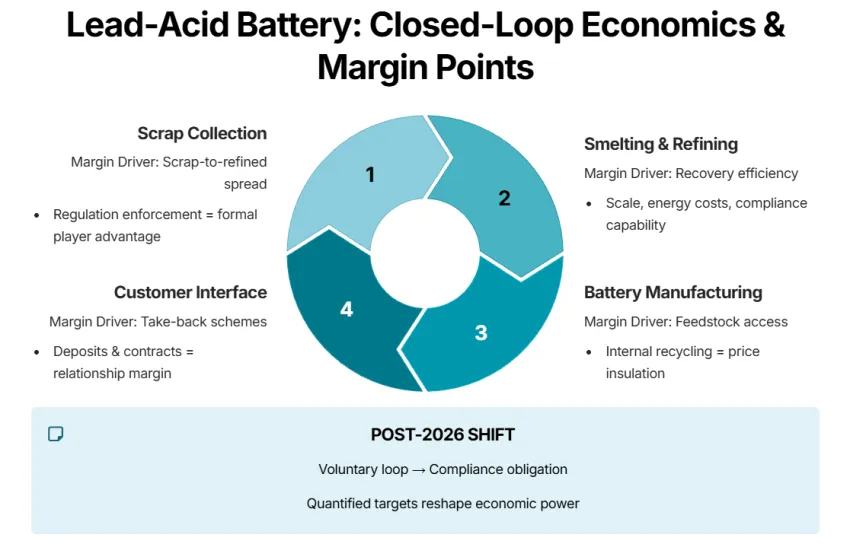
Why are regulation and ESG turning lead-acid into a compliance-driven asset class
The European Union’s new battery regulation sets out a clear direction. Recyclers handling lead-acid batteries in Europe must meet minimum recycling efficiencies of around three quarters by 2025 and eighty percent by 2030 by weight, alongside high material recovery rates for lead itself. Other provisions introduce recycled content disclosure and future minimum recycled content shares for lead in industrial batteries, effectively rewarding those who operate deep closed loops and penalising producers who cannot demonstrate traceable recovery.
In parallel, health and environment agencies continue to document the burden of disease from informal used lead-acid battery recycling, especially in low and middle income countries. Case studies show elevated blood lead levels in workers and communities near substandard recycling sites and significant contributions to the overall disease burden from these exposures. For brands and investors, this has two implications. First, any business model that relies on exporting used batteries or sourcing recycled lead from opaque supply chains now carries regulatory, reputational and litigation risk.
Lead is increasingly framed as a global environmental justice issue, not only as a workplace hazard. Second, regulations that raise minimum recycling efficiency and recovered content effectively set a floor under the cost of responsible lead-acid systems. In the short term that can compress margins for laggards. Over the medium term it favours players that have already invested in compliant reverse logistics, modern smelters and transparent data.
What does this mean for OEMs, utilities and investors who still depend on lead-acid?
For vehicle OEMs and aftermarket brands, the strategic question is who owns the used battery. A manufacturer that bundles take-back into dealer contracts, controls collection points and partners with certified recyclers can turn an environmental obligation into a predictable metal stream and a competitive story on circularity. Those who leave the end of life phase to fragmented traders are effectively subsidising informal recycling and raising long-term risk.
For telecom and data centre operators, lead-acid procurement is moving from simple backup-minutes-per-dollar optimisation to a dual objective. Reliable, low-maintenance standby capacity remains non negotiable, but boards and lenders are increasingly asking whether the batteries sit in a certified closed loop and whether the supplier can evidence compliance with emerging regulations and health guidance. That pushes operators toward fewer, larger suppliers who can provide both technical performance and ESG assurances.
For investors, lead-acid exposures need reclassification. The chemistry itself is mature and technically well understood. The real differentiation is in geography, regulation and business model. Holdings in companies tied to robust extended producer responsibility schemes and high-efficiency secondary smelters look very different from exposures linked to jurisdictions where scrap still flows into informal channels. Capital expenditure on compliance, monitoring and reporting will rise, but so will the barriers to entry.
If you put these pieces together, the conclusion is not that lead-acid is obsolete. It is that by the late 2020s profitability will be driven less by cell performance and more by the ability to run a transparent, high-efficiency reverse loop under tightening rules.

Sources
- Basel Convention / World Health Organization. (2017). Recycling used lead-acid batteries: Health considerations. World Health Organization.
- European Commission. (2025). New rules to boost recycling efficiency from waste batteries. Directorate-General for Environment.
- International Energy Agency. (2024). EU sustainable batteries regulation – Policy database entry. International Energy Agency.
- International Lead Association. (2022). Lead and lead-acid batteries: Applications and recycling in the global economy. International Lead Association and Consortium for Battery Innovation.
- Scur, G., et al. (2022). Lead-acid batteries closed-loop supply chain: Evidence from the Brazilian vehicle battery chain. Batteries, 8(10), 139.

