


Key Takeaways
- Blow fill seal equipment is built to cut human intervention during container forming, filling, and sealing in one enclosed sequence.
- Demand is anchored in sterile liquid formats where unit dose convenience and high throughput matter most.
- Tighter contamination control expectations in sterile manufacturing generally favor more closed, automated processing routes.
- Growth from 2026-2036 is more likely than decline, but it will be uneven by drug type and container format.
- The biggest ceiling comes from prefilled syringes, ready to use vial systems, and isolator based conventional fill lines.
- Material and product compatibility remains a practical limiter, especially for sensitive biologics and long shelf life needs.
- Vaccine and global health packaging innovation can expand BFS use cases, but timelines depend on licensure and program adoption.
Why does blow fill seal exist in modern sterile manufacturing?
Blow fill seal, often shortened to BFS, is essentially a bet against the weakest link in aseptic manufacturing: human intervention. Instead of bringing preformed containers into a filling line, BFS forms a plastic container from resin, fills it with sterile product, and seals it in a continuous operation within the same machine. The appeal is not just speed. The deeper logic is contamination control through fewer open handling steps and fewer opportunities for the surrounding environment, operators, or components to introduce risk.
This matters because regulators and quality systems increasingly treat sterile manufacturing as a contamination control strategy problem, not a final testing problem. In that worldview, the strongest processes are those that are designed to be closed, repeatable, and resilient under real plant conditions. BFS fits that direction because it reduces the number of transfers, staging steps, and container handling interfaces that otherwise must be controlled, monitored, and validated.
Where BFS earns its keep is sterile liquid products that benefit from unit dose packaging, rapid cycle times, and integrated container closure formation. Common examples include respiratory nebules, ophthalmic unit doses, and some small volume sterile solutions. BFS can also matter when glass breakage risk, line speed, or compact packaging are priority constraints. Still, it is not a universal replacement for conventional fill finish. The plastic container itself becomes part of the product quality equation, which pushes BFS into segments where polymer containers are acceptable for stability, barrier performance, and leachables expectations.
What will determine BFS equipment growth in 2026-2036?
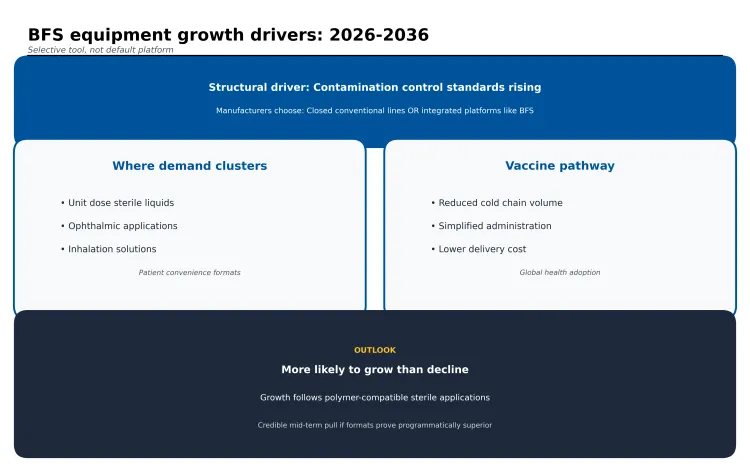
Overall, BFS equipment is more likely to grow than decline in 2026-2036, but it will grow like a selective tool, not a default platform. The strongest driver is structural: sterile manufacturing standards keep raising the bar on contamination control, container closure integrity expectations, and defensible validation. As manufacturers respond, they tend to invest in either more closed conventional lines using isolators and barrier systems, or in inherently integrated platforms like BFS that reduce interventions by design. That creates a steady pull for BFS in products where polymer primary packaging is technically and regulatorily comfortable.
The second driver is where demand actually lives. BFS demand pools are not evenly distributed across pharma. They cluster around unit dose sterile liquids and delivery formats where patient convenience and dosing simplicity are valuable, such as ophthalmic unit doses and inhalation solutions. There is also a vaccine and global health pathway: compact primary packaging formats that reduce cold chain volume, simplify administration, and lower delivery cost have been actively evaluated by public health and nonprofit actors. Those efforts do not translate into immediate equipment waves everywhere, but they create credible mid term pull if a few formats prove programmatically superior and get adopted at scale.
The limiting factor is that the hottest growth in injectables is not just more sterile liquids, it is more complex sterile products. Biologics, combination products, and self administration formats keep pushing the market toward prefilled syringes and autoinjectors, plus ready to use nested vials run on high containment, high automation conventional lines. BFS can participate, but it must win on compatibility, stability, and economics for each molecule and presentation. So the likely 2026-2036 story is: BFS grows steadily in its strongholds, expands at the edges where polymer container performance and device integration improve, and loses some upside to prefilled systems in high value biologics.
Which alternatives and innovations could divert demand away from BFS?
The most powerful alternative is not another niche technology, it is a modern version of the old one: conventional vial filling, upgraded with isolators, restricted access barrier systems, better automation, and ready to use components. This path preserves glass as the dominant container for many sterile drugs, especially where barrier properties, long shelf life, and broad regulatory familiarity matter. When a company can buy speed and sterility assurance through isolator based lines and standardized components, BFS has to justify why changing the primary container to polymer is worth it.
Prefilled syringes and autoinjectors are the second gravitational force. They solve patient use convenience, dosing accuracy, and in some cases safety, but they introduce their own manufacturing and material challenges. Even so, they are the obvious destination format for self administered biologics and chronic therapies, which are exactly the segments that often attract investment. That means some of the capital that might have gone to BFS for certain injectables will instead go to syringe, cartridge, and device oriented fill finish ecosystems.
Then there are innovation pathways that compete indirectly. One is packaging and delivery concepts designed to reduce cold chain and simplify immunization logistics, such as compact prefilled autodisable devices and other next generation primary packaging concepts. Another is formulation and process innovation that shifts products toward terminal sterilization compatibility or other processing routes where BFS is not the primary lever. Finally, polymer science and process controls can cut both ways: improved polymers and better thermal management can expand BFS eligibility for sensitive products, but improved coatings, reduced extractables systems, and better syringe and vial components can also strengthen the competing formats. Net result: BFS will not disappear, but its growth rate will be defined by how quickly it can expand beyond its natural home of unit dose sterile liquids without losing on stability, regulatory comfort, or total cost.
How FMI can Help
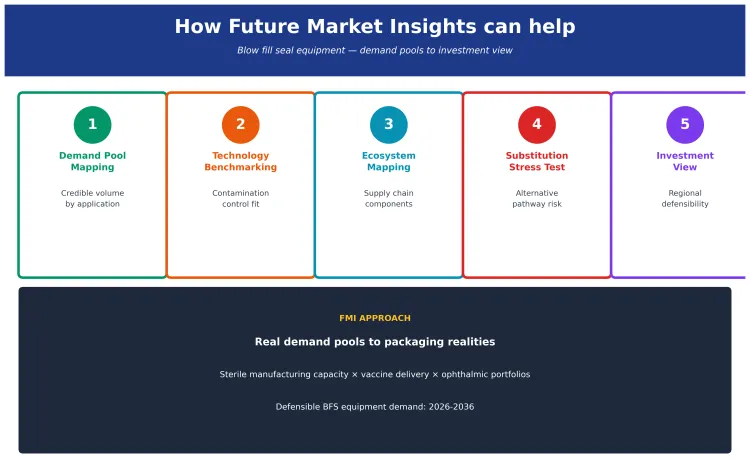
FMI can support decision makers evaluating blow fill seal equipment demand by mapping real demand pools to product and packaging realities, not just market labels. We can break down where sterile unit dose liquids, ophthalmics, respiratory solutions, and vaccine packaging initiatives create credible volume, and where biologics and self administration formats structurally favor prefilled systems. We can also benchmark technology fit by application, linking contamination control expectations, container closure integrity requirements, and validation burden to each primary packaging route.
On the supply side, we can map the BFS ecosystem across resin inputs, mold and tooling, machine throughput classes, automation and inspection add ons, and the contract manufacturing landscape. For strategy, we can stress test growth narratives against substitution risk from isolator based vial lines, ready to use nested components, and syringe and autoinjector expansion. Finally, we can translate all of this into an investment view by region, highlighting where sterile manufacturing capacity additions, vaccine delivery modernization, and ophthalmic and respiratory portfolios make BFS equipment demand most defensible over 2026-2036.
Bibliography
- European Commission. 2022. EudraLex Volume 4, EU Guidelines for Good Manufacturing Practice for Medicinal Products for Human and Veterinary Use, Annex 1, Manufacture of Sterile Medicinal Products.
- European Medicines Agency. 2019. Guideline on sterilisation of the medicinal product, active substance, excipient and primary container. EMA CHMP CVMP QWP 850374 2015.
- World Health Organization. 2022. WHO good manufacturing practices for sterile pharmaceutical products. WHO Technical Report Series 1044, Annex 2.
- World Health Organization. 2011. WHO good manufacturing practices for sterile pharmaceutical products. WHO Technical Report Series 961, Annex 6.
- United States Food and Drug Administration. 2004. Sterile Drug Products Produced by Aseptic Processing, Current Good Manufacturing Practice, Guidance for Industry.
- Zadbuke, N., & Shahi, S. 2013. Recent trends and future of pharmaceutical packaging technology. Journal of Pharmacy and Bioallied Sciences. DOI 10.4103/0975-7406.111820.
- Makwana, S., Basu, B., Makasana, Y., & Dharamsi, A. 2011. Prefilled syringes: An innovation in parenteral packaging. International Journal of Pharmaceutical Investigation. DOI 10.4103/2230-973X.93004.
- Badkar, A., & Singh, M. 2011. Development of biotechnology products in prefilled syringes: Technical challenges and approaches. AAPS PharmSciTech.
- Sedita, J., Perrella, S., Morio, M., et al. 2018. Cost of goods sold and total cost of delivery for oral and parenteral vaccine packaging formats. Vaccine, 36, 1700-1709. DOI 10.1016/j.vaccine.2018.01.011.
- Zehrung, D., Jarrahian, C., Giersing, B., & Kristensen, D. 2017. Exploring new packaging and delivery options for the immunization supply chain. Vaccine, 35, 2265-2271. DOI 10.1016/j.vaccine.2016.11.095.
- Gavi, the Vaccine Alliance. 2019. VIPS Phase I technical note: Blow fill seal primary containers.
- PATH. 2018. Programmatic and human factors evaluation of three blow fill seal parenteral vaccine container designs.
- Whitfield, R., et al. 2025. Defining drug delivery device performance of ophthalmic blow fill seal ampoules based on physical and performance characteristics. Investigative Ophthalmology and Visual Science.

