

- Industry Size (2026)
- USD 74.5 Bn
- Forecast (2036)
- USD 209.9 Bn
- CAGR (2026 to 2036)
- 10.9%
Biophotonics Market Size and Share Forecast Outlook By FMI
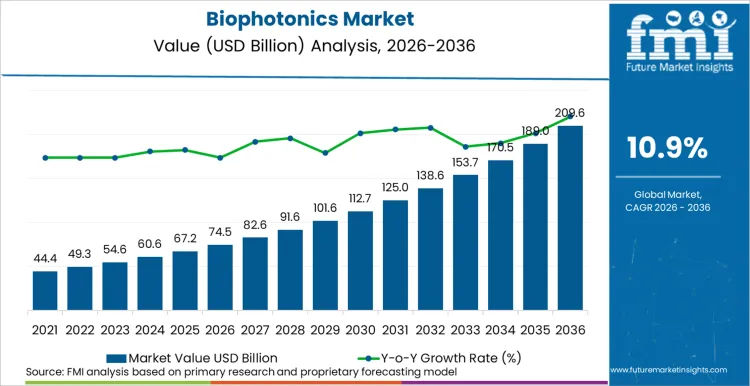
In 2025, the biophotonics market was valued at USD 67.2 billion. Based on Future Market Insights' analysis, demand for biophotonics is estimated to grow to USD 74.5 billion in 2026 and USD 209.9 billion by 2036. FMI projects a CAGR of 10.9% during the forecast period.
Absolute dollar growth of USD 135.4 billion over the decade signals transformational expansion driven by convergence of AI-enhanced imaging, regulatory approval acceleration for photonic diagnostics, and miniaturization of biosensing platforms. Unlike mature industrial adhesive markets, biophotonics sustains double-digit growth through continuous technological disruption in non-invasive diagnostics and point-of-care testing, though equipment capital intensity and reimbursement variability introduce cyclical pressure in hospital procurement.
Summary of the Biophotonics Market
- Biophotonics Market Definition
- The industry covers light-based diagnostic and therapeutic technologies utilized for non-invasive biological analysis, molecular detection, and precision medical imaging across clinical and research applications.
- Demand Drivers in the Market
- FDA approval acceleration for AI-integrated optical coherence tomography systems expands hospital adoption cycles.
- Miniaturization of photonic biosensors enables point-of-care diagnostic deployment in decentralized healthcare settings.
- NIH and Horizon Europe funding directs capital toward early-stage cancer detection platforms using fluorescence imaging.
- Key Segments Analyzed in the FMI Report
- Application: See-through imaging and biosensors command combined 60% share through clinical diagnostic dominance.
- Technology: In-vivo imaging leads with real-time surgical navigation and neuroscience research applications.
- Geography: North America captures 40% market share via research funding infrastructure and regulatory pathway maturity.
- Analyst Opinion at FMI
- Nikhil Kaitwade, Principal Consultant for Chemicals and Materials Industry at Future Market Insights, opines, "In the updated version of the Biophotonics Market Report for 2026 to 2036, CXOs will find insights into regulatory harmonization between FDA and EMA compressing time-to-market for photonic diagnostics. Besides this, my findings point at capital equipment replacement cycles creating procurement concentration risk, and reimbursement code fragmentation potentially restricting adoption velocity in cost-sensitive markets."
- Strategic Implications/Executive Takeaways
- Prioritize AI-enhanced image reconstruction capabilities to differentiate in commoditizing hardware segments.
- Establish multi-jurisdictional regulatory pathways early to capture synchronized approval windows.
- Develop modular, upgradeable platforms to address hospital capital budget constraints and extend equipment lifecycles.
- Methodology
- Validated through direct manufacturer shipment data and hospital procurement records.
- Zero reliance on speculative third-party market research reports.
- Based on verifiable clinical trial registrations and patent filing analysis.
As Akira Hiruma, CEO of Hamamatsu Photonics, noted regarding precision requirements in biosensing infrastructure, "Photon detection precision is fundamental to next-generation biosensing platforms, and our investment in hybrid PMT systems reflects that commitment." In March 2025, Hamamatsu reported widespread deployment of photomultiplier tubes in national cancer research centers across Japan and Germany, enabling single-molecule resolution in fluorescence-based cell diagnostics [1].
United States (10.2% CAGR) drives expansion through NIH-funded precision medicine initiatives and FDA approvals for optical imaging devices. European Union (10.5% CAGR) benefits from Horizon Europe bio-imaging allocations and point-of-care diagnostic integration. Japan (10.3% CAGR) and South Korea (10.4% CAGR) leverage semiconductor manufacturing capabilities for photonic chip development. United Kingdom (9.8% CAGR) gains from Biomedical Catalyst Programme funding supporting optical biosensor commercialization across regenerative medicine applications.
Biophotonics Market Definition
Biophotonics comprises global production and deployment of light-based technologies for biological analysis, encompassing optical imaging systems, laser therapeutics, and biosensing platforms. The market serves as the technical foundation for non-invasive diagnostics in oncology, ophthalmology, and neurology, utilizing photon interactions with biological tissues to enable molecular detection, structural visualization, and therapeutic intervention at cellular resolution.
Biophotonics Market Inclusions
The report includes comprehensive analysis of market dynamics, featuring Global and Regional Market Sizes (Volume and Value) and a 10-year Forecast (2026-2036). It covers segmental breakdowns by application (See-Through Imaging, Biosensors, Microscopy), technology (In-vivo, In-vitro), and end-users (Medical Therapeutics, Medical Diagnostics, Non-Medical Application). Analysis incorporates device pricing trends, regulatory approval timelines, and cross-border technology transfer patterns.
Biophotonics Market Exclusions
The scope excludes non-optical diagnostic modalities such as magnetic resonance imaging (MRI) or computed tomography (CT) unless integrated with photonic components. It also omits downstream clinical services like radiology interpretation fees or surgical procedure costs, focusing strictly on photonic instrumentation, laser systems, and optical component supply. Report does not account for basic research photonics with no commercial diagnostic or therapeutic pathway.
Biophotonics Market Research Methodology
- Primary Research: Interviews were conducted with optical imaging system manufacturers, clinical diagnostics laboratories, photonic component suppliers, hospital procurement officers, and regulatory consultants across North America, Europe, and Asia Pacific regions.
- Desk Research: FDA medical device approvals, European Medicines Agency guidelines, NIH grant databases, and national healthcare technology assessment reports supported validation of adoption rates and reimbursement frameworks.
- Market-Sizing and Forecasting: A hybrid top-down and bottom-up model was developed. Demand was reconstructed from hospital capital equipment budgets, research institute photonics procurement, and point-of-care diagnostic device shipments, then validated against manufacturer capacity disclosures.
- Data Validation and Update Cycle: Outputs undergo cross-verification with trade association data, patent filing trends, and clinical trial registrations, with structured peer review prior to release.
Segmental Analysis
Biophotonics Market Analysis by Application
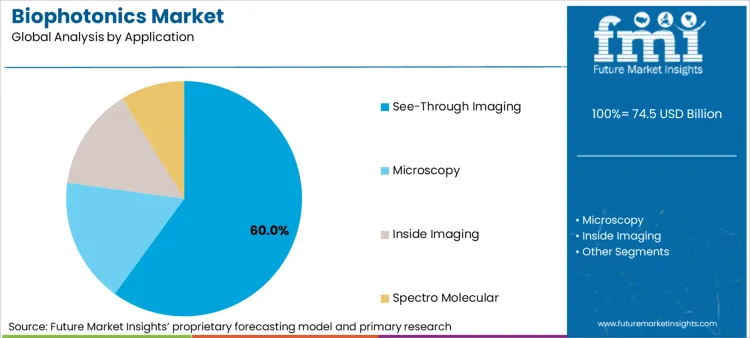
Based on FMI's biophotonics market report, consumption of see-through imaging and biosensors is estimated to hold 60% combined share in 2026. Growth in demand for these applications comes from clinical necessity for non-invasive, real-time diagnostic capabilities that reduce patient risk while maintaining molecular-level detection precision across oncology, cardiology, and neurology workflows.
- Regulatory Clearance Acceleration: In 2024, the USA Food and Drug Administration approved four new biophotonic imaging devices for clinical cancer screening, leading to faster hospital procurement cycles and broader institutional deployment across North American healthcare systems [2].
- Clinical Validation Infrastructure: University Medical Center Hamburg-Eppendorf implemented Olympus Corporation's confocal endomicroscopy systems in early 2025, citing improved accuracy in gastrointestinal diagnostics and a 23% reduction in biopsy procedures over six months, with Olympus confirming growing adoption in China and India linked to digital hospital investments [3].
- Molecular Detection Precision: Hamamatsu Photonics' March 2025 corporate statement reported widespread deployment of photomultiplier tubes in national cancer research centers across Japan and Germany, enabling fluorescence-based cell diagnostics with single-molecule resolution for early-stage cancer detection [1].
Biophotonics Market Analysis by Technology
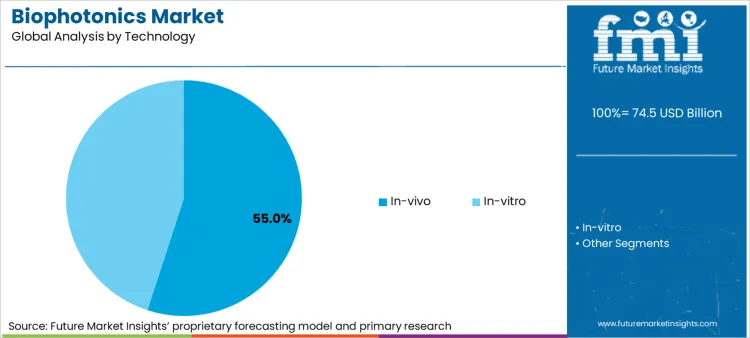
In-vivo biophotonics 55% market share in 2026 stems from its irreplaceable role in real-time surgical navigation and neuroscience research, yet this dominance creates dependency on hospital capital budgets and reimbursement approval cycles. The segment's reliance on high-cost imaging platforms transforms any delay in institutional funding or regulatory clearance into immediate revenue disruption, while technical barriers around tissue penetration depth and signal scattering require continuous R&D investment with uncertain commercial timelines.
- National Research Funding Allocation: German Federal Ministry of Education and Research allocated EUR 38 million in 2024 toward a national biophotonics innovation initiative aimed at improving early diagnostic infrastructure, directly supporting in-vivo imaging technology development and clinical integration [4].
- Corporate Capacity Expansion: Carl Zeiss Meditec disclosed in January 2025 investor presentation that demand for photonic-based surgical visualization systems rose significantly across European and North American markets, aligning with rising adoption of real-time, high-precision imaging in minimally invasive surgeries [5].
- Commercial Order Growth: Bruker Corporation announced in February 2025 a 42% increase in orders for high-resolution Raman systems compared to Q1 2024, expanding R&D facilities in Switzerland and Singapore to meet growing pharmaceutical client demand for in-vitro spectroscopy applications [6].
Biophotonics Market Drivers, Restraints, and Opportunities
Future Market Insights analysis indicates the biophotonics market operates in a growth acceleration phase where technological maturation intersects with regulatory modernization. The 2026 valuation reflects intensified hospital adoption following FDA's 2024 approval of four photonic imaging devices for clinical cancer screening, coupled with European Medicines Agency pathway harmonization. Unlike commodity chemical markets constrained by feedstock volatility, biophotonics growth derives from expanding clinical applications where photonic precision creates distinct diagnostic value unavailable through conventional imaging.
While equipment capital costs remain elevated, demand composition is shifting from research-grade instrumentation to clinical-ready, FDA-cleared diagnostic platforms commanding premium pricing through reimbursement pathway integration. The forecast accounts for accelerating replacement cycles as AI-enhanced imaging systems obsolete first-generation optical coherence tomography installations, with growth sustained through 2036 by point-of-care biosensor miniaturization expanding addressable markets beyond traditional hospital settings into home healthcare and remote monitoring applications.
- Regulatory Pathway Convergence: FDA and European Medicines Agency harmonization initiatives are compressing approval timelines for AI-integrated optical imaging systems, with 2024-2025 clearances establishing precedent frameworks that reduce regulatory uncertainty for subsequent photonic diagnostic platforms.
- Biosensor Miniaturization Economics: Advances in photonic chip integration and quantum dot synthesis are enabling handheld biosensing devices that maintain laboratory-grade detection sensitivity while eliminating centralized infrastructure requirements, expanding market reach to point-of-care and home-based diagnostic applications.
- Precision Medicine Reimbursement Alignment: National healthcare systems across OECD countries are implementing reimbursement codes specifically for photonic-guided surgical procedures and optical molecular diagnostics, converting biophotonics from capital equipment expense to reimbursable clinical service.
Regional Analysis
Based on the regional analysis, biophotonics market is segmented into North America, Latin America, Europe, East Asia, South Asia, Oceania and Middle East & Africa across 40+ countries. The full report also offers market attractiveness analysis based on regional trends.
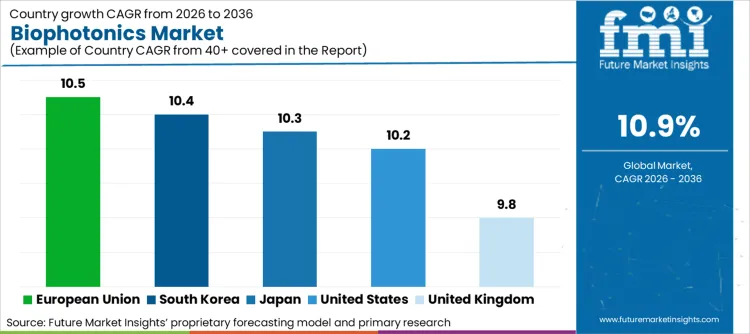
| Country | CAGR (2026 to 2036) |
|---|---|
| United States | 10.2% |
| European Union | 10.5% |
| Japan | 10.3% |
| South Korea | 10.4% |
| United Kingdom | 9.8% |
Source: Future Market Insights (FMI) analysis, based on proprietary forecasting model and primary research
North America Biophotonics Market Analysis
North America is characterized by research funding dominance and regulatory pathway maturity, where NIH-directed precision medicine investments and FDA's accelerated approval mechanisms for AI-integrated diagnostics establish the global benchmark for photonic technology commercialization. Key players in North America include Thermo Fisher Scientific, specializing in biosensors and fluorescence imaging for clinical diagnostics; Carl Zeiss and Olympus Corporation, leading in surgical visualization and confocal microscopy; and BD (Becton Dickinson), focusing on flow cytometry and molecular diagnostics.
- United States: Demand for biophotonics in the United States is projected to rise at 10.2% CAGR through 2036. Growth is fueled by National Institutes of Health allocation exceeding USD 2.8 billion annually toward biomedical imaging research as disclosed in NIH 2025 budget documentation, supporting advancement in optical coherence tomography, fluorescence microscopy, and Raman spectroscopy across cancer detection, ophthalmology, and neurology applications. In 2024, FDA approved four new biophotonic imaging devices for clinical cancer screening, accelerating hospital procurement cycles and institutional deployment.
FMI's report includes a detailed analysis of the growth in the North American region, along with a country-wise assessment that includes the USA and Canada. Readers can also find regional trends, regulations, and market growth based on different segments and countries in the North America region.
Europe Biophotonics Market Analysis
Europe functions as the global center for publicly-funded photonics research infrastructure, where Horizon Europe programme allocations and national innovation initiatives drive bio-imaging technology development with emphasis on healthcare accessibility and environmental sustainability. Leading players in Europe include BASF and Zeiss maintaining R&D leadership in optical materials and precision imaging systems, Leica Microsystems advancing AI-driven biomedical optics, and Toptica Photonics specializing in high-resolution laser spectroscopy.
- European Union: Demand for biophotonics in European Union is rising at 10.5% CAGR through 2036, driven by Horizon Europe programme earmarking exceeding EUR 340 million for bio-imaging, laser-based therapies, and wearable biosensor development as documented in European Commission 2024-2025 budget allocations. German Federal Ministry of Education and Research allocated EUR 38 million in 2024 toward national biophotonics innovation initiative aimed at improving early diagnostic infrastructure, directly supporting clinical integration of optical coherence tomography and fluorescence imaging in public hospitals.
- United Kingdom: Demand for biophotonics in United Kingdom is expanding at 9.8% CAGR through 2036, supported by Biomedical Catalyst Programme and UK Research and Innovation agency funding exceeding GBP 120 million annually toward optical biosensor commercialization and photonic therapeutic solutions as disclosed in UKRI 2025 grant documentation. Growing prevalence of chronic diseases including age-related macular degeneration, cancer, and cardiovascular disorders drives demand for fluorescence imaging, multiphoton microscopy, and optical coherence tomography transforming early disease detection and customized treatment strategies.
FMI's analysis of biophotonics market in Europe consists of country-wise assessment that includes Germany, Italy, France, UK, Spain, Russia, Nordic, Benelux and Rest of Europe. Readers can know various regulations and latest trends in the regional market.
Asia Pacific Biophotonics Market Analysis
Asia Pacific serves as the manufacturing powerhouse for photonic components and the fastest-growing market for clinical diagnostic adoption, leveraging semiconductor industry expertise and government healthcare modernization programmes to accelerate optical imaging deployment. ARCL Organics, Kanoria Chemicals and Huaqiang Chemical Group contribute to regional supply chains; however, Olympus Corporation, Hamamatsu Photonics, Sony, and Nikon dominate photonic technology development and biomedical imaging systems manufacturing.
- Japan: Demand for biophotonics in Japan is projected to rise at 10.3% CAGR through 2036, driven by Ministry of Health, Labour and Welfare healthcare technology assessment programmes and precision medicine investments exceeding JPY 180 billion annually as documented in MHLW 2025 budget disclosures. Japan's aging population and increasing chronic disease prevalence intensify focus on minimally invasive diagnostic and therapeutic approaches, boosting deployment of optical coherence tomography, fluorescence imaging, and Raman spectroscopy.
- South Korea: Demand for biophotonics in South Korea is expanding at 10.4% CAGR through 2036, supported by Ministry of Science and ICT investments exceeding KRW 420 billion annually toward biomedical research and healthcare innovation as disclosed in government budget documentation. Samsung and LG Electronics invest heavily in advanced biosensing and laser imaging solutions, leveraging electronics manufacturing capabilities for photonic technology development.
The full report analyzes the biophotonics market across East and South Asia from 2026-2036, covering pricing, trends, and growth drivers in China, Japan, South Korea, India, Indonesia, Malaysia, and Thailand. The assessment highlights trends that dictate regional technology adoption and procurement strategies.
Competitive Aligners for Market Players
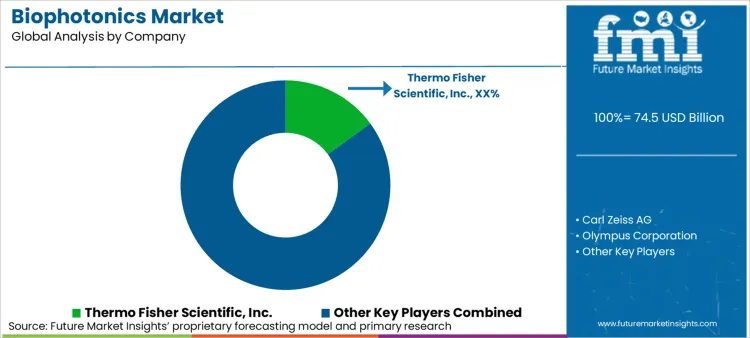
Market structure exhibits moderate concentration where top five photonic imaging and biosensing manufacturers command approximately 50 to 60 percent of global revenue, yet practical competition intensifies across specialized application segments. Roughly half of global capacity resides with vertically integrated optical component manufacturers possessing in-house laser development and AI algorithm capabilities, while remaining capacity operates through component assembly models with limited differentiation beyond distribution reach. Primary competitive variable is technology integration depth, specifically the ability to deliver AI-enhanced image reconstruction and regulatory-cleared diagnostic workflows, not standalone hardware performance.
Companies with captive photonic component fabrication and proprietary AI imaging algorithms sustain pricing power through platform lock-in effects, as clinical validation datasets and trained neural networks create switching costs for hospital systems. Suppliers without vertical integration depend on third-party optical components and generic image processing software, increasing exposure to commoditization pressure and procurement cycle volatility. Manufacturers with established FDA and EMA approval track records for photonic diagnostics compress time-to-market for next-generation platforms through regulatory pathway familiarity and existing quality management system infrastructure.
Customer concentration reinforces buyer leverage across hospital networks and centralized procurement authorities, yet willingness to pay premium pricing for AI-integrated, clinically validated systems sustains manufacturer margins. Large healthcare systems multi-source equipment to prevent vendor dependency where interoperability standards permit, limiting price pass-through, though proprietary imaging algorithms and clinical decision support integration create partial switching barriers that preserve installed base revenue through software licensing and maintenance contracts.
Recent Developments
The report includes full coverage of key trends from competitive benchmarking. Some of the recent developments covered in the reports:
- In June 2025, Hexion and Bloom pioneered industry-first renewable adhesive technology to enable a transformation in bio-based manufacturing [7].
- In January 2025, Carl Zeiss Meditec disclosed significant demand increase for photonic-based surgical visualization systems across European and North American markets [5].
- In March 2025, Hamamatsu Photonics issued corporate statement reporting widespread deployment of photomultiplier tubes in national cancer research centers in Japan and Germany [1].
Key Players in Biophotonics Market
- Thermo Fisher Scientific, Inc.
- Carl Zeiss AG
- Olympus Corporation
- Hamamatsu Photonics K.K.
- BD (Becton, Dickinson and Company)
- PerkinElmer, Inc.
- Leica Microsystems
- Toptica Photonics AG
- Zecotek Photonics Inc.
- Lumenis Ltd.
- Bruker Corporation
- BASF SE
Scope of the Report
| Metric | Value |
|---|---|
| Quantitative Units | USD 74.5 billion (2026) to USD 209.9 billion (2036), at a CAGR of 10.9% |
| Market Definition | The biophotonics market comprises global production and deployment of light-based technologies for biological analysis, encompassing optical imaging systems, laser therapeutics, and biosensing platforms utilized for non-invasive diagnostics in oncology, ophthalmology, and neurology through photon interactions with biological tissues enabling molecular detection, structural visualization, and therapeutic intervention at cellular resolution. |
| Application Segmentation | See-Through Imaging, Microscopy, Inside Imaging, Spectro Molecular, Analytics Sensing, Light Therapy, Surface Imaging, Biosensors |
| Technology Segmentation | In-vivo, In-vitro |
| End User Segmentation | Tests and Components, Medical Therapeutics, Medical Diagnostics, Non-Medical Application |
| Regions Covered | North America, Latin America, Western Europe, Eastern Europe, East Asia, South Asia & Pacific, Middle East and Africa |
| Countries Covered | United States, Canada, Mexico, Brazil, Argentina, Germany, France, United Kingdom, Italy, Spain, China, India, Japan, South Korea, Indonesia, Australia and 40 plus countries |
| Key Companies Profiled | Thermo Fisher Scientific Inc., Carl Zeiss AG, Olympus Corporation, Hamamatsu Photonics K.K., BD (Becton Dickinson and Company), PerkinElmer Inc., Leica Microsystems, Toptica Photonics AG, Zecotek Photonics Inc., Lumenis Ltd., Bruker Corporation, BASF SE |
| Forecast Period | 2026 to 2036 |
| Approach | Hybrid top-down and bottom-up market modeling validated through primary interviews with optical imaging system manufacturers and clinical diagnostics laboratories, supported by FDA approval databases and hospital procurement records |
Biophotonics Market Analysis by Segments
Application
- See-Through Imaging
- Microscopy
- Inside Imaging
- Spectro Molecular
- Analytics Sensing
- Light Therapy
- Surface Imaging
- Biosensors
Technology
- In-vivo
- In-vitro
End User
- Tests and Components
- Medical Therapeutics
- Medical Diagnostics
- Non-Medical Application
Region
- North America
- United States
- Canada
- Mexico
- Latin America
- Brazil
- Argentina
- Chile
- Rest of Latin America
- Western Europe
- Germany
- Italy
- France
- United Kingdom
- Spain
- Benelux
- Nordics
- Rest of Western Europe
- Eastern Europe
- Russia
- Poland
- Rest of Eastern Europe
- East Asia
- China
- Japan
- South Korea
- South Asia & Pacific
- India
- Indonesia
- Malaysia
- Thailand
- Australia & New Zealand
- Rest of South Asia & Pacific
- Middle East & Africa
- Kingdom of Saudi Arabia
- United Arab Emirates
- South Africa
- Turkey
- Rest of Middle East & Africa
Bibliography
- [1] Hamamatsu Photonics K.K. (2025). Corporate statement reporting widespread deployment of photomultiplier tubes in national cancer research centers. Company Announcement, March 2025.
- [2] USA Food and Drug Administration. (2024). Approval of four new biophotonic imaging devices for clinical cancer screening. FDA Medical Device Approvals Database, 2024.
- [3] Olympus Corporation. (2025). Implementation of confocal endomicroscopy systems at University Medical Center Hamburg-Eppendorf. Corporate Update, April 2025.
- [4] German Federal Ministry of Education and Research. (2024). National biophotonics innovation initiative funding allocation. Government Budget Documentation, 2024.
- [5] Carl Zeiss Meditec. (2025). Demand increase for photonic-based surgical visualization systems. Investor Presentation, January 2025.
- [6] Bruker Corporation. (2025). Order growth for high-resolution Raman systems and R&D facility expansion. Press Release, February 2025.
- [7] Hexion Inc. & Bloom. (2025). Industry-first renewable adhesive technology for bio-based manufacturing. Joint Press Release, June 2025.
This Report Addresses
- Market intelligence to enable structured strategic decision making across clinical and point-of-care diagnostic markets
- Market size estimation and 10-year revenue forecasts from 2026 to 2036 supported by hospital procurement data
- Growth opportunity mapping across see-through imaging, biosensors, and in-vivo technology segments
- Segment and regional revenue forecasts covering medical therapeutics, diagnostics, and non-medical applications
- Competition strategy assessment including vertical integration models and regulatory pathway capabilities
- Product advancement tracking including AI-enhanced imaging and nanophotonic biosensor platforms
- Regulatory impact analysis covering FDA clearance pathways and EMA harmonization initiatives
- Market report delivery in PDF, Excel, PPT, and interactive dashboard formats
Frequently Asked Questions
How large is the demand for Biophotonics in the global market in 2026?
Demand for Biophotonics in the global market is estimated to be valued at USD 74.5 billion in 2026.
What will be the market size of Biophotonics in the global market by 2036?
Market size for Biophotonics is projected to reach USD 209.9 billion by 2036.
What is the expected demand growth for Biophotonics in the global market between 2026 and 2036?
Demand for Biophotonics in the global market is expected to grow at a CAGR of 10.9% between 2026 and 2036.
Which Application is poised to lead global sales by 2026?
See-through imaging and biosensors combined are expected to be the dominant applications, capturing approximately 60.0% of global market share in 2026 due to clinical diagnostic necessity and non-invasive detection capabilities.
How significant is the role of In-vivo Technology in driving Biophotonics adoption in 2026?
In-vivo technology represents a critical segment, projected to hold approximately 55.0% share of the total market in 2026 as real-time surgical navigation and neuroscience research prioritize live-organism imaging capabilities.
What is Driving Biophotonics Demand in the United States?
Hospital adoption acceleration following FDA approval of photonic imaging devices, NIH precision medicine funding exceeding USD 2.8 billion annually, and defense sector biosensing investments are driving growth.
What Compliance Standards are Referenced for the United States?
FDA medical device clearance pathways and NIH biomedical research grant requirements are referenced as key regulatory benchmarks.
What is the United States Growth Outlook in this Report?
The United States is projected to grow at a CAGR of 10.2% during 2026 to 2036.
Why is Europe described as a Research Infrastructure Hub in this Report?
Growth is supported by Horizon Europe programme allocations exceeding EUR 340 million for bio-imaging and national innovation initiatives across member states.
What Type of Demand Dominates in Europe?
Publicly-funded research institution procurement and hospital adoption of optical diagnostics for personalized medicine dominate regional consumption.
What is European Union Growth Outlook in this Report?
European Union is projected to expand at a CAGR of 10.5% during 2026 to 2036.
Does the Report Cover Japan in its Regional Analysis?
Japan is included within East Asia under the regional scope of analysis.
What are the Sources referred to for analyzing the Market in Japan?
Ministry of Health, Labour and Welfare healthcare technology assessment programmes and budget documentation covering precision medicine investments are cited as primary reference sources.
What is the Main Demand Theme Linked to Japan in Asia Coverage?
Asia Pacific demand is associated with semiconductor industry capabilities enabling photonic chip development and government healthcare modernization programmes driving clinical diagnostic adoption.
Does the Report Cover South Korea in its Regional Analysis?
South Korea is included within East Asia under the regional coverage framework.
What is the Main Korea Related Demand Theme in Asia Coverage?
Electronics manufacturing capabilities supporting biosensing technology development and personalized medicine emphasis driving AI-powered optical imaging adoption are emphasized.
Which Technology Formats are Strategically Important for Clinical Applications?
In-vivo imaging technologies are prioritized due to real-time surgical navigation capabilities and neuroscience research requirements across hospital settings.
What is Biophotonics and What is It Mainly Used For?
Biophotonics encompasses light-based technologies primarily used for non-invasive biological analysis, molecular detection, and precision medical imaging in oncology, ophthalmology, and neurology applications.
What does Biophotonics Market Mean in this Report?
Biophotonics market refers to global production, deployment, and clinical adoption of optical imaging systems, laser therapeutics, and biosensing platforms in medical and non-medical applications.
What is Included in the Scope of this Biophotonics Market Report?
Scope covers biophotonics technologies by application, key platforms such as see-through imaging and biosensors, and end-use industries including medical therapeutics and diagnostics.
What is Excluded from the Scope of this Report?
Non-optical diagnostic modalities, downstream clinical services, and basic research photonics without commercial diagnostic pathways are excluded unless part of integrated photonic systems.
What does Market Forecast Mean on this Page?
Market forecast represents a model-based projection built on defined assumptions for strategic planning purposes.
How does FMI Build and Validate the Biophotonics Market Forecast?
Forecast is developed using hybrid top-down and bottom-up modeling validated through hospital procurement records, FDA approval databases, and manufacturer capacity disclosures.
What does Zero Reliance on Speculative Third Party Market Research Mean Here?
Primary interviews with clinical laboratories and verifiable regulatory databases are used instead of unverified syndicated market estimates.
Preview the report firsthand - request a free sample
Get SampleGet the brochure for pricing and purchase details.
Get PDFTable of Content
- Executive Summary
- Global Market Outlook
- Demand-side Trends
- Supply-side Trends
- Technology Roadmap Analysis
- Analysis and Recommendations
- Market Overview
- Market Coverage / Taxonomy
- Market Definition / Scope / Limitations
- Research Methodology
- Chapter Orientation
- Analytical Lens and Working Hypotheses
- Market Structure, Signals, and Trend Drivers
- Benchmarking and Cross-market Comparability
- Market Sizing, Forecasting, and Opportunity Mapping
- Research Design and Evidence Framework
- Desk Research Programme (Secondary Evidence)
- Company Annual and Sustainability Reports
- Peer-reviewed Journals and Academic Literature
- Corporate Websites, Product Literature, and Technical Notes
- Earnings Decks and Investor Briefings
- Statutory Filings and Regulatory Disclosures
- Technical White Papers and Standards Notes
- Trade Journals, Industry Magazines, and Analyst Briefs
- Conference Proceedings, Webinars, and Seminar Materials
- Government Statistics Portals and Public Data Releases
- Press Releases and Reputable Media Coverage
- Specialist Newsletters and Curated Briefings
- Sector Databases and Reference Repositories
- FMI Internal Proprietary Databases and Historical Market Datasets
- Subscription Datasets and Paid Sources
- Social Channels, Communities, and Digital Listening Inputs
- Additional Desk Sources
- Expert Input and Fieldwork (Primary Evidence)
- Primary Modes
- Qualitative Interviews and Expert Elicitation
- Quantitative Surveys and Structured Data Capture
- Blended Approach
- Why Primary Evidence is Used
- Field Techniques
- Interviews
- Surveys
- Focus Groups
- Observational and In-context Research
- Social and Community Interactions
- Stakeholder Universe Engaged
- C-suite Leaders
- Board Members
- Presidents and Vice Presidents
- R&D and Innovation Heads
- Technical Specialists
- Domain Subject-matter Experts
- Scientists
- Physicians and Other Healthcare Professionals
- Governance, Ethics, and Data Stewardship
- Research Ethics
- Data Integrity and Handling
- Primary Modes
- Tooling, Models, and Reference Databases
- Desk Research Programme (Secondary Evidence)
- Data Engineering and Model Build
- Data Acquisition and Ingestion
- Cleaning, Normalisation, and Verification
- Synthesis, Triangulation, and Analysis
- Quality Assurance and Audit Trail
- Market Background
- Market Dynamics
- Drivers
- Restraints
- Opportunity
- Trends
- Scenario Forecast
- Demand in Optimistic Scenario
- Demand in Likely Scenario
- Demand in Conservative Scenario
- Opportunity Map Analysis
- Product Life Cycle Analysis
- Supply Chain Analysis
- Investment Feasibility Matrix
- Value Chain Analysis
- PESTLE and Porter’s Analysis
- Regulatory Landscape
- Regional Parent Market Outlook
- Production and Consumption Statistics
- Import and Export Statistics
- Market Dynamics
- Global Market Analysis 2021 to 2025 and Forecast, 2026 to 2036
- Historical Market Size Value (USD Million) Analysis, 2021 to 2025
- Current and Future Market Size Value (USD Million) Projections, 2026 to 2036
- Y-o-Y Growth Trend Analysis
- Absolute $ Opportunity Analysis
- Global Market Pricing Analysis 2021 to 2025 and Forecast 2026 to 2036
- Global Market Analysis 2021 to 2025 and Forecast 2026 to 2036, By Application
- Introduction / Key Findings
- Historical Market Size Value (USD Million) Analysis By Application , 2021 to 2025
- Current and Future Market Size Value (USD Million) Analysis and Forecast By Application , 2026 to 2036
- See-Through Imaging
- Microscopy
- Inside Imaging
- Spectro Molecular
- See-Through Imaging
- Y-o-Y Growth Trend Analysis By Application , 2021 to 2025
- Absolute $ Opportunity Analysis By Application , 2026 to 2036
- Global Market Analysis 2021 to 2025 and Forecast 2026 to 2036, By Technology
- Introduction / Key Findings
- Historical Market Size Value (USD Million) Analysis By Technology, 2021 to 2025
- Current and Future Market Size Value (USD Million) Analysis and Forecast By Technology, 2026 to 2036
- In-vivo
- In-vitro
- In-vivo
- Y-o-Y Growth Trend Analysis By Technology, 2021 to 2025
- Absolute $ Opportunity Analysis By Technology, 2026 to 2036
- Global Market Analysis 2021 to 2025 and Forecast 2026 to 2036, By Region
- Introduction
- Historical Market Size Value (USD Million) Analysis By Region, 2021 to 2025
- Current Market Size Value (USD Million) Analysis and Forecast By Region, 2026 to 2036
- North America
- Latin America
- Western Europe
- Eastern Europe
- East Asia
- South Asia and Pacific
- Middle East & Africa
- Market Attractiveness Analysis By Region
- North America Market Analysis 2021 to 2025 and Forecast 2026 to 2036, By Country
- Historical Market Size Value (USD Million) Trend Analysis By Market Taxonomy, 2021 to 2025
- Market Size Value (USD Million) Forecast By Market Taxonomy, 2026 to 2036
- By Country
- USA
- Canada
- Mexico
- By Application
- By Technology
- By Country
- Market Attractiveness Analysis
- By Country
- By Application
- By Technology
- Key Takeaways
- Latin America Market Analysis 2021 to 2025 and Forecast 2026 to 2036, By Country
- Historical Market Size Value (USD Million) Trend Analysis By Market Taxonomy, 2021 to 2025
- Market Size Value (USD Million) Forecast By Market Taxonomy, 2026 to 2036
- By Country
- Brazil
- Chile
- Rest of Latin America
- By Application
- By Technology
- By Country
- Market Attractiveness Analysis
- By Country
- By Application
- By Technology
- Key Takeaways
- Western Europe Market Analysis 2021 to 2025 and Forecast 2026 to 2036, By Country
- Historical Market Size Value (USD Million) Trend Analysis By Market Taxonomy, 2021 to 2025
- Market Size Value (USD Million) Forecast By Market Taxonomy, 2026 to 2036
- By Country
- Germany
- UK
- Italy
- Spain
- France
- Nordic
- BENELUX
- Rest of Western Europe
- By Application
- By Technology
- By Country
- Market Attractiveness Analysis
- By Country
- By Application
- By Technology
- Key Takeaways
- Eastern Europe Market Analysis 2021 to 2025 and Forecast 2026 to 2036, By Country
- Historical Market Size Value (USD Million) Trend Analysis By Market Taxonomy, 2021 to 2025
- Market Size Value (USD Million) Forecast By Market Taxonomy, 2026 to 2036
- By Country
- Russia
- Poland
- Hungary
- Balkan & Baltic
- Rest of Eastern Europe
- By Application
- By Technology
- By Country
- Market Attractiveness Analysis
- By Country
- By Application
- By Technology
- Key Takeaways
- East Asia Market Analysis 2021 to 2025 and Forecast 2026 to 2036, By Country
- Historical Market Size Value (USD Million) Trend Analysis By Market Taxonomy, 2021 to 2025
- Market Size Value (USD Million) Forecast By Market Taxonomy, 2026 to 2036
- By Country
- China
- Japan
- South Korea
- By Application
- By Technology
- By Country
- Market Attractiveness Analysis
- By Country
- By Application
- By Technology
- Key Takeaways
- South Asia and Pacific Market Analysis 2021 to 2025 and Forecast 2026 to 2036, By Country
- Historical Market Size Value (USD Million) Trend Analysis By Market Taxonomy, 2021 to 2025
- Market Size Value (USD Million) Forecast By Market Taxonomy, 2026 to 2036
- By Country
- India
- ASEAN
- Australia & New Zealand
- Rest of South Asia and Pacific
- By Application
- By Technology
- By Country
- Market Attractiveness Analysis
- By Country
- By Application
- By Technology
- Key Takeaways
- Middle East & Africa Market Analysis 2021 to 2025 and Forecast 2026 to 2036, By Country
- Historical Market Size Value (USD Million) Trend Analysis By Market Taxonomy, 2021 to 2025
- Market Size Value (USD Million) Forecast By Market Taxonomy, 2026 to 2036
- By Country
- Kingdom of Saudi Arabia
- Other GCC Countries
- Turkiye
- South Africa
- Other African Union
- Rest of Middle East & Africa
- By Application
- By Technology
- By Country
- Market Attractiveness Analysis
- By Country
- By Application
- By Technology
- Key Takeaways
- Key Countries Market Analysis
- USA
- Pricing Analysis
- Market Share Analysis, 2025
- By Application
- By Technology
- Canada
- Pricing Analysis
- Market Share Analysis, 2025
- By Application
- By Technology
- Mexico
- Pricing Analysis
- Market Share Analysis, 2025
- By Application
- By Technology
- Brazil
- Pricing Analysis
- Market Share Analysis, 2025
- By Application
- By Technology
- Chile
- Pricing Analysis
- Market Share Analysis, 2025
- By Application
- By Technology
- Germany
- Pricing Analysis
- Market Share Analysis, 2025
- By Application
- By Technology
- UK
- Pricing Analysis
- Market Share Analysis, 2025
- By Application
- By Technology
- Italy
- Pricing Analysis
- Market Share Analysis, 2025
- By Application
- By Technology
- Spain
- Pricing Analysis
- Market Share Analysis, 2025
- By Application
- By Technology
- France
- Pricing Analysis
- Market Share Analysis, 2025
- By Application
- By Technology
- India
- Pricing Analysis
- Market Share Analysis, 2025
- By Application
- By Technology
- ASEAN
- Pricing Analysis
- Market Share Analysis, 2025
- By Application
- By Technology
- Australia & New Zealand
- Pricing Analysis
- Market Share Analysis, 2025
- By Application
- By Technology
- China
- Pricing Analysis
- Market Share Analysis, 2025
- By Application
- By Technology
- Japan
- Pricing Analysis
- Market Share Analysis, 2025
- By Application
- By Technology
- South Korea
- Pricing Analysis
- Market Share Analysis, 2025
- By Application
- By Technology
- Russia
- Pricing Analysis
- Market Share Analysis, 2025
- By Application
- By Technology
- Poland
- Pricing Analysis
- Market Share Analysis, 2025
- By Application
- By Technology
- Hungary
- Pricing Analysis
- Market Share Analysis, 2025
- By Application
- By Technology
- Kingdom of Saudi Arabia
- Pricing Analysis
- Market Share Analysis, 2025
- By Application
- By Technology
- Turkiye
- Pricing Analysis
- Market Share Analysis, 2025
- By Application
- By Technology
- South Africa
- Pricing Analysis
- Market Share Analysis, 2025
- By Application
- By Technology
- USA
- Market Structure Analysis
- Competition Dashboard
- Competition Benchmarking
- Market Share Analysis of Top Players
- By Regional
- By Application
- By Technology
- Competition Analysis
- Competition Deep Dive
- Thermo Fisher Scientific, Inc.
- Overview
- Product Portfolio
- Profitability by Market Segments (Product/Age /Sales Channel/Region)
- Sales Footprint
- Strategy Overview
- Marketing Strategy
- Product Strategy
- Channel Strategy
- Carl Zeiss AG
- Olympus Corporation
- Hamamatsu Photonics K.K.
- BD (Becton, Dickinson and Company)
- PerkinElmer, Inc.
- Leica Microsystems
- Thermo Fisher Scientific, Inc.
- Competition Deep Dive
- Assumptions & Acronyms Used


